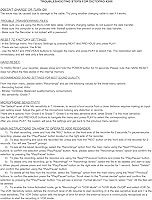
Overview

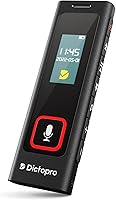
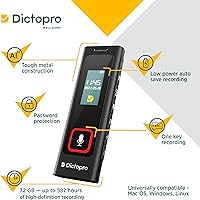
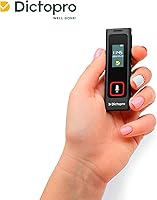
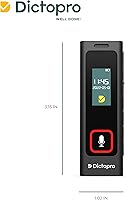
The DictoPro X200 is a slim, pen-shaped zinc alloy recorder compact enough to slip into a shirt pocket without a second thought. Launched in 2019, it targets students, journalists, and budget-conscious professionals who need a no-fuss way to capture audio on the go. With 32GB of built-in storage and support for both MP3 and WAV formats, it covers the basics without any expandable memory option. There is no app to configure, no pairing process to fumble through. At this price point, the core appeal is straightforward: hit record, walk away, and retrieve your files later.

Features & Benefits

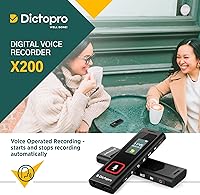
The headline feature here is voice-activated recording — the device listens for sound and starts capturing automatically, which means no fumbled button presses during a lecture or interview. That said, the advertised 582-hour battery figure deserves scrutiny: that number likely reflects standby time or total capacity, not continuous active use, which runs closer to 17 hours. Still, for unattended sessions, that is genuinely useful. Built-in noise reduction helps in quieter environments, though it will struggle in loud, echo-heavy rooms. A 3.5mm headphone jack lets you monitor playback directly, and USB 2.0 handles file transfers to your laptop — no wireless sync, but functional enough.

Best For

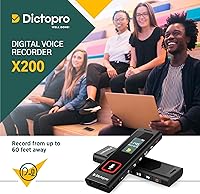
This pocket recorder makes the most sense for students who want to capture a full lecture without babysitting the device, and for journalists or researchers running one-on-one interviews in reasonably quiet spaces. It also works as a practical backup tool for professionals who already rely on a phone or laptop as their primary capture method but want a failsafe in the room. What it is not suited for: crowded press conferences, noisy fieldwork, or anyone who needs broadcast-quality audio. If long unattended recording matters more than rich sound, this voice-activated recorder fits the bill — think of it as a reliable secondary device, not a standalone workhorse.

User Feedback

With 60 reviews and a 3.4-out-of-5 rating, buyer sentiment on the X200 is genuinely mixed. Fans highlight the ease of setup, the responsive voice-activation trigger, and the device's impressively small footprint. Critics, on the other hand, raise concerns about audio clarity in noisier environments and question whether real-world battery life actually matches the marketing. A handful of buyers also report friction transferring files via USB on certain laptops. It is hard to overlook that Dictopro's X100 model — a comparable sibling — holds a 4.0 rating across over 2,300 reviews. That gap suggests meaningful room for improvement, and prospective buyers would be wise to weigh both options before deciding.

Pros

  • Truly pocket-sized at under an ounce — easy to forget it is there until you need it.
  • Voice activation works reliably in quiet settings, removing the stress of manually hitting record.
  • 32GB of onboard storage handles hundreds of hours of speech recordings before filling up.
  • Minimal setup means most users are recording within minutes of unboxing.
  • The 3.5mm headphone jack lets you review audio immediately without needing a computer.
  • Zinc alloy body feels more substantial than typical plastic devices at this price point.
  • Playback supports FLAC, WMA, APE, and other formats well beyond what the device itself records.
  • 17 hours of active recording battery life is genuinely sufficient for full-day use cases.
  • Simple controls make this pocket recorder accessible even for non-technical users.

Cons

  • Audio quality degrades noticeably in noisy or reverberant environments, limiting real-world versatility.
  • The 582-hour battery claim is misleading — active recording life is closer to 17 hours.
  • No Bluetooth or Wi-Fi sync means file transfers require a physical USB connection every time.
  • Newer laptops without USB-A ports will need an adapter, adding friction to an otherwise simple process.
  • No screen means zero visibility into battery level, storage remaining, or current recording status.
  • The sibling X100 model holds a significantly higher rating across far more reviews — a hard comparison to ignore.
  • Noise reduction struggles with dynamic ambient sounds and can introduce slight audio artifacts on playback.
  • Navigation through long recordings is cumbersome with no timestamps, chapter markers, or search function.
  • Only 60 reviews make it difficult to draw firm conclusions about long-term reliability or durability.
  • No expandable memory slot means you are locked into 32GB with no upgrade path.

Ratings

The DictoPro X200 has been evaluated by our AI system after analyzing verified buyer reviews from global markets, with spam, bot-generated, and incentivized submissions actively filtered out. The scores below reflect an honest cross-section of real user experiences — strengths and shortcomings alike — so you can make a genuinely informed decision. This pocket recorder earns praise in some areas and draws consistent criticism in others, and both sides are transparently represented here.

Voice Activation Reliability
78%
22%
Most buyers found the voice-activated trigger responsive enough for practical use — setting the recorder on a desk during a lecture or leaving it unattended in a meeting room without needing to touch it again. The automatic start-stop behavior works well in relatively quiet, controlled environments.
In noisier settings, the trigger can misfire — either cutting in too late or activating on background noise rather than speech. A few users noted inconsistent sensitivity levels that required some trial and error before finding a workable threshold for their environment.
Audio Clarity
61%
39%
In quiet rooms — a private office, a one-on-one interview, or a small classroom — recorded speech comes through clearly enough to transcribe without straining. Users appreciate that voices at close to mid range are captured with decent intelligibility for a device this size.
Audio quality drops noticeably in reverberant or crowded spaces. Background noise bleeds through more than buyers expect, and the noise reduction does not fully compensate in real-world conditions like cafeterias, open-plan offices, or public transport.
Battery Performance
58%
42%
For unattended recording sessions — leaving the device running through a multi-hour lecture or all-day conference — the battery holds up reasonably well in active use. Buyers who understood the 17-hour active recording ceiling going in found it adequate for most single-day needs.
The advertised 582-hour figure is widely misunderstood as active recording time, and buyers who expected that felt misled. Real-world continuous recording is capped around 17 hours, and several reviewers flagged the marketing as deceptive, which significantly dented trust in the product.
Portability & Form Factor
91%
At under an ounce and barely three inches long, this voice-activated recorder genuinely disappears into a pocket or pencil case. Students and journalists consistently praised the discreet profile — it draws no attention sitting on a desk during an interview or class.
The slim build does come with tradeoffs: the small body makes button control fiddly, particularly for users with larger hands. A few buyers also noted that the zinc alloy shell, while solid-feeling, does not inspire the same confidence as aluminum-bodied rivals in the same category.
Noise Reduction Effectiveness
57%
43%
In low-noise settings, the built-in noise reduction does a decent job of softening steady background hum — think air conditioning or a quiet fan. Buyers using it in controlled environments noticed a cleaner recording compared to entry-level devices with no processing at all.
The noise reduction struggles with dynamic or irregular ambient sounds — crowd noise, overlapping conversations, or outdoor environments. Rather than removing interference cleanly, it sometimes introduces a slight processing artifact that makes the audio feel slightly unnatural on playback.
Ease of Use
84%
Setup is genuinely minimal. Buyers repeatedly noted that they were recording within minutes of unboxing — no software to install, no account to create, no confusing menu trees to navigate. For older users or first-time recorder owners, that simplicity is a real selling point.
The lack of a display screen means there is limited feedback on recording status, remaining storage, or battery level during use. Some users had to guess whether the device was actively recording or in standby, which caused a few missed captures in real sessions.
Build Quality & Durability
66%
34%
The zinc alloy casing gives the device a solid, premium feel for its price tier — it does not feel hollow or plasticky in hand. Buyers who treated it carefully reported no issues with the body or button mechanisms over extended use.
Longer-term durability feedback is limited given the review volume, but some buyers flagged concerns about the USB port and button responsiveness after a few months of daily use. It feels built for occasional rather than heavy daily wear.
Storage & File Management
72%
28%
32GB of onboard storage is generous at this price point and will handle hundreds of hours of MP3 recordings before filling up. For most students and professionals, running out of space mid-session is not a realistic concern in normal use.
There is no expandable memory option, and a handful of buyers reported friction when transferring files via USB to certain laptops — particularly on newer machines with limited USB-A ports. File organization on the device itself is also basic, with no folder structure or tagging system.
Playback Experience
73%
27%
The 3.5mm headphone jack lets users review recordings directly on the device without needing a computer, which is handy when checking a recording immediately after a meeting. The broad playback format support — including FLAC and APE — is a quiet bonus that goes beyond what most rivals offer.
Playback controls are minimal, and fast-forwarding or rewinding to a specific point in a long recording can be tedious without time-stamping or chapter markers. Users who needed to revisit specific moments in a two-hour lecture found navigation cumbersome.
Value for Money
63%
37%
For buyers who primarily need voice activation and basic long-session recording in quiet environments, the X200 delivers on its core promise at an accessible price. As a backup device or a starter recorder, the cost-to-function ratio is defensible.
The mixed review average and the stark contrast with the higher-rated X100 sibling make value harder to justify when a modest price difference potentially buys meaningfully better satisfaction. Buyers comparing both models closely tend to lean toward the X100 without much hesitation.
Microphone Sensitivity
68%
32%
The built-in microphone picks up voices at a comfortable conversational distance, which works well for face-to-face interviews or lectures where the speaker is within a few feet. Sensitivity levels are adequate for the use cases this device targets.
Sensitivity becomes a liability in noisy spaces — the mic captures everything indiscriminately, making the noise reduction feature do more heavy lifting than it can handle. Directional recording is not possible, so ambient sounds from all sides compete equally with the intended audio source.
Connectivity & Compatibility
64%
36%
USB 2.0 file transfer works reliably on most Windows laptops, and no driver installation is typically required. For users with standard setups, plugging in and dragging files over is quick and uncomplicated.
The absence of Bluetooth or Wi-Fi sync feels like a gap for a device sold in 2024. Mac users and those with newer laptops lacking USB-A ports have reported compatibility friction, and there is no companion app to streamline file management or automated transcription workflows.
Size & Weight
88%
Weighing just under an ounce, this pocket recorder is one of the lightest options in its category. Slipping it into a jacket pocket or clipping it to a notebook is effortless, and its narrow profile means it genuinely does not get in the way.
The trade-off for that minimal footprint is a small interface surface — controls are tightly packed and not always intuitive by touch alone, particularly in low-light conditions or for users who need to operate the device without looking at it directly.
Recording Format Options
74%
26%
Support for both MP3 and WAV recording gives users a practical choice between compressed files for long sessions and lossless captures when quality is a priority. Most users will find MP3 mode more than sufficient for speech recordings.
The format options are functional but not particularly flexible — there is no adjustable bitrate or quality setting mentioned, which limits control for users who want to fine-tune the balance between file size and audio fidelity depending on the session type.

Suitable for:

The DictoPro X200 is a practical fit for students who need a discreet, no-setup recorder to leave on a desk during lectures without drawing attention or draining mental energy managing the device. It also works well for journalists and researchers conducting one-on-one interviews in reasonably controlled spaces — a quiet office, a coffee shop corner, or a small meeting room — where ambient noise is manageable. Professionals who want a lightweight backup recorder running silently alongside their laptop or phone will find the voice-activation feature genuinely useful rather than gimmicky. If your priority is long unattended sessions in calm environments and you are not chasing broadcast-quality audio, this pocket recorder covers the basics without demanding much from you. It is also a sensible first recorder for anyone who has never owned a dedicated device and wants to try the format before investing in something more capable.

Not suitable for:

Anyone planning to record in noisy, crowded, or acoustically challenging environments — open-plan offices, conference halls, outdoor events, or busy cafes — will likely be disappointed by what this voice-activated recorder captures. The built-in noise reduction is not powerful enough to rescue audio in those conditions, and the omnidirectional microphone picks up everything around it without discrimination. Buyers expecting the advertised 582-hour figure to represent continuous active recording should also look elsewhere; real-world active use tops out around 17 hours, and the gap between marketing and reality has frustrated a meaningful share of reviewers. The DictoPro X200 is equally ill-suited for anyone who needs wireless file transfer, a companion app, or seamless Mac compatibility — the USB 2.0 connection works, but it is a friction point on modern machines. And if you are shopping for a primary, rely-on-it-daily recorder for professional broadcast, legal, or archival work, the 3.4-star rating and relatively thin review base should give you pause before committing.

Specifications

  • Brand: Manufactured by Dictopro, a brand operated under Productech.
  • Model: X200, a pen-shaped compact digital voice recorder first listed in June 2019.
  • Dimensions: The device measures 1.02″ wide by 0.36″ deep by 3.15″ tall, fitting comfortably in a shirt pocket.
  • Weight: The unit weighs 0.9 oz, making it one of the lightest options in its category.
  • Body Material: The outer shell is constructed from zinc alloy, providing a solid feel without excessive bulk.
  • Storage: 32GB of built-in flash memory is included with no expandable memory slot available.
  • Active Battery Life: Continuous active recording runs up to approximately 17 hours on a full charge under standard conditions.
  • Standby Capacity: The advertised 582-hour figure reflects total battery standby or capacity rating, not continuous recording time.
  • Recording Formats: Audio is recorded in MP3 or WAV format, selectable depending on storage and quality preferences.
  • Playback Formats: The device supports playback of MP3, WAV, WMA, APE, and FLAC files stored on the internal memory.
  • Microphone: A built-in omnidirectional sensitive microphone captures speech from multiple directions without an external mic required.
  • Voice Activation: A Voice Operated Switch (VOS) system automatically starts and stops recording based on detected sound levels.
  • Noise Reduction: An onboard noise reduction feature processes audio during recording to reduce steady ambient background hum.
  • Headphone Output: A 3.5mm headphone jack allows direct playback monitoring through standard earphones without connecting to a computer.
  • Connectivity: USB 2.0 is used for file transfer to laptops and PCs; no Bluetooth or wireless connectivity is available.
  • Power Source: The device is powered by one included rechargeable battery, charged via the USB connection.
  • Compatible Devices: File transfer compatibility is confirmed for laptops running standard operating systems via USB 2.0.
  • Item Weight: The shipping and listed item weight is noted at 1.81 oz including packaging and accessories.

Related Reviews
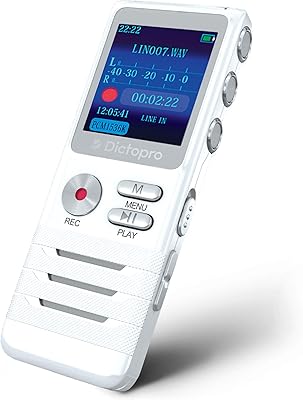
DictoPro X100 8GB
DictoPro X100 8GB
80%
83%
Audio Clarity
71%
Voice Activation Accuracy
86%
Build Quality
68%
Battery Life
91%
Storage & Capacity
More
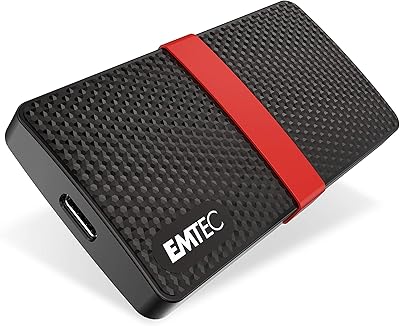
Xilecam X200 1080P Action Camera with 32GB Memory Card
79%
91%
Value for Money
85%
Video Quality
88%
Waterproof Performance
84%
Battery Life
82%
Build Quality
More
Emtec X200 Power Plus 512GB mSATA Portable SSD
86%
88%
Performance
90%
Build Quality
85%
Transfer Speed
92%
Portability
87%
Durability
More
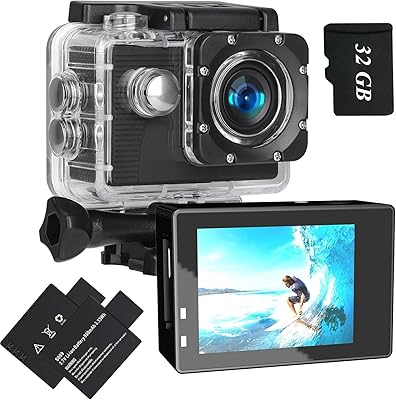
Emtec X200 Power Plus 256GB mSATA Portable SSD
88%
89%
Performance & Speed
91%
Build Quality & Durability
95%
Portability & Size
85%
Compatibility & Setup
88%
Reliability & Longevity
More
Emtec X200 Power Plus 1TB mSATA Portable SSD
86%
91%
Data Transfer Speed
94%
Portability
85%
Build Quality
89%
Ease of Use
90%
Compatibility
More

FAQ

The voice-activated system works well in quiet to moderately noisy environments — set it on a desk and it will start capturing when someone speaks and pause when the room goes silent. That said, in loud or unpredictable settings it can misfire in both directions, either triggering on background noise or cutting in slightly late. For controlled environments like classrooms or small meeting rooms, most users find it dependable enough to trust.

No, and this is probably the most important clarification to make before buying. The 582-hour figure refers to the total battery capacity or standby time, not continuous active recording. Real-world active recording tops out around 17 hours on a full charge, which is still solid for a full day of use but nowhere close to the headline number. Go in with that expectation and you will not feel misled.

The DictoPro X200 is designed primarily for Windows-based laptops, and most Mac users report some friction — particularly on newer MacBooks that lack a USB-A port entirely. You would need a USB-A to USB-C adapter to connect it, and even then, file management may not be as smooth as on Windows. It is not incompatible with Mac in principle, but it is not optimized for it either.

Honestly, a large lecture hall is one of the more challenging environments for this pocket recorder. The omnidirectional mic captures sound from all directions, so echo, room reverb, and distance all affect clarity. In smaller classrooms where you can place the device on a desk close to the speaker, results are much better. For big auditoriums, you might find the audio intelligible but not crisp enough to transcribe without effort.

No, there is no microSD or memory card slot on this device. You are limited to the 32GB of built-in storage, which is enough for several hundred hours of MP3 recordings, but if you fill it up you will need to transfer files to a computer and clear space before recording again.

There is no display screen on this voice-activated recorder, so you cannot check battery level or remaining storage at a glance during use. Some users find this frustrating — particularly when they are unsure whether the device is actively recording or sitting in standby. Getting into the habit of checking via USB before important sessions is a practical workaround.

The X100 is the stronger performer by most measures — it carries a 4.0 rating across over 2,300 reviews compared to the X200's 3.4 across 60, which is a meaningful gap. The X100 is slightly larger and heavier but appears to deliver more consistent audio quality based on buyer feedback. If portability is your top priority, the X200 edges ahead on size; if you want more confidence in overall performance, the X100 is the safer pick.

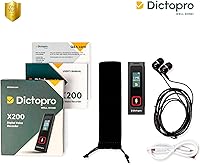
The device includes a 3.5mm headphone jack, but standard earphones or headphones are not included in the box. Any pair of standard 3.5mm earphones you already own will work fine for playback monitoring directly on the device.

No software installation is needed. Plug the device into your computer via the included USB cable, and it should appear as a removable storage drive. You can then drag and drop the audio files directly to your desktop or any folder. The main friction point is that newer laptops without a USB-A port will require an adapter, which is not included.

For informal or personal use — job interviews, research conversations, or casual note-taking — this recorder is adequate if the setting is quiet. For legal proceedings, depositions, or any recording where accuracy and clarity are non-negotiable, the audio limitations in complex acoustic environments make it a risky primary choice. A higher-tier recorder with a directional microphone and more robust noise handling would be a more reliable investment for professional legal contexts.

Where to Buy

eBay
In stock $57.21
Newegg.com
In stock $59.97
GoVets.com
In stock $47.49
Treblab
In stock $59.97
Macy's
In stock $59.97
DigiKey
In stock $59.97
Staples
In stock $65.23
SHI International
In stock $68.00