Overview

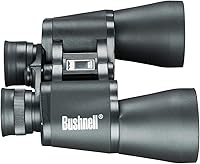
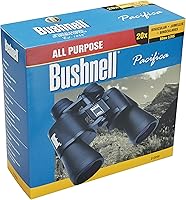
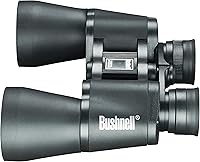
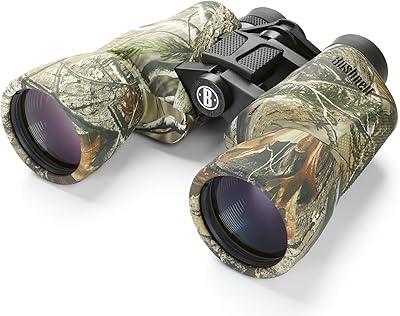
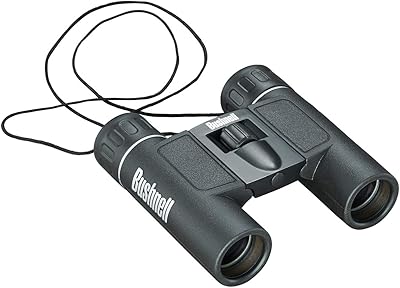
The Bushnell Pacifica 20x50 Binoculars occupy an interesting spot in the optics market — a high-magnification tool from a brand with genuine credibility, offered at a price that removes most of the financial risk from buying. The 20x power combined with a 50mm objective is genuinely rare at this tier. That said, one thing worth flagging upfront: handheld 20x use is notoriously tricky. Any tremor in your hands gets amplified considerably, so if you plan to use these without a tripod or firm support, temper your expectations accordingly. The porro prism design is a time-tested optical layout that tends to produce wide, bright images when conditions cooperate.
Features & Benefits

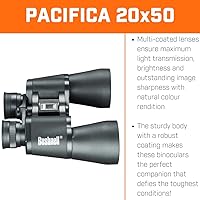
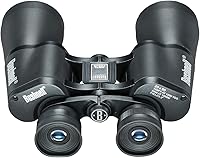
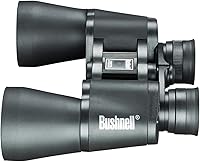
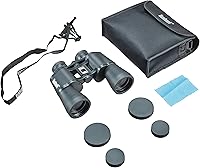
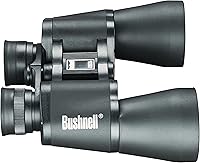
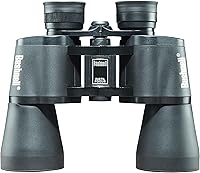
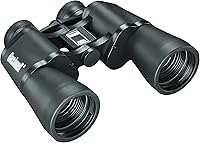
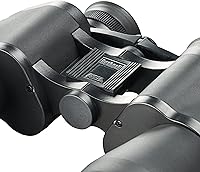
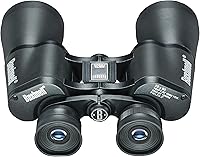
The 1-touch InstaFocus system is one of the more practical touches here — it lets you lock onto a subject quickly without fumbling through sluggish adjustments. Fully coated optics do a reasonable job pulling in available light, making daytime use noticeably cleaner than cheaper uncoated alternatives. The 50mm objective earns its keep in overcast conditions where light-gathering genuinely matters. The rubber-armored body provides a confident grip, and the overall build feels more solid than the cost suggests. A low-profile eyepiece design also allows users to wear glasses, hats, or hearing protection without constantly repositioning these high-powered binoculars.

Best For

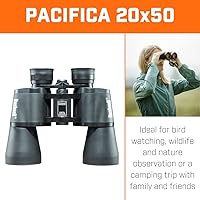
This Bushnell porro prism model shines brightest when paired with a tripod or steady surface rest. That is where it truly delivers — wildlife observation, hunting at distance, or tracking aircraft at an air show becomes far more rewarding once you eliminate hand tremor. Stargazers on a budget will find the 50mm aperture pulls in enough light for casual moon and planet viewing. Fans attending outdoor sporting events or racetracks will appreciate the extra reach. Where these are less ideal is any compact, carry-everywhere scenario — at over 2 pounds and a substantial frame, portability is limited.

User Feedback

Across nearly a thousand ratings, the Pacifica 20x50 holds a 3.9-star average — which signals genuine fans alongside clear limitations. Buyers consistently highlight image brightness in daylight as impressive for the cost, and the rubber grip earns frequent praise for feeling solid and secure. The most common friction point is hand shake at 20x, which catches many buyers off guard, particularly those new to high-magnification optics. Eyeglass wearers report mixed experiences with eye relief comfort. A handful of reviewers also note edge distortion at full magnification, and the focus ring can feel stiff initially, though most say it loosens naturally with regular use.

Pros

  • Genuine 20x magnification from a reputable optics brand at an entry-level price.
  • The 50mm objective lens pulls in noticeably more light than smaller budget alternatives.
  • Rubber-armored body feels solid and grips well even in wet or cold conditions.
  • The InstaFocus system makes locking onto distant subjects faster than a standard center wheel.
  • Daytime image sharpness consistently impresses buyers relative to the cost.
  • Works well at outdoor events where you can brace or rest the binoculars on a surface.
  • Low-profile eyepiece accommodates users wearing hats, helmets, or hearing protection.
  • Build quality holds up over time with regular outdoor use according to long-term owners.
  • These high-powered binoculars rank among the top 150 in their category — a sign of sustained buyer confidence.
  • Great entry point for new stargazers who want more reach without a large financial commitment.

Cons

  • Handheld 20x use is genuinely difficult — a tripod is practically required for steady viewing.
  • No tripod is included, adding a hidden cost that many buyers only realize after purchase.
  • Focus ring feels stiff and gritty straight out of the box, which frustrates early use.
  • Edge distortion is noticeable at full magnification, reducing the usable field of view.
  • Eyeglass wearers frequently report restricted or vignetted views during longer sessions.
  • At over 2 pounds with a large frame, carry fatigue sets in faster than expected.
  • Not weather-sealed despite the rubber exterior, making it vulnerable to humidity and condensation.
  • Low-light and twilight performance is mediocre compared to multi-coated alternatives in a similar price range.
  • Acquiring fast-moving subjects in the narrow 20x field of view requires a real learning curve.
  • The dated porro prism form factor is bulkier than modern roof-prism alternatives of similar magnification.

Ratings

The Bushnell Pacifica 20x50 Binoculars have been scored by our AI system after analyzing hundreds of verified buyer reviews from global markets, with spam, bot-generated, and incentivized feedback actively filtered out. The scores below reflect where this Bushnell porro prism model genuinely delivers and where real buyers have run into friction. Both strengths and limitations are represented transparently so you can make an informed call.
Optical Clarity
74%
26%
In good daylight, these high-powered binoculars produce a surprisingly clean, detailed image for the price tier. Buyers regularly mention picking out fine details at long distances — bird plumage, scoreboard text, distant wildlife — with more sharpness than they expected.
Clarity drops noticeably toward the edges of the field of view, and low-light performance, while aided by the 50mm objective, still falls short of mid-range competitors. Some users report a slight softness at the outer 20-25% of the image.
Magnification Performance
81%
19%
The 20x power is the headline reason most people buy these, and for stationary or tripod-mounted use it genuinely impresses. Wildlife watchers and air show attendees report being able to track subjects at distances where standard 8x or 10x binoculars simply give up.
Twenty times magnification is an aggressive number for handheld use. Even minor hand tremor becomes a visible wobble in the image, which frustrates buyers who did not anticipate needing a tripod or stable surface to get consistent results.
Build Quality
78%
22%
The rubber-armored exterior gives the Pacifica 20x50 a reassuringly solid feel that most buyers did not expect at this price. The grip is secure in damp or cold conditions, and the body has held up well for users who carry these in bags or take them on rough outdoor trips.
While the outer shell is sturdy, some buyers note the internal mechanics feel less refined — particularly the focus wheel, which can feel gritty or stiff right out of the box. Hinge tension also varies unit to unit based on a number of reports.
Focus System
71%
29%
The 1-touch InstaFocus mechanism is a genuine convenience feature. Once you find your preferred focus distance, locking onto a moving subject — a bird in flight, a car on a track — is faster and more intuitive than standard center-wheel systems.
Out of the box, the focus mechanism can feel stiff and resistant, which is a common complaint in early reviews. Most users say it loosens with use, but buyers wanting smooth operation from day one may be disappointed during the initial break-in period.
Value for Money
88%
At its price point, finding 20x50 binoculars from a known optics brand with fully coated lenses and a recognizable focus system is genuinely hard to beat. For casual stargazers, first-time birders, or sports fans wanting serious reach on a limited budget, the cost-to-capability ratio is strong.
The value equation only holds if buyers understand what they are getting into. Those expecting performance comparable to mid-range or premium optics will feel let down, and the tripod dependency for stable 20x viewing is an added cost not reflected in the sticker price.
Comfort & Ergonomics
66%
34%
The low-profile eyepiece design is a practical touch that gets overlooked in specs listings. Users wearing glasses, hard hats, or hearing protection at events have noted they can use these without constantly removing accessories, which makes a real difference during extended sessions.
At just over 2 pounds and a bulky frame, these are not comfortable for prolonged handheld viewing. Eye relief for eyeglass wearers is inconsistent across user reports, with some finding it adequate and others noting eye fatigue during sessions longer than 20 minutes.
Portability
57%
43%
The stated lightweight and portable spec does hold some truth relative to large astronomical binoculars or spotting scopes. For casual day trips or keeping them in a car, the size is manageable enough that buyers do not feel burdened carrying them occasionally.
These are not compact by any stretch. Compared to standard 8x42 or 10x42 binoculars, the Pacifica 20x50 is noticeably bigger and heavier. Hikers, travelers, or anyone wanting a pocket-friendly option will find these impractical for everyday carry.
Low-Light Performance
63%
37%
The 50mm objective lens does a decent job gathering light in overcast or early-morning conditions compared to smaller-aperture budget binoculars. Casual moon and bright-planet observers report usable views, and dawn or dusk wildlife watchers find the extra aperture helpful.
Fully coated rather than fully multi-coated optics means light transmission is adequate but not exceptional. In genuinely dim conditions — dense forest shade, late twilight — image quality deteriorates faster than buyers hoping for an all-conditions performer would like.
Eye Relief & Eyeglass Compatibility
61%
39%
The low-profile eyepiece at least attempts to accommodate eyeglass wearers, and some users who wear thin-framed glasses report no major issues maintaining a full field of view during shorter viewing sessions at outdoor events.
Mixed user feedback here is the clearest signal that this is a weak point. Multiple eyeglass wearers describe a narrowed or vignetted field of view, requiring awkward repositioning. It is not a dealbreaker for naked-eye users, but spectacle wearers should be aware before buying.
Durability Over Time
72%
28%
Long-term owners — some with two or three years of use — report that the rubber armor holds up without peeling or cracking, and the optical alignment has remained stable with normal use. For occasional rather than daily use, these appear to have reasonable longevity.
Durability under harder use conditions is less certain. A handful of reviews mention internal fogging after exposure to humidity or temperature changes, suggesting the sealing is not weatherproof in any meaningful sense despite the rubber exterior.
Field of View
67%
33%
For a 20x binocular, the field of view is acceptable and allows users to track moderately moving subjects like birds or vehicles once they are acquired in frame. Buyers coming from lower-magnification optics often accept the narrower field as a fair trade for the extra reach.
High magnification inherently narrows the field, and these are no exception. Finding and acquiring fast-moving subjects — particularly in a dense tree canopy or at a crowded event — takes practice. New users often frustrate themselves trying to locate subjects before they disappear.
Tripod Compatibility
76%
24%
The standard tripod adapter thread means most users can mount these on an entry-level tripod without any specialist hardware. Those who invest in even a basic fluid-head tripod report that the viewing experience transforms dramatically compared to handheld use.
A tripod is not included, and there is no prominent mention of its practical necessity in standard product listings. Buyers who purchase these expecting confident handheld use at 20x often leave disappointed — the tripod is less optional than it appears.
Image Stability
49%
51%
When fully braced — against a wall, car roof, or on a tripod — image stability is solid and the optics reward you with a steady, detailed view. Users who build a habit of finding a brace point quickly tend to rate their experience much more positively.
This is arguably the most common source of buyer regret. Handheld 20x viewing produces a shaky, difficult-to-hold image for the vast majority of users. It is not a flaw in manufacturing — it is physics — but the gap between expectation and reality catches many buyers off guard.
Aesthetic & Finish
70%
30%
The all-black rubber-coated finish looks purposeful and clean rather than cheap and plasticky. Buyers mention it looks like a legitimate piece of outdoor gear, which matters when using these at public events or in group settings where appearance is a small but real factor.
The overall design is utilitarian and dated compared to newer compact binoculars. There are no modern styling touches, and the sizeable porro prism form factor is noticeably bulkier than slim roof-prism alternatives, which may matter to buyers who care about aesthetics.

Suitable for:

The Bushnell Pacifica 20x50 Binoculars are a strong match for buyers who want serious long-distance reach without committing to a serious budget. If you are a casual stargazer looking to get closer views of the moon and brighter planets, the 50mm aperture pulls in enough light to make evening sessions genuinely rewarding. Wildlife observers and hunters who habitually use a tripod or brace against a vehicle or fence post will find that the 20x magnification delivers impressive subject detail at distances where most standard binoculars simply cannot compete. These high-powered binoculars also suit fans who attend outdoor sporting events, air shows, or racetracks — situations where the action is far away and a stable resting position is easy to find. Budget-conscious buyers upgrading from basic 8x or 10x optics will likely be impressed by how much more reach this Bushnell porro prism model provides at a price that does not require much deliberation.
Not suitable for:

The Bushnell Pacifica 20x50 Binoculars are a poor fit for anyone expecting to use them freely handheld for extended periods — at 20x magnification, even a steady hand produces a visibly shaky image, and that is simply the physics of high-magnification optics rather than a product defect. Hikers, travelers, and anyone prioritizing a compact, lightweight carry will find these too bulky and heavy for comfort on the trail or in a bag. Eyeglass wearers should approach with caution, as user feedback on eye relief is mixed enough that comfort cannot be assumed. Buyers who need reliable low-light or twilight performance — such as serious birders at dusk or stargazers chasing faint deep-sky objects — will find the fully coated (rather than multi-coated) optics limiting. If you want a versatile, grab-and-go pair for daily use across varied conditions, this Bushnell porro prism model is not the right tool; a more moderate 8x42 or 10x42 from a similar price tier would serve you far better.
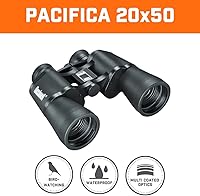
Specifications

  • Brand: Manufactured by Bushnell, a well-established American optics brand with decades of experience producing consumer and professional-grade optical equipment.
  • Model Number: This unit carries the item model number 212050, which can be used to identify the exact variant when cross-referencing with retailer or warranty records.
  • Magnification: Provides 20x magnification, meaning distant subjects appear twenty times closer than they would to the naked eye.
  • Objective Diameter: The objective lenses measure 50mm in diameter, enabling meaningful light-gathering capability for daylight and overcast conditions.
  • Prism Type: Uses a Porro prism optical layout, a classic design that delivers a wide, three-dimensional image with strong depth perception relative to roof prism alternatives at the same price.
  • Optics Coating: Lenses are fully coated, applying a single anti-reflective layer to all air-to-glass surfaces to improve light transmission and reduce glare in bright conditions.
  • Focus System: Features Bushnell's patented 1-touch InstaFocus mechanism, allowing users to lock focus quickly without rotating a traditional center wheel.
  • Body Material: The exterior is rubber armored, providing a non-slip grip surface and a degree of impact protection against knocks and drops during outdoor use.
  • Weight: Weighs approximately 2.09 pounds, which is manageable for short sessions but noticeable during extended handheld use.
  • Dimensions: Overall dimensions measure 11.81 x 11.81 x 7.87 inches, reflecting the larger footprint typical of porro prism binoculars at this magnification level.
  • Weather Resistance: The rubber armor provides grip and limited protection from light splashes, but the unit is not stated to be fully waterproof or nitrogen-purged against internal fogging.
  • Eye Relief: Features a low-profile eyepiece design intended to accommodate users wearing glasses, helmets, hats, or hearing protection, though individual comfort varies.
  • Exit Pupil: The exit pupil measures 2.5mm (calculated as objective diameter divided by magnification: 50 divided by 20), which is adequate for bright daylight use but narrow for dim conditions.
  • Field of View: At 20x magnification, the field of view is inherently narrow, which is a standard optical trade-off when prioritizing reach over wide scene coverage.
  • Tripod Mount: Includes a standard tripod adapter thread, allowing the binoculars to be mounted on any compatible tripod for stable, shake-free viewing sessions.
  • Target User: Designed for adult use, suited to outdoor recreation activities including wildlife observation, sporting events, stargazing, and hunting.
  • Amazon Rating: Holds a 3.9 out of 5 star rating based on 972 verified global ratings at the time of evaluation, ranking at number 150 in the Binoculars category.
  • Date Available: First listed on Amazon on June 17, 2012, indicating this is a long-standing model with an established track record in the market.

Related Reviews
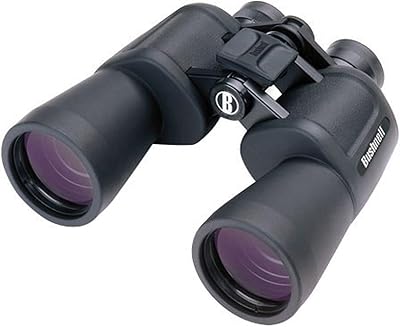
Bushnell PowerView 20x50 Binoculars
70%
78%
Optical Clarity
83%
Magnification Performance
51%
Image Stability
74%
Light Gathering & Brightness
81%
Build Quality
More
PISEZ 20x50 Binoculars
72%
72%
Optical Clarity
68%
Magnification Performance
74%
Low-Light Performance
71%
Build Quality & Durability
88%
Value for Money
More
ZIYOUHU 20x50 Binoculars
74%
74%
Optical Clarity
71%
Light Transmission
63%
Magnification Usability
69%
Build Quality
82%
Waterproofing & Fog Resistance
More
BRESSER 20x50 Binoculars
83%
91%
Magnification Performance
88%
Build Quality & Durability
87%
Image Clarity & Brightness
82%
Portability & Design
89%
Waterproof & Shockproof Features
More
Allenjoy 20x50 Binoculars
78%
83%
Optical Clarity
78%
Magnification Performance
69%
Low-Light Performance
81%
Build Quality
88%
Ease of Focus
More
FoliumpX 20x50 Binoculars
87%
92%
Optical Performance
89%
Build Quality
81%
Portability
85%
Ease of Use
90%
Waterproof Durability
More
Bushnell H2O 8x42 Binoculars
80%
83%
Optical Clarity
91%
Waterproofing & Weather Resistance
88%
Fogproof Performance
79%
Build Quality & Durability
86%
Grip & Handling
More
Bushnell Prime 10x42 Binoculars
84%
91%
Image Clarity
89%
Build Quality & Durability
85%
Ease of Use
87%
Field of View
90%
Waterproof & Fogproof Performance
More
Bushnell H2O 10x42 Binoculars
80%
91%
Waterproof Performance
83%
Optical Clarity
88%
Fog Resistance
86%
Build Quality & Durability
82%
Ergonomics & Grip
More
Bushnell PowerView 12x25 Binoculars
82%
80%
Performance at Distance
91%
Portability/Size
83%
Magnification Clarity
88%
Ease of Use
85%
Build Quality/Durability
More

FAQ

You can technically use them handheld, but at 20x magnification the image shake from even a steady hand becomes very noticeable. Most buyers who end up unhappy with these did not use a tripod. For casual quick glances at a fixed object you can brace against something solid, but for any serious sustained viewing, a tripod makes a transformative difference.

Yes, with the right setup. At outdoor stadiums and racetracks where you have a stable surface — a railing, a seat back, or a small tripod on a bleacher — these high-powered binoculars will give you impressive detail on distant action. In a crowded setting where handheld is your only option, the shakiness at 20x can make tracking fast movement frustrating.

They work well for casual moon and bright planet viewing. The 50mm objective gathers a reasonable amount of light, and you will see clear lunar craters and the moons of Jupiter on a clear night when mounted on a tripod. Deep-sky objects like faint nebulae or galaxies are less rewarding due to the narrow exit pupil, but for entry-level stargazing they are a solid starting point.

Almost certainly not. Stiff focus out of the box is one of the most commonly reported observations with this Bushnell porro prism model, and users consistently report that it loosens up after a few weeks of regular use. If it remains completely locked after extended use, that would be worth contacting Bushnell support about, but initial stiffness is normal.

This is genuinely hit or miss depending on your prescription and frame style. Some eyeglass wearers report no issues with the low-profile eyepiece design, while others describe a slightly reduced or vignetted field of view requiring awkward repositioning. If possible, try a set in person before committing, or buy somewhere with a flexible return policy.

The rubber armor will handle light splashes and give you a good grip in damp conditions, but these are not waterproof or water-resistant rated in any meaningful technical sense. Extended exposure to rain or submersion risks internal fogging. For occasional light outdoor use in drizzle you should be fine, but they are not built for heavy weather.

The exit pupil on these is 2.5mm, calculated by dividing the 50mm objective by the 20x magnification. In bright daylight that is perfectly fine, but in low light your pupil dilates larger than 2.5mm, meaning you cannot take full advantage of available light. For dawn, dusk, or indoor use this limits performance — in full sun it is a non-issue.

There is a standard tripod adapter thread on the body that accepts most common tripod adapters. You may need a binocular tripod adapter if your tripod only has a camera-style ball head mount — these are inexpensive and widely available. Once mounted, the improvement in image stability at 20x is immediately obvious.

There is no fixed maximum distance since clarity depends on atmospheric conditions, lighting, and subject contrast. Under ideal daylight conditions, many users report reading text or identifying bird species at distances of several hundred meters. At night or in haze, effective range drops considerably. The practical limit in good conditions is genuinely impressive for the price tier.

Bushnell typically backs its consumer optics with a limited lifetime warranty, which covers defects in materials and workmanship. It is worth registering the product on the Bushnell website after purchase and keeping your proof of purchase, as warranty service processes vary. Check Bushnell's current warranty terms directly, as coverage details can be updated over time.