Overview

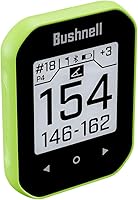
The Bushnell Phantom 3 Slope Handheld Golf GPS landed in mid-2024 as a practical answer for golfers who want slope-adjusted yardages without wrestling with a laser rangefinder. The neon green casing is easy to spot on a cart, and the built-in magnet mount means you snap it in place and forget it until you need it. With over 38,000 preloaded courses and auto hole advance, setup on a new track is genuinely hands-off. Just keep expectations grounded: this is a GPS unit, so distances are calculated, not laser-measured to the pin. It is a relatively new release with a growing and largely positive review base.
Features & Benefits

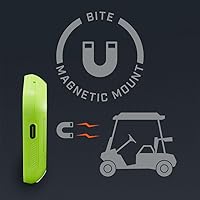
What separates the Phantom 3 Slope from a standard GPS unit is its patented slope calculation, which adjusts raw yardage based on elevation change. Standing 155 yards out on a downhill par 3 might mean the device suggests a 143-yard play distance — that kind of context can be the difference between a 7-iron and an 8-iron. The 3-inch touchscreen holds up well in bright sunlight, though users with thick gloves may find it slightly less responsive. Auto hole advance works quietly in the background, and the 14-hour battery comfortably outlasts a full round, including slow groups and cart delays. The magnetic cart mount is a genuine convenience for riders, snapping on securely without any fumbling.

Best For

This handheld golf GPS makes most sense for mid-handicap recreational players who want more information than a basic GPS watch provides, without the learning curve of a laser rangefinder. Cart riders get the clearest benefit — snap it to the mount, glance at the screen, pull your club. Walkers can pocket it easily given how light it is. Frequent travelers will appreciate the 38,000-plus course database, which means the device is ready to go almost anywhere without manual downloads. If you already own a quality rangefinder and just want pinpoint precision to the flag, this probably is not your primary tool — but as an all-round GPS option, it covers the bases well.

User Feedback

With over 370 ratings averaging 4.5 stars, the Bushnell Phantom 3 has earned genuine goodwill from buyers. The most consistent praise centers on ease of setup and how quickly the device locks onto a course — most users report it just works right out of the box. The magnet mount draws particular approval from cart golfers. On the critical side, a recurring theme is touchscreen sensitivity in wet or cold conditions, where taps can register inconsistently. A handful of users also note that GPS acquisition can lag slightly on the opening hole. One point worth flagging: slope mode is not permitted in formal competition, so it will need to be disabled during tournament rounds.

Pros

  • Slope-compensated distances give genuinely useful club selection context on hilly courses.
  • The magnetic cart mount is well-engineered — it holds firmly and releases cleanly every time.
  • Auto course and hole recognition works quietly in the background with no manual input needed.
  • Battery life comfortably covers a full 18 holes, even on slower rounds.
  • The 38,000-plus course database means it is ready to use almost anywhere without extra downloads.
  • At under two ounces, it is light enough to carry in a shorts pocket without any discomfort.
  • The 3-inch screen is easy to read in bright sunlight, which cheaper GPS units often struggle with.
  • Setup straight out of the box is fast and straightforward, even for less tech-savvy golfers.
  • Neon green coloring makes it easy to spot on a cart or in a bag at a glance.
  • Ranks among the top three best-selling golf GPS units on Amazon, reflecting broad buyer confidence.

Cons

  • Touchscreen responsiveness can become unreliable in wet weather or when wearing thick gloves.
  • GPS yardages to the pin are calculated estimates and will never match the precision of a laser rangefinder.
  • Slope mode must be manually turned off for tournament play, which is easy to overlook on competition day.
  • Initial GPS lock on the first hole can take longer than expected, particularly at unfamiliar courses.
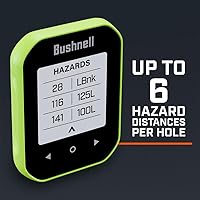
  • Front, center, and back distances only — there is no hazard or layup yardage detail on the display.
  • The one-year manufacturer warranty is fairly short for a device in this price range.
  • Cart riders benefit far more from the magnetic mount than walkers, making the premium feature less universal.
  • As a 2024 release, long-term durability data and firmware update history are still limited.

Ratings

The scores below reflect our AI-driven analysis of verified global buyer reviews for the Bushnell Phantom 3 Slope Handheld Golf GPS, with spam, bot-generated, and incentivized feedback actively filtered out before scoring. Each category is rated on real-world performance patterns drawn from hundreds of confirmed purchases, capturing both what buyers consistently praise and where the device genuinely falls short. Nothing has been smoothed over — the numbers reflect the full picture.

Slope Accuracy
88%
Golfers standing on uneven terrain — think a downhill approach to a tucked green — consistently report that the slope-adjusted yardage aligns well with their on-course intuition. The patented calculation earns real trust from mid-handicap players who previously guessed at elevation-based adjustments.
On extreme or unusual terrain changes, a small number of users feel the slope compensation can feel slightly off compared to a dedicated rangefinder with inclinometer hardware. It is a GPS estimate, not a laser measurement, and a handful of experienced players notice the difference.
GPS Distance Accuracy
83%
Front, center, and back yardages are reliably consistent across well-mapped courses, and most users report figures that match course markers within an acceptable margin for club selection. Buyers upgrading from phone apps or GPS watches notice an immediate improvement in confidence.
Like all GPS units, accuracy depends entirely on the quality of the preloaded course map rather than a live measurement. At less-common or recently renovated courses, occasional discrepancies of several yards have been flagged, which matters when the difference between clubs is tight.
Ease of Setup
92%
Out-of-box experience draws strong praise — charge it, turn it on, and it finds your course without any pairing, software installation, or account creation. Even less tech-savvy golfers report being up and running before the first tee shot without reading a manual.
A small number of users note that the initial GPS satellite lock on the very first use can take a minute or two longer than expected, particularly in areas with heavy tree cover near the first tee. Subsequent rounds lock in much faster once the device has established a baseline.
Touchscreen Responsiveness
71%
29%
In dry, temperate conditions the 3-inch screen is crisp and responds well to deliberate taps, and the interface layout is intuitive enough that most users navigate it without any learning curve. Sunlight legibility is genuinely good, which puts it ahead of several competitors at a similar price.
Wet fingers, light rain, and thick winter gloves all noticeably degrade input reliability — this is the most frequently cited frustration across user feedback. Golfers in the Pacific Northwest or UK who play through autumn and winter conditions find this limitation genuinely limiting in real-round scenarios.
Magnetic Cart Mount
91%
Cart riders consistently describe the magnetic mount as one of the standout practical features — it snaps on firmly, stays put over bumpy cart paths, and releases cleanly with one hand. Several users mention switching from a strap-style mount on a previous device and not looking back.
The mount is only useful for cart riders; walkers get no practical benefit from it and must pocket the device instead. On carts with plastic or heavily powder-coated rails, the magnetic hold can be weaker than expected, and a couple of users report the unit vibrating loose on rougher terrain.
Battery Life
86%
The rated 14-hour figure holds up well in practice, with the vast majority of users reporting significant charge remaining after a full round, even a slow five-hour one. For golfers who play multiple days in a row on a trip, a single overnight charge typically covers back-to-back rounds.
A small subset of users report noticeably faster-than-advertised drain, though this appears linked to specific usage patterns like leaving the screen on continuously between shots. The battery is non-removable, so if it degrades significantly over years of use, there is no quick field fix.
Auto Hole Advance
79%
21%
On courses with straightforward routing, the auto advance feature works reliably in the background without any interaction, which keeps the experience feeling smooth and effortless. Most golfers report never needing to manually advance a hole across a standard 18-hole round.
Courses with unusual or looping layouts occasionally trip up the auto detection, requiring a manual override. The delay is minor but can be momentarily disorienting when you arrive at the next tee and the screen is still showing the previous hole.
Course Database Coverage
87%
With over 38,000 courses preloaded globally, frequent travelers and golfers who play a wide rotation of local tracks rarely encounter a course the device does not recognize. International golfers across Europe, Australia, and Asia report solid coverage at established venues.
Newly opened courses, private layouts, and heavily renovated tracks can sometimes be missing or outdated in the database. Users who play at boutique or resort courses in less-charted regions have occasionally found their course absent, requiring a manual workaround or firmware update.
Build Quality & Durability
74%
26%
The device feels solid in hand despite its featherlight weight, and the casing shows no flex or creak under normal handling. Early adopters who have carried it through a full season of regular play report no significant cosmetic or functional deterioration.
As a 2024 release, long-term durability data is still limited, and the plastic casing shows minor scuffing after repeated cart mount contact over time. The device lacks a formal IP water-resistance rating, which leaves some buyers uncertain about its ability to handle anything beyond light drizzle.
Value for Money
81%
19%
Buyers consistently feel the combination of slope compensation, large course database, and magnetic mount at this price tier represents a fair exchange, particularly compared to dedicated slope rangefinders that cost considerably more. For golfers who do not need pin-point laser precision, the value proposition is clear.
Those who already own a quality rangefinder may struggle to justify the outlay for a complementary device that offers GPS convenience but less precision. The one-year warranty feels short for the price, and a few buyers note that comparable features are available on competing units at a slightly lower cost.
Portability & Form Factor
89%
At under an ounce, the Bushnell Phantom 3 is genuinely pocketable — walkers barely notice it in a shorts pocket, and it does not add any meaningful bulk to a carry bag. The neon green color is a practical touch that makes it easy to spot on a crowded cart or in a side pocket.
The dimensions, while compact, are slightly larger than a GPS watch, which some walkers who prefer wrist-mounted devices find less convenient. A belt clip or lanyard attachment option is absent, limiting carrying flexibility for golfers who want a hands-free option beyond the cart mount.
Display Readability
84%
Sunlight visibility is one of the more pleasant surprises for new owners — the 3-inch screen reads clearly even in harsh midday sun, which is a genuine weakness on many competing touchscreen GPS units. Text size and layout are well-judged, making yardages readable with a quick glance.
The screen size, while adequate, means there is limited real estate for displaying additional data like hazard distances or shot history simultaneously. Users who want a data-dense display alongside the core yardages may find the interface feels stripped back.
Tournament Compliance
63%
37%
The device does allow slope mode to be disabled, which technically makes it usable in formal competition rounds once that setting is turned off. For golfers who play both casual and competitive golf, the ability to switch modes means one device can serve both purposes.
The requirement to manually disable slope before competition is a real friction point, and it is an easy step to forget during a pre-round routine. There is no automatic or prompted compliance mode, which means the burden of remembering falls entirely on the user — a meaningful oversight for competitive players.

Suitable for:

The Bushnell Phantom 3 Slope Handheld Golf GPS is a strong fit for recreational and mid-handicap golfers who want meaningful course data without the hassle of pointing a laser at every flag. Cart riders in particular get a lot out of it — the magnetic mount keeps the device at eye level between shots, so checking yardage takes a second rather than digging through a bag. It also suits golfers who play a wide variety of courses, whether travelling for golf or just rotating through local tracks, since the 38,000-plus course database means setup is rarely a concern. For anyone upgrading from a basic GPS watch or a phone app, the larger touchscreen and slope-adjusted distances represent a real step up in on-course decision-making. Walkers will find it light enough to slip into a pocket without noticing the weight.
Not suitable for:

Golfers who compete regularly in stroke-play tournaments should think carefully before relying on the Bushnell Phantom 3 Slope Handheld Golf GPS as their sole device, since slope mode is not permitted under the Rules of Golf in most formal competitions and must be manually disabled — a step that is easy to forget. Players who prioritize exact pin distance over green-center yardage may find GPS measurements less satisfying than a laser rangefinder, which can lock onto a flag within a yard from 200-plus yards out. If you already own a quality rangefinder and are happy with it, this device does not offer a compelling reason to switch. Low-handicap players who dissect every approach shot with surgical precision may find the front-center-back yardage format too broad for their game. Anyone expecting the touchscreen to behave flawlessly in cold, wet conditions or with heavy winter gloves should also temper expectations.
Specifications

  • Display: Features a 3-inch touchscreen that remains legible in direct sunlight and responds to standard touch input.
  • Dimensions: The unit measures 7.2 x 5.1 x 1.7 inches, making it compact enough to fit in a golf shorts pocket.
  • Weight: Weighs just 0.635 ounces, one of the lightest handheld GPS units in its category.
  • Battery Life: Rated for up to 14 hours of continuous use on a single charge, which comfortably covers a full 18-hole round.
  • Battery Type: Powered by a rechargeable lithium-ion battery that is included in the box.
  • Course Database: Comes preloaded with over 38,000 golf courses worldwide, requiring no additional downloads for most destinations.
  • Slope Feature: Uses a patented algorithm to calculate slope-compensated distances, adjusting raw GPS yardage based on elevation change between the player and the target.
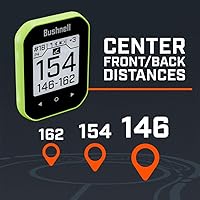
  • Yardage Outputs: Displays front, center, and back distances to each green as the primary yardage readouts on every hole.
  • Navigation: Includes auto course and hole recognition, so the device identifies your location and advances to the next hole without any manual input.
  • Mount: Ships with a strong magnetic cart mount that attaches to most metal cart surfaces and holds the unit securely during play.
  • Color: Available in neon green, which improves visibility on a cart or in a bag compared to darker-colored units.
  • Warranty: Covered by a one-year manufacturer warranty against defects in materials and workmanship.
  • Release Date: First became available in June 2024, making it one of the newer handheld GPS options in Bushnell's lineup.
  • Sales Rank: Holds the number three position in the Golf Course GPS Units category on Amazon as of its ranking data.
  • Manufacturer: Designed and manufactured by Bushnell Golf, a brand with a long track record in golf distance-measurement devices.

Related Reviews

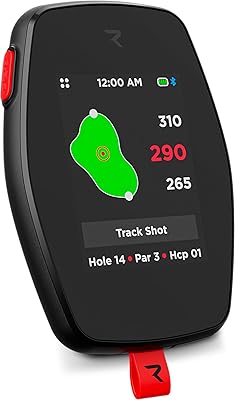
Rad Golf Hand+ Handheld Golf GPS
78%
74%
GPS Accuracy
81%
Touchscreen Responsiveness
93%
No-Subscription Value
78%
Shot & Stat Tracking
76%
Green View Quality
More
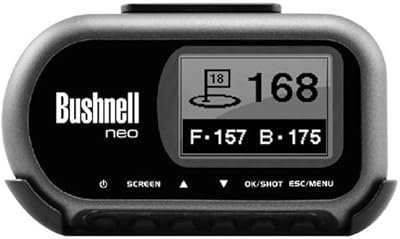
Bushnell Neo Golf GPS Rangefinder
86%
91%
Ease of Use
89%
Battery Life
75%
Display Quality
94%
Accuracy of Yardage
90%
Portability
More
Blue Tees Ringer Golf GPS Device
79%
74%
GPS Accuracy
93%
Magnetic Mounting System
81%
Touchscreen Responsiveness
86%
Battery Life
78%
Post-Round Analytics
More
Canmore H300 Handheld Golf GPS
75%
83%
Value for Money
76%
Course Database Coverage
74%
GPS Accuracy
88%
Ease of Use
81%
Display Readability
More
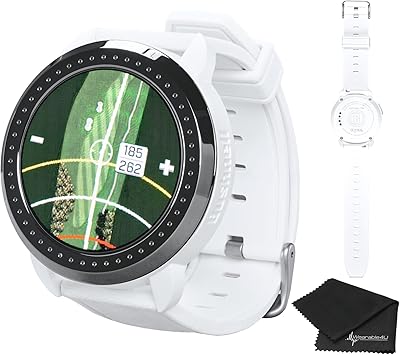
Bushnell iON Elite Golf GPS Watch
79%
91%
GPS Accuracy
89%
Slope Technology
86%
Touchscreen Usability
63%
Battery Life
93%
Course Library
More
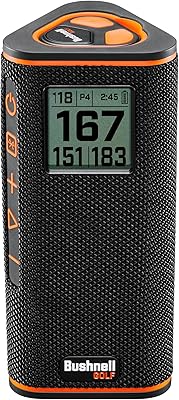
Bushnell Wingman View Golf GPS Speaker
80%
86%
Sound Quality
74%
GPS Accuracy
88%
LCD Screen Visibility
91%
Battery Life
67%
Bluetooth Connectivity
More
Izzo Swami ACE Handheld Golf GPS
79%
93%
Ease of Use
78%
GPS Accuracy
81%
Course Database Coverage
91%
Value for Money
87%
Battery Life
More
Garmin Approach G80 GPS Golf Handheld with Launch Monitor
85%
94%
Course Mapping Accuracy
89%
Launch Monitor Performance
83%
Ease of Use
90%
Battery Life
86%
Display Quality
More
Izzo Swami Kiss 2.0 Golf GPS
81%
91%
Ease of Setup
84%
Yardage Accuracy
93%
Magnetic Mount Performance
82%
Course Database Coverage
72%
i-Caddie Club Suggestions
More
Garmin GPS 73
Garmin GPS 73
80%
93%
Battery Life
88%
SailAssist Features
91%
Build Quality & Durability
54%
Display Quality
82%
Ease of Use
More

FAQ

The Bushnell Phantom 3 Slope Handheld Golf GPS is designed to be ready with minimal setup. Charge it up, power it on at the course, and the device will automatically detect your location and load the relevant course. There is no need to sync it with a computer before your first round.
No — slope mode is not permitted under the Rules of Golf during stroke-play or match-play competitions. You will need to disable the slope function before teeing off in any formal tournament. It is worth double-checking this before a competition round, since it is easy to forget when you have been using slope in casual play.

GPS units like the Phantom 3 Slope calculate distances based on satellite positioning and preloaded course mapping, typically landing within a few yards of the actual distance. A laser rangefinder can be more precise to the pin, especially on long approach shots. For most recreational golfers, the GPS accuracy is more than adequate for club selection, but if pin-perfect precision is non-negotiable for you, a laser will always have the edge.

The mount works well on most standard metal golf cart frames and rails. It will not attach to plastic or non-magnetic surfaces. If your cart has a heavily painted or coated metal rail, the hold may be slightly weaker, so it is worth testing the mount on your specific cart before relying on it mid-round.

The device uses GPS positioning to detect when you have moved from one hole to the next and updates automatically. In practice, it works quietly in the background and rarely requires any manual input. Some users report the occasional brief delay on courses with unusual routing, but for the vast majority of rounds it just keeps pace with play.

This is one area where several users have noted limitations. The screen performs well in dry conditions, but wet fingers or thick winter gloves can reduce responsiveness noticeably. In light drizzle or when hands are slightly damp, most users still get reliable input, but in heavier rain it can become frustrating. If you play regularly in cold or wet climates, it is worth keeping this trade-off in mind.

The preloaded database covers over 38,000 courses worldwide, so international coverage is extensive. Bushnell has historically maintained strong global course databases across their GPS lineup, and the Phantom 3 continues that. That said, coverage at very new or very remote courses can occasionally be incomplete, so it is worth checking in advance if you are playing somewhere unusual.

The rated 14-hour battery life is generous, and real-world feedback largely reflects that. Most users report the battery is still well above 50 percent after a standard four-hour round. Even on a slow five-and-a-half-hour day with the device running continuously, running out of power is unlikely. Charging overnight before a round is a good habit to keep.

For most golfers, yes. The dedicated 3-inch screen is significantly easier to read at a glance than a watch face, and the slope-adjusted distances add a layer of information that most apps and watches do not provide. Phone apps can drain your phone battery and require you to keep your phone accessible; a standalone device like this keeps things simple and purpose-built for golf.

The primary display focuses on front, center, and back distances to the green. Detailed hazard and layup yardages are not a featured output on this unit. If granular hazard information is important to your game, it is worth noting this limitation before purchasing, as some competing GPS devices in this category offer more detailed hole mapping.

Where to Buy