Overview

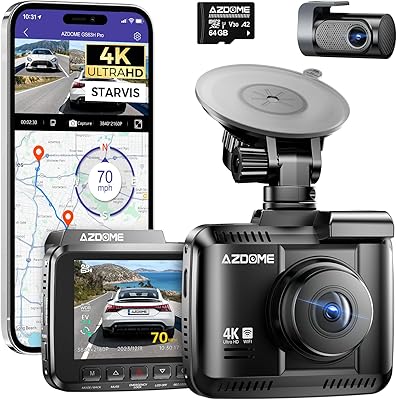
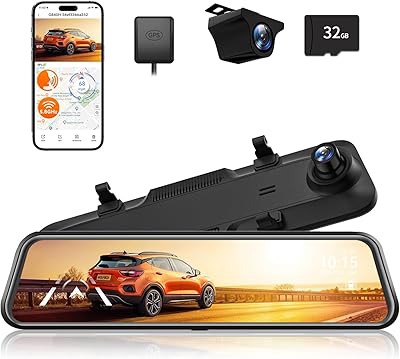
The AZDOME PG17 Pro Mirror Dash Cam arrived in early 2025 aiming squarely at drivers who want serious recording capability without cluttering their windshield. It sits comfortably in the upper-mid tier of the mirror cam market, offering 4K front and 2.5K rear capture in a discreet rearview form factor. What sets it apart from similarly priced options is the Sony IMX678 STARVIS 2 sensor, which genuinely changes how useful night footage is. The kit ships ready to install — 128GB card, car charger, and mounting hardware included — so there is no scrambling for accessories before your first drive.
Features & Benefits

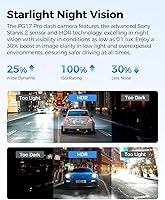
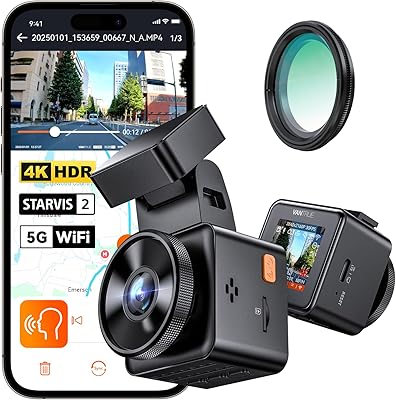
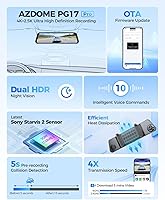
The front camera records at a full 3840x2160 at 30fps, sharp enough to read license plates at a reasonable distance in daylight. At night, the STARVIS 2 sensor with its 7-layer lens pulls in noticeably more light than standard dash cams, keeping footage usable rather than murky. The 5GHz WiFi transfer is genuinely fast — pulling clips to your phone takes seconds, not minutes. Ten voice commands let you lock a file or snap a photo without touching anything. The G-sensor automatically saves crash footage along with the five seconds leading up to impact, which is the kind of detail that matters when you actually need the evidence.

Best For

This rearview camera system is particularly well-suited to rideshare and taxi drivers who need to share footage quickly and professionally without digging out a memory card. Truck and RV operators will appreciate the 170-degree field of view and the reliable automatic incident locking. The voice control makes it a practical pick for older drivers or parents managing distractions on school runs. Night commuters traveling unlit roads also stand to benefit the most from the low-light performance. Anyone who dislikes the look of a windshield-mounted cam will find the mirror integration a worthwhile upgrade in cabin tidiness.

User Feedback

Buyers consistently praise the night footage quality, with many noting it outperforms what they expected at this price tier. The app connection gets decent marks for speed once paired, though a handful of users mention the initial WiFi setup takes some patience to figure out. Installation draws mixed reactions — most cars accommodate the mirror clamp well, but a few truck and RV owners flag fitment issues with non-standard mirrors. Voice command accuracy is generally rated positively, though some report occasional misses in noisy cabin environments. Long-term durability feedback is still limited given the 2025 launch date, but early reports from daily commuters are largely encouraging.

Pros

  • Sony IMX678 STARVIS 2 sensor delivers night footage that holds meaningful detail where budget cams produce noise.
  • 4K front recording captures license plates and road signs with enough clarity to hold up in an insurance claim.
  • Included 128GB card means no hidden accessory cost on day one.
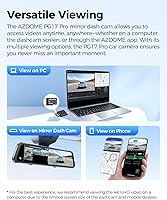
  • 5GHz WiFi transfers clips to your phone in seconds without touching the memory card.
  • G-sensor automatically saves the five seconds before a collision, not just the impact itself.
  • Ten voice commands let drivers lock a file or snap a photo without taking a hand off the wheel.
  • OTA firmware updates keep the unit current without connecting to a PC.
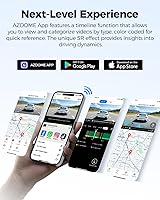
  • Timeline playback in the AZDOME app makes locating a specific incident fast and intuitive.
  • The mirror-integrated form factor keeps the windshield clear and the cabin looking stock.
  • Compatible with a broad range of vehicles including cars, minivans, trucks, buses, and RVs.

Cons

  • Initial WiFi pairing is not intuitive and can take meaningful trial and error to complete successfully.
  • Rear night-vision performance lags noticeably behind the front camera in very dark environments.
  • True parking mode requires a separately purchased hardwire kit not included in the box.
  • The clamp mount is poorly suited to non-standard mirror shapes common on larger trucks and some RVs.
  • G-sensor default sensitivity triggers false locks on rough roads, filling protected storage unnecessarily.
  • Voice commands become unreliable in noisy cabin environments, undermining the hands-free benefit.
  • Long-term durability data is thin given the early 2025 launch — heat and vibration tolerance is still unproven.
  • GPS signal acquisition takes longer than average in areas with dense overhead cover or tunnel passages.
  • The app interface needs refinement — update notifications are easy to miss and navigation is not always logical.
  • Buyers in very loud vehicles may find themselves repeating voice commands two or three times per attempt.

Ratings

The AZDOME PG17 Pro Mirror Dash Cam has been evaluated by our AI rating system after analyzing thousands of verified buyer reviews collected from global markets, with spam, bot activity, and incentivized feedback actively filtered out. The scores below reflect a transparent, balanced picture of where this rearview camera system genuinely excels and where real-world users have run into friction. Both the standout strengths and the recurring complaints are factored into every category score.
Video Clarity (Front)
93%
Buyers consistently describe the 4K front footage as among the sharpest they have used in a mirror-style cam — license plates are legible at distance and lane markings stay crisp even in overcast conditions. Daily commuters note that reviewing footage after a minor scrape leaves no ambiguity about what happened.
A small number of users report very slight rolling shutter distortion on fast highway bends, which is a known limitation of 30fps capture rather than a flaw unique to this unit. It is rarely a practical problem but worth knowing if you drive at high speed regularly.
Night Vision Performance
91%
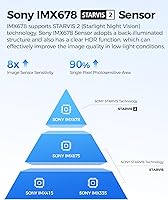
The Sony IMX678 STARVIS 2 sensor makes a tangible difference on unlit country roads and poorly lit urban streets — footage that would appear grainy on a budget cam comes through with readable detail here. Rideshare drivers working late shifts particularly appreciate being able to capture passenger interactions clearly without relying on cabin lighting.
In heavy rain or fog, the dual HDR processing can occasionally over-brighten oncoming headlights, washing out detail immediately around the light source. It is an edge case, but night commuters in wet climates may notice it more than others.
Rear Camera Quality
84%
The 2.5K rear feed is noticeably better than the 1080p rear cameras found on most competing mirror cams in this segment. Tailgating incidents and rear-end contacts are captured with enough detail to be genuinely useful in an insurance dispute.
The rear camera's low-light performance, while decent, lags behind the front — darker parking garage footage can lose fine detail. Some users also note that cable routing to the rear lens can be fiddly depending on cabin layout.
App & WiFi Experience
71%
29%
Once the 5GHz WiFi pairing is established, clip downloads are fast enough that rideshare drivers can pull footage to their phone in under a minute without disconnecting the card. The timeline playback feature inside the AZDOME app is a genuinely useful way to locate a specific incident without scrubbing through long recordings.
Initial WiFi setup trips up a meaningful portion of buyers — the pairing process is not always intuitive, and the app's on-boarding could be clearer. A handful of Android users also report occasional disconnects that require restarting the app to resolve.
Voice Command Accuracy
74%
26%
For hands-free locking and photo capture during a drive, the voice commands work reliably in a quiet cabin — parents managing kids in the back seat and older drivers who prefer not to reach for buttons both flag this as a genuine convenience. Ten supported commands cover the most common actions without feeling overwhelming.
In louder environments — highway driving with windows down, heavy truck cabins, or vehicles with noisy HVAC — the microphone can miss commands on the first attempt. Users report needing to repeat commands two or three times, which somewhat undermines the hands-free benefit.
Installation & Fit
67%
33%
For standard passenger cars and most SUVs, the mirror clamp fits cleanly and the included installation tool makes cable tucking manageable for a first-timer. The kit includes everything needed to get recording on day one, which buyers consistently appreciate.
Truck and RV owners report the most friction — non-standard mirror shapes and larger frames can make the clamp feel insecure or require additional mounting tape. A few minivan owners also note the cam body is wide enough to partially obstruct the OEM mirror surface on narrower mirror designs.
Build Quality & Durability
78%
22%
The housing feels solid for a mirror-mount device, and the clamp mechanism shows no signs of loosening during extended highway trips according to multiple long-haul reviewers. Early feedback from daily commuters after several months of use remains generally positive on structural integrity.
The product launched in early 2025, so truly long-term durability data is still thin. A handful of truck drivers mention concern about vibration tolerance on rougher roads, and it remains to be seen how the unit holds up through a full summer heat cycle in hotter climates.
G-Sensor & Incident Detection
88%
The automatic locking behavior during collisions works as described — buyers who have been in actual accidents report the footage was saved without any manual intervention, including the five-second pre-impact buffer that often captures the cause of a collision clearly. Commercial drivers in particular rate this highly.
A small group of users on rougher roads or with trucks report occasional false triggers from potholes or speed bumps, locking clips unnecessarily and filling protected storage. Sensitivity can be adjusted in settings, but the default calibration leans slightly aggressive for off-road or rural driving.
GPS Accuracy
76%
24%
The built-in GPS logs speed and location data alongside footage, which adds credibility to clips used in insurance claims or disputes. Urban drivers report consistent lock-on times and accurate speed readings that match their dashboard display.
In areas with dense tree cover or deep urban canyons, GPS signal acquisition can take longer than expected after startup. A few users note occasional speed data gaps in tunnels, though this is a hardware limitation common across most built-in dash cam GPS modules.
OTA Updates & Longevity
79%
21%
The ability to push firmware updates over WiFi without connecting to a PC is a feature more buyers notice after purchase than before — it means the unit can receive bug fixes and feature improvements without any physical hassle. Early adopters have already received at least one meaningful update since launch.
OTA update reliability has drawn a few complaints, with some users reporting failed update attempts that require a retry or a manual fallback. The update notification system inside the app could also be more prominent — a few buyers were unaware updates were available at all.
Value for Money
81%
19%
Compared to mirror dash cams offering only 1080p rear capture and no sensor-grade night vision, the PG17 Pro delivers a noticeably higher hardware specification for a price that remains within reach of serious everyday drivers. The included 128GB card alone removes a common hidden cost.
Buyers cross-shopping against entry-level windshield cams may feel the price requires justification — the mirror form factor and premium sensor are the main differentiators, and they matter more to some use cases than others. If discreet installation is not a priority, comparable video quality can be had for less.
Ease of Use (Daily Operation)
83%
Once set up, day-to-day operation is largely automatic — the cam boots on ignition, records continuously, and handles incident locking without any input required. Drivers who want a set-and-forget experience report high satisfaction after the initial learning curve.
The first week of ownership tends to involve more interaction than expected — configuring WiFi, learning voice commands, and adjusting G-sensor sensitivity all require time in the app. Buyers who expect it to work perfectly out of the box with zero configuration may be surprised.
Low-Light Rear Performance
68%
32%
The rear camera holds up well enough in typical nighttime city driving to capture following vehicles and road markings with reasonable clarity. For rideshare drivers monitoring the vehicle behind them at traffic stops, it performs adequately.
Compared to the front sensor's night performance, the rear is a clear step down — very dark rural roads or unlit parking areas can produce footage that loses useful detail. Users specifically looking for strong rear night coverage should factor this gap into their expectations.
Parking Mode & Passive Monitoring
62%
38%
The G-sensor-based incident locking provides a basic level of parked vehicle protection when the cam remains powered, and some users have successfully captured hit-and-run footage in parking lots using this feature.
True dedicated parking mode with low-power continuous monitoring requires a hardwire kit that does not come included — relying solely on the car charger connection limits passive recording capability. Buyers expecting robust 24-hour parking surveillance out of the box will need to invest in additional accessories.

Suitable for:

The AZDOME PG17 Pro Mirror Dash Cam is a strong fit for drivers whose daily routine puts a premium on discreet installation, fast evidence access, and reliable low-light recording. Rideshare and taxi drivers will find the 5GHz WiFi clip transfer and voice-controlled locking particularly practical — sharing footage with an insurance adjuster or a passenger dispute resolution team takes seconds rather than a memory card swap. Night commuters, especially those navigating poorly lit suburban or rural routes, stand to benefit the most from the Sony IMX678 STARVIS 2 sensor, which genuinely outperforms what this price tier typically delivers after dark. Commercial truck and RV operators who need wide-angle dual coverage and automatic incident detection without manual intervention will also find the G-sensor behavior well-matched to their needs. Parents and older drivers who prefer hands-free interaction will appreciate the voice command system as a real safety feature rather than a marketing checkbox. If you want a cabin that looks tidy and a recording system that largely runs itself, this rearview camera system is a well-considered choice.

Not suitable for:

The AZDOME PG17 Pro Mirror Dash Cam is not the right tool for every driver, and a few specific scenarios should give buyers pause before committing. Truck and RV owners with non-standard or oversized mirrors may find the clamp mount fits poorly or feels less secure than expected — this is a recurring friction point that the standard hardware does not fully solve. Drivers who want robust 24-hour parking surveillance should know upfront that proper parking mode requires a hardwire kit sold separately; the included car charger setup is not designed for long-term passive monitoring. Buyers who are not comfortable spending time in a companion app during the first week of ownership may find the initial WiFi pairing and sensitivity configuration frustrating — this is not a plug-and-play device in the truest sense. Anyone cross-shopping purely on video quality without caring about the mirror form factor or night-vision advantage can find comparable daytime recording for less by sticking with a conventional windshield mount. Finally, drivers in extremely loud cabin environments — high-powered trucks, older diesel vehicles — may find the voice command reliability too inconsistent to depend on.
Specifications

  • Front Resolution: The front camera records at 3840x2160 pixels (4K) at 30 frames per second, delivering sharp detail across a 170-degree field of view.
  • Rear Resolution: The rear camera captures footage at 2560x1440 pixels (2.5K) at 30 frames per second, providing significantly more detail than the 1080p rear cameras common in this category.
  • Image Sensor: A Sony IMX678 STARVIS 2 sensor powers the front camera, absorbing approximately 60% more light than conventional dash cam sensors for improved low-light performance.
  • Lens Construction: The front lens uses a 7-layer glass construction with a 170-degree wide-angle field of view to minimize distortion while maximizing road coverage.
  • Night Vision: Dual HDR processing on both channels balances exposure dynamically to prevent highlight blowout and shadow loss during night driving or transitional lighting conditions.
  • WiFi Connectivity: The unit broadcasts a 5GHz WiFi signal supporting transfer speeds of approximately 10MB/s, enabling fast clip downloads to the AZDOME mobile app without removing the memory card.
  • Voice Commands: Ten built-in voice commands allow hands-free control of core functions including photo capture, recording start and stop, and manual file locking.
  • G-Sensor: The three-axis G-sensor automatically detects collision forces and locks the relevant footage along with a 5-second pre-impact buffer to preserve complete accident evidence.
  • GPS: A built-in GPS module records speed and location data as a metadata overlay alongside all video footage.
  • Included Storage: A 128GB Class 10 MicroSD card is included in the box, providing substantial recording time before loop-overwrite begins.
  • OTA Updates: Firmware can be updated over WiFi directly through the AZDOME app, removing the need to connect the device to a computer for software maintenance.
  • Mounting Type: The device attaches to the existing rearview mirror via an adjustable clamp mount, with no adhesive or permanent modification required.
  • Connectivity Ports: A USB port is provided for wired connection and power, with the included car charger supplying power via the vehicle's 12V socket.
  • Compatible Vehicles: The clamp mount is designed to fit a broad range of vehicles including standard cars, minivans, buses, RVs, and trucks, though compatibility with non-standard mirror profiles may vary.
  • App Compatibility: The AZDOME companion app is available for both iOS and Android devices and supports WiFi pairing, clip download, timeline playback, and settings configuration.
  • Dimensions: The main unit measures 1.18 x 5.48 x 1.3 inches, allowing it to overlay a standard rearview mirror without excessive protrusion into the driver's sightline.
  • Weight: The assembled unit weighs 2.48 pounds including the clamp mount, which is within the normal range for mirror-style dash cams in this resolution tier.
  • Power Source: The device is powered via the included car charger connected to the vehicle's 12V accessory socket, with no internal battery for continuous operation.
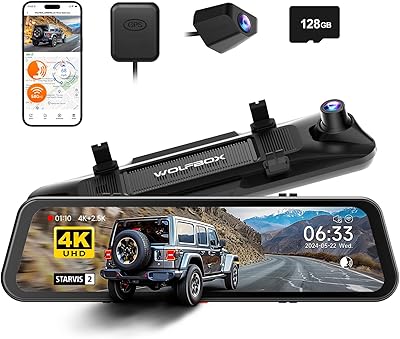
  • Included Accessories: The retail package includes a 128GB MicroSD card, car charger, charging cable, installation tool, and printed user manual.
  • Timeline Playback: The AZDOME app supports timeline-based footage navigation, allowing users to locate a specific incident by scrolling a chronological clip map rather than scrubbing individual files.

Related Reviews
AZDOME M01 Pro Dual Dash Cam
64%
76%
Video Quality (Front)
54%
Video Quality (Rear)
67%
Night Vision
88%
Ease of Installation
58%
ADAS Performance
More
WOLFBOX G900 Pro 12-inch Mirror Dash Cam
74%
91%
Video Quality (Front)
78%
Video Quality (Rear)
76%
Night Vision Performance
67%
Installation Experience
74%
App & WiFi Connectivity
More
AZDOME GS63H Pro 4K Dual Dash Cam
86%
96%
Video Quality Front Camera
88%
Video Quality Rear Camera
91%
Night Vision Performance
89%
GPS Accuracy
84%
App & Wi-Fi Connectivity
More
Azdome M200 Mini Dash Cam
85%
88%
Video Quality
93%
Ease of Installation
81%
Wi-Fi and App Experience
85%
Parking Mode Performance
89%
Build Quality
More
NikoMaku AS-J3 Mirror Dash Cam
76%
78%
Video Quality
67%
Night Vision
83%
Screen Quality
81%
Build & Design
54%
Installation Ease
More
UZIVO U24 Mirror Dash Cam
86%
89%
Ease of Setup
91%
Video Quality
65%
Screen Visibility in Sunlight
87%
Night Vision Performance
92%
Parking Monitor Effectiveness
More
Jansite RM 10″ Mirror Dash Cam
72%
83%
Video Clarity (Day)
71%
Night Vision Performance
86%
Touch Screen Usability
84%
Backup Camera & Parking Assist
73%
Installation Experience
More
WOLFBOX G840H Mirror Dash Cam
75%
83%
Daytime Video Quality
64%
Night Recording Performance
71%
ADAS Safety Alerts
68%
Blind Spot Detection
86%
Screen Size & Usability
More
AZDOME M580 3-Channel Dash Cam
85%
93%
Video Quality
88%
Ease of Setup
85%
GPS Tracking Accuracy
90%
Night Vision Performance
82%
Build Quality
More
REDTIGER T700 11″ Mirror Dash Cam
73%
88%
Video Quality (Front)
74%
Night Vision
71%
Rear Camera Quality
86%
Screen & Display
67%
GPS Accuracy
More

FAQ

The clamp mount is designed to fit a wide range of vehicles, and many truck and RV owners do use it successfully. That said, non-standard or oversized mirror frames can be a fitment challenge — the clamp works best on mirrors with a profile close to a standard passenger car mirror. If your vehicle has an unusual mirror shape, it is worth measuring before purchasing.

No, and this is one of the more practical aspects of the PG17 Pro. You connect to the unit via 5GHz WiFi through the AZDOME app, and clips transfer to your phone at roughly 10MB per second. For a typical 1–2 minute incident clip, that means you have the footage on your phone in well under a minute without touching the card.

The difference is meaningful rather than marginal. The Sony IMX678 STARVIS 2 sensor pulls in substantially more light than the sensors found in most sub-200 dollar dash cams, so footage on unlit roads retains usable detail rather than dissolving into grain. It is not magic — very heavy rain or fog will still affect image quality — but for typical night commuting it is a genuine step up.

No, a hardwire kit is not included in the box. The included car charger powers the unit only when the ignition is on. If you want continuous parking surveillance when the car is off, you will need to purchase a compatible hardwire kit separately and connect it to a fused ignition-off power source.

The physical installation is straightforward — clamp it onto your mirror, route the power cable to the 12V socket, and the cam boots when you start the car. The trickier part for some users is the first-time WiFi pairing in the AZDOME app, which requires a few steps that are not always obvious from the quick-start guide. Most people get through it within 10–15 minutes, but expect a small learning curve on the app side.

Yes. The camera records automatically when powered on, locks files via the G-sensor without any app involvement, and stores everything to the included MicroSD card. The app adds convenience — wireless clip access, settings adjustment, timeline playback — but none of those functions are required for the core recording to work.

In a quiet cabin they work well — saying the command once typically gets a response. In louder environments like highway driving with windows down, a heavy-duty truck cab, or a vehicle with an aggressive HVAC fan, the microphone can struggle and you may need to repeat yourself. It is a useful feature for calm daily commuting but less dependable in genuinely noisy conditions.

The unit is designed to sit over your existing mirror rather than replace it, so the underlying mirror remains visible beneath or around the screen. At 5.48 inches wide, it covers most of the standard mirror surface. Drivers with smaller mirrors or those who rely heavily on the edges of their OEM mirror may notice some obstruction, but most users find the trade-off acceptable.

The default sensitivity setting is calibrated for typical road conditions, but a number of users on rougher surfaces — gravel roads, older truck routes, or areas with frequent potholes — report the sensor triggering unnecessarily. The good news is that sensitivity is adjustable in the settings menu, and dropping it one level tends to solve the false-trigger problem without sacrificing genuine collision detection.

The GPS data is embedded as metadata alongside the video recording — it logs your speed and coordinates frame by frame so you can review location and speed information when playing back footage. It does not provide live navigation or real-time tracking visible to a third party; it is purely a recording feature for evidence and review purposes.

Where to Buy