Overview

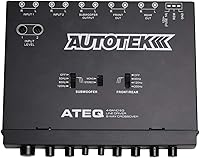
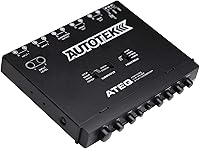
The Autotek ATEQ 4-Band Car Equalizer is one of those practical little boxes that solves a very specific problem: you have a factory head unit you're happy with, but your aftermarket amp is starving for a clean, strong signal. This half-DIN equalizer slots into a standard dash opening without major surgery, which is a genuine relief for anyone who has dealt with custom mounting brackets. At its core, it acts as a signal processing bridge between your car radio and the rest of your audio chain, pushing a 9V preamp output through the RCAs. For budget-conscious builders, that combination of form factor and functionality is hard to argue with.

Features & Benefits

The four EQ bands — covering bass, low-mid, high-mid, and treble — give you enough range to correct a muddy low end or tame harsh highs without needing a full DSP processor. What makes this in-dash signal processor particularly useful is the line driver circuit, which cranks the RCA output up to 9 volts. In practical terms, that means your amp receives a stronger, cleaner signal, translating to less hiss and better headroom at higher volumes. The front/rear active crossover lets you direct the right frequencies to your mains and subwoofer separately. Add in independent input controls for both sources and a master SPL knob, and you have surprisingly capable tone management for the price point.

Best For

This in-dash signal processor really shines in one scenario: you want better sound without pulling your factory head unit. If you are bolting in an aftermarket amplifier and the stock stereo's RCA output is weak or nonexistent, the Autotek EQ unit steps in to fix that without a full head unit swap. It is also a practical pick for anyone who regularly switches between their car radio and a phone or media player — the A/B input selector handles that cleanly. Space-conscious installs benefit from the half-DIN footprint. That said, if your head unit already has built-in DSP or high-voltage RCA outputs, this unit adds redundancy rather than real value.

User Feedback

Buyers who picked up the Autotek EQ unit for a basic amplifier install tend to come away satisfied with the audible difference in signal clarity — less background hiss and a noticeably tighter low end are the most common wins. Installation gets mixed reviews; the quick start guide is thin, and first-time installers often mention needing a tutorial video to sort out the wiring. The plastic build raises eyebrows for some, though most accept it at this price. Longer-term owners generally report it holding up fine over a year or more, while a handful flag durability concerns after heavy use. Overall, buyers rate it favorably for what it costs.

Pros

  • Boosts RCA output to 9 volts, giving aftermarket amps a cleaner, stronger signal to work with.
  • Half-DIN size fits most standard dash openings without custom mounting work.
  • Four EQ bands cover the key frequency ranges needed for basic but effective tone shaping.
  • Front and rear active crossover helps route frequencies correctly without a separate unit.
  • Dual audio inputs let you switch between your head unit and a secondary source quickly.
  • Independent input level controls on both sources eliminate volume mismatches when switching.
  • The master SPL knob gives you centralized volume management across both inputs.
  • Delivers a noticeable reduction in amplifier hiss and background noise in real-world installs.
  • One-year warranty provides a reasonable safety net for a budget-priced component.
  • Solid BSR ranking in its category suggests consistent buyer demand and repeat satisfaction.

Cons

  • The included quick start guide is thin and often leaves first-time installers searching for help online.
  • Plastic construction feels less premium than competing units, which may concern long-term buyers.
  • Only four EQ bands limits serious tuning compared to six- or ten-band alternatives.
  • No digital display or visual feedback makes dialing in settings a purely trial-and-error process.
  • Heat dissipation in tight, enclosed dash spaces has been flagged by some users over time.
  • Wiring layout can be confusing without prior car audio experience or a supplemental guide.
  • The 9V output, while useful, is not class-leading and may still fall short for high-demand amplifier setups.
  • No remote turn-on lead included, which adds a minor but real extra step during installation.
  • Build consistency has been questioned by a subset of buyers who report variance between units.

Ratings

Our AI rating engine analyzed verified buyer reviews for the Autotek ATEQ 4-Band Car Equalizer from markets worldwide, actively filtering out incentivized, duplicate, and bot-generated submissions to surface what real owners actually experience. The scores below reflect a balanced synthesis of genuine praise and recurring frustrations, so you get a complete picture before making your decision.

Signal Quality Improvement
83%
The most consistent compliment from buyers is a clearly audible reduction in amp hiss and background noise after installation. Drivers who were previously struggling with a weak factory head unit signal describe the difference as immediately noticeable, especially at highway volumes where amplifier noise tends to become intrusive.
A minority of users with already-decent aftermarket head units report a smaller perceptible difference, suggesting the improvement is most dramatic when upgrading from a genuinely weak OEM source. In very high-end setups, the 9V output ceiling is still not class-leading compared to premium processors.
Value for Money
81%
19%
Buyers consistently rate this in-dash signal processor as one of the better-performing options at its price tier, particularly when the alternative is a full head unit replacement costing several times more. For a budget car audio build where every dollar needs to pull weight, the combination of line driver, EQ, and crossover in one unit is hard to beat.
Buyers who stretch their expectations beyond what a budget-tier component can realistically deliver tend to feel let down by build quality relative to cost. Compared to purpose-built line drivers or standalone DSP units in a higher bracket, the overall performance ceiling is noticeably lower.
Ease of Installation
61%
39%
Experienced car audio installers report the wiring process is straightforward, following standard conventions for power, ground, ACC, and RCA connections. The half-DIN chassis drops into most factory openings without custom work, which saves real time during a full amplifier install.
First-time installers consistently flag the quick start guide as too sparse to get the job done without outside help. Several buyers had to turn to online forums or video tutorials to complete the wiring correctly, which adds friction that a more thorough manual would have avoided entirely.
Build Quality
57%
43%
The unit's functional layout is clean and the controls feel responsive enough during normal use. For buyers who are mounting it in a concealed location like under the dash, the utilitarian construction is less of a concern since it is rarely seen or handled after installation.
The plastic housing is the most commonly cited disappointment, with multiple reviewers describing it as feeling cheaper than expected even at this price point. A handful of longer-term owners report that knobs and the selector switch show wear earlier than they would like, raising questions about multi-year durability.
EQ Performance
74%
26%
The four-band layout covers the core frequency zones that matter most for a typical car audio tune — taming boomy bass, cleaning up muddy mids, and smoothing out harsh treble. For daily listening in a commuter vehicle, most buyers find the range of adjustment more than sufficient to get a satisfying, balanced sound.
Audiophiles and enthusiast builders who are accustomed to six- or ten-band parametric equalizers will find the four-band setup limiting for precise tuning. There is no visual feedback like a display or LED indicator, so dialing in the right settings is entirely by ear, which takes patience.
Crossover Functionality
71%
29%
The built-in front and rear active crossover is a genuine convenience for anyone setting up a basic two-zone system, handling frequency splitting without a separate component. Buyers running a simple amp-plus-subwoofer configuration particularly appreciate having this capability bundled in at no extra cost.
The crossover control options are basic, and users building more complex multi-amp setups will quickly outgrow them. Crossover slope and frequency adjustability are limited compared to dedicated external crossover units, so precision routing across multiple speaker types is not really achievable here.
Dual Input Usability
78%
22%
The ability to connect both a car radio and a secondary source — like a phone or Bluetooth receiver — and switch between them on the fly is a feature buyers genuinely use. The independent input level controls mean most users can set and forget the balance once calibrated, making source switching quick and non-disruptive.
The physical selector switch, while functional, is not the most refined mechanism, and a few users note it can feel slightly loose over time. There is no soft switching or fading between sources, so toggling mid-playback produces an abrupt cut rather than a smooth transition.
Noise Floor & Interference
69%
31%
In well-grounded installs, the Autotek EQ unit performs respectably at minimizing electrical interference, and the boosted output voltage helps push the signal above typical noise thresholds. Buyers who followed proper grounding practices during installation report clean output with no ground loop hum.
A recurring thread in negative reviews involves alternator whine or ground loop interference that proved difficult to eliminate. This is partly an installation issue, but the unit offers no built-in noise filtering or ground isolation, meaning poorly grounded vehicles are more vulnerable to these issues.
Dash Fitment
86%
The half-DIN form factor is one of this unit's most practical attributes, fitting cleanly into the vast majority of vehicles with a standard dash opening. Most buyers report dropping it in without any modification, which is exactly what you want from a component that is supposed to simplify an install.
Vehicles with non-standard or fully integrated dash designs — common in newer European and Japanese models — may require additional adapter kits that are not included. In some trucks and older American vehicles with unusual DIN configurations, buyers report needing aftermarket mounting sleeves.
Documentation & Support
44%
56%
The physical quick start guide at least provides a basic wiring diagram that serves as a reference point for experienced installers. For anyone who has done a car audio install before, the fundamental logic of the connections is familiar enough to work through without much hand-holding.
For less experienced buyers, the documentation is genuinely inadequate. There is no detailed wiring guide, no troubleshooting section, and Autotek's online support resources are sparse, leaving many first-timers reliant entirely on third-party forums and YouTube content to complete their install successfully.
Long-Term Reliability
63%
37%
A solid portion of buyers report the unit functioning without issue through a year or more of regular daily use, which is consistent with the one-year warranty coverage. In temperate climates with standard install conditions, the failure rate based on buyer reports appears reasonable for the price tier.
In hotter climates or installs where the unit is exposed to elevated temperatures — common in vehicles parked in direct sun — some owners report performance degradation or failure after extended periods. The build quality does not inspire confidence for demanding environments or multi-year service life.
Master Volume Control
76%
24%
Having a single master volume knob that governs overall output across both audio sources is a convenient feature that buyers in shared-vehicle situations particularly appreciate. It removes the need to reach for multiple controls when quickly adjusting overall loudness while driving.
The physical knob itself lacks the tactile precision of higher-end units, and a few users report minor channel imbalance at very low volume positions, which is a known characteristic of budget potentiometers. It is a minor issue in most cases but worth knowing if low-level listening is important to you.
Packaging & Unboxing
59%
41%
The unit arrives securely packaged with no reports of transit damage being a common issue, and the box contents are at least clearly laid out. For a utilitarian car audio component, the presentation is functional if unremarkable.
No RCA cables, mounting hardware, or wiring harness adapters are included, which means budget buyers who assumed those essentials were bundled in will face additional cost and a separate parts run. The absence of any accessories beyond the sparse guide is a noticeable gap for beginners.

Suitable for:

The Autotek ATEQ 4-Band Car Equalizer is purpose-built for the driver who wants a meaningful audio upgrade without touching their factory head unit. If you are running an aftermarket amplifier off a stock stereo, the weak preamp output from most OEM radios is a real problem — this in-dash signal processor addresses that directly by boosting the RCA signal to a level that gives your amp something solid to work with. It also makes a lot of sense for anyone juggling two audio sources, like a car radio and a phone, since the input selector handles switching cleanly without any adapter hacks. Budget-conscious builders working with limited dash real estate will appreciate that the half-DIN form factor drops in without custom fabrication. Essentially, if your goal is better sound for a modest outlay and your current setup leaves your amp underdriven, this unit delivers practical value where it counts.

Not suitable for:

The Autotek ATEQ 4-Band Car Equalizer is not the right tool for every car audio build, and knowing when to skip it matters. If your aftermarket head unit already outputs high-voltage RCA signals or includes built-in DSP with parametric EQ, adding this unit creates redundancy without any real gain. Audiophiles who need precise, multi-band frequency control or time-alignment features will find the four-band layout too limited for serious tuning work. First-time installers who expect thorough documentation may run into friction, since the included quick start guide leaves a lot of questions unanswered. Anyone prioritizing premium build quality or long-term durability in demanding conditions — extreme heat, heavy vibration — should probably look at more robust options in a higher price bracket. This is a utility-focused, budget-tier device, and buyers should approach it with that expectation firmly in mind.

Specifications

  • Form Factor: Half-DIN chassis fits into any standard single-DIN or half-DIN dash opening without requiring custom mounting brackets.
  • EQ Bands: Four independent equalization bands cover bass, low-mid, high-mid, and treble frequency ranges.
  • Preamp Output: Line driver circuit delivers up to 9 volts of preamp signal through the RCA outputs, well above the typical 2–4V from most factory head units.
  • Output Connectors: RCA outputs carry the boosted signal from the unit to a connected amplifier or processor.
  • Crossover Type: Active front and rear crossover allows independent frequency routing to front speakers and rear speakers or subwoofer channels.
  • Audio Inputs: Two audio inputs are provided: one for a head unit and one for an auxiliary media source such as a phone or media player.
  • Input Level Controls: Separate input level adjustment controls are included for each audio source to ensure matched volume levels when switching between them.
  • Master Volume: A dedicated master SPL volume knob controls the overall output level across both connected audio sources simultaneously.
  • Input Selector: A hardware switch allows the user to toggle between the head unit input and the auxiliary source input on demand.
  • Power Source: The unit draws power from the vehicle's electrical system via a standard ACC and ground wiring connection.
  • Dimensions: Package dimensions measure 11.73 x 8.07 x 2.01 inches, with the unit itself sized to half-DIN specification.
  • Weight: The unit weighs approximately 2 pounds, making it easy to handle and mount during installation.
  • Color: Finished in black to blend with most standard dash environments and mounting sleeves.
  • Warranty: Covered by a one-year limited manufacturer warranty from Autotek.
  • In the Box: Each unit ships with the equalizer and a quick start guide; no additional cables or mounting hardware are included.
  • Batteries: No batteries are required or included; the unit operates exclusively on vehicle power.
  • Manufacturer: Designed and sold by Autotek, a brand with a history in budget and mid-tier car audio components.
  • Model Number: The official model identifier for this unit is ATEQ, as listed by the manufacturer.

Related Reviews
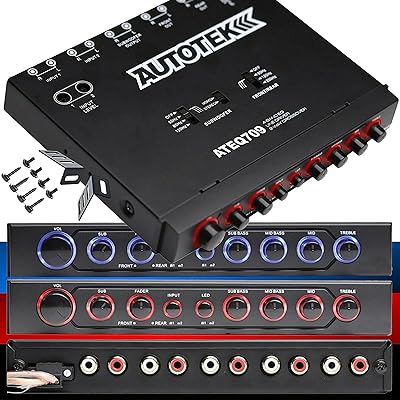
Autotek ATEQ709 4-Band Audio Equalizer with 2-Way Crossover

86%
85%
Sound Quality
92%
Ease of Installation
80%
Build Quality
87%
User Interface
88%
Audio Clarity
More
Sound Storm Laboratories S4EQ 4 Band Pre-Amp Car Audio Stereo Equalizer
84%
88%
Sound Quality
93%
Ease of Installation
85%
Bass Response
80%
Build Quality
87%
Subwoofer Control
More
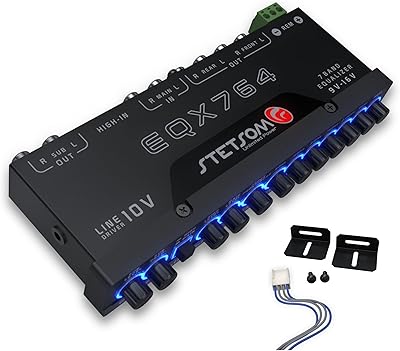
Stetsom EQX764 7-Band Car Audio Equalizer
85%
91%
Sound Quality Enhancement
89%
Ease of Installation
93%
Bass Control
85%
Frequency Band Flexibility
88%
Output Channels
More
TOPSTRONGGEAR TSG7EQ 7-Band Car Audio Equalizer
83%
87%
Sound Quality
91%
Ease of Installation
84%
Bass Control
80%
Build Quality
85%
Connectivity Options
More
Clarion EQS755 7-Band Car Audio Equalizer
85%
89%
Sound Quality
85%
Connectivity Options
92%
Ease of Installation
87%
Build Quality
90%
Subwoofer Control
More
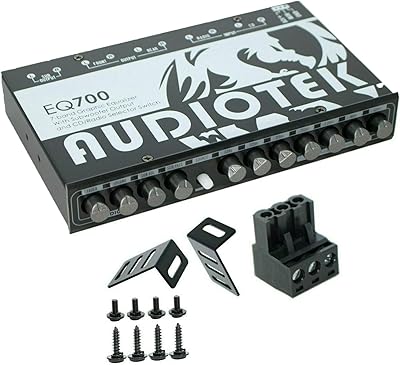
Audiotek AT-EQ700 7 Band Car Audio Equalizer
85%
91%
Bass Control
84%
Ease of Installation
87%
Sound Quality
85%
Compatibility with Audio Devices
92%
Customizability (Frequency Bands)
More
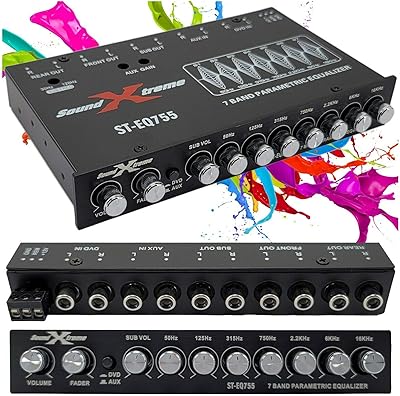
Xtremevision ST-EQ755 7-Band Car Audio Equalizer
82%
88%
Sound Quality
90%
Bass Performance
76%
Ease of Use
83%
Build Quality
71%
Setup & Installation
More
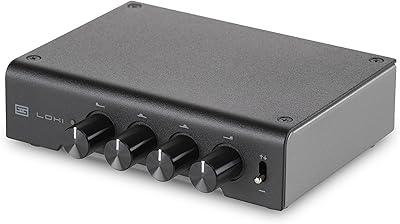
Schiit Loki Mini+ 4-Band Equalizer
81%
91%
Signal Transparency
93%
Passive Bypass Quality
88%
Build Quality
82%
Noise Floor
76%
Tonal Control Range
More
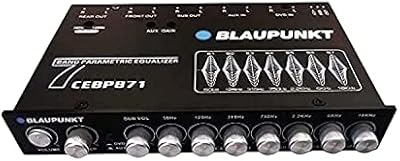
Blaupunkt CEBP871 7-Band Car Audio Graphic Equalizer
86%
89%
Sound Quality
91%
Ease of Installation
85%
Customization Options
87%
Input Versatility
82%
Build Quality
More
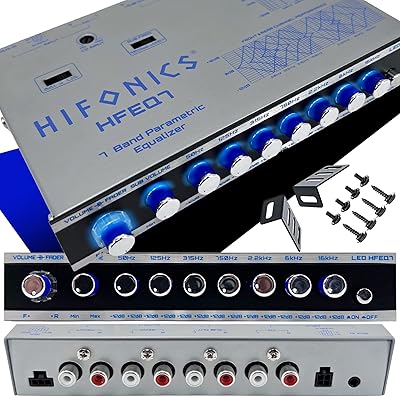
Hifonics HFEQ7 7-Band Pre-Amp Car Audio Equalizer
85%
88%
Sound Quality
94%
Ease of Installation
90%
Bass Control
85%
Build Quality
91%
Value for Money
More

FAQ

No, that is actually the main reason most people buy it. This in-dash signal processor is designed to work between your existing head unit and your amplifier, so your factory stereo stays exactly where it is. You just run the signal through the unit before it reaches your amp.

You will need a way to get an RCA-level signal first, typically through a high-low adapter or line output converter connected to your speaker wires. Once you have an RCA signal coming in, this unit can then boost and shape it before sending it to your amplifier.

Most stock head units put out somewhere between 2 and 4 volts on their RCA connections, which is often not enough to drive an aftermarket amp cleanly at higher volumes. Boosting that to 9 volts means your amplifier gets a stronger, cleaner input signal, which typically results in less background hiss and more dynamic range before distortion sets in.

It is manageable for someone with basic car audio experience, but the included documentation is minimal. If you are relatively new to wiring, plan to supplement the quick start guide with an online wiring tutorial or a YouTube walkthrough for your specific vehicle. The connections themselves are standard — power, ground, ACC, RCA in, RCA out — nothing unusual.

Yes. The unit has two audio inputs: one for your head unit and one for a secondary source. You can connect a phone or media player to the auxiliary input and use the selector switch to toggle between the two. The independent level controls let you match the volume between sources so there is no jarring jump when you switch.

In most vehicles, yes. The half-DIN form factor is a standard size that fits into the lower slot of a typical double-DIN dash opening or into a dedicated half-DIN pocket. Some vehicles may require a mounting sleeve or bracket, but full custom fabrication is rarely necessary.

The built-in front and rear active crossover handles basic frequency splitting between your front speakers and your rear or subwoofer channels, so for a straightforward two-zone setup it covers that need. If you are building a more complex multi-amp system with separate components that each need precise crossover settings, a dedicated external crossover will give you more control.

Feedback from buyers suggests it holds up well under normal conditions for a year or more, which aligns with the warranty period. The plastic housing does not inspire the same confidence as metal-chassis competitors, so if your install location sees significant heat or vibration, it is worth considering that before committing. For a typical underdash or in-dash mount, most users report no issues.

Yes, the RCA outputs are a universal standard, so this in-dash signal processor works with any amplifier that accepts RCA inputs regardless of brand. Just match the RCA cable to the input sensitivity range of your specific amp and adjust accordingly.

Honestly, this unit would not add much for you. If your head unit already outputs 4 volts or more and includes its own DSP tuning tools, running the signal through the Autotek EQ unit mostly duplicates functionality you already have. In that situation, the money would be better spent elsewhere in your audio chain.