Overview

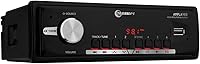
The Taramp's Amplayer 400 Car Stereo Receiver is one of those rare units that asks a genuinely interesting question: what if you didn't need a separate amplifier at all? Taramps is a Brazilian audio brand with a strong following in the high-output car audio world, and this single-DIN hybrid unit reflects that DNA. It's built for enthusiasts who want a clean install without running extra cables to a trunk-mounted amp. At 3.6 stars across 68 ratings, it's not a crowd-pleaser for everyone — but that score tells you more about the install complexity than the unit itself.
Features & Benefits

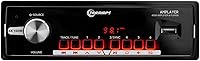
The core appeal of this all-in-one receiver-amp is straightforward: four channels pushing 100 watts each into 2-ohm loads, with bridge mode letting you consolidate to two channels at 200 watts apiece — useful when running a dedicated pair of component speakers. Real-world output will vary based on your wiring and impedance, so don't treat the rated figures as gospel. Beyond power, it covers Bluetooth streaming, FM reception, and USB playback without breaking a sweat. Integrated crossovers (high-pass, low-pass, and full-range) let you tune the signal without adding an external processor, and the LINE OUT keeps the door open for a subwoofer amp down the road.

Best For

This single-din hybrid unit is a natural fit for car audio hobbyists who want to keep things tidy — one slot, one unit, done. It's especially well-suited for upgrading older vehicles that lack factory amplification and don't need complex OEM integration. If you're already planning to add a sub later, the LINE OUT makes that expansion straightforward. That said, DIY install comfort is basically a prerequisite here. The wiring runs directly from the battery, requires proper gauge cable, and demands some electrical know-how. Plug-and-play buyers will likely struggle. For someone who enjoys the process of a clean audio build, though, this all-in-one receiver-amp punches well above its size.

User Feedback

Buyers who got the install right tend to come away genuinely impressed — particularly with Bluetooth pairing reliability and the sound quality at moderate listening volumes. FM reception and remote control range also draw consistent praise. Where things go sideways is the installation itself. The dual-fuse setup confuses some buyers, and the crossover adjustment curve catches others off guard. A few owners noted that without proper gauge wiring, the unit trips protection modes — frustrating if you don't know why it's happening. Polarized reviews are the honest takeaway here: the 3.6-star average isn't a reflection of a bad product so much as a product that rewards preparation and penalizes shortcuts.

Pros

  • Combines a head unit and 4-channel amplifier in one single-DIN slot, freeing up trunk and cabin space.
  • Bridge mode lets you run two high-power channels at 200 watts each when needed for demanding speakers.
  • Bluetooth pairing is straightforward and reliable once the unit is properly installed.
  • FM tuner and USB input give you multiple source options without relying solely on your phone.
  • Built-in crossovers let you shape the sound for different speaker configurations without extra hardware.
  • LINE OUT makes it easy to add a subwoofer amplifier later without redoing the entire install.
  • The long-distance remote is a practical touch — change the volume or source without leaning over the dash.
  • Dual-fuse protection helps guard your vehicle's electrical system against overload scenarios.
  • Buyers who install it correctly consistently report solid sound quality for the price point.

Cons

  • Installation requires running new wire directly from the battery — not a simple head unit swap by any measure.
  • The dual-fuse system and two power modes confuse many buyers and are poorly explained in the included documentation.
  • Rated wattage figures assume ideal 2-ohm loads; real-world output drops noticeably with typical 4-ohm speakers.
  • The crossover adjustment process has a steep learning curve for anyone without prior audio tuning experience.
  • No support for modern factory integration, CANBUS systems, or amplified OEM speaker outputs.
  • At 3.6 stars across 68 ratings, buyer satisfaction is inconsistent enough to warrant realistic expectations.
  • The onboard signal processing is too basic for listeners who want precise frequency control or time alignment.
  • Wire gauge and power cable sizing requirements are strict — underspec your wiring and the unit will go into protection mode.
  • No touchscreen or visual interface to speak of, which limits usability compared to modern head units in the same price range.

Ratings

The scores below were generated by AI after analyzing verified buyer reviews of the Taramp's Amplayer 400 Car Stereo Receiver from multiple global sources, with spam, incentivized submissions, and bot activity actively filtered out. Every category reflects the honest spread of user experience — where buyers consistently praised something, the score climbs; where real frustrations surfaced repeatedly, that's reflected too. Nothing here is averaged into flatness: both the strengths and the friction points are shown as buyers actually reported them.
Power Output
78%
22%
Buyers who completed a proper install were genuinely impressed by how much output this unit delivers for its size. Running four speakers at real volume without distortion at moderate-to-high levels is something most standalone head units simply cannot do, and that distinction comes up repeatedly in satisfied reviews.
Rated figures are measured at 2 ohms, so anyone running standard 4-ohm speakers will see real-world output that's noticeably lower than the headline number suggests. A handful of buyers felt misled by the spec sheet when their speakers didn't hit the loudness they expected.
Installation Experience
41%
59%
For buyers who approached this as a proper car audio project — running new battery cable, sizing wire correctly, and reading up on the dual-fuse system — the installation ultimately delivered a clean and rewarding result with no loose ends in the dash.
This is the single biggest pain point across buyer feedback. Direct battery wiring, strict gauge requirements, and a dual-fuse setup that confuses even experienced installers combine to make this a genuinely difficult first-time install. Multiple buyers reported protection mode trips they couldn't diagnose without outside help.
Sound Quality
74%
26%
At moderate listening volumes, buyers describe the sound as clear and well-balanced, particularly for a unit that doesn't require a separate amp. Daily commuters upgrading from a bare factory system consistently noted a marked improvement in vocal clarity and stereo separation.
At higher volumes, some buyers noticed compression or slight harshness, particularly in the upper midrange. The onboard crossovers help, but they require tuning time — buyers who left them at default settings often reported a less satisfying result than those who dialed them in properly.
Bluetooth Performance
81%
19%
Pairing is fast and stable across Android and iOS devices, which is one of the most consistently praised aspects of this all-in-one receiver-amp. Buyers streaming music during daily drives report reliable connection with no frequent dropout complaints under normal usage conditions.
A small number of buyers noted occasional audio lag or reconnection delays after the vehicle sat idle for a period, requiring a manual re-pair. Bluetooth range within the cabin is fine, but it's not tested for extended distance scenarios the way a dedicated wireless audio receiver would be.
FM Tuner Reception
69%
31%
When the antenna is properly connected, FM reception draws positive feedback — buyers in suburban and urban areas report clear station lock with minimal static. The tuner performs adequately for everyday radio listening without any need for an external module.
Reception quality drops noticeably if the antenna lead is loose or the powered antenna turn-on wire is not connected correctly. A few buyers in rural or fringe-signal areas found reception underwhelming, though this is partially a vehicle antenna limitation rather than a unit deficiency.
Build Quality
66%
34%
The chassis feels solid and purposeful for a unit at this price point, with no obvious flex or rattling from the enclosure itself once mounted in the dash. Taramps has clearly built this to handle the thermal demands of an integrated amplifier, with adequate ventilation in the design.
The front panel controls and button feel are functional but not refined — buyers used to higher-end Japanese or German head units will notice the difference in tactile quality immediately. The overall finish reads as utilitarian rather than premium, which is a fair trade-off at this price tier but worth knowing upfront.
Value for Money
76%
24%
Replacing a head unit and a 4-channel amplifier with a single unit is a genuinely cost-effective approach for the right buyer. When the install goes well, buyers consistently feel they got more amplification per dollar than any comparable two-component setup at a similar total budget.
The value equation tilts if the install goes wrong — buyers who needed professional help to sort out wiring or protection mode issues effectively added significant cost to the total spend. For buyers who underestimated the install complexity, the perceived value dropped sharply.
Crossover Functionality
63%
37%
Having HPF, LPF, and full-range crossover options built into the unit is a genuine advantage over a basic head unit with no signal shaping at all. Buyers who took the time to tune each channel's filter reported noticeably better speaker protection and a cleaner overall sound.
The crossover controls lack the precision of an external processor or a DSP unit, and there's minimal documentation to guide buyers through the adjustment process. Several reviewers described trial-and-error as their primary method of finding usable settings, which is frustrating for anyone without a background in audio tuning.
Remote Control
72%
28%
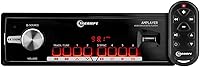
The included long-distance remote is a practical inclusion that buyers appreciate during parking-lot audio checks or when the head unit is mounted in an awkward position. Volume control and source switching from across the car works reliably without needing to reach across the dash.
The remote feels cheap relative to the unit itself, and a few buyers reported response inconsistency at wider angles or longer distances. It's a useful convenience item, but not something you'd want to rely on as your primary control method for daily driving.
LINE OUT Usability
77%
23%
The unamplified LINE OUT is a well-thought-out addition for buyers planning a phased build — getting front speakers running first and adding a subwoofer amp later without rewiring. Buyers who used it this way described the signal handoff as clean and the integration straightforward.
The output level can be hotter than some external amps expect, and Taramps recommends reducing the receiving amp's input gain — a step that's easy to miss and causes distortion if skipped. Buyers who didn't read the documentation carefully hit this issue before diagnosing its source.
Fuse & Protection System
53%
47%
The dual-fuse architecture does provide meaningful protection for the vehicle's electrical system, and buyers who understood how it worked appreciated having a low-power mode available for less demanding setups before committing to the full high-power configuration.
The distinction between the external 15A and internal 20A fuse modes is poorly communicated in the product documentation, and confusion around this system is one of the most commonly cited sources of frustration across buyer feedback. A significant number of buyers triggered protection mode without understanding why.
Compatibility
58%
42%
For vehicles with straightforward wiring — no factory amplification, no CANBUS, no active noise cancellation — the Amplayer 400 slots in without major obstacles. Older domestic vehicles and basic import platforms tend to be the most trouble-free install environments for this single-din hybrid unit.
Modern vehicles with factory-amplified outputs, Bose or Harman systems, or any kind of integrated infotainment architecture are not compatible without significant additional work. Buyers who didn't verify their vehicle's wiring type before purchasing frequently reported incompatibility issues that required a full return.
Documentation & Setup Guidance
37%
63%
The physical unit does include a wiring diagram, and buyers who paired it with third-party installation guides from the car audio community found enough reference material to complete the install successfully. Online resources from Taramps supplement what the box provides.
The included manual is brief, technically sparse, and does not adequately explain the fuse system, wire gauge requirements, or crossover adjustment in plain language. This is arguably the most criticized non-hardware aspect of the product, and several buyers attributed their install problems directly to gaps in the official documentation.
Form Factor & Fitment
83%
Single-DIN fitment is universally straightforward — if your dash has the slot, this unit drops in cleanly without modification. The compact size relative to the power output is a consistent point of praise, especially from buyers building audio systems in smaller cabins or classic cars.
Buyers with double-DIN openings need an adapter pocket, and the unit's depth may be a tight fit in certain dash configurations with limited clearance behind the mounting slot. It's worth measuring your available depth before ordering, particularly in older vehicles with shallow head unit cavities.

Suitable for:

The Taramp's Amplayer 400 Car Stereo Receiver is purpose-built for car audio enthusiasts who want to consolidate their setup without sacrificing real amplification. If you're working with a single-DIN dash opening and don't want to lose trunk space or run lengthy RCA cables to a separate amp, this all-in-one receiver-amp makes a compelling case for itself. It's a strong match for anyone upgrading an older vehicle — a classic car, a work truck, or a bare-bones commuter — where there's no factory amplification to work around and no complex infotainment system to integrate. The built-in LINE OUT also makes it a smart starting point for a modular build: get your front stage sorted first, then add a subwoofer amp later without rethinking your entire install. Buyers who are comfortable running new wire directly from the battery and who understand basic audio concepts like impedance and crossover filtering will get the most out of what this single-din hybrid unit offers.
Not suitable for:

The Taramp's Amplayer 400 Car Stereo Receiver is genuinely not the right tool for every buyer, and it's worth being honest about that. If you're expecting a plug-and-play experience — pulling out your factory head unit and swapping this in with minimal effort — you're likely to run into trouble. The installation requires running dedicated power cable directly from the battery, sizing your wire gauge correctly, and understanding how the dual-fuse system operates; skip any of those steps and the unit will protect itself by shutting down, which frustrates buyers who don't know what triggered it. This all-in-one receiver-amp also isn't suited for vehicles with modern factory systems that rely on amplified speaker outputs or CANBUS integration, since it expects a clean, standard wiring environment. Audiophiles chasing high-fidelity sound with precise DSP control will also find the onboard crossovers too basic for their needs and should look at separating the source unit and amplification into dedicated components.
Specifications

  • Total RMS Power: The unit delivers 400 watts RMS total, split across four channels at 100 watts each when driving 2-ohm loads.
  • Bridge Mode: In bridge mode, the four channels consolidate into two, each capable of 200 watts RMS into a 4-ohm load.
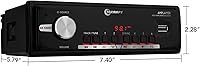
  • Form Factor: Built to fit a standard single-DIN (1-DIN) dash opening, measuring 5.91 × 7.87 × 2.36 inches overall.
  • Weight: The unit weighs 2.2 pounds, making it lightweight relative to traditional standalone amplifiers of comparable output.
  • Bluetooth: Built-in Bluetooth allows wireless audio streaming directly from a paired smartphone or compatible device.
  • FM Tuner: An integrated FM tuner enables over-the-air radio reception without requiring a separate head unit or external tuner module.
  • USB Input: A USB port accepts flash drives for direct audio file playback, supporting common formats used in car audio setups.
  • Auxiliary Input: A standard auxiliary input (3.5mm or RCA) is available for wired connection to external audio sources.
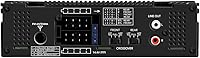
  • Crossovers: Onboard crossover filters include High-Pass (HPF), Low-Pass (LPF), and Full-Range modes for basic speaker-level signal shaping.
  • LINE OUT: The unamplified LINE OUT passes the audio signal to external amplifiers or an active subwoofer without boosting the signal itself.
  • Remote Control: A long-distance remote control is included in the box for managing volume and source selection from the driver seat.
  • External Fuse: An external 15A fuse governs the low-power operating mode and serves as the first line of overcurrent protection.
  • Internal Fuse: An internal 20A fuse protects the high-power mode circuitry and is not user-accessible without opening the unit.
  • Power Cable Spec: Taramps recommends a 4mm² cross-section cable for both the positive and negative battery connections to ensure safe, stable power delivery.
  • ACC & Antenna Cable: The ACC wire and antenna or remote turn-on lead each require 0.75mm² cable gauge for proper low-current signal operation.
  • Color: The unit ships in a single color option: black, with a compact, utilitarian chassis finish.
  • Brand Origin: Taramps is a Brazilian audio manufacturer with an established reputation in the high-output car audio segment across South America and internationally.
  • In the Box: The package includes one Amplayer 400 unit and one long-distance remote control; no speaker wire or power cable is included.

Related Reviews
Philips Single Din Bluetooth Car Stereo
74%
78%
Sound Quality
74%
Bluetooth Performance
83%
AM/FM Reception
67%
Hands-Free Calling
76%
Ease of Installation
More
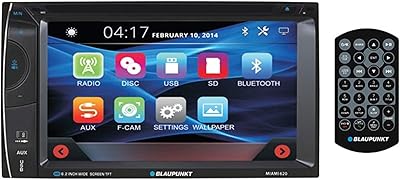
Blaupunkt Miami 620 6.2-inch Car Stereo Receiver
69%
78%
Bluetooth Connectivity
58%
Touchscreen Responsiveness
83%
Value for Money
71%
Ease of Installation
63%
Sound Quality
More
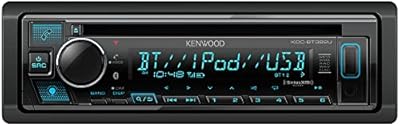
Kenwood KDC-BT382U CD Car Stereo Receiver
75%
86%
Bluetooth Connectivity
83%
Sound Quality
91%
Ease of Installation
78%
Value for Money
63%
Voice Assistant (Alexa)
More
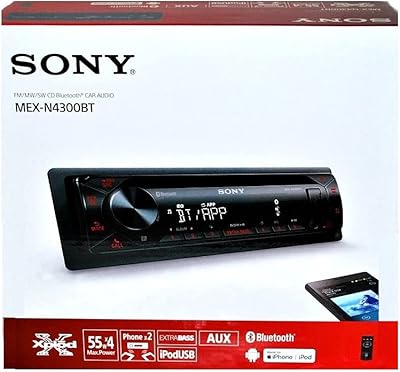
Sony MEX-N4300BT Car Stereo Receiver
78%
88%
Bluetooth Performance
83%
Sound Quality
79%
NFC Pairing
81%
Streaming App Control
74%
Voice Control
More
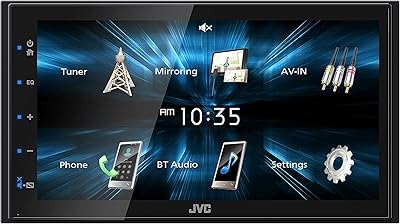
JVC KW-M150BT Bluetooth Car Stereo Receiver
75%
83%
Sound Quality
79%
Touchscreen Responsiveness
86%
Bluetooth Performance
88%
Value for Money
66%
USB Compatibility
More
JVC KW-M180BT Double DIN Car Stereo Receiver
78%
81%
Touchscreen Quality
84%
Bluetooth Performance
73%
Android Integration
88%
Audio Tuning Depth
79%
Value for Money
More
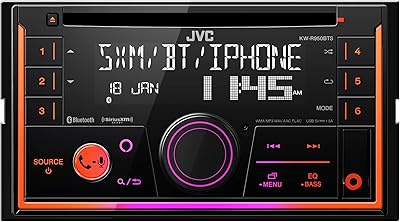
JVC KW-R950BTS Car Stereo Receiver
79%
83%
Sound Quality
86%
Bluetooth Performance
84%
Value for Money
61%
Display Readability
88%
Multi-Device Pairing
More
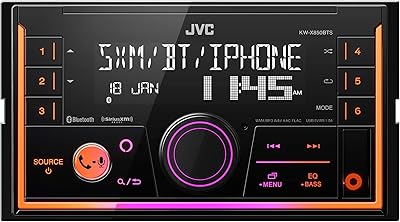
JVC KW-X850BTS
JVC KW-X850BTS
87%
92%
Bluetooth Stability
78%
Voice Assistant Integration
89%
Sound Customization
94%
Device Charging Speed
86%
Display Visibility
More
JVC KW-R940BTS Double DIN Car Stereo Receiver
82%
88%
Bluetooth Performance
91%
Sound Quality
61%
Display Readability
83%
Ease of Installation
87%
Value for Money
More
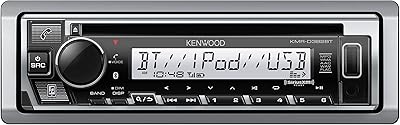
Kenwood KMR-D382BT Marine Car Stereo Receiver
77%
83%
Sound Quality
79%
Weather Resistance
81%
Bluetooth Performance
58%
Display Readability
76%
Ease of Installation
More

FAQ

Yes, for most front-stage setups it genuinely replaces a standalone amp. The four built-in channels can drive a full set of door speakers directly, so if you're not running a subwoofer, you may not need anything else. If you do want to add a sub later, the LINE OUT lets you connect a dedicated subwoofer amplifier without modifying the rest of your install.

It's doable as a DIY project, but it's not beginner-friendly. You'll need to run new power cable directly from the battery — the unit should not tap into your vehicle's existing wiring harness. If you're comfortable with basic car audio installs and understand wire sizing, you can handle it. If this is your first install, budgeting for professional help is a reasonable call.

Nine times out of ten, this comes down to wiring. If the power cable is undersized for the load, or if the ground connection isn't solid, the unit will trip its protection circuit and cut out. Double-check that you're using the recommended 4mm² cable for battery connections and that your ground point is clean bare metal. Also confirm which fuse mode you're running — the external 15A fuse enables low-power mode, while the internal 20A handles higher output.

The external 15A fuse puts the unit in a lower-power operating mode, which is safer for modest installs or when you're not pushing the speakers hard. The internal 20A fuse unlocks higher output and is meant for more demanding setups with proper gauge wiring in place. Most buyers who want the full power of the unit should ensure the internal fuse is intact and focus their attention on getting the external wiring right.

It will work with 4-ohm speakers, but the rated 100 watts per channel is measured at 2 ohms. At 4 ohms, each channel will put out noticeably less power — roughly half in practical terms. That's normal for any amplifier, not a flaw specific to this unit. For most everyday speaker setups at 4 ohms, you'll still have more than enough volume and headroom.

Buyers generally report solid Bluetooth performance once the unit is installed and paired correctly. Short-range dropouts are uncommon in typical use, and pairing a phone is straightforward. Range will depend on your vehicle's interior and whether there are other wireless devices nearby causing interference, but most users don't flag this as a recurring problem.

Yes, that's exactly what it's designed for. The LINE OUT sends an unamplified signal to whatever external amplifier or active subwoofer you connect. Just keep in mind that Taramps recommends reducing the input gain on your external amp when using this output, since the signal level may be higher than what some amps expect by default.

Reception quality is generally decent and draws positive mentions from buyers, though it does depend on your antenna connection. Make sure the antenna lead is properly connected — a loose or missing antenna will significantly hurt FM performance. If your vehicle has a powered antenna, you'll also need to wire the remote turn-on lead correctly so the antenna extends when the unit powers on.

There is a display, but it's minimal — a basic segment or LED-style readout for source information, volume level, and FM frequency. Don't expect a touchscreen or anything resembling a modern multimedia interface. This all-in-one receiver-amp is built around audio performance, not visual features, so the interface is functional rather than fancy.

No, this single-din hybrid unit occupies only a standard single-DIN slot. If your vehicle has a double-DIN opening, you would need a single-DIN adapter pocket or filler panel to mount it properly, which are widely available at car audio shops. The physical footprint of the unit itself is compact, so fitting it into a properly adapted opening is generally straightforward.