Overview

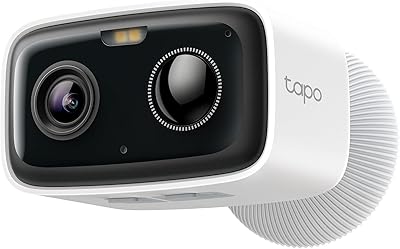
The Tapo C420S2 Wireless Outdoor Security Camera System is a two-camera kit built around a dedicated hub, aimed squarely at homeowners who want capable outdoor surveillance without running a single wire. Each camera runs on a rechargeable battery, and all footage routes through the included Tapo H200 hub rather than connecting directly to your router — an important distinction worth understanding before you buy. The package arrives complete with both cameras, the hub, mounting hardware, and cables, so there is nothing critical left to purchase separately. For the price, it competes respectably against both wired alternatives and other battery-powered systems in the same tier.

Features & Benefits

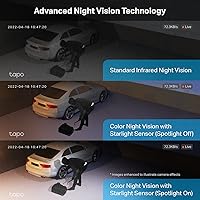
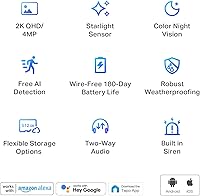
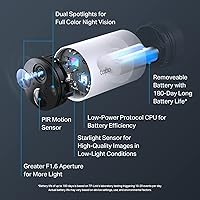
The jump to 2K QHD resolution over older 1080p cameras is genuinely noticeable — faces and license plates hold up well when you zoom into a clip. Low-light performance is a real strength here; the F1.6 aperture and Starlight sensor pull in considerably more ambient light than typical outdoor cameras, and the dual spotlights kick in to render full color rather than the flat grayscale you get from IR-only systems. The AI detection does a solid job separating people, pets, and vehicles from generic motion, which keeps notification fatigue manageable. Built-in two-way audio and a siren round things out for anyone who wants to actively respond rather than just record.

Best For

This wireless security setup suits homeowners who need wire-free flexibility without accepting a significant drop in image quality. If your Wi-Fi signal is inconsistent near the camera locations, the hub-based architecture actually works in your favor since the cameras connect to the hub over a more stable short-range link. Two cameras cover a front door and driveway simultaneously, which handles most standard residential setups cleanly. There is no subscription required for AI detection, which matters for buyers who are tired of paywalled features. Anyone prioritizing local storage over cloud dependency will also appreciate how the system handles footage retention.

User Feedback

Most buyers highlight how straightforward the app setup is and praise the color night vision as performing better than expected for a mid-range system. Reliable motion alerts with relatively few false positives come up repeatedly in positive reviews. On the critical side, the 15fps frame rate is a real trade-off — motion can appear slightly choppy compared to 30fps competitors, and fast-moving subjects suffer for it. Battery longevity varies considerably; the advertised ceiling assumes a quiet environment, not a busy suburban driveway. A handful of users also express frustration with the hub dependency, expecting a simpler standalone Wi-Fi setup. Long-term durability reports are mostly positive, though a small subset notes connectivity issues after extended outdoor exposure.

Pros

  • 2K QHD resolution captures faces and license plates with enough clarity to actually be useful as evidence.
  • Full-color night vision via dual spotlights is a meaningful upgrade over grayscale IR-only cameras.
  • AI detection reliably separates people, pets, and vehicles from generic motion, keeping false alerts manageable.
  • No subscription required for core AI detection or local video storage — a genuine long-term cost advantage.
  • The hub architecture improves camera connectivity in homes with thick walls or weak Wi-Fi near mounting points.
  • Complete out-of-the-box package means no scrambling for missing hardware after unboxing.
  • IP65 weatherproofing holds up well through rain and humidity based on extended real-world use.
  • Alexa, Google Home, and SmartThings integration works reliably without workarounds or third-party bridges.
  • The Tapo app is consistently praised for clean layout and fast live-view access from anywhere.
  • Battery-powered design allows flexible camera placement where wiring would be impractical or impossible.

Cons

  • The 15-to-20fps frame rate makes fast-moving subjects appear choppy — a real weakness versus 30fps rivals.
  • Hub dependency surprises buyers expecting standalone Wi-Fi cameras; placement near a router is non-negotiable.
  • A microSD card for the hub is sold separately — skip it and you have no recorded footage at all.
  • Battery life in active, high-traffic locations falls well short of the advertised 180-day ceiling.
  • Apple HomeKit is unsupported, excluding a significant portion of smart home users from native integration.
  • The hub creates a single point of failure — if it loses connection, all cameras go offline simultaneously.
  • Speaker audio sounds hollow at higher volumes, limiting the practical usefulness of two-way conversation.
  • Plastic housing shows UV discoloration over time in south-facing or high-sun installations.
  • Some users report connectivity degradation after extended exposure in high-humidity outdoor environments.
  • Clip playback inside the app is less intuitive than competing platforms, adding friction when reviewing recorded events.

Ratings

The Tapo C420S2 Wireless Outdoor Security Camera System earns its scores below from an AI-driven analysis of verified global buyer reviews, with spam, bot activity, and incentivized feedback actively filtered out before any scoring took place. Ratings reflect the full picture — where this two-camera kit genuinely delivers and where real users have run into friction — so you can make an informed call before buying.

Video Clarity
88%
Reviewers consistently note that the 2K QHD resolution is a meaningful step up from older 1080p setups — faces captured at a front door or license plates at the end of a driveway hold enough detail to actually be useful. Daytime footage looks crisp and well-exposed across a wide range of lighting conditions.
Some users find that the 15fps frame rate undercuts the high resolution when capturing fast movement — a running person or a vehicle pulling out quickly can appear slightly blurred or choppy in the recorded clip, which is a noticeable limitation compared to 30fps alternatives at a similar price.
Night Vision Performance
91%
The Starlight sensor combined with the F1.6 aperture pulls in far more ambient light than users expect at this price tier, producing cleaner low-light footage without the grainy, washed-out look common in budget cameras. When the dual spotlights trigger, the shift to full-color night footage is a genuine advantage for identifying clothing colors or vehicle details.
The spotlight activation can feel abrupt in quiet neighborhoods, and a few users report that very dark environments beyond the 49-foot IR range result in noticeably degraded image quality. Color accuracy under the spotlights also diminishes at the edges of the frame.
Battery Life
72%
28%
In genuinely low-traffic locations — a side gate, a backyard with minimal movement — users report the batteries lasting several months between charges, which reduces the maintenance burden considerably. The rechargeable setup means no recurring battery replacement costs.
The advertised 180-day figure does not reflect real-world suburban use. Homes with busy driveways or active street-facing cameras see battery levels drop within four to eight weeks, and several verified buyers express frustration that this gap between advertised and actual performance was not clearly communicated upfront.
Motion & AI Detection
84%
The AI classification — separating people, pets, vehicles, and general motion — meaningfully cuts down on nuisance alerts from tree branches, passing headlights, or small animals. Users monitoring a driveway or front walkway find the person-detection alerts reliably accurate under normal conditions.
Detection sensitivity can be inconsistent in certain environmental conditions; some users note missed alerts during heavy rain or when subjects approach from the far edges of the field of view. Occasional misclassification between pets and people also surfaces in feedback, particularly for larger dogs.
Installation & Setup
89%
The out-of-the-box experience is a strong point — everything needed for a two-camera install arrives in the box, and the Tapo app guides users through hub pairing and camera mounting in a straightforward sequence that most buyers complete in under an hour without any technical background.
The hub requirement adds a step that catches some buyers off guard, particularly those expecting to pair cameras directly to their home Wi-Fi like most standalone systems. Finding an appropriate location for the hub near both a power outlet and the router can create placement complications in older homes.
App & Remote Access
83%
The Tapo app receives consistent praise for its clean layout, live view responsiveness, and the ease of setting up activity zones and notification schedules. Remote access over mobile data works reliably for most users checking in while away from home.
A subset of users reports occasional lag in live view during peak hours, and the app's clip playback interface is described as less intuitive than competitors. A few long-term users also note that firmware updates have occasionally required re-pairing cameras to the hub.
Build Quality & Weatherproofing
86%
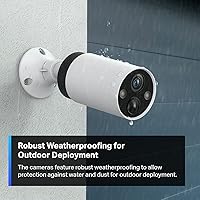
The IP65 rating holds up well in practice — buyers in rainy climates and humid coastal areas report no water ingress issues after extended outdoor deployment. The camera housing feels solid for the price tier, and the mounting bracket does not flex or shift after installation.
The plastic housing shows minor scuffing and discoloration after prolonged UV exposure, particularly in south-facing installations. A small number of users also report that the charging port cover becomes harder to reseal cleanly over repeated charge cycles, raising minor long-term weatherproofing concerns.
Two-Way Audio & Siren
74%
26%
The microphone picks up voices clearly enough for brief exchanges at a front door, and the built-in siren is loud enough to function as a credible deterrent in most residential settings. Push-to-talk activation through the app is fast enough for practical use.
Audio quality on the speaker side is average — voices sound slightly hollow at higher volumes, and wind noise can overwhelm the microphone outdoors. The siren, while functional, is not as piercing as dedicated alarm systems, and some users feel it lacks the authority needed for a genuine intruder scenario.
Smart Home Integration
81%
19%
Alexa and Google Home compatibility works reliably for voice-triggered live view on compatible displays, and the SmartThings integration adds useful automation possibilities for households already invested in that ecosystem. Setup requires no third-party workarounds.
Deeper automation — such as triggering external smart lights or locks based on camera detection events — is more limited than some competing systems. Apple HomeKit is notably absent, which is a dealbreaker for users centered on that ecosystem.
Local Storage & Privacy
87%
The hub-based local storage model is a genuine differentiator for privacy-conscious buyers who do not want footage leaving their home network. No cloud subscription is required to access recordings, which is a meaningful long-term cost advantage over platforms that paywall basic history.
Storage capacity depends entirely on the microSD card inserted into the hub, which is sold separately. Users who neglect this step end up with no recording history at all, and the maximum supported card size limits total retention duration in high-activity environments.
Value for Money
82%
18%
Getting two cameras, a hub, and a full hardware package without a mandatory subscription puts this kit in a favorable position against single-camera competitors at similar or higher prices. The absence of recurring fees for AI detection is a recurring positive across long-term ownership reviews.
Buyers who later discover the hub dependency, the separate microSD card requirement, and the 15fps limitation sometimes feel the value proposition is less clear than it appeared initially. At its price point, a few direct competitors offer 30fps recording, which shifts the perceived value calculation.
Wi-Fi & Connectivity Stability
76%
24%
The hub architecture provides a more stable connection to cameras than direct long-range Wi-Fi in homes with thick walls or signal dead zones near camera mounting points. Users in such environments specifically cite this as a reason they chose this system over competitors.
The hub itself requires a stable wired or Wi-Fi connection to the router, and if that connection drops, all cameras go offline simultaneously — a single point of failure that frustrates users during router reboots or internet outages. Hub placement is more constrained than users anticipate.
Frame Rate
61%
39%
The 20fps mode is adequate for static monitoring scenarios — parked vehicles, package deliveries at a door, or general perimeter checks — where smooth motion rendering is less critical and image resolution takes priority.
Against the growing number of outdoor cameras offering 30fps at comparable or lower prices, the 15-to-20fps ceiling is a real and frequently mentioned weakness. Fast-moving subjects — cyclists, running children, reversing vehicles — appear noticeably choppy in saved footage, which limits evidential usefulness.
Long-Term Durability
78%
22%
The majority of verified buyers who have owned the system for over a year report no hardware failures, consistent app connectivity, and no degradation in camera performance. The brand's firmware update cadence has generally improved stability over time.
A meaningful minority of reviews cite connectivity issues emerging after six to twelve months of outdoor exposure, particularly in high-humidity environments. Battery capacity degradation over many charge cycles is also noted, with some users reporting noticeably shorter runtimes after eighteen months of use.

Suitable for:

The Tapo C420S2 Wireless Outdoor Security Camera System is a strong fit for homeowners who want to cover two entry points — a front door and a driveway, for example — without running power cables or paying for ongoing cloud storage. If your Wi-Fi signal is inconsistent near your intended camera locations, the hub-based architecture actually works in your favor, since cameras connect to the hub over a shorter, more stable link rather than stretching directly to your router. Privacy-conscious buyers will appreciate that AI-powered person, pet, and vehicle detection works without a subscription, and all footage can stay entirely on a local microSD card inside the hub. It also suits renters or anyone in a temporary living situation, since the wall-mount installation is minimally invasive and the entire system is easy to relocate. Households already using Alexa, Google Home, or SmartThings will find the integration straightforward and genuinely functional, not just a checkbox feature.
Not suitable for:

Buyers expecting a simple plug-and-play Wi-Fi camera will likely be caught off guard by the Tapo C420S2 Wireless Outdoor Security Camera System, since every camera in the kit must route through the included H200 hub — there is no option to skip it and connect directly to your router. If you need smooth footage of fast-moving subjects — vehicles accelerating out of a driveway, cyclists, or running individuals — the 15-to-20fps frame rate will be a persistent frustration compared to the 30fps cameras available at similar price points. Anyone covering a high-traffic front yard or busy street-facing property should also temper expectations around battery life; the advertised ceiling assumes a quiet environment, and active locations will require recharging every four to eight weeks. Apple HomeKit users will find no native support here, which is a genuine gap for households built around that ecosystem. Finally, if you need more than two cameras right away, the system's expansion requires additional purchases and hub capacity planning, which adds cost and complexity.

Specifications

  • Resolution: Each camera records at 2K QHD (4MP), delivering noticeably sharper detail than standard 1080p systems for identifying faces and license plates.
  • Frame Rate: Cameras support 15fps and 20fps recording modes; there is no 30fps option, which is worth noting for fast-motion scenarios.
  • Aperture: The F1.6 aperture is among the largest in this camera category, allowing more light to reach the sensor under low-light conditions.
  • Night Vision Range: The built-in 850nm IR sensor provides visibility up to 49 feet in complete darkness, supplemented by dual color spotlights for full-color night footage.
  • Low-Light Technology: A Starlight sensor works alongside the wide aperture to produce cleaner, less noisy footage in dimly lit environments without relying solely on infrared.
  • Field of View: Each camera covers a 113-degree horizontal field of view, suitable for monitoring wide entry points like driveways or front yards.
  • Weatherproofing: The cameras carry an IP65 rating, meaning they are protected against dust ingress and direct water jets from any direction.
  • Battery Life: Manufacturer-rated battery life is up to 180 days per camera, though real-world usage in active environments typically results in four to eight week cycles.
  • Connectivity: Cameras connect via 2.4GHz Wi-Fi to the included Tapo H200 hub, which then links to your home network; direct router pairing is not supported.
  • Local Storage: Video footage is stored locally on a microSD card inserted into the Tapo H200 hub; the card is sold separately and is required for recording history.
  • Audio: Two-way audio is supported via a built-in microphone and speaker on each camera, with a push-to-talk function accessible through the Tapo app.
  • Built-In Siren: Each camera includes an integrated siren and light alarm that can be triggered manually through the app or set to activate automatically on detection events.
  • AI Detection: On-device and cloud-assisted AI classifies detected motion as a person, pet, vehicle, or general movement, reducing irrelevant push notifications.
  • Smart Home Support: The system is compatible with Amazon Alexa, Google Home, and Samsung SmartThings; Apple HomeKit is not supported.
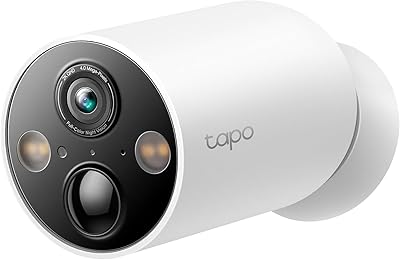
  • Camera Dimensions: Each camera unit measures 4.35 x 2.52 x 2.52 inches (L x W x H) with a cylindrical bullet-style form factor.
  • Camera Weight: Each camera weighs approximately 330g (11.6 oz), which is manageable for standard wall-mount bracket installation.
  • Mounting Type: Cameras mount via a screw-in wall bracket included in the box; no specialty tools beyond a drill and standard screwdriver are required.
  • Package Contents: The kit includes two Tapo C420 cameras, one Tapo H200 hub, mounting brackets, screws, templates, an RJ45 Ethernet cable, USB adapter, USB cable, and a quick start guide.
  • Power Source: Each camera is powered by a built-in rechargeable lithium-ion battery; a USB charging cable is included for recharging without removing the full bracket assembly.
  • Video Format: Recorded clips are saved in MP4 format, which is widely compatible with standard media players and editing software without conversion.

Related Reviews

Tapo C425 MagCam Outdoor Security Camera
79%
88%
Image Clarity
83%
Night Vision Quality
74%
Battery Life
93%
Ease of Installation
71%
App Experience
More
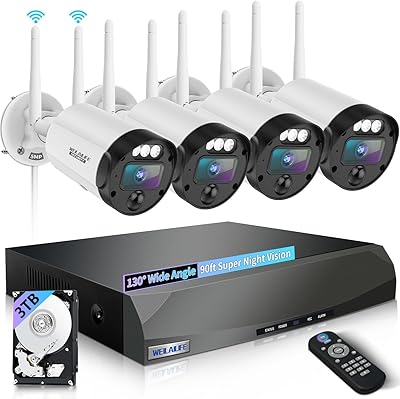
WEILAILIFE 3TB Wireless Security Camera System
76%
93%
Local Storage Capacity
86%
Video Resolution & Clarity
88%
Night Vision Performance
58%
Frame Rate
84%
Ease of Setup
More
ZHXINSD Dual-Lens PTZ 4-Camera Security System 1TB
72%
83%
Image Clarity
79%
Auto-Tracking Performance
71%
Wireless Connectivity
58%
Setup Experience
54%
App Usability
More
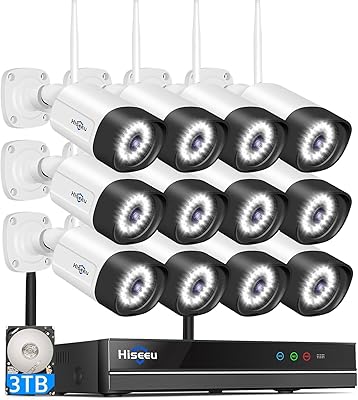
Hiseeu 12-Camera 3TB Wireless Security System
70%
83%
Value for Money
76%
Image Quality
71%
Night Vision
78%
Setup & Installation
58%
App Experience
More
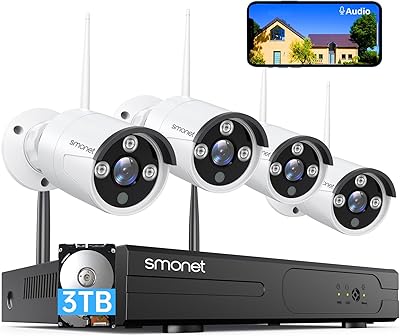
SMONET 8-Channel Wireless Security Camera System with 4pcs 1080P Cameras and 3TB HDD
85%
91%
Value for Money
96%
Ease of Setup
87%
Video Quality
90%
Night Vision Performance
85%
App Usability
More
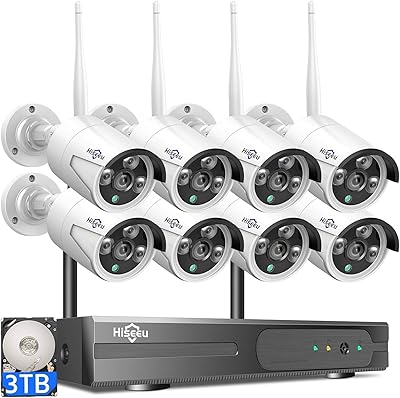
Hiseeu Wireless Pro 4K NVR Security Camera System, 8 Cameras, 3TB Storage
85%
94%
Setup and Installation
88%
Image Quality
92%
Storage Capacity
85%
Motion Detection Accuracy
87%
Night Vision Performance
More
SmartSF Wireless Security Camera System 10CH 5MP NVR with 8 3MP Cameras 3TB HDD
84%
88%
Setup & Installation
91%
Video Quality
89%
Night Vision Performance
83%
Motion Detection
82%
App Experience
More
SmartSF SSF-KV04-US 4-Camera 1TB NVR Security System
77%
88%
Ease of Setup
83%
Image Quality
81%
Night Vision Performance
67%
App & Remote Access
84%
Local Storage & HDD Value
More
OHWOAI CSOH-05SW3MP05 Wireless Security Camera System
74%
83%
Image Clarity
71%
Night Vision
86%
Ease of Setup
54%
Video Smoothness
78%
App Experience
More
Juyivast Q151SP Solar Wireless Security Camera
70%
83%
Value for Money
67%
Solar Performance
78%
Video Quality
71%
Motion Detection
84%
Setup & Installation
More

FAQ

You need the hub — there is no way around it. The cameras exclusively pair to the Tapo H200 hub, which then connects to your home network. It is a different setup than most standalone Wi-Fi cameras, so make sure you have a good spot for the hub near your router before you buy.

No, and that is one of the stronger selling points of this system. AI-based detection for people, pets, and vehicles, along with push notifications, works without any paid plan. You do need a microSD card in the hub to actually save recordings, but that is a one-time purchase with no recurring fee.

Honestly, it depends heavily on how much activity your cameras see. In a quiet backyard with minimal triggers, a few months between charges is realistic. But if a camera is pointed at a busy driveway or a street, expect to recharge every four to six weeks. The 180-day figure in the marketing assumes a low-traffic environment.

Unfortunately, no. The Tapo C420S2 Wireless Outdoor Security Camera System supports Amazon Alexa, Google Home, and Samsung SmartThings, but Apple HomeKit is not on the list. If your smart home runs on HomeKit, this kit is not compatible and you would need to look at other options.
Yes, the Tapo H200 hub supports up to four channels, so you can add up to two more compatible cameras without needing a second hub. Just keep in mind that more active cameras will also draw more on individual batteries, so factor that into your recharging routine.

All recordings are stored locally on a microSD card that you insert into the H200 hub. The card is not included in the box, so you will need to pick one up separately before you have any saved video history. Without a card, you can still view a live feed, but nothing gets recorded.

Live remote viewing through the app will not work without internet, but local recording to the microSD card continues as long as the hub has power. You can review that footage once your connection is restored. The cameras stay connected to the hub itself, so local operation is not interrupted by an internet outage.

It does both, depending on the situation. In very dark conditions with no available ambient light, the 850nm IR sensor kicks in and produces the standard black-and-white night footage. But when the dual spotlights activate — either automatically on motion or manually — the footage switches to full color, which is genuinely useful for identifying clothing colors or vehicle details.

Not at all — this is a wire-free system designed for DIY installation. The cameras mount on a wall bracket using the included screws and template, and the only power involved is the hub's USB adapter into a standard outlet. Most people complete the full two-camera setup in under an hour using just a drill and the step-by-step guide in the Tapo app.

The affected camera will show as offline in the app and stop recording until the connection is re-established. This can happen if the camera is mounted too far from the hub or if there is significant interference. Repositioning the hub closer to the cameras, or reducing obstructions between them, usually resolves it. The other cameras on the hub are not affected by one unit dropping off.