Overview

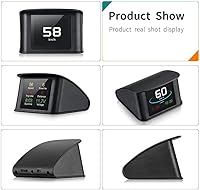
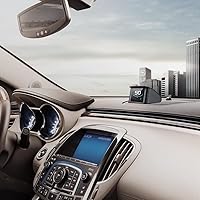
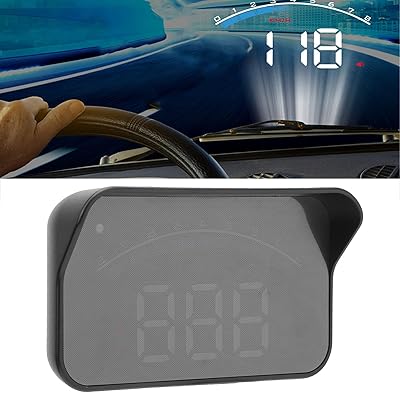
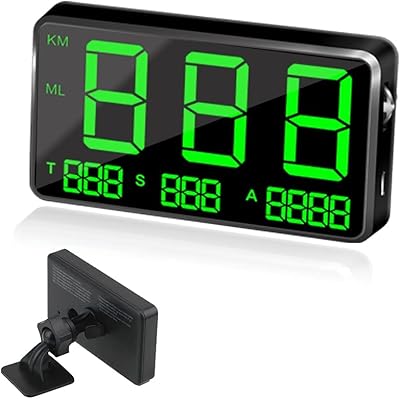
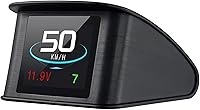
The TIMPROVE T600 GPS Car HUD Speedometer takes a different approach than most head-up displays by relying entirely on satellite data rather than your car's OBD-II port, which means it works in virtually any vehicle — from a 1990s pickup to a brand-new import. The compact polycarbonate unit sits on your dashboard without any windshield film or reflective sticker required. It pulls in speed, heading, altitude, and satellite-synced time, presenting everything on a small color LCD. It is not trying to be a full telematics system. Think of it as a practical, eyes-forward driving companion that costs a fraction of what factory-fitted HUDs typically run.
Features & Benefits

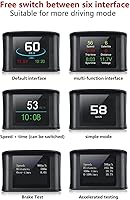
The 2.2-inch TFT LCD panel at the heart of this GPS HUD is small but genuinely readable at a glance, and the multi-color display modes let you dial in contrast for day or night driving. The housing comes pre-angled at 30 degrees, so you are not fiddling with tilt adjustments every time you get in. An overspeed alarm chirps when you cross your set threshold — useful passive accountability on long highway runs. There is also a brake test and speedup function, though these are GPS-estimated readings, not the precision you would get from dedicated diagnostic hardware. Switching between km/h and mph takes a single button press, and the satellite-synced clock keeps trip time accurate without needing your phone.

Best For

This dashboard speedometer makes the most sense for drivers whose cars lack any digital instrument cluster — older vehicles, budget imports, or anything predating OBD-II compatibility. Rideshare and delivery drivers will appreciate a dedicated glanceable speed readout in their peripheral vision instead of propping up a phone. New drivers can lean on the overspeed alert as a quiet habit-builder rather than a punishing alarm. If you enjoy informal performance testing, the speedup and brake metrics give you something to work with on an empty road — just treat those numbers as rough estimates. And if you regularly cross borders or drive rental cars abroad, the flexible unit switching alone makes it worth having on hand.

User Feedback

Buyers consistently praise the plug-and-play setup — there is genuinely nothing complicated about getting the T600 display running, and the universal compatibility claim holds up well for most owners. Where things get more nuanced: GPS lock can take a minute or two on cold starts, and driving through dense urban canyons occasionally disrupts the signal. Screen brightness draws split opinions — on overcast days it looks sharp, but direct afternoon sun can wash it out. Some users also note a slight speed lag versus their physical speedometer, which is expected behavior for any GPS-based device. Long-term, a few buyers mention the mount adhesive losing grip over time. Overall sentiment leans genuinely positive, especially among buyers who went in with realistic expectations.

Pros

  • Works with literally any vehicle — no OBD-II port, no special wiring, no compatibility research needed.
  • Setup takes minutes; just plug in power, place it on the dash, and you are ready to drive.
  • No windshield film or reflective sticker required, keeping your glass clean and unobstructed.
  • The overspeed alert is genuinely useful for highway driving or speed-restricted zones.
  • Switching between km/h and mph is fast and easy, which matters more than it sounds on road trips abroad.
  • Satellite-synced time means the clock is always accurate, even after the battery dies.
  • The fixed 30-degree tilt puts the display in a natural sightline without fussing with adjustments.
  • At its price point, this GPS HUD offers a feature set that would cost significantly more in a factory option.
  • Compact and light enough to move between vehicles in seconds — handy for rental cars or fleet use.
  • The low-voltage alarm adds a small but practical layer of battery health awareness during daily use.

Cons

  • GPS lock on cold starts can take one to two minutes, leaving you without speed data at the beginning of a trip.
  • Screen brightness struggles in strong direct sunlight, making the display hard to read in certain conditions.
  • Speed readings lag slightly behind the physical speedometer, which can be mildly disorienting at first.
  • The brake and speedup test functions produce GPS-estimated figures, not the precise diagnostics serious drivers need.
  • Some users report the adhesive mount loses grip over time, particularly in hot climates where dashboards heat up.
  • Cable management is minimal — the power cord can look untidy depending on your dashboard layout.
  • Signal dropouts in tunnels or dense urban areas cut off all display data temporarily with no fallback.
  • The 2.2-inch screen is small, and users with any degree of vision sensitivity may find it hard to read quickly.
  • There is no companion app or data logging, so trip information is lost once the device powers down.
  • Build materials feel utilitarian; the T600 display does not inspire the same confidence as pricier HUD alternatives.

Ratings

The scores below reflect AI-assisted analysis of verified global buyer reviews for the TIMPROVE T600 GPS Car HUD Speedometer, with automated filtering applied to remove incentivized, bot-generated, and outlier feedback. Each category is scored to honestly represent both what real drivers loved and where genuine frustrations surfaced. Nothing has been smoothed over — the numbers reflect the full picture.

Universal Compatibility
93%
Buyers across a remarkably wide range of vehicles — from aging sedans to motorcycles to imported vans with non-standard ports — consistently report that this GPS HUD just works without any fiddling. The absence of OBD-II dependency is the single most praised aspect, particularly among owners of pre-2000 vehicles who had no other viable HUD option.
A small number of users in very remote areas with weak satellite infrastructure noted longer-than-expected lock times, occasionally stretching beyond three minutes. This is a GPS network limitation more than a device flaw, but it does affect the experience for a specific subset of buyers.
Ease of Setup
91%
The out-of-box experience draws near-universal praise — plug in the power cable, place the unit on the dash, and you are reading data within minutes. Rideshare drivers who move the device between vehicles regularly call it one of the least frustrating gadgets they own, specifically because there are no pairing steps, apps, or calibration routines.
A recurring minor complaint involves the power cable length and routing — in some vehicle layouts, the cord does not reach the cigarette lighter cleanly and ends up draped visibly across the center console. It is a small thing, but it bothers detail-oriented buyers more than the manufacturer seems to have anticipated.
GPS Signal Reliability
67%
33%
On open roads and suburban environments with clear sky visibility, the T600 display locks on quickly and holds signal throughout most journeys without interruption. Drivers who primarily commute on highways or rural roads report consistently stable readings that closely track their physical speedometer under normal conditions.
Signal loss in tunnels, underground parking structures, and dense city centers is a documented and recurring frustration. Some urban commuters report brief but disorienting blackout periods several times per trip, and the cold-start lock delay — sometimes over 90 seconds — means the display is essentially useless for the first stretch of shorter journeys.
Display Readability
71%
29%
In mixed or overcast lighting, most drivers find the color LCD punchy enough to read at a glance without leaning forward or squinting. The multi-color mode selector is a practical touch — switching to a high-contrast white-on-black scheme noticeably improves legibility on cloudy days or in shaded parking structures.
Direct afternoon sunlight is where this dashboard speedometer genuinely struggles; the 2.2-inch screen simply lacks the brightness ceiling to compete with harsh glare. Several buyers in sun-belt climates describe the display as borderline unreadable on clear summer days, which is a meaningful limitation for a device whose primary job is to be seen.
Speed Accuracy
69%
31%
For steady-state highway cruising, the GPS speed reading is close enough to the physical speedometer that most drivers stop noticing any discrepancy after a day or two. Delivery drivers who use it as a reference for staying within speed limits report it serves that function adequately without causing confusion.
The inherent lag in GPS-calculated speed becomes noticeable during active driving — accelerating out of a junction or braking into a roundabout — where the displayed figure can trail real speed by two to four seconds. Drivers who expected real-time precision similar to an OBD-II system consistently express disappointment with this behavior.
Overspeed Alarm
82%
18%
New and younger drivers in particular appreciate having a configurable speed threshold alert that activates passively in the background — it functions as an effective habit-builder for motorway driving without demanding active attention. Several parents who gifted the unit to newly licensed teenagers specifically called out this feature as their primary purchase motivation.
Because the alarm relies on GPS speed rather than actual wheel speed, it can trigger a beat or two late during rapid acceleration, or fail to alert promptly enough when cresting a speed bump in a restricted zone. It works well enough for highway use, but in dynamic urban environments the slight lag reduces its reliability as a precision warning tool.
Speedup & Brake Test
58%
42%
Casual enthusiasts who want rough ballpark figures for their car's 0-to-60 feel or braking distance find these modes entertaining and surprisingly useful for informal comparisons between different vehicles or driving conditions. As a conversation-starter feature at a car meet, it delivers more than the price would suggest.
Anyone expecting OBD-level diagnostic accuracy will be let down fast — these are GPS-derived estimates that can vary meaningfully between back-to-back runs on the same road. The readings are fun for curiosity purposes but lack the consistency and precision that performance-oriented buyers actually need, which makes this feature feel more like a gimmick than a genuine tool.
Mount & Stability
61%
39%
Out of the box, the adhesive pad holds the unit firmly in place on most dashboard surfaces, and the relatively light weight of the device means it does not stress the mount during normal driving or modest cornering. Buyers in temperate climates rarely report mount issues at all.
In hotter climates — or simply during summer months when a parked car's interior can reach high temperatures — the adhesive pad softens and loses grip, causing the unit to slide or tilt. This is the second most common long-term complaint from owners, and several users resort to aftermarket mounting tape or a non-slip pad as a workaround within the first few months.
Build Quality
63%
37%
The polycarbonate housing feels solid enough for everyday use, and the unit does not rattle or creak during normal driving, which matters more than it sounds when the device sits in your direct sightline all day. For its price tier, buyers generally agree the physical construction is acceptable.
The overall material feel is clearly budget-grade — buttons have a shallow, cheap click, and the casing shows light scratches faster than comparable electronics in the same category. Long-term owners occasionally report button responsiveness degrading over eighteen months or more of daily use.
Screen Size & Layout
66%
34%
The compact 2.2-inch footprint is genuinely unobtrusive on the dashboard — it does not block sightlines or feel like a cluttered add-on. Drivers with smaller dashboards or vehicles where space is at a premium specifically appreciate that the unit does not demand real estate.
Some drivers, particularly those over 50 or with any degree of vision sensitivity, find the small screen difficult to parse quickly while moving. When multiple data fields are displayed simultaneously, the individual figures become quite small, and reading anything beyond the primary speed number requires a longer glance than is ideal for safe driving.
Value for Money
84%
The breadth of data this GPS HUD provides at its price point genuinely surprises most buyers — voltage monitoring, altitude, satellite count, and trip distance together constitute a feature set that would cost considerably more if purchased as separate accessories. Buyers who approach it as a utility tool rather than a premium gadget consistently rate it as excellent value.
Buyers who compare it to higher-end HUD alternatives and expect similar brightness, precision, or build quality tend to feel shortchanged. The value calculation only holds when expectations are calibrated to the product's actual market tier — buyers who miss that context leave disappointed despite the device performing exactly as described.
Low-Voltage Alert
77%
23%
The passive battery health alert catches genuinely useful edge cases — several owners report the alarm tipped them off to a failing alternator or a draining auxiliary battery days before they would have otherwise noticed. For drivers who park for extended periods or run accessories while the engine is off, this adds real practical value.
The voltage reading itself is GPS-circuit-derived and not a direct tap into the vehicle's electrical system, so it is not as granular or reliable as a dedicated battery monitor. Users with older vehicles who hoped it would function as a proper diagnostic voltage tool found the readings too approximate for that purpose.
Unit Switching (km/h ∕ mph)
88%
International drivers and expats genuinely love how frictionless this toggle is — a single button press with no menu navigation required. Several reviewers mention it as the feature that keeps them reaching for this GPS HUD over their phone when driving rental cars abroad, particularly across the UK-Europe border.
There is no memory function, so the unit defaults back to a set unit preference each time it powers on rather than remembering the last selection. For drivers who only occasionally need to switch, this is a minor annoyance that adds a small but unnecessary step at the start of certain trips.
Cable Management
54%
46%
The included power cable is functional and reaches the cigarette lighter socket in most standard vehicle layouts without excessive tension. In compact cars with a central console-mounted socket close to the dash, the setup actually looks reasonably tidy with minimal effort.
In larger vehicles — SUVs, vans, trucks — or cars where the power socket is positioned far from the ideal HUD placement zone, the cable run becomes visibly messy and difficult to conceal cleanly. No cable clip or management hardware is included in the box, which feels like an oversight given how directly cable tidiness affects the user experience every single day.

Suitable for:

The TIMPROVE T600 GPS Car HUD Speedometer is a strong fit for anyone whose vehicle simply cannot support an OBD-II-based HUD — think older cars, motorcycles with a dash adapter, or any import that uses non-standard diagnostic ports. Rideshare and delivery drivers get particular value here, since having a dedicated speed readout in the lower field of vision is meaningfully safer than glancing down at a phone mount. New or young drivers can also benefit from the configurable overspeed alert, which nudges awareness without being intrusive. International travelers and expats who regularly switch between metric and imperial systems will appreciate how quickly the unit toggle works. If you just want a clean, low-effort way to add a heads-up speed display to any car without touching your windshield or running diagnostic cables, this GPS HUD covers that job reliably.
Not suitable for:

Drivers expecting real-time precision from the TIMPROVE T600 GPS Car HUD Speedometer should temper expectations — GPS-derived speed readings carry an inherent lag and can lose signal entirely in tunnels, underground car parks, or dense city canyons. Anyone who needs accurate 0-to-60 timing or brake stopping distances for performance purposes will find the satellite-estimated figures too approximate to be useful; that kind of data really requires a dedicated OBD-II tool or a proper track logger. If you drive primarily in direct, intense sunlight — think desert highways or open farmland in midsummer — the 2.2-inch screen may not be bright enough to read comfortably without squinting. Buyers who want a fully integrated HUD experience with real-time engine data, RPM, coolant temperature, or fault codes will need to look at OBD-II-based alternatives. And if long-term build quality and a robust mounting system are non-negotiable for you, this dashboard speedometer may feel underwhelming over an extended period.
Specifications

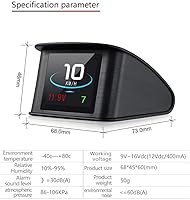
  • Display Size: The unit features a 2.2″ TFT LCD screen that presents driving data in a compact, easy-to-scan format.
  • Display Colors: The screen supports multiple switchable color modes, allowing drivers to adjust contrast and tone for different lighting environments.
  • Signal Source: All data is derived from an internal GPS satellite module — no connection to the vehicle's electronics is required.
  • OBD-II Required: No OBD-II port or vehicle wiring is needed; the device operates entirely independently of the car's onboard systems.
  • Speed Units: Drivers can toggle between km/h and mph at any time using the onboard controls.
  • Tilt Angle: The housing is fixed at a 30-degree angle to position the display within the driver's natural forward sightline.
  • Dimensions: The device measures 3.54 x 2.13 x 0.47 inches, keeping the dashboard footprint small and unobtrusive.
  • Weight: At 5.6 oz, the unit is light enough to stay securely mounted on the dashboard without excessive strain on the adhesive pad.
  • Material: The outer housing is constructed from polycarbonate (PC), a durable and impact-resistant thermoplastic.
  • Model Number: The official model designation is T600, manufactured by TIMPROVE.
  • Vehicle Compatibility: The GPS-based design makes this device compatible with all vehicle makes and models worldwide, including those without OBD-II ports.
  • Windshield Film: No reflective sticker or film needs to be applied to the windshield; the display reads directly on the unit's own screen.
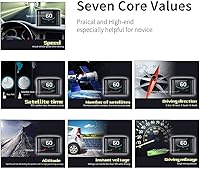
  • Core Functions: Displayed data includes vehicle speed, driving direction, altitude, voltage, trip distance, driving time, satellite count, and a satellite-synced clock.
  • Alarms: Two alert functions are built in: a configurable overspeed alarm and a low-voltage warning to monitor battery health.
  • Performance Tests: The device includes GPS-estimated speedup (acceleration) and brake performance test modes for informal vehicle performance monitoring.
  • Date Available: This product was first made available in July 2018 and remains in active production.

Related Reviews

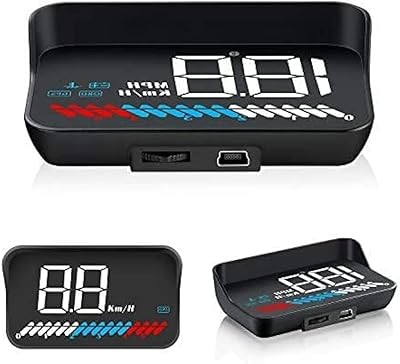
wiiyii G6 Car GPS HUD Display
76%
93%
Ease of Setup
71%
GPS Accuracy
62%
Satellite Lock Speed
69%
Display Readability
81%
Overspeed Alert
More
Liontru 7-Inch Truck GPS Navigator
70%
74%
Truck Routing Accuracy
67%
Map Coverage & Accuracy
78%
Lifetime Map Updates
83%
Screen Size & Readability
61%
Satellite Signal & Lock Time
More
LONGRUF 710 7-Inch Car GPS Navigator
72%
81%
Value for Money
84%
Ease of Setup
61%
Screen Quality
67%
Map Accuracy
79%
Voice Guidance
More
Toothbace 3.5-Inch OBD2 Car HUD Display
70%
91%
Ease of Installation
67%
Display Clarity
72%
Data Accuracy
88%
Value for Money
61%
Build Quality
More
Kingneed C60S GPS HUD Speedometer
75%
93%
Ease of Setup
67%
GPS Speed Accuracy
54%
Daytime Visibility
84%
Nighttime Visibility
58%
Build Quality
More
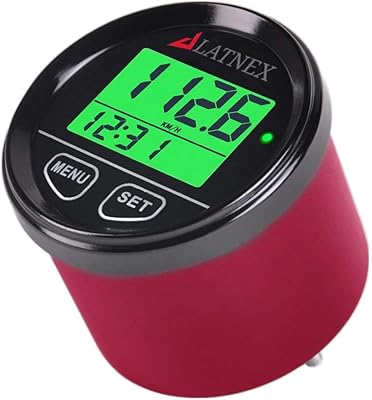
LATNEX SP-GPS95 GPS Speedometer
79%
88%
Ease of Installation
83%
GPS Speed Accuracy
91%
Waterproof Performance
76%
Display Visibility
79%
Voltage Detection Utility
More
Brickhouse Security Spark Nano 7
76%
88%
Battery Life
93%
Ease of Installation
74%
GPS Tracking Accuracy
57%
Subscription Value
68%
App Experience
More
iKiKin M7 Dual Mode Car HUD Display
78%
91%
Ease of Installation
88%
Dual-Mode Versatility
58%
GPS Speed Accuracy
83%
OBD2 Data Accuracy
63%
Screen Visibility
More
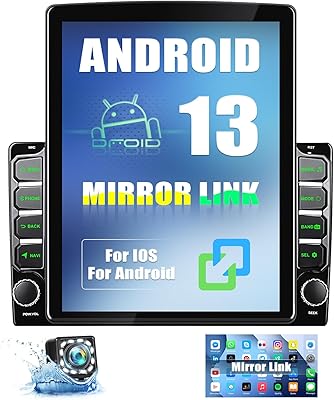
OiLiehu RM 9.7″ Android 13 Car Stereo with GPS and Bluetooth
85%
90%
Ease of Installation
88%
Display Clarity
86%
GPS Accuracy
82%
Sound Quality
72%
Wireless Connectivity
More
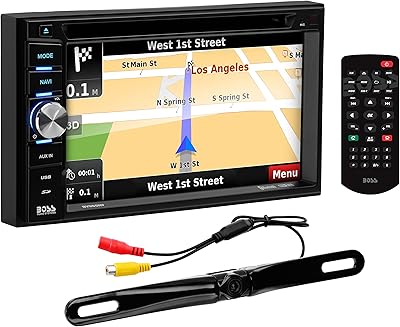
BOSS BN965BLC Double Din Car DVD Receiver
74%
88%
Value for Money
83%
Bluetooth Performance
57%
GPS Navigation
76%
Touchscreen Responsiveness
79%
Installation Experience
More

FAQ

Yes, that is actually one of the main reasons people choose it. The TIMPROVE T600 GPS Car HUD Speedometer uses an internal GPS module for all its data, so it has no dependency on your car's diagnostic port whatsoever. Whether your vehicle is from the 1980s or brand new, setup is the same.
On a cold start — meaning the device has been off for a while or you are in a new location — it typically takes between one and two minutes to lock onto enough satellites to display accurate speed. Once the unit has been used regularly in the same area, subsequent locks tend to be faster.

It is accurate for everyday driving purposes, but there is a small inherent lag compared to your physical speedometer since the reading is GPS-calculated rather than pulled directly from the drivetrain. The difference is usually minor on open roads, but it can feel slightly sluggish during rapid acceleration or braking.

In most lighting conditions, yes — the TFT LCD is reasonably bright and the multi-color modes help with contrast. The one genuine weak spot is intense direct sunlight, particularly in summer on open roads where the sun hits the dash at a low angle. Some drivers reposition the unit or adjust the color setting to compensate.

The alarm triggers when your GPS-detected speed exceeds a threshold you configure through the device's button controls. It is designed as a passive background alert rather than a loud intrusion — useful for staying aware of speed limits on unfamiliar roads or in zones where your attention is divided.

Both functions use GPS data to estimate performance — the speedup test measures how long it takes to reach a target speed, and the brake test logs the distance and time taken to decelerate. These are useful for rough, informal comparisons but should not be treated as precision engineering data. For serious performance testing, a dedicated OBD-II logger will give you more reliable figures.

No. This dashboard speedometer does not require any film, sticker, or adhesive to be applied to your windshield at all. The display sits on the dash and you read it directly, so there is nothing to peel off or clean up later.

The display will lose its GPS signal and freeze or go blank on the speed and direction data until you are back in open sky. This is a fundamental limitation of any GPS-only device and is worth factoring in if you regularly drive routes with long tunnels.

It powers via a 12V car cigarette lighter or USB port depending on the cable included. The wire routing is the one area where setup takes a bit more care — depending on your dashboard layout, the cable can look a bit untidy if you do not tuck it away. It is worth spending five minutes routing it along the edge of the dash for a cleaner look.

This is the most common long-term complaint from owners. Standard dashboard adhesive pads can soften and lose grip when dashboards get very hot — which is a real issue in climates with intense summers or if your car sits in direct sun for hours. A few buyers use additional mounting tape or a non-slip mat as a backup, which tends to solve the problem without any permanent modification.

Where to Buy