Overview

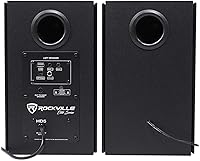
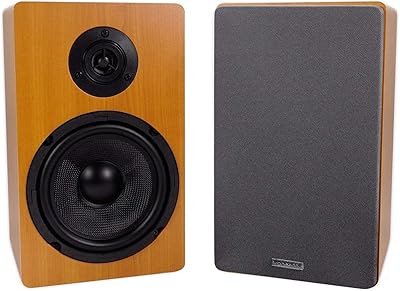
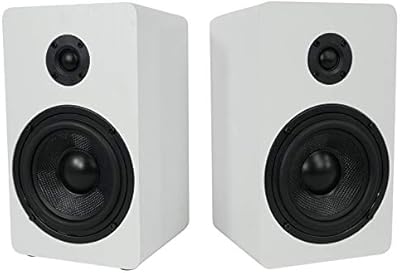
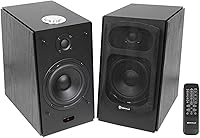
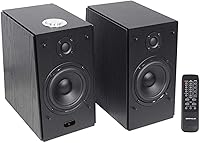
The Rockville HD5B 5″ Bookshelf Speakers are a self-contained stereo system built for anyone who wants real sound without the complexity of a separate receiver. Each cabinet packs a 5-inch woofer and a 0.75-inch silk dome tweeter, powered by a built-in Class D amplifier — so the only cable you truly need is a power cord. The MDF wood-finish enclosures look noticeably more substantial than the flimsy plastic shells common at this price. Out of the box you get a remote, batteries, and an RCA-to-AUX cable, which means most buyers can be up and running in minutes. For a first step into proper home audio, the value proposition is hard to argue with.
Features & Benefits

What separates these powered bookshelf speakers from a basic Bluetooth box is the sheer number of ways you can connect. Bluetooth 4.2 handles wireless from across the room reliably, but the optical and coaxial inputs mean plugging directly into a TV is just as straightforward. Two AUX ports add flexibility for a second device — a turntable preamp, a games console, whatever — without unplugging anything. Four preset EQ modes won't impress audiophiles, but casual listeners will notice a real difference between Music and Movie settings. The 150W RMS rating is the number worth paying attention to; the 600W figure on the box refers to peak output, not what these speakers actually sustain.

Best For

The HD5B pair makes the most sense in situations where simplicity matters. A bedroom TV with no sound system, a dorm desk, a basement gaming setup — anywhere you want decent stereo audio without buying a separate amplifier or receiver. The optical input is particularly handy for TV connections, since most modern sets include one. Cord-cutters who rely on a phone or laptop as their primary source will appreciate how quickly Bluetooth pairing works. These aren't speakers for someone building a serious listening room, but for a first-time home audio buyer ready to move past built-in TV sound or a basic soundbar, they hit the brief very well.

User Feedback

Owners of these Rockville speakers tend to land in one of two camps. The most common praise is about volume — people are genuinely caught off guard by how loud a speaker this size can get. Midrange clarity also draws consistent compliments; TV dialogue and vocals come through without sounding harsh. The criticism, just as consistently, is about bass — these speakers don't go deep, and anyone into bass-heavy music will likely want a subwoofer. The remote feels like an afterthought: cheap plastic, small buttons. Longer-term reliability is also a question mark, with a notable number of buyers reporting one channel dropping out somewhere past the first year.

Pros

  • Surprisingly loud for the cabinet size — volume output consistently catches new buyers off guard.
  • Clean midrange and non-fatiguing highs make long TV sessions and casual listening genuinely comfortable.
  • Optical, coaxial, dual AUX, Bluetooth, and USB inputs cover virtually every source device in one unit.
  • No receiver needed — the built-in amplifier means one box, one power cable, done.
  • MDF wood-finish cabinets look noticeably more substantial than plastic-shelled alternatives at this price.
  • Bluetooth pairing is fast and holds steady across a typical room without dropouts.
  • Four built-in EQ presets offer a practical, no-app way to shift the tonal balance for different content.
  • Auto-switching power supply works on both 110V and 240V — useful for international buyers or frequent movers.
  • Setup takes under ten minutes and the box includes everything needed to get started immediately.

Cons

  • Bass depth is limited — these Rockville speakers struggle with low-frequency weight on music-heavy listening.
  • Adding a subwoofer later to fix the bass gap increases total cost and complicates the simple setup appeal.
  • The included remote feels hollow and cheap, with buttons that lack confidence and a build that does not inspire trust.
  • No optical cable is included despite optical being a headline connection feature — an annoying omission.
  • Long-term reliability is inconsistent; channel dropout issues appear in a meaningful portion of reviews past the one-year mark.
  • USB playback is capped at 16GB, which feels restrictive for users with larger local audio libraries.
  • No subwoofer output limits the upgrade path for buyers who later want to add bass reinforcement.
  • Bluetooth 4.2 is functional but dated — no support for high-resolution wireless audio codecs.
  • The front panel LED indicator has no brightness adjustment and can be distracting in a dark room.

Ratings

The scores below are generated by AI after analyzing thousands of verified buyer reviews worldwide for the Rockville HD5B 5″ Bookshelf Speakers, with spam, bot activity, and incentivized feedback actively filtered out before processing. Ratings reflect real-world usage patterns across home theater setups, desktop listening, and TV audio upgrades — not manufacturer claims. Both the standout strengths and the recurring pain points are weighted transparently into every score.

Sound Quality
74%
26%
For the price tier, midrange reproduction impresses consistently — vocals in movies and TV dialogue come through with clarity and reasonable presence. The silk dome tweeter keeps highs from turning harsh even at higher volumes, which is something buyers in this category frequently struggle to find.
The low-frequency response is the obvious weak link. Bass is present but lacks depth and weight, which becomes noticeable during music with prominent kick drums or bass lines. Buyers expecting full-range sound without a subwoofer are likely to be disappointed.
Volume & Power Output
88%
This is consistently the most praised aspect across buyer reviews. Users in medium-sized rooms report the speakers getting genuinely loud — louder than most people expect from a compact bookshelf pair at this price. Party-level volume in a dorm or bedroom is entirely achievable.
At the upper end of the volume range, some buyers notice a slight compression or hardness in the sound. The 150W RMS figure is for both speakers combined, not each — a distinction worth understanding before comparing against competitors quoting per-channel wattage.
Bass Performance
51%
49%
Bass is serviceable for casual TV viewing and spoken-word content. Users watching news, podcasts, or dialogue-heavy shows rarely flag it as a problem, and the lower midrange does a reasonable job filling in where true sub-bass trails off.
For music listening — especially hip-hop, electronic, or anything bass-forward — the 5-inch woofers simply cannot move enough air to satisfy. A notable share of buyers end up pairing these with a separate subwoofer, which adds cost and somewhat undermines the all-in-one appeal.
Connectivity & Inputs
91%
The input selection is one of the strongest arguments for these powered bookshelf speakers compared to similarly priced alternatives. Optical, coaxial, two AUX ports, Bluetooth, and USB in a single unit covers virtually every common source device a typical home user would own.
There is no dedicated phono input, so vinyl enthusiasts need a separate preamp. The USB port is also capped at 16GB, which feels dated given how cheap high-capacity drives are today — a minor frustration for users with large local music libraries.
Bluetooth Performance
83%
Pairing is quick and reliable in practice. Users streaming from a phone or laptop in an average-sized room report stable connections throughout the rated 33-foot range with no cutting or dropout under normal conditions. The connection holds well even with walls in between.
Bluetooth 4.2 is functional but not current — aptX HD or LDAC support is absent, which matters to buyers who prioritize high-resolution wireless audio. In dense apartment buildings with lots of wireless interference, a small number of users have reported occasional brief dropouts.
Build Quality
69%
31%
The MDF cabinet construction and wood-grain finish give these speakers a look and feel that punches above their price point. Sitting on a shelf or desk, they read more as proper bookshelf speakers than budget electronics, which matters to buyers who care about how a room looks.
The cabinet quality is noticeably better than the accessories. The remote in particular feels flimsy and cheap relative to the speakers themselves, and the buttons lack tactile confidence. A few buyers have also noted that the cabinet finish can scratch more easily than expected.
Ease of Setup
92%
Unboxing to playing audio typically takes under ten minutes. The included cables, pre-installed batteries in the remote, and clearly labeled rear-panel inputs mean most buyers do not need to consult the manual at all. It is one of the more friction-free setup experiences in this category.
The manual is thin and leaves some questions unanswered — particularly around the EQ modes and what the 3D setting actually does to the signal. Users who want to optimize the speakers beyond basic setup may find themselves searching online for clearer guidance.
Value for Money
86%
The core value proposition holds up: buying a receiver plus a passive bookshelf speaker pair that matches this feature set would cost considerably more. For buyers who want one box, one remote, and good-enough sound, the price-to-capability ratio is genuinely strong.
The value calculation softens if you factor in a likely subwoofer purchase to address the bass gap. At that point the total spend climbs, and buyers start bumping into competing systems that offer better integrated sound for a similar combined investment.
Remote Control
44%
56%
The remote works as advertised for basic functions — volume, input switching, EQ mode selection — and the included batteries mean you can use it straight away. For casual couch-distance TV use, the range is adequate.
It is undeniably the weakest physical component in the box. The plastic feels lightweight and hollow, the buttons have almost no travel, and several reviewers mention the remote failing or becoming unresponsive within the first year. It feels like a last-minute inclusion rather than a designed accessory.
Long-Term Durability
58%
42%
Many buyers report their units running without issue for two or more years under regular daily use, which is a reasonable lifespan expectation at this price tier. The Class D amplifier runs cool, which generally works in favor of component longevity.
The durability picture is uneven enough to warrant caution. A statistically notable portion of buyers report one channel going silent or the unit cutting out intermittently somewhere between 12 and 24 months of use. Whether that is a quality-control consistency issue or isolated bad luck is unclear from reviews alone.
Design & Aesthetics
78%
22%
The wood-grain MDF finish is a genuine differentiator at this price point. On a media console or desk, these Rockville speakers look the part — they do not scream budget electronics. The compact footprint also makes placement easy in smaller rooms.
Color and style options are limited, and the front panel LED indicator — while useful for knowing which input is active — has a brightness that some users find distracting in a dark room during late-night viewing. A brightness adjustment would be a welcome addition.
EQ & Sound Customization
67%
33%
Having four named presets built directly into the speakers is a practical feature that most competitors at this price skip entirely. Switching to Movie mode for a film night or News mode for morning news genuinely produces a noticeable and useful tonal shift without touching any app or menu.
Four fixed presets are the ceiling here — there is no parametric EQ, no app control, and no way to save a custom curve. Buyers who like to fine-tune their sound will hit that ceiling quickly, and the presets themselves are fairly broad strokes rather than nuanced adjustments.
Compatibility & Versatility
89%
The combination of auto-switching power supply, multiple digital and analog inputs, and Bluetooth makes these speakers genuinely flexible. They work equally well as a TV speaker, a desktop audio system, or a Bluetooth party speaker, which is a wider use-case range than most single units in this class cover.
There is no subwoofer output, which limits the upgrade path for buyers who later want to add bass reinforcement. Wireless multiroom audio is also not supported — these are a single stereo pair only, with no ecosystem or app to expand into.
Packaging & Included Accessories
72%
28%
The out-of-box experience is more complete than average. Getting a remote with batteries already included and a connection cable in the box means most buyers can set up without a separate trip to the store. The packaging itself is sturdy enough that units typically arrive undamaged.
The RCA-to-AUX cable is useful but only covers one connection scenario. An optical cable is not included despite the optical input being a headline feature — buyers connecting to a TV via optical will need to source that separately, which feels like an oversight given how the product is marketed.

Suitable for:

The Rockville HD5B 5″ Bookshelf Speakers are a strong fit for anyone who wants a noticeable audio upgrade without the complexity or cost of building a traditional stereo system around a separate receiver. They work particularly well in apartments, dorms, or secondary bedrooms where space is tight and simplicity matters more than audiophile precision. If your main goal is better sound from a bedroom TV, the built-in optical input makes the connection clean and straightforward with no extra equipment required. Gamers and streamers who spend long hours at a desk will appreciate having genuine stereo separation and real volume headroom without needing a dedicated amp on the shelf. Cord-cutters and Bluetooth-first users will find the wireless pairing fast and reliable enough for daily use. First-time home audio buyers stepping up from built-in TV speakers or a basic soundbar will likely find the jump in sound quality immediately obvious and satisfying.
Not suitable for:

The Rockville HD5B 5″ Bookshelf Speakers are not the right call for buyers who prioritize deep, room-filling bass in their listening. The 5-inch woofers do a competent job with midrange and dialogue, but anyone who regularly listens to bass-heavy music genres — hip-hop, electronic, or anything with prominent low-end — will find themselves wanting significantly more. Serious music listeners or anyone with trained ears comparing this against higher-end passive setups will notice the ceiling on sound fidelity relatively quickly. The durability track record is also mixed enough that buyers who need reliable daily use over several years without any risk of failure may want to consider options with a stronger long-term service reputation. If you already own a receiver and are simply looking for passive speakers to connect to it, the built-in amplifier here is redundant and you would likely get better acoustic performance by spending the same budget on passive bookshelf drivers alone. Finally, buyers expecting remote control quality to match the speakers themselves will be let down — the included remote feels like an afterthought.
Specifications

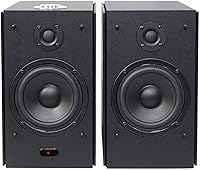
  • Speaker Configuration: The system is a 2.0 stereo pair, with each cabinet housing a 5-inch woofer and a 0.75-inch silk dome tweeter.
  • Power Output: Combined RMS output is 150W across both speakers, with a peak rating of 600W — the RMS figure reflects real sustained listening levels.
  • Amplifier Type: A built-in Class D digital amplifier is integrated into the primary speaker, eliminating the need for a separate receiver or amp.
  • Frequency Response: The speakers reproduce audio from 50Hz to 20kHz, covering midrange and high frequencies well but rolling off before deep sub-bass territory.
  • Bluetooth: Bluetooth 4.2 with Enhanced Data Rate (EDR) provides wireless connectivity up to 33 feet from the source device.
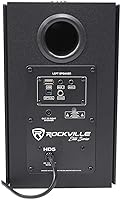
  • Wired Inputs: Available wired inputs include one optical (PCM), one coaxial, two 3.5mm AUX ports, and one USB-A port for local file playback.
  • USB Playback: The USB input supports playback of audio files stored on drives up to 16GB capacity.
  • EQ Presets: Four built-in preset EQ curves — Music, Movie, News, and 3D — are selectable via the remote or front panel controls.
  • Impedance: The woofer carries a 6-ohm impedance rating and the tweeter a 5-ohm rating in each speaker cabinet.
  • Cabinet Material: Both enclosures are constructed from 0.472-inch thick high-grade MDF with a black wood-grain finish on the exterior.
  • Dimensions: Each speaker measures 9.84-inch wide by 10.83-inch tall by 6.38-inch deep.
  • Weight: The combined net weight of both speakers is 13.9 lbs, with a shipping weight of 17.2 lbs including packaging.
  • Power Supply: The unit uses an auto-switching SMPS power supply rated at AC 110V–240V, 50/60Hz, compatible with both North American and European outlets.
  • Signal-to-Noise Ratio: The S/N ratio is rated at 72dB or above, which is adequate for casual listening but below the threshold of high-fidelity audio equipment.
  • Voice Coil: Each woofer uses an aluminum former wound with 100% oxygen-free copper wire for the voice coil.
  • Included Accessories: The package includes a remote control, two AAA batteries, and one RCA-to-AUX cable; an optical cable is not included.
  • Magnet Weight: Each woofer is driven by an 11-oz high-BL magnet, contributing to sensitivity and output efficiency at the rated power level.
  • Warranty: Rockville includes a limited warranty card in the box; buyers should register directly with Rockville for coverage terms and duration.

Related Reviews
Rockville RockShelf 68B V2 6.5″ Bookshelf Speakers
83%
85%
Sound Quality
92%
Value for Money
87%
Build Quality
90%
Ease of Installation
82%
Bass Response
More
Rockville RockShelf 64B V2
75%
83%
Sound Clarity
61%
Bass Performance
74%
Build Quality
88%
Value for Money
79%
Tweeter Quality
More
Rockville RockShelf 68C Classic 6.5″ Home Bookshelf Speakers
85%
89%
Sound Clarity
91%
Build Quality
68%
Bass Response
92%
Value for Money
85%
Ease of Setup
More
Rockville RockShelf 58W 5.25″ Bookshelf Speakers
78%
83%
Sound Clarity
61%
Bass Response
79%
Build Quality
88%
Value for Money
81%
Tweeter Performance
More
Rockville UT65B 6.5″ Marine Speakers
83%
88%
Sound Quality
93%
Waterproof Performance
85%
Build Quality
80%
Installation Ease
76%
Durability
More
Rockville RMSTS65B 6.5″ Marine Speakers
88%
91%
Sound Quality
95%
Durability
89%
Ease of Installation
94%
Waterproof Performance
87%
Bass Response
More
Rockville RockShelf 54B V2
77%
83%
Sound Clarity
61%
Bass Performance
78%
Treble & High-Frequency Response
81%
Build Quality
89%
Value for Money
More
Rockville RSM65B 6.5″ Marine Speakers
85%
88%
Sound Quality
85%
Build Durability
91%
Ease of Installation
87%
Waterproofing Performance
83%
Bass Performance
More
Rockville ROCKBOX 6.5″ 100W Bluetooth Speaker
83%
88%
Sound Quality
91%
Battery Life
84%
Portability
86%
Build Quality
89%
Ease of Use
More
Rockville RVL6KIT 6.5″ Component Car Speakers
84%
88%
Sound Clarity
80%
Bass Performance
94%
Ease of Installation
86%
Build Quality
92%
Value for Money
More

FAQ

No — that is the main point of the design. The amplifier is built directly into the primary speaker, so you just plug into power, connect your source (TV, phone, laptop), and you are ready to go. No separate receiver required.

Yes, and it is one of the more practical things about the HD5B pair. If your TV has an optical output — which most sets made in the last ten years do — that is the cleanest connection. You can also use an AUX cable from the TV headphone jack or the coaxial input if your TV supports it.

Honestly, if bass is a priority for your listening, these Rockville speakers will probably leave you wanting more. The 5-inch woofers handle midrange well, but they cannot reproduce deep low-end convincingly on their own. Many buyers in your situation end up adding a separate subwoofer, which works fine but adds to the total cost.

Most buyers report solid, reliable pairing within the rated 33-foot range. In typical home environments — a living room, bedroom, or desk setup — dropouts are uncommon. In dense apartment buildings with heavy wireless congestion, a small number of users have noted occasional brief interruptions, but that is not a widespread complaint.

That figure is a peak power rating, not what the speakers actually run at during normal use. The number you should pay attention to is 150W RMS, which represents the combined sustained output across both speakers. Peak figures in budget audio marketing are routinely inflated and are not a reliable comparison point.

Both speakers need to be connected to function. This is an active-passive pair — one cabinet houses the amplifier and handles the signal processing, while the second speaker connects to it via the included speaker wire. Neither operates independently.

The auto-switching power supply covers both 110V and 240V at 50 or 60Hz, so they will work in Europe, the UK, Australia, and most other regions without a voltage converter. You may need a plug adapter for the local outlet shape, but no power transformer is required.

Yes, both AUX ports are physically present on the rear panel simultaneously, and you can have two devices plugged in at once. You switch between them using the input selector on the remote or the front panel button. Only one input plays at a time, but it saves you from unplugging anything when you switch between devices.

The remote handles the essentials — volume, input switching, EQ preset selection, and power — but do not expect much in terms of build quality. Buyers consistently describe it as lightweight and plasticky. It works, but it is clearly not a premium accessory. Some users report it becoming unreliable after extended use.

Unfortunately, no — there is no dedicated subwoofer output on the rear panel. If you want to add a sub, your best option is to use a subwoofer that accepts a speaker-level input and tap into the existing speaker connections, or use a subwoofer with its own line-level input fed from one of the AUX outputs if your sub supports that configuration. It is a workable workaround, but not as clean as having a dedicated output.