Overview

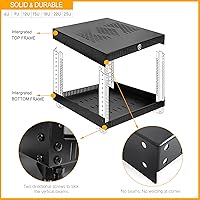
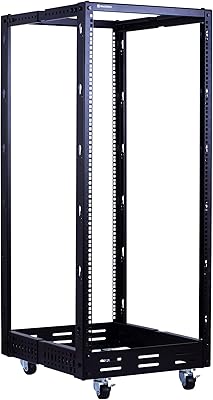
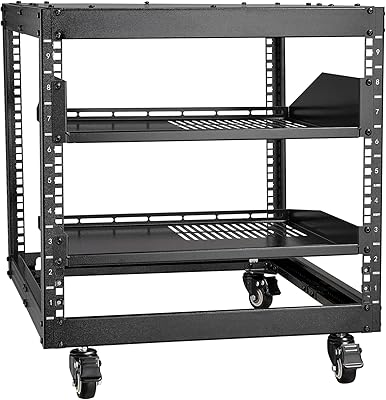
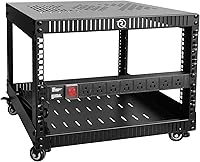
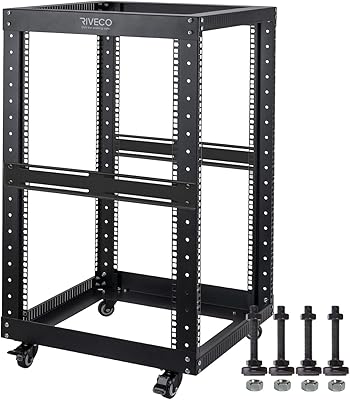
The RIVECO 6U Open Frame Network Rack is a compact, floor-standing rack built for home labs, small offices, and AV setups that need organized gear without dedicating half a room to it. It takes a hybrid approach — reinforced vented top and bottom plates give it more structure than a bare-bones open frame, while still letting air move freely around your equipment. The alloy steel frame handles serious weight, though for most home-lab builds you will never stress it. It ships as a complete kit with casters, leveling feet, cage nuts, and an 8-outlet PDU included, which puts it ahead of many competitors at a similar price point.
Features & Benefits

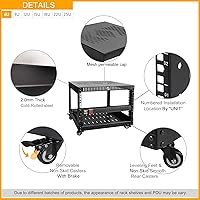
The rail system is one of the more practical details on this open-frame rack. One rail side has round holes designed for standard 10-32 screws — the type used by most audio interfaces, preamps, and AV equipment. Flip to the other side and you get square holes for M5 and M6 screws, which is what most switches, patch panels, and 19-inch network gear require. So if you are mixing a guitar preamp with a network switch in the same rack, it actually works without adapters. The four rolling casters make repositioning easy, while the leveling feet give you a solid, wobble-free base when the rack is staying put. At 19.7″ wide and 21.7″ deep, it fits standard rackmount gear comfortably.

Best For

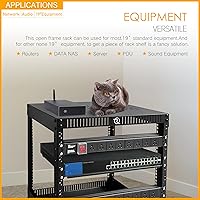
This rack unit is a natural fit for anyone assembling their first home lab on a budget. Think: a small managed switch, a patch panel, maybe a NAS — all neatly stacked in a corner of your home office without sprawling across the floor. Musicians and podcasters will also find it useful; the compact footprint handles a signal processor, a preamp, and a power conditioner without taking up much real estate. The wheeled base is a real convenience if your setup is not permanent — rolling the rack out to access rear cabling saves a lot of frustration. RIVECO also offers larger sizes in the same line, so if your gear list grows, upgrading is straightforward.

User Feedback

Across 74 reviews, this open-frame rack holds a 4.3-star average — and reading through the feedback, the pattern is consistent. Buyers appreciate how complete the package feels right out of the box, and the assembly process draws almost no complaints. The dual hole pattern gets specific praise from people mixing audio and network gear, which suggests it solves a real pain point. On the downside, the included PDU draws mixed reactions — it is functional for initial setup, but several buyers swapped it out for a higher-quality strip over time. There are also notes about slight caster wobble under heavier loads, and a few users found the depth limiting for full-size 1U servers.

Pros

  • Ships as a genuinely complete kit — casters, leveling feet, cage nuts, and a PDU are all in the box.
  • Dual-rail hole pattern accommodates both AV and network gear without adapters or workarounds.
  • Compact footprint fits easily in a home-office corner, closet, or studio without dominating the space.
  • Rolling casters make rear-cable access easy without fully unracking equipment.
  • Bolt-together assembly is beginner-friendly and typically done in under an hour.
  • Reinforced vented plates add structural rigidity while still allowing passive airflow around gear.
  • Part of a scalable product line, so sizing up later does not mean switching brands entirely.
  • At this price tier, the all-in cost undercuts most branded alternatives once accessories are factored in.
  • The alloy steel frame handles typical home-lab loads with no flex or creaking under normal use.

Cons

  • The included PDU feels like a temporary fix — most buyers replace it within a few months.
  • Casters wobble noticeably under heavier builds; leveling feet are the better choice for loaded racks.
  • 21.7-inch depth gets tight with full-depth servers or patch panels running thick rear cables.
  • 6U fills up faster than expected once shelves, a PDU, and patch panels are all counted in.
  • Rail labeling is minimal, which creates guesswork for first-time builders about which side uses which screw type.
  • Some units arrived with missing cage nuts or hardware bag inconsistencies, requiring a quick parts sourcing fix.
  • The powder-coat finish shows uneven application around welds under close inspection.
  • No side panels or cable management channels means rear wiring can look chaotic without extra organization effort.
  • Leveling feet have limited adjustment range, making perfectly level installs tricky on uneven or older floors.

Ratings

The RIVECO 6U Open Frame Network Rack scores here reflect AI-driven analysis of verified buyer reviews from multiple global markets, with spam, bot submissions, and incentivized feedback actively filtered out. Ratings cover everything from structural integrity to the quality of included accessories, giving you an honest read on where this rack unit excels and where it falls short. Both the genuine strengths and the real-world frustrations buyers have reported are transparently baked into every score.
Build Quality
81%
19%
The alloy steel frame feels solid for its size and price class. Buyers running a switch, patch panel, and NAS report no flex or creaking under normal load, and the reinforced top and bottom plates add meaningful rigidity compared to bare-rail open frames at similar price points.
A handful of users noted the frame corners had minor sharp edges straight out of the box, requiring a quick file-down before safe handling. The steel gauge, while adequate for home-lab loads, would not satisfy anyone planning to push close to the rated capacity long-term.
Assembly Experience
88%
Most buyers describe the build process as genuinely straightforward — bolt-together construction with labeled hardware bags and a clear instruction sheet means even first-time rack builders get it done in under an hour without calling in a favor. No power tools needed.
A few reviewers noted the instruction sheet lacks detail for the caster-to-leveling-foot swap, which can cause confusion if you decide to change the base configuration after the initial build. Nothing a YouTube search cannot fix, but it should not require one.
Included Accessories
76%
24%
Shipping with casters, leveling feet, cage nuts, assembly screws, and an 8-outlet PDU in the same box is a real convenience, particularly for beginners who do not yet have a parts drawer full of rack hardware. For a first build, you genuinely need very little else to get started.
The PDU is the weakest link in the bundle. Multiple buyers treat it as a temporary placeholder and swap it out within a few months. It powers gear fine for basic use, but the build quality and outlet spacing do not inspire long-term confidence for anything mission-critical.
Mobility & Casters
74%
26%
The four rolling casters make a real practical difference when your rack lives in a home office or studio and you need to access rear cabling without fully unracking gear. Buyers who move equipment between rooms specifically call out this feature as a time-saver.
Under heavier builds, several users reported noticeable wobble on the casters, particularly on uneven flooring. The consensus is to use the leveling feet for anything approaching a fully loaded rack — the casters are best suited for lighter, more mobile setups.
Rail Hole Pattern
86%
The dual-pattern rails — round holes on one side for audio gear using 10-32 screws, square holes on the other for network equipment using M5 or M6 screws — solve a real problem for anyone mixing AV and IT hardware on the same rack without needing adapters or workarounds.
The labeling on the rails is minimal, so new users sometimes have to reference the manual or online guides to confirm which side handles which screw type. Not a dealbreaker, but clearer stamping would remove any guesswork during a first build.
Airflow & Ventilation
79%
21%
The vented top and bottom plates allow passive airflow to move through the rack reasonably well for a compact 6U unit. Buyers running a NAS alongside a switch report no unexpected heat buildup during normal operation in a ventilated room.
Being an open-frame design, this rack offers no active cooling and no side panels to direct airflow in any controlled way. In warmer climates or poorly ventilated rooms, dense builds may still run warm, and buyers should not expect the ventilation design alone to compensate for a hot environment.
Depth & Fit for Equipment
68%
32%
At 21.7 inches deep, the rack handles most 1U switches, patch panels, and audio gear without issue. For the majority of home-lab and AV use cases, standard shallow-to-mid-depth equipment fits comfortably with room for cable management at the rear.
A noticeable minority of buyers flag that deeper 1U servers and patch panels with bulky rear cable runs push the usable depth to its limit. If your gear list includes full-depth servers or you plan on serious structured cabling, this rack unit will feel tight.
Stability on Leveling Feet
84%
With leveling feet installed on a flat surface, the rack sits rock-solid. Buyers who committed to a permanent install location consistently report zero movement or wobble, even when firmly mounting and unmounting gear during upgrades.
The leveling feet adjustment range is somewhat limited, which means on noticeably uneven floors — common in older buildings or basements — getting all four feet perfectly planted can take more fiddling than expected.
Value for Money
83%
For what you get in the box at this price tier, the value proposition is hard to argue with. Comparable branded racks often ship without a PDU or casters, meaning the all-in cost of a competing setup frequently ends up higher once you source the missing accessories separately.
Buyers who prioritize long-term durability or plan to scale beyond a light home-lab build may find the savings less compelling. The PDU replacement cost and potential caster upgrade eat into the perceived value over time for more demanding use cases.
Footprint & Space Efficiency
82%
18%
At under 20 inches wide and just over 17 inches tall with casters, this rack fits in corners and closets where larger units simply cannot go. Home-office buyers consistently praise how little floor space it claims relative to the amount of gear it organizes.
The 6U capacity is genuinely tight if your gear list grows. Buyers who started with two or three devices and added accessories over time often found themselves looking at the larger RIVECO models within a year, so planning ahead matters.
Aesthetic & Finish
72%
28%
The matte black powder coat finish looks clean in a home office or studio setting without drawing attention to itself. It photographs well enough that a few buyers mention using it as visible background in streaming and podcast setups.
The finish is functional rather than refined. Under close inspection, some buyers noted uneven coating around welds and mounting holes. It holds up to normal use without chipping, but anyone placing this in a visible, design-forward space may wish the finish were more consistent.
Compatibility with Standard Gear
87%
Standard 19-inch rackmount gear — switches, patch panels, audio interfaces, 1U power conditioners — drops in without any fitment surprises. The rails align correctly with industry-standard hole spacing, so adapters are rarely needed for typical home-lab or AV equipment.
Non-standard or oddly proportioned gear occasionally requires shimming or creative mounting. A small number of buyers noted that certain rack shelves from third-party brands did not align cleanly with the square-hole rails, requiring minor adjustment.
Packaging & Shipping Protection
77%
23%
The majority of buyers received their unit intact with no bent rails or damaged hardware. The packaging uses foam corner inserts and a cardboard inner structure that does a decent job protecting the frame through standard carrier handling.
A small but consistent group of reviewers reported arriving hardware bags with missing cage nuts or a single missing caster bolt. Nothing that cannot be sourced cheaply, but it adds a small friction point to what should be a smooth unboxing and build experience.

Suitable for:

The RIVECO 6U Open Frame Network Rack is a strong fit for anyone building a compact, organized gear setup without wanting to spend hours sourcing individual parts. Home lab enthusiasts who need a tidy home for a small managed switch, a patch panel, and a NAS will find the 6U capacity more than enough to get started, and the rolling casters make it practical in spaces where the rack might need to shift periodically. Musicians and podcasters who rack-mount audio interfaces, preamps, or signal processors will appreciate the dual-rail design — one side handles the screw type common to most AV gear, the other handles the standard used by network equipment, so mixed builds actually work without adapters. Small home-office setups on a budget benefit especially from the all-in-one packaging: the included PDU, casters, leveling feet, and hardware mean the total cost of getting up and running is lower than buying a bare rack and sourcing accessories separately. If you are building your first rack and just want something solid, functional, and ready to assemble in an afternoon, this is a sensible place to start.
Not suitable for:

The RIVECO 6U Open Frame Network Rack is not the right tool for buyers who need to house full-depth 1U servers or run dense structured cabling through the rear — at 21.7 inches deep, the usable space gets tight quickly once thick patch cables and power runs are factored in. Anyone planning a production environment, a growing small business server room, or a build that will push close to maximum load should look elsewhere; the casters show wobble under heavy configurations, and the frame, while solid for home use, is not engineered for enterprise-grade punishment. The included PDU is genuinely adequate for getting started, but buyers who need reliable, long-term power distribution for sensitive equipment will almost certainly want to replace it, which adds cost that should be factored into the decision upfront. Open-frame designs also offer zero protection from dust, accidental contact, or cable interference — if your rack is in a shared space, a workshop, or anywhere with heavy foot traffic, a closed-cabinet solution is a more practical choice. Finally, anyone with more than six rack units of gear already in hand should skip this model entirely and size up within the same product line rather than trying to make it fit.
Specifications

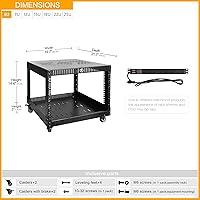
  • Rack Units: This rack provides 6U of usable mounting space, suitable for housing a small switch, patch panel, NAS, or audio gear in a compact floor-standing form factor.
  • Rail Width: Rails are spaced to the industry-standard 19-inch width, ensuring compatibility with standard rackmount equipment from most major networking and AV brands.
  • Depth: The rack measures 21.7″ from front rail to rear rail, accommodating most shallow-to-mid-depth 1U and 2U equipment comfortably.
  • Width: Overall external width is 19.7″, keeping the footprint narrow enough to fit in home-office corners, studio alcoves, or small server closets.
  • Height: With casters installed, the total height is 17.4″; switching to leveling feet reduces the height slightly for a lower, floor-anchored profile.
  • Weight: The assembled rack weighs 29.3 lbs, light enough for one person to move and position during initial setup.
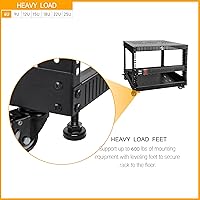
  • Max Load (Feet): When secured with leveling feet on a flat surface, the rack supports up to 500 lbs of mounted equipment.
  • Max Load (Casters): With casters installed for mobile use, the rated load capacity is 400 lbs of rack-mounted equipment.
  • Material: The frame and rails are constructed from alloy steel with a black powder-coat finish for corrosion resistance and durability under normal indoor use.
  • Hole Pattern: Rails feature a dual hole pattern: round holes on one side accept 10-32 screws standard to most AV and audio equipment, while square holes on the other side accept M5 and M6 screws used by most network and IT gear.
  • Top & Bottom Plates: Both the top and bottom plates are reinforced and vented, providing structural rigidity while allowing passive airflow and offering a flat surface for lightweight items.
  • Included PDU: One 8-outlet PDU power strip is included in the box, providing basic power distribution for initial rack setup without requiring a separate purchase.
  • Casters: Four rolling casters are included and allow the rack to be repositioned without unracking equipment; they lock to prevent unintended movement.
  • Leveling Feet: Four adjustable leveling feet are included as an alternative to casters, designed to anchor the rack to the floor and eliminate wobble under heavier loads.
  • Hardware Kit: The package includes all necessary cage nuts, assembly screws, and mounting hardware required to complete the build and mount standard rackmount equipment.
  • Model Number: The manufacturer model number for this unit is CAOFCO5506, which can be used to verify compatibility or source replacement parts.
  • Color: The rack is finished in matte black, giving it a clean, neutral appearance that suits home offices, studios, and small server closets.
  • Availability: This product was first listed in November 2022 and is not discontinued, with the manufacturer offering multiple size variants ranging from 6U up to 25U in the same product line.

Related Reviews
RIVECO 18U Open Frame Server Rack
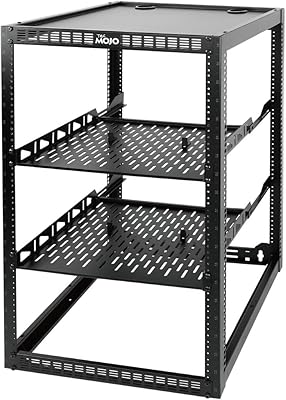
84%
89%
Build Quality
91%
Ease of Assembly
87%
Durability
88%
Mobility and Stability
84%
Versatility for Different Equipment
More
Tecmojo 20U Open Frame Network Rack
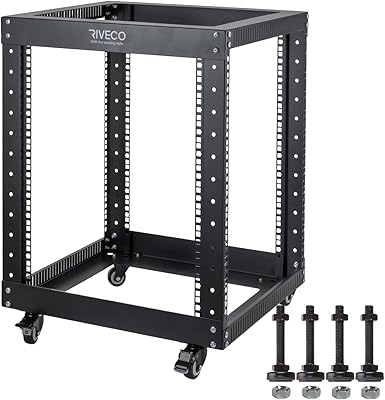
84%
91%
Durability
88%
Weight Capacity
87%
Ease of Setup
89%
Build Quality
90%
Versatility (Mounting Options)
More
RIVECO 12U Server Rack Open Frame with Casters
85%
89%
Build Quality
93%
Ease of Assembly
85%
Weight Capacity
88%
Mobility with Casters
82%
Durability of Finish
More
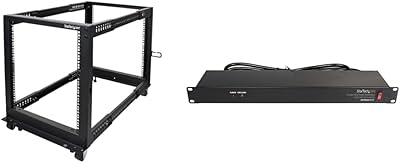
StarTech.com 12U Open Frame Server Rack & 8 Outlet Rack Mount PDU
86%
92%
Build Quality
89%
Ease of Assembly
88%
Power Distribution
90%
Surge Protection
84%
Adjustable Depth
More
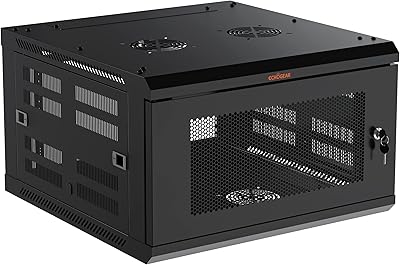
ECHOGEAR 6U Enclosed Wall Mount Network Rack
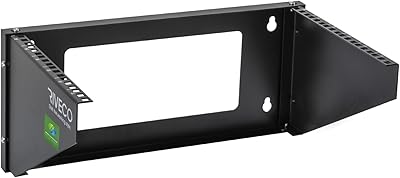
82%
88%
Build Quality
91%
Value for Money
83%
Cooling Performance
84%
Installation Experience
72%
Capacity & Space Utilization
More
RIVECO 6U Wall Mount Rack
87%
91%
Build Quality
87%
Ease of Installation
93%
Space Efficiency
88%
Weight Capacity
89%
Durability
More
Eastrexon 15U Open Frame Server Rack
75%
76%
Build Quality
68%
Assembly Experience
82%
Rack Compatibility
71%
Caster & Mobility
88%
Value for Money
More
VEVOR 9U Open Frame Server Rack
83%
91%
Build Quality & Durability
89%
Assembly Ease
88%
Weight Capacity
87%
Flexibility & Versatility
85%
Portability & Mobility
More
RackPath 25U Open Frame Server Rack
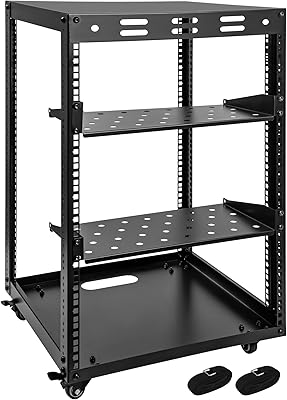
86%
89%
Build Quality
93%
Weight Capacity
85%
Ease of Assembly
88%
Mobility and Casters
91%
Cable Management
More
RIVECO 3U Wall Mount Rack for Network Equipment
86%
89%
Ease of Setup
91%
Build Quality
85%
Mounting Versatility
92%
Space Efficiency
87%
Weight Capacity
More

FAQ

For most basic setups, everything you need is in the box: casters, leveling feet, cage nuts, assembly screws, and an 8-outlet PDU. If you are mounting gear that requires specific cage nuts beyond what is included, you may need extras, but the average home-lab or AV build is covered without an additional parts order.

One rail side has round holes designed for 10-32 screws, which is the standard used by most audio interfaces, preamps, and AV equipment. The other side has square holes for M5 and M6 screws, which most network switches, routers, and patch panels use. Check what screw type your gear requires before you start mounting, and orient accordingly — using the wrong side means your screws will not seat properly.

The included PDU works fine for getting up and running, and most buyers use it without issues in the short term. That said, a recurring theme in user feedback is that it feels like a budget component — the outlet spacing is a bit tight and the build quality is basic. If you are powering sensitive or expensive gear, budgeting for a better PDU at some point is a reasonable plan.

On casters, some wobble is reported when the rack is heavily loaded, particularly on slightly uneven floors. If your build is going to be fully loaded or permanent, install the leveling feet instead — they anchor the rack firmly and eliminate the movement. Casters are best for lighter, more mobile setups where you need to reposition the rack occasionally.

It depends on how deep your server is. The usable internal depth is around 21.7″, which works for most shallow and mid-depth 1U gear. Full-depth enterprise servers that run 28″ to 30″ deep will not fit, and even mid-depth servers leave limited room for rear cabling if you have a lot of patch cables running out the back.

Most buyers report getting the rack fully assembled in 30 to 60 minutes. You need basic hand tools — a screwdriver and possibly a wrench — but nothing specialized. The instruction sheet covers the main steps, though the caster-to-leveling-foot configuration swap is not explained in great detail, so leaving a little extra time for that step is wise.

Yes, the rails conform to the standard 19-inch rackmount specification, so equipment from Netgear, Ubiquiti, APC, and most other major brands will mount without issues. Just confirm whether your gear uses 10-32 or M6 screws so you use the correct rail side.

Yes, the reinforced vented top plate is designed for this. It is flat and sturdy enough to hold a laptop, a small projector, or a router that sits outside the rack. Just avoid placing anything heavy or unstable on top, and keep in mind that the venting below does mean small items could theoretically fall through if they are very small.

Yes, RIVECO offers the same open-frame rack design in larger sizes — 9U, 12U, 15U, 18U, 22U, and 25U — so you can size up without switching to a different brand or mounting ecosystem. The design language and accessory compatibility are consistent across the lineup.

As an open-frame design, it does not offer any dust protection — everything is exposed. In dusty environments or workshops, gear will accumulate dust faster than it would in a closed cabinet. For cable management, there are no built-in cable channels or velcro points, so most buyers add their own cable ties or a dedicated management panel to keep the rear wiring tidy.