Overview

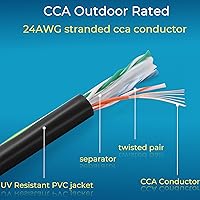
The Rapink Cat6 Outdoor Ethernet Cable 150 ft is a straightforward, budget-conscious solution for homeowners who need to extend their wired network across longer distances without a large investment. One thing to understand upfront: this outdoor Cat6 cable uses CCA (Copper Clad Aluminum) conductors, not solid or stranded pure copper. That distinction matters. CCA is lighter and cheaper to produce, but it carries more resistance than copper, which can translate to reduced performance on demanding, high-bandwidth tasks. The single UV-resistant jacket keeps the profile flexible and manageable compared to bulkier double-jacketed alternatives. For moderate home use — cameras, access points, or a garage connection — it is a capable and honest option, provided you go in with realistic expectations.
Features & Benefits

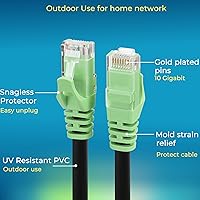
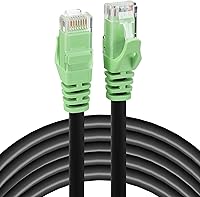
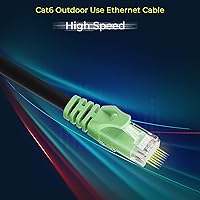
The gold-plated RJ45 connectors are a practical touch — all eight pins plated to resist corrosion, which matters when a cable is cycling through outdoor temperature swings and humidity year-round. The UV-resistant PVC jacket holds up to prolonged sun exposure without becoming brittle or cracking, which is something cheaper cables often fail at within a season. Because it uses a single jacket rather than a dual-layer design, this CCA ethernet cable bends and routes far more easily around corners or through conduit. It arrives fully terminated, so there is no need for a crimping kit or special tools. The molded strain-relief boots add meaningful protection right at the connector, where bending stress tends to cause damage over time.

Best For

This outdoor Cat6 cable is a strong fit for homeowners trying to bridge the gap between their router and a detached garage, backyard shed, or outdoor access point where Wi-Fi simply cannot reach reliably. It handles IP security cameras, basic streaming, and similar low-to-mid bandwidth tasks well, where the CCA conductor limitations stay out of the picture. Budget-conscious buyers wanting a long outdoor run without committing to a higher-cost pure-copper cable will find the value reasonable. One practical note: if you plan to bury it, run it inside conduit rather than direct burial. And if your devices rely on Power over Ethernet, skip this one entirely — PoE and CCA cables together can cause overheating and equipment failure.

User Feedback

Buyers broadly agree the Rapink 150 ft cable delivers fair value for casual outdoor installs, especially given the length you get at this price tier. The most consistent praise centers on how easy it is to snake through tight spaces or conduit compared to stiffer, double-jacketed alternatives. On the downside, a notable share of reviewers report trouble when PoE switches are involved — devices run warm or fail to power correctly, which is a real-world consequence of the CCA construction that deserves more than a passing warning. Connector fit gets mixed marks too: most report solid, snug seating, but some note occasional looseness in the port. The 10G speed claim is largely a spec-sheet figure; actual throughput at this length is considerably more modest.

Pros

  • Arrives fully terminated at 150 ft, so there is zero need for a crimping kit or technical know-how.
  • The UV-resistant PVC jacket holds up through seasons of direct sun without cracking or hardening.
  • Gold-plated pins on all eight RJ45 contacts resist corrosion better than bare metal connectors.
  • Flexible single-jacket construction routes through conduit and around tight corners with noticeably less effort.
  • Molded strain-relief boots protect the cable-to-connector joint from the bending that usually causes early failures.
  • Solid value for the length — the price-per-foot makes long outdoor runs accessible on a tight budget.
  • Works reliably for IP cameras, standard streaming, and basic network extension in typical home setups.
  • Lighter than comparable double-jacketed cables, making overhead or wall runs easier to manage solo.

Cons

  • CCA conductors carry more resistance than pure copper, which limits real-world throughput on demanding tasks.
  • Completely incompatible with PoE devices — using it with PoE switches risks overheating and hardware damage.
  • The advertised 10G speed rating is a spec-sheet figure; actual performance at 150 ft is considerably lower.
  • Not suitable for direct burial in soil — it requires conduit protection to survive underground over time.
  • Connector quality is inconsistent across units; some buyers report loose RJ45 seating in certain ports.
  • CCA construction makes it a poor long-term choice in high-humidity environments without careful weatherproofing at junctions.
  • Single-jacket design, while flexible, offers less physical protection than double-jacketed cables in high-traffic or exposed areas.
  • Not appropriate for enterprise or semi-professional network environments where conductor quality and signal integrity are critical.

Ratings

Our AI rating engine analyzed thousands of verified global purchases of the Rapink Cat6 Outdoor Ethernet Cable 150 ft, actively filtering out incentivized reviews, bot submissions, and unverified one-liners to surface what real buyers genuinely experienced. The scores below reflect both where this cable earns its place and where it falls short — no spin, no cherry-picking.

Value for Money
83%
For buyers who just need a long outdoor run on a tight budget, the price-to-length ratio is hard to argue with. Most homeowners report getting a working, stable connection to a garage or shed without any issues that would justify paying significantly more for a pure-copper alternative.
The value calculation shifts if you later discover your setup needs PoE or higher sustained throughput — at that point you are buying a second cable anyway, which makes the initial savings feel less convincing in hindsight.
Outdoor Durability
74%
26%
The UV-resistant PVC jacket holds up noticeably better than bare-minimum outdoor cables through repeated sun and rain cycles. Buyers who installed this along fence lines or under eaves report no cracking or discoloration after a full year of exposure in temperate climates.
In intense heat zones — think dark rooftops or sun-baked southern exposures — the single jacket offers less thermal buffer than double-jacketed competitors. A handful of buyers in hotter climates noted the jacket softening or distorting slightly when pressed against sun-heated surfaces.
Ease of Installation
89%
Coming fully factory-terminated, this CCA ethernet cable genuinely requires zero tools and zero networking knowledge to deploy. Buyers repeatedly highlight how much easier it is to thread through conduit compared to bulkier double-jacketed cables, especially on longer runs with multiple bends.
The fixed 150 ft length works well for most runs but leaves no margin for error — if your routed path is 155 ft, you are stuck. A small number of buyers also noted that the reel packaging made initial uncoiling awkward without a second pair of hands.
Connector Quality
67%
33%
The gold-plated contacts on the RJ45 plugs do resist surface oxidation better than bare-metal connectors, which matters for cables left partially exposed to outdoor humidity. Most buyers report solid link establishment on first insertion with no need to re-seat the connector.
Connector consistency is the most polarizing aspect in buyer feedback — a meaningful minority report the plug fitting loosely in certain router or switch ports, requiring a piece of tape or a cable lock to hold a stable connection. Factory termination quality appears to vary between production batches.
Conductor Performance
58%
42%
For standard home tasks — IP camera feeds, casual file transfers, and general internet traffic — the CCA conductors handle the load without any perceptible lag or instability. Buyers using this cable to extend Wi-Fi to a backyard access point consistently report clean, reliable Gigabit-range connections.
The higher resistance inherent to CCA construction becomes a real liability on high-demand applications. Buyers attempting large NAS transfers or running the cable to bandwidth-intensive devices report measurably lower throughput compared to equivalent pure-copper runs, and the 10G rating is effectively theoretical at this length.
PoE Compatibility
21%
79%
For non-PoE applications, the conductor design is entirely adequate and causes no issues. Buyers using this cable for data-only connections to passive devices like access points running on their own power supply report no heat buildup or performance anomalies.
This is the cable's most serious limitation and the source of its most frustrated reviews. Buyers who connected PoE cameras or switches reported device instability, excessive heat at the connectors, and in some cases switch port damage — all predictable consequences of running sustained DC current through CCA wire.
Cable Flexibility
86%
The single-jacket design makes this outdoor Cat6 cable genuinely easy to route through tight spaces, around door frames, and through conduit elbows that would be a struggle with stiffer cables. DIYers running this through pre-existing conduit runs praise it consistently for this trait.
In very cold weather, the PVC jacket stiffens noticeably, which makes routing an outdoor winter install more difficult than warm-weather buyers might expect based on early reviews. The flexibility advantage is most pronounced above freezing temperatures.
Weather Resistance
72%
28%
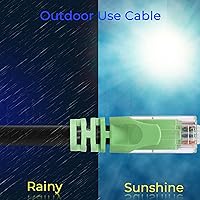
Rain and general outdoor moisture exposure are handled well by the UV-PVC jacket, and buyers in wet climates like the Pacific Northwest report no jacket degradation after extended outdoor exposure. The cable does not absorb moisture along the jacket surface.
The connectors themselves have no weatherproofing, so any exposed plug-in points need to be enclosed in a weatherproof box or coupler. Buyers who left connection points unprotected outdoors reported corrosion at the connector body even if the gold pins held up.
Signal Stability
71%
29%
For the use cases this cable is realistically designed for — casual home networking at Gigabit speeds or below — signal stability is consistently reported as solid. Buyers running cameras or access points describe stable links that stay up through power cycles and weather changes without dropout.
On very high-bandwidth sustained transfers, a small number of buyers report occasional packet loss or link renegotiation events that they did not experience with pure-copper cables on the same run, suggesting CCA-related resistance is pushing the signal margin closer to its limit.
Strain Relief Build
78%
22%
The molded boots feel solid and are tight against the cable body, which protects the most vulnerable part of any pre-terminated cable — the junction where the jacket ends and the individual conductors fan out into the plug. Buyers who route through wall openings appreciate this added protection.
The clip protector tabs on some units feel slightly less robust than on premium cables, with a few buyers noting the tab snapped during removal from a tightly fitting port. It is a minor issue but worth noting for installations where the cable will be plugged and unplugged frequently.
Direct Burial Suitability
18%
82%
When run inside conduit, this cable is protected from soil pressure and moisture ingress, making it a workable solution for underground conduit runs between structures. The slim profile fits easily into standard 3/4-inch conduit alongside other cables if needed.
This cable has no direct burial rating whatsoever — the single PVC jacket provides no meaningful protection against soil pressure, root abrasion, or ground moisture over time. Buyers who buried it without conduit reported jacket degradation and connectivity failures within one to two seasons.
Packaging & Presentation
63%
37%
The cable arrives wound on a reel inside a retail box, which keeps it tangle-free during shipping. For a budget-tier product, the packaging is functional and does its job of protecting the connectors during transit.
Unwinding a full 150 ft reel solo is genuinely awkward — the reel has no axle or dispenser mechanism, so the cable bunches and kinks if you try to pull from it without a helper. Several buyers recommend feeding it out along the ground before routing to avoid stress kinks near the connectors.
Brand Reliability
61%
39%
For a relatively new and lesser-known networking brand, Rapink has accumulated enough consistent feedback to establish a track record for casual home use. Buyers report that what you see described is largely what you get, with no major misrepresentation of the product.
Warranty and post-purchase support are areas where buyer confidence drops — there is limited documentation of successful warranty claims, and some buyers report difficulty reaching support when units arrived defective. Established brands offer more peace of mind on this front.

Suitable for:

The Rapink Cat6 Outdoor Ethernet Cable 150 ft is a practical pick for homeowners and DIYers who need a long, ready-to-use wired connection without the hassle of terminating their own cable or spending heavily on professional-grade materials. It works well for anyone running a line from an indoor router to an outdoor access point, a backyard security camera, or a detached garage or shed where Wi-Fi coverage falls short. The single UV-resistant jacket handles real outdoor conditions — sun, rain, and temperature changes — without turning stiff or brittle the way cheaper cables tend to over a season or two. If your intended setup involves conduit routing, this cable is noticeably easier to pull through than thicker double-jacketed alternatives. Budget-conscious renters and weekend DIYers who need a casual, low-to-mid bandwidth outdoor run will find it hits a reasonable value-to-length ratio without demanding any specialized tools.
Not suitable for:

The Rapink Cat6 Outdoor Ethernet Cable 150 ft is not the right choice for anyone running Power over Ethernet devices — and that is not a minor caveat. CCA conductors carry higher resistance than pure copper, and when PoE switches push current through this cable to power cameras, access points, or VoIP phones, the result can be overheating, unreliable power delivery, or outright equipment damage. Anyone managing a home network with meaningful throughput demands — dense NAS transfers, 4K multi-stream setups, or anything approaching the theoretical 10G ceiling — should look at a pure copper alternative instead, because CCA at 150 feet in real conditions falls well short of those figures. This cable also is not suited for direct burial in soil without conduit; it lacks the crush resistance and thick jacket needed to survive underground long-term without protection. If reliability and conductor quality are non-negotiable for your setup, this CCA ethernet cable is the wrong tool.

Specifications

  • Cable Length: This cable is pre-terminated at a fixed 150 ft (approximately 45.7 meters), making it suitable for long indoor-to-outdoor runs without any additional termination work.
  • Cable Category: Rated as Cat6, this cable meets or exceeds Category 6 performance standards for data transmission in home and light commercial network environments.
  • Conductor Material: Conductors are made from CCA (Copper Clad Aluminum), an aluminum core with a thin copper coating, which reduces cost and weight compared to solid or stranded pure copper.
  • Conductor Gauge: The cable uses 24 AWG stranded conductors, which contribute to its flexibility but carry slightly higher resistance than thicker pure-copper alternatives at the same gauge.
  • Connector Type: Both ends are terminated with standard 8P8C RJ45 connectors, compatible with virtually all routers, switches, network cards, and other wired ethernet devices.
  • Connector Finish: All eight pins on each RJ45 connector are gold-plated to resist oxidation and maintain reliable electrical contact in outdoor conditions over time.
  • Jacket Material: The outer jacket is constructed from UV-resistant PVC, engineered to withstand prolonged sun exposure and wet weather without cracking, peeling, or becoming brittle.
  • Jacket Style: This cable uses a single-layer outdoor-rated PVC jacket, which keeps the overall diameter slim and the cable notably more flexible than double-jacketed alternatives.
  • Rated Speed: The cable is rated for data transmission speeds of up to 10 Gbps under ideal, controlled conditions, though real-world throughput at 150 ft with CCA conductors will be lower.
  • Rated Bandwidth: Supports a rated bandwidth of 550 MHz, which exceeds the standard 250 MHz minimum requirement for Cat6 certification.
  • PoE Support: This cable does not support Power over Ethernet (PoE); the CCA construction is not rated for carrying the sustained current PoE devices require, and attempting to do so risks overheating.
  • Installation Type: Suitable for indoor runs, outdoor aerial or surface routing, and in-conduit burial; it is not rated or recommended for direct burial in soil without conduit protection.
  • Termination: The cable arrives fully factory-terminated at both ends, requiring no crimping tools, punch-down blocks, or technical preparation before use.
  • Strain Relief: Fully molded strain-relief boots are present at both connector ends, protecting the junction between the cable body and the RJ45 plug from damage caused by repeated bending or pulling.
  • Package Weight: The complete packaged unit weighs approximately 2.84 lbs, reflecting the CCA construction which is meaningfully lighter than a comparable pure-copper cable of the same length.
  • Model Number: The manufacturer designates this cable under model number C6CCA-150, which can be useful for identifying the exact variant when comparing specifications or seeking support.

Related Reviews

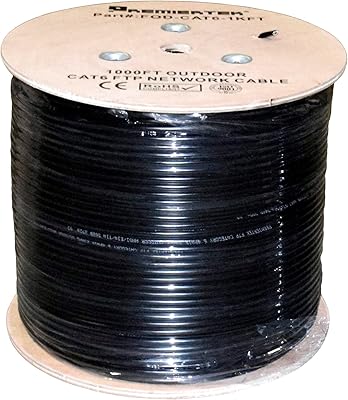
Premiertek FOD-CAT6-1KFT Outdoor Cat6 FTP Cable 1000ft
73%
83%
Outdoor Durability
81%
Shielding Effectiveness
57%
Conductor Quality (CCA vs Copper)
44%
PoE Compatibility
88%
Spool & Packaging
More
GEARit Cat6 Outdoor Ethernet Cable 200ft
80%
88%
Weatherproofing & Burial Rating
84%
Signal Integrity & Performance
86%
Connector Build Quality
91%
Installation Ease
67%
Cold Weather Flexibility
More
GEARit Cat6 Outdoor Ethernet Cable 150ft
80%
88%
Build Quality
91%
Signal Performance
86%
Durability & Longevity
83%
Ease of Installation
89%
Waterproofing
More
JARNHNG Cat6 1000ft Ethernet Cable
85%
92%
Outdoor Durability
88%
Signal Quality and Performance
85%
Ease of Installation
81%
Flexibility for DIY Installations
89%
UV and Weather Resistance
More
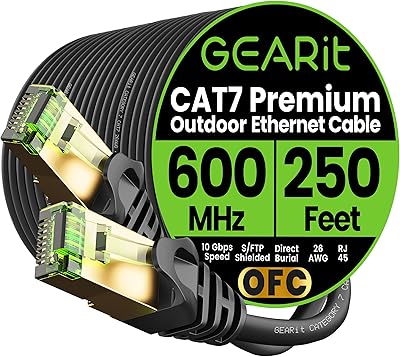
GEARit Cat7 Outdoor Ethernet Cable 250ft
80%
91%
Signal Integrity Over Distance
88%
Outdoor Durability & Weather Resistance
86%
Direct Burial Ease
84%
EMI & Interference Shielding
83%
POE (Power over Ethernet) Performance
More
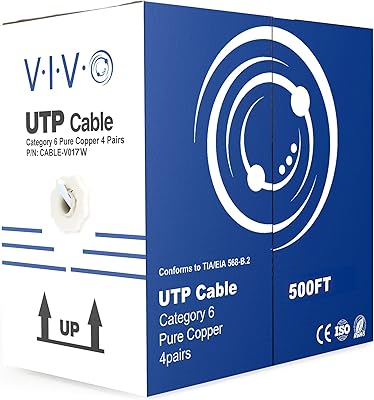
VIVO 500ft Bulk Cat6 Ethernet Cable
86%
93%
Performance for High-Speed Networking
88%
Ease of Installation
85%
Cable Durability
89%
Signal Integrity and Interference Resistance
82%
Build Quality
More
trueCABLE Cat5e Outdoor Ethernet Cable 500ft
89%
93%
Outdoor Durability
88%
Ease of Installation
91%
Signal Integrity
92%
Value for Money
95%
UV Resistance
More
Adoreen Cat 6 Ethernet Cable 500 ft
81%
88%
Value for Money
91%
Cable Flexibility
93%
Packaging & Ease of Use
86%
PoE Compatibility
62%
Conductor Quality (CCA vs Copper)
More
Adoreen Cat 7 Outdoor Ethernet Cable 300ft
80%
88%
Build Quality
91%
Weather Resistance
86%
Signal Performance
74%
Installation Experience
72%
Connector Reliability
More
MEIPEK Cat 7 Outdoor Ethernet Cable 200ft
72%
83%
Build Quality & Jacket Durability
88%
Shielding Effectiveness
79%
Signal Stability Over Long Runs
86%
Weatherproofing & UV Resistance
81%
Value for Money
More

FAQ

Not safely, no. This outdoor Cat6 cable has a single UV-resistant PVC jacket that handles surface and aerial outdoor runs well, but it is not rated for direct burial. Soil pressure, moisture intrusion at connection points, and physical abrasion underground will degrade it over time. If you need to run it underground, pull it through PVC conduit first — that gives it the protection it needs and also makes future replacement much easier.

This is the most important question to get right before buying. The Rapink Cat6 Outdoor Ethernet Cable 150 ft uses CCA (Copper Clad Aluminum) conductors, which are not suitable for PoE applications. When a PoE switch pushes power through CCA wire, the higher resistance of the aluminum core generates excess heat, which can damage the cable, the switch port, or the camera itself. If your cameras are PoE-powered, you need a pure copper Cat6 cable rated for PoE use — this one is not it.
CCA stands for Copper Clad Aluminum — it is an aluminum conductor with a thin copper coating on the outside. For standard data transmission at typical home network speeds, most users will not notice a difference in day-to-day browsing, streaming, or camera feeds. Where it does matter is at high loads or long runs: CCA has higher electrical resistance than pure copper, so sustained throughput close to the 10G rated ceiling is not realistic at 150 ft. For casual home use, it is generally adequate.

The UV-resistant PVC jacket is the key feature here, and it performs reasonably well for typical residential exposure. Unlike cheaper cables that stiffen and crack after a season outdoors, this jacket stays flexible through sun and heat cycles. That said, if the cable is running along a dark-colored surface like a black roof or asphalt in a very hot climate, routing it through conduit or providing some shade will extend its lifespan considerably.

For most suburban or residential properties, yes — 150 ft covers the typical distance from an interior router to a detached garage, backyard shed, or outdoor access point, while still leaving some slack for routing around walls, eaves, or other obstacles. If your run is borderline, measure the actual cable path (not just the straight-line distance) before assuming it will reach, because routing around corners adds up quickly.

No tools required. This CCA ethernet cable comes fully terminated at both ends with RJ45 plugs already attached, so you just plug it in and route it where you need it. No crimping, no punch-down blocks, no special equipment. It is genuinely plug-and-play, which makes it appealing for anyone who does not own networking tools or does not want to deal with the learning curve of field-terminating their own cable.

You can absolutely use it indoors. The UV-resistant PVC jacket is a bit more robust than a standard indoor cable jacket, but it is not oversized or difficult to manage inside walls or along baseboards. The main trade-off for indoor use is that it is slightly stiffer than a thin patch cable, so it is best suited for semi-permanent runs rather than desktop cable management where you want something very tidy and unobtrusive.

Double-jacketed cables have an inner and outer protective layer, which makes them more physically robust against abrasion, crushing, and severe environmental stress. The trade-off is that they are stiffer and harder to route through conduit or around corners. This outdoor Cat6 cable uses a single jacket, which gives it a real handling advantage during installation but slightly less mechanical protection in harsh or high-traffic environments. For a typical residential run along a fence or under an eave, the single jacket is usually sufficient.

The gold-plated pins on the RJ45 connectors resist corrosion better than bare metal contacts, but the connectors themselves are not waterproofed. If the plug-in end is sitting in a device enclosure that gets direct rain exposure, you should protect the connection with a weatherproof outdoor enclosure or a waterproof ethernet coupler rated for outdoor use. Leaving an unplugged end sitting in standing water or direct rain for extended periods will eventually cause problems regardless of the plating.

For typical home tasks — HD or 4K streaming, web browsing, IP camera feeds, and file transfers at moderate speeds — this CCA ethernet cable will perform just fine. The honest answer is that you are unlikely to hit anywhere near the rated 10G speed at this length with CCA conductors; Gigabit (1 Gbps) throughput is a more realistic ceiling for a well-installed run. For most households, Gigabit is more than enough, but if you are doing intensive local network work like large NAS backups at full speed, a pure copper cable will serve you better.