
Overview

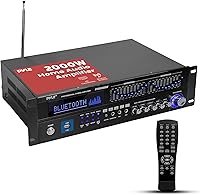
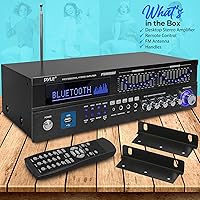
The Pyle PT6060CHAE is a rack-mount home amplifier that arrived in late 2020, pitched squarely at home theater builders and karaoke fans who want a lot of inputs without spending heavily. It runs six channels with a 5.1 surround configuration and advertises 2000W peak power — though that peak figure deserves a skeptical eye, since real-world continuous output will be considerably lower. A VFD front-panel display gives it a semi-professional look, and the combination of Bluetooth streaming, FM radio, and a long list of wired connections makes this rack amplifier genuinely versatile for a single-chassis unit at this price tier.

Features & Benefits

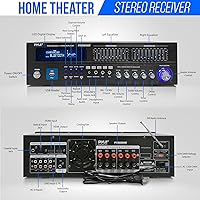
The connectivity on this home theater amp is one of its strongest selling points. Nine separate inputs cover USB, AUX, optical, coaxial, HDMI, AC-3, DVD, and dual microphone jacks — an unusual combination at this price. A dual 10-band equalizer gives real control over tone shaping for both music and karaoke, which is more granular than most competitors offer here. Bluetooth pairs without fuss for wireless streaming, and the built-in cooling fan means you can install it in a rack enclosure without worrying about heat buildup. Front-panel controls handle mic volume, echo, treble, bass, and master volume all in one place.

Best For

This rack amplifier makes the most sense for two distinct audiences. Karaoke enthusiasts get dual mic inputs with independent echo and volume controls, which most stereo receivers simply do not offer. On the home theater side, anyone assembling a multi-source basement or entertainment room will appreciate having optical, coaxial, HDMI, and DVD inputs all in one box — no external switching required. The rack-mount design with handles is not just cosmetic; it allows permanent installation in a media rack, which genuinely matters for setups where a clean, fixed configuration is preferable to another box sitting loosely on a shelf.

User Feedback

With over a thousand ratings and a score of 3.9 out of 5, the Pyle receiver earns a solid but honestly mixed verdict. The karaoke crowd tends to be the most satisfied — dual mic capability at this price is hard to find elsewhere, and many praise the overall feature set relative to what they paid. Recurring criticisms, though, include doubts about long-term durability and inconsistent Bluetooth behavior on some units. A handful of buyers also find input switching less intuitive than expected straight out of the box. Set realistic expectations and it delivers reasonable value; approach it expecting audiophile performance and you will likely be disappointed.

Pros

  • Dual mic inputs with echo and volume control are rare at this price — a genuine win for home karaoke setups.
  • Nine separate inputs let you connect modern streaming gear and legacy devices simultaneously without a switcher.
  • Rack-mount design with handles allows clean permanent installation in a media rack, not just shelf placement.
  • Built-in cooling fan makes enclosed rack installation practical without heat concerns during long sessions.
  • Dual 10-band EQ per channel offers more tonal control than most competing receivers in this category.
  • Bluetooth pairing is quick and reliable for casual day-to-day music streaming from phones and tablets.
  • FM radio with auto-scan and included antenna adds a useful source many modern receivers quietly drop.
  • The VFD display reads well in dim home theater rooms and gives clear feedback on active settings.
  • Front-panel controls keep all key adjustments — volume, treble, bass, echo — accessible without a remote.
  • Over a thousand real-world reviews provide a solid indication of how the Pyle receiver holds up in actual homes.

Cons

  • The 2000W power claim is peak-only — continuous output is significantly lower and can disappoint with demanding speakers.
  • Fan noise is audible during quiet passages, which is genuinely distracting in a proper home theater environment.
  • Bluetooth connectivity drops or requires re-pairing on power cycles for a notable share of owners.
  • Input switching lacks intuitive labeling, requiring a learning period that frustrates new users.
  • Build quality concerns emerge after extended use, with knob feel and channel consistency degrading over time.
  • The included manual is too sparse to guide buyers through advanced configurations like 5.1 channel assignment.
  • Remote control range is shorter than expected in larger rooms, limiting usability from a distance.
  • Mic preamp introduces audible noise at higher gain settings, ruling it out for recording or condenser microphone use.
  • EQ settings may not persist after power cycles on some units, forcing buyers to re-tune after each restart.
  • Manufacturer support resources are thin, leaving buyers dependent on community forums for troubleshooting guidance.

Ratings

Our AI rating system analyzed verified buyer reviews for the Pyle PT6060CHAE from multiple global markets, actively filtering out incentivized, spam, and low-quality feedback to surface what real owners actually experience. The scores below reflect both the genuine strengths that keep buyers recommending this rack amplifier and the recurring frustrations that temper enthusiasm. Nothing is glossed over — the wins and the trade-offs are weighted equally.

Value for Money
81%
19%
For buyers assembling a multi-source home entertainment rack on a limited budget, the sheer breadth of inputs and features packed into this price tier is difficult to match. Most reviewers acknowledge they would have needed to spend significantly more to get comparable connectivity from a competing brand.
A few buyers who expected performance on par with the spec sheet felt let down once they heard the unit in action, particularly around power output. When expectations are set by the peak wattage number rather than realistic continuous output, the value perception drops noticeably.
Input Versatility
88%
Nine inputs covering optical, coaxial, HDMI, AC-3, DVD, USB, AUX, and dual mic jacks make this home theater amp genuinely flexible for mixed-source setups. Buyers running older DVD players alongside modern streaming devices specifically call out how rare this combination is at this price point.
Input switching can feel unintuitive at first, and a handful of reviewers noted a learning curve navigating between sources without the manual nearby. The labeling on the rear panel is functional but not always immediately clear when you are working in a dark rack cabinet.
Karaoke Performance
83%
Dual microphone inputs with independent echo and volume control are the headline feature for entertainment-focused buyers, and most agree it delivers on that promise for casual home karaoke nights. The ability to adjust echo depth in real time from the front panel gets consistent praise from family-use reviewers.
The echo effect, while fun, lacks the nuance of dedicated karaoke processors — at higher echo settings some users report a metallic or washy quality that detracts from the experience. Those using it for more serious vocal practice rather than casual singalongs may find the mic preamp quality underwhelming.
Bluetooth Reliability
67%
33%
For the majority of users, pairing with smartphones and tablets is quick and stays connected reliably during normal listening sessions. Buyers who primarily use Bluetooth for background music or casual playback report few issues in their day-to-day use.
A consistent minority of reviewers report dropout problems, particularly when the source device is more than a few meters away or when walls intervene. Re-pairing issues after the unit powers off are mentioned often enough to suggest it is a real design limitation rather than isolated bad luck.
Build Quality
61%
39%
The chassis feels solid and the rack-mount handles give it a purposeful, professional appearance that owners appreciate when it is installed in a media rack. For a budget-tier unit, the overall assembly does not feel embarrassingly cheap out of the box.
Longer-term durability is where confidence erodes — several reviewers report issues emerging after six to eighteen months of regular use, including intermittent channel dropouts and knob feel degrading over time. The internal components appear to reflect the price tier more than the exterior does.
Sound Quality
63%
37%
For background music, FM radio listening, and karaoke use, the audio output is clean enough to satisfy casual listeners in a living room or basement setup. Buyers not coming from a high-fidelity background tend to rate the sound positively and appreciate the EQ flexibility.
Audiophiles and anyone accustomed to mid-fi separates will notice a lack of dynamic detail and some noise floor bleed at higher volumes. The 2000W peak claim creates an expectation gap — real continuous power is a fraction of that figure, and the amplifier can sound strained when pushed toward its actual limits.
Equalizer Effectiveness
77%
23%
Having a dual 10-band EQ per channel is a meaningful advantage over receivers that offer only basic bass and treble controls. Buyers who take time to dial it in for their specific speaker setup report noticeably improved clarity and tonal balance compared to out-of-box settings.
The EQ bands are adjusted via front-panel controls that require some patience to calibrate correctly, and there is no visual memory of saved settings — power cycling resets adjustments on some firmware versions, which frustrates users who spent time tuning their configuration.
Rack-Mount Design
84%
The rack-mount form factor with handles is a genuine practical advantage for buyers who want a permanent, tidy AV installation rather than another box sitting loose on a shelf. The built-in cooling fan means it can sit enclosed in a rack without overheating during extended use.
The fan produces an audible hum that is noticeable in quiet rooms or during soft music passages. Buyers who expected silent operation in a home theater context — where ambient noise matters — flag this as a real annoyance that is not mentioned clearly in product materials.
Remote Control Usability
59%
41%
The included remote covers the core functions — input switching, volume, EQ mode selection — and works reasonably well in direct line-of-sight situations. For basic day-to-day operation from the couch it is functional enough.
The remote feels plasticky and the button layout is not especially logical, requiring repeated trial and error before muscle memory kicks in. Several reviewers also report the remote range being shorter than expected, which is frustrating in larger rooms where the receiver is mounted at a distance.
FM Radio Performance
72%
28%
The auto-scan station search works reliably and the included antenna picks up local stations with decent clarity. For buyers who still use FM as a primary background audio source, this is a welcome inclusion that many receivers at this tier quietly drop.
In areas with weaker signal coverage, reception quality drops off and static becomes a real problem. The antenna connection on the rear is functional but not particularly robust, and repositioning it for optimal reception in a rack setup can be awkward.
Setup & Installation
69%
31%
Physical installation into a standard rack is straightforward thanks to the included handles and conventional rack-mount dimensions. Most users have the unit physically installed and running within an hour even without prior rack-building experience.
The manual is terse and leaves buyers guessing on some of the more nuanced configurations, particularly around digital input prioritization and 5.1 channel assignment. Online support resources from Pyle are limited, so troubleshooting beyond basic setup often means relying on community forums.
Display & Interface
74%
26%
The VFD display reads clearly in dim home theater environments and provides useful feedback on input selection, volume level, and radio frequency. It gives the unit a more purposeful, semi-professional look compared to basic LED indicators found on competing receivers.
In brightly lit rooms the display can be hard to read from across the room, and the font size for some secondary readouts is small enough to require moving closer to confirm settings. There is no adjustable brightness control, which would have been a simple usability improvement.
Channel Configuration
71%
29%
The 5.1 surround channel configuration covers the needs of most standard home theater speaker setups without requiring additional equipment. Buyers running a conventional front-center-surround layout find it maps cleanly to their existing speaker arrangements.
Getting the most from the 6-channel design requires careful speaker matching and calibration that the manual does not guide buyers through thoroughly. Users with non-standard speaker configurations or those mixing 4-ohm and higher-impedance speakers report inconsistent channel balance.
Microphone Input Quality
65%
35%
Having two dedicated mic inputs with separate gain controls is genuinely uncommon at this price, and for casual home karaoke or small gathering use the preamp handles standard dynamic microphones without significant distortion at moderate levels.
The mic preamp introduces audible noise when gain is pushed beyond the midpoint, which limits usability for anyone recording or using condenser microphones. Serious vocalists or anyone routing mic output to a recording interface will likely find the signal quality inadequate.

Suitable for:

The Pyle PT6060CHAE is a strong fit for anyone building a casual home entertainment setup where versatility matters more than audiophile precision. Karaoke enthusiasts in particular get genuine value here — dual microphone inputs with echo control are genuinely rare at this price tier, and the front-panel adjustments make it easy to manage a singalong without diving into menus. Home theater builders on a tighter budget who need to connect a mix of legacy gear — DVD players, older coaxial sources — alongside modern Bluetooth devices will appreciate having everything handled by a single chassis. The rack-mount form factor is a real advantage for anyone who wants a permanent, organized AV installation rather than stacking loose components; if you already have or are building a media rack, this unit slots in cleanly and stays put. Basement entertainment rooms, family game rooms, and small gathering spaces where the priority is fun and flexibility over critical listening are exactly the environments where this home theater amp earns its keep.

Not suitable for:

Buyers approaching the Pyle PT6060CHAE with high-fidelity expectations should look elsewhere — the 2000W figure on the spec sheet is a peak measurement, and the real continuous output is considerably more modest, which becomes apparent when you push the unit or pair it with demanding speakers. Audiophiles, home recording enthusiasts, or anyone routing condenser microphones through the mic inputs will likely find the signal quality and noise floor below their standards. The build quality is functional for casual use but shows the limitations of its price tier over time — if you need a unit that will run reliably for many years in a demanding environment, investing in a more robust receiver from a specialist brand makes more sense. Bluetooth performance is inconsistent enough across units that buyers who rely heavily on wireless streaming as their primary source should be cautious. Anyone expecting a polished out-of-box experience backed by thorough documentation and responsive manufacturer support will also find this rack amplifier frustrating, as both the manual and Pyle's support resources leave real gaps.

Specifications

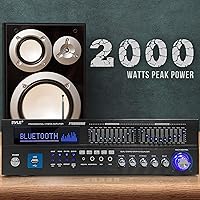
  • Peak Power: The unit is rated at 2000W peak power across its 6 channels, though continuous RMS output is considerably lower and more relevant for real-world speaker pairing decisions.
  • Channels: Six-channel amplification supports a 5.1 surround sound configuration, covering front left and right, center, surround left and right, and subwoofer.
  • Impedance: Designed to drive speakers with a 4-ohm impedance rating; pairing with higher-impedance speakers will reduce effective output.
  • Dimensions: The chassis measures 16.93 x 11.81 x 4.72 inches, conforming to a standard rack-mount footprint suitable for most 19-inch AV racks.
  • Weight: The unit weighs approximately 18.6 pounds, which is typical for a multi-channel rack-mount receiver with a steel chassis and internal transformer.
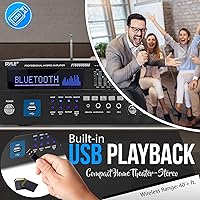
  • Inputs: Nine inputs are provided: USB, AUX 3.5mm, optical digital, coaxial digital, HDMI, AC-3, DVD, and two dedicated microphone jacks.
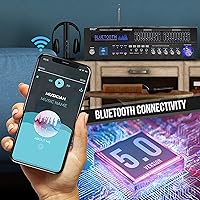
  • Bluetooth: Built-in Bluetooth enables wireless audio streaming from smartphones, tablets, laptops, and other compatible devices without a separate receiver or adapter.
  • Equalizer: A dual 10-band graphic equalizer allows independent tonal adjustment across the frequency spectrum for nuanced control over music and vocal reproduction.
  • Display: A VFD (vacuum fluorescent display) on the front panel shows active input, volume level, radio frequency, and other operating information.
  • FM Radio: An integrated FM tuner with an included antenna supports auto-scan station searching and manual tuning across standard FM broadcast frequencies.
  • Microphone Controls: Each of the two mic inputs has independent volume and echo depth adjustment, accessible directly from the front panel without navigating any menu system.
  • Cooling: An internal cooling fan runs continuously during operation to manage heat buildup, making enclosed rack-mount installation viable for extended listening sessions.
  • Form Factor: The rack-mount chassis includes integrated side handles for installation into standard 19-inch equipment racks or for portable transport between venues.
  • Remote Control: A full-function infrared remote control is included, covering input selection, volume adjustment, EQ mode switching, and radio station navigation.
  • Channel Config: The amplifier supports 5.1 surround sound channel assignment, making it compatible with standard home theater multi-speaker layouts without additional processing hardware.
  • AUX Input: A 3.5mm AUX input on the front panel allows direct connection of portable audio players, phones, or other line-level sources without accessing the rear panel.
  • HDMI Ports: Two HDMI ports are included, supporting audio pass-through for source devices such as Blu-ray players, gaming consoles, and set-top boxes.
  • AC Input: The unit operates on standard AC mains power and includes a rear-panel power connection; no external power brick or adapter is required.

Related Reviews
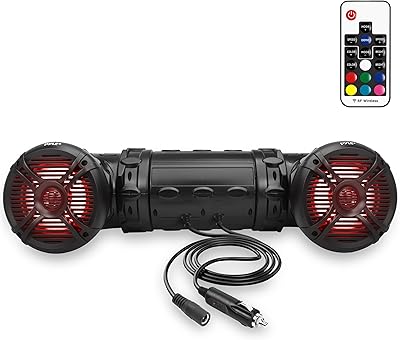
Pyle PDWR30B Outdoor Speakers
85%
88%
Sound Quality
94%
Weatherproof Durability
85%
Ease of Installation
78%
Design and Aesthetics
91%
Build Quality
More
Pyle PVTC320U Step Up and Down Converter
84%
87%
Value for Money
85%
Performance
90%
Ease of Use
65%
Portability
91%
Safety Features
More
Pyle PLMR57W Marine Speakers
85%
84%
Sound Quality
91%
Durability
89%
Ease of Installation
90%
Weather Resistance
75%
Bass Performance
More
Pyle PLATV65BT Bluetooth Speakers
86%
88%
Sound Quality
91%
LED Light Features
85%
Water Resistance
89%
Ease of Installation
87%
Build Quality
More
Pyle PLMR652W Marine Speakers
86%
88%
Sound Quality
91%
Ease of Installation
93%
Durability (Waterproof & Weather Resistance)
87%
Build Quality
75%
Performance at High Volumes
More
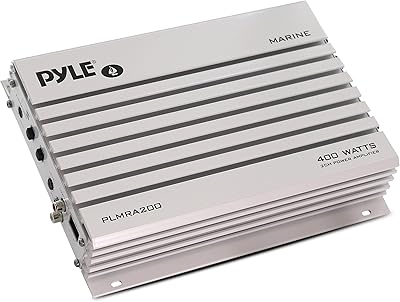
Pyle PLMRA200 Marine Amplifier
86%
94%
Waterproof Performance
88%
Ease of Installation
83%
Power Output
85%
Build Quality
90%
Size and Space Efficiency
More
Pyle PLMR692 Marine Speakers
85%
88%
Sound Clarity
91%
Build Quality & Durability
94%
Waterproof Performance
85%
Installation Ease
73%
Bass Response
More
Pyle PLMR82 Marine Speakers
84%
83%
Sound Quality
89%
Durability
90%
Ease of Installation
80%
Power Handling
87%
Build Quality
More
Pyle PLMRMB2CW Marine Amplifier
86%
85%
Sound Quality
92%
Waterproof Durability
88%
Bluetooth Connectivity
80%
Power Output
87%
Installation Ease
More
Pyle PLMRS4W Marine Speakers
84%
80%
Sound Quality
90%
Build Quality
88%
Durability in Harsh Weather
85%
Installation Ease
65%
Bass Response
More

FAQ

No — 2000W is a peak measurement, which represents the maximum instantaneous power the unit can momentarily handle under ideal conditions. The real continuous RMS output is considerably lower. For practical speaker pairing purposes, treat the power output as mid-range rather than high-powered, and choose speakers rated for moderate sensitivity.

Yes, the receiver has two dedicated mic inputs that operate simultaneously, each with its own independent volume and echo control on the front panel. This makes it straightforward to run two singers at once without any additional mixer or splitter.

This is one of the more commonly reported issues with this home theater amp. A portion of owners find that Bluetooth does not automatically reconnect after a power cycle and requires manual re-pairing from the source device. If seamless auto-reconnect is important to your setup, keep that limitation in mind.

Yes, the Pyle PT6060CHAE is built to fit a standard 19-inch rack and includes side handles for that purpose. Just confirm available rack unit height in your specific rack before installing, as the unit occupies a few rack units of vertical space.

Speakers rated at 4 ohms impedance are the intended match for this rack amplifier. You can use 8-ohm speakers, but output will be reduced. Avoid mixing impedance ratings across channels if you want balanced volume levels throughout your speaker layout.

It can work in a small, low-demand setting like a cafe background system or a small private event room, but it is fundamentally designed for home use. For anything requiring consistent commercial-grade reliability or higher continuous output, a purpose-built commercial amplifier would be a safer long-term investment.

It can be, yes. The cooling fan runs continuously whenever the unit is powered on, and in a quiet room during soft music or film dialogue the hum is audible. For a dedicated home theater room where ambient noise matters, this is worth factoring into your decision.

Based on the chassis height of 4.72 inches, the unit occupies approximately 3U (three rack units) in a standard 19-inch equipment rack. Measure your available rack space before purchasing to confirm it fits your specific installation.

Some owners report that EQ adjustments reset after a power cycle, requiring them to re-tune each time the unit is switched on. This appears to affect a portion of units and firmware versions rather than all of them, but it is a known complaint worth being aware of if you plan to spend time dialing in a specific sound profile.

Yes, both optical and HDMI inputs are available for connecting to a TV or media player. For full 5.1 surround decoding via the AC-3 input, your source device needs to output a compatible digital audio signal. Standard stereo optical from a TV will work fine for two-channel audio; surround requires the appropriate source format and speaker setup.