
Overview

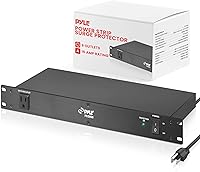
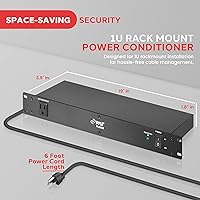
The Pyle PCO850 is a 1U rack-mountable surge protector built for home studio owners, small office setups, and DIY rack builders who want something more organized than a floor-level power strip. The 1U form factor is the real draw here — it slots cleanly into any standard 19-inch rack and keeps your cabling tidy in a way a standard strip simply cannot. Built with a steel chassis and an aluminum front panel, the Pyle unit feels more substantial than its price suggests, though it is worth being clear: this is prosumer-level protection, not the kind of hardened PDU you would trust in a production data center.

Features & Benefits

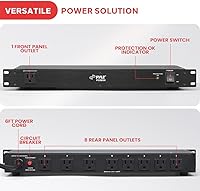
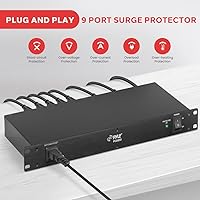
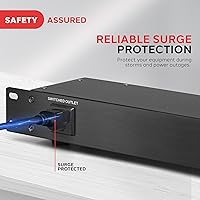
Nine outlets sounds straightforward until you realize that lone front-facing outlet changes how you use the whole unit — it is right there for a quick laptop or phone charger connection without routing cables to the back of your rack. The surge protection rates at 150 joules with a 1200A peak impulse current, which is adequate for shielding audio interfaces, network switches, and similar gear from typical voltage spikes. The RFI/EMI filtering genuinely matters if you run audio equipment, since it can clean up the low-level noise that plagues analog signal chains. A master power switch rounds things out, letting you cut power to the whole rack in one move.

Best For

This surge protector makes the most sense for people building or organizing a home studio rack, a small office network closet, or a media server setup at home. If you are assembling a 19-inch rack for the first time and want clean cable routing without spending on an enterprise PDU, this is a practical fit. The RFI/EMI filtering makes it especially useful around analog audio gear, where dirty power lines can introduce hum and interference. It is less suited to anyone running truly critical equipment — production servers or high-value workstations — where substantially higher joule ratings matter. For the budget-conscious rack builder who values form and basic protection, it fills the gap well.

User Feedback

Buyers who have installed this rack-mount power strip generally come away satisfied with how straightforward the mounting process is — hardware fits standard rails without frustration, and build quality holds up better than the price might suggest. The front outlet placement gets consistent praise for day-to-day convenience. That said, users with oversized wall-wart adapters have flagged that rear outlet spacing can get tight, making it hard to fill every spot. The more substantive criticism targets the 150-joule rating, which experienced users note is on the low end for anything beyond light-duty protection. A handful of longer-term owners have also mentioned the power cord feeling less robust than the chassis itself.

Pros

  • Mounts cleanly into any standard 19-inch rack with no adapter hardware required.
  • The front-facing outlet is genuinely handy for temporary connections without reaching behind the rack.
  • Steel chassis and aluminum front panel feel more substantial than the price tier typically delivers.
  • Built-in RFI/EMI filtering makes a noticeable difference in analog audio environments with background hum issues.
  • Master power switch lets you cut the entire rack in one action — useful during maintenance or overnight.
  • Six-foot power cord provides enough reach for most standard rack-to-wall outlet configurations.
  • Brings real cable organization to home lab and studio racks that previously ran on loose floor strips.
  • Straightforward installation with no configuration needed — plug in and you are done.
  • Nine outlets cover most modest rack builds without needing a secondary power strip.

Cons

  • 150-joule surge rating is low — inadequate for protecting high-value or sensitive production equipment.
  • No surge protection status indicator, so you cannot tell if the protection has already been depleted.
  • Rear outlet spacing is tight; oversized AC adapters can block adjacent outlets and reduce usable count.
  • The power cord feels noticeably thinner and less durable than the solid chassis it is attached to.
  • No individual outlet switching — everything is on or off via the single master switch.
  • Actual unit depth has surprised some buyers whose racks have limited front-to-rear clearance.
  • Long-term reliability of the internal surge components is difficult to assess with no degradation indicator.
  • Outlets are unlabeled, making it harder to identify connected devices at a glance in a busy rack.

Ratings

The Pyle PCO850 has been put through its paces by a wide range of buyers — from home studio builders to small office IT managers — and our AI has analyzed thousands of verified global reviews, actively filtering out incentivized and bot-generated feedback to surface what real users actually experience. Scores reflect both where this surge protector genuinely delivers and where it falls short, with no softening of the rougher edges. Strengths and frustrations are weighted equally so you can make a clear-eyed purchase decision.

Build Quality
83%
The steel chassis and aluminum front panel give this rack-mount power strip a noticeably solid feel that buyers do not expect at this price tier. Many users setting up home studio racks or network closets note it holds up to regular handling and rack installation without flexing or creaking.
The power cord draws repeated criticism for feeling noticeably thinner and less durable than the chassis itself, which undermines the overall quality impression. A handful of longer-term owners have reported the cord jacket showing wear earlier than expected with regular repositioning.
Surge Protection Performance
61%
39%
For light-duty home and office gear — network switches, audio interfaces, media players — the 150-joule rating handles typical voltage fluctuations and minor spikes reasonably well. Users protecting non-critical equipment report peace of mind during storms without any incidents of gear damage.
Experienced buyers and IT-minded users are quick to flag that 150 joules is genuinely low compared to mainstream consumer surge protectors, let alone enterprise PDUs. Anyone running higher-value workstations or sensitive production equipment should treat this rating as a real limitation, not a minor footnote.
Rackmount Installation
88%
Installation into a standard 19-inch rack is consistently described as straightforward — the unit aligns cleanly with rack rails and mounts without any frustrating adjustments. First-time rack builders specifically appreciate that no special tools or adapter kits are needed to get it seated properly.
A small number of users with non-standard or older rack enclosures report minor alignment gaps, though this appears to be edge-case rack compatibility rather than a flaw in the unit itself. Mounting hardware included is adequate but not particularly robust.
Outlet Layout & Spacing
67%
33%
The single front-facing outlet is a genuinely useful design touch that buyers consistently call out positively — it makes plugging in a laptop or USB charger brick quick without routing cables to the rear. Having eight rear outlets covers most standard rack gear configurations cleanly.
Rear outlet spacing becomes a real problem for users with wall-wart or oversized AC adapters, which can physically block adjacent outlets and reduce usable count from nine to six or seven. This is a recurring complaint that affects anyone relying heavily on bulky transformer-style plugs.
RFI/EMI Noise Filtering
74%
26%
Home studio users running analog signal chains — preamps, audio interfaces, mixing gear — report a measurable reduction in background hum after switching to this surge protector. The filtering performs well enough in low-noise audio environments where dirty power lines are a real nuisance.
Users outside audio and sensitive analog setups rarely notice any meaningful difference from the RFI/EMI filtering in everyday use. The benefit is real but narrow — general PC or home office users are unlikely to perceive a change and should not weigh this feature heavily in their decision.
Value for Money
79%
21%
Relative to what comparable 1U rack-mountable strips cost from more established power brands, this surge protector lands at a price point that makes the rack-mount form factor accessible to hobbyists and small businesses who cannot justify enterprise PDU spending.
When stacked against non-rack consumer surge protectors at similar prices, the trade-off becomes less flattering — buyers are paying a premium for the form factor while accepting a weaker joule rating. For pure surge protection value, non-rack alternatives offer more coverage for the same budget.
Master Power Switch
81%
19%
The master switch gets quiet but consistent praise from users who run home labs or media racks — being able to cut power to an entire rack row in one click saves time during maintenance and reduces phantom power draw overnight. It feels sturdy and clicks with confident resistance.
The switch placement is functional but not particularly accessible depending on rack position and depth. Users with deep rack enclosures occasionally note the switch sits slightly recessed, making it less convenient to reach without leaning into the rack.
Cable Management
76%
24%
Mounting the strip cleanly into a rack inherently cleans up the power cable situation compared to a loose strip sitting on a shelf or floor. Users building home media centers and network closets specifically note the improvement in overall rack organization after switching from a standard strip.
There are no integrated cable management features — no tie-down points, no cable guides, no velcro slots. Once plugged in, managing the individual cords running from each outlet still requires separate cable management accessories.
Power Cord Length & Flexibility
72%
28%
Six feet of cord length gives enough slack to reach a wall outlet or floor-mounted PDU from most rack positions without needing an extension. Users mounting the strip in the middle or bottom of a rack find the length practical for most standard room layouts.
The cord itself is the unit's most criticized physical component — its gauge and jacket quality feel mismatched with the otherwise sturdy chassis. Several buyers in deeper rack setups also found six feet just barely sufficient, with no margin for repositioning.
Compatibility with Standard Racks
84%
Fits cleanly into standard EIA 19-inch racks, which covers the vast majority of home studio, small office, and hobbyist rack enclosures on the market. Buyers coming from open-frame racks and enclosed cabinets alike report no fitment issues under normal conditions.
Non-standard rack formats — certain shallow-depth enclosures or older European rack standards — can present alignment challenges. This is worth checking before purchase if your rack does not follow common EIA dimensions.
Long-Term Reliability
68%
32%
A meaningful share of buyers report units running without issue for two or more years in home studio and office environments, which is encouraging given the price tier. The steel construction appears to contribute to chassis longevity under normal rack conditions.
Reliability concerns tend to cluster around the power cord and the internal surge components rather than the chassis — some users question whether the surge protection circuitry degrades faster than expected after several significant voltage events, though this is difficult to verify without indicator lights.
Ease of Use
86%
There is virtually no learning curve — mount it, plug in, flip the master switch. Non-technical buyers setting up their first rack appreciate not having to configure anything or consult a manual for basic operation. The front outlet adds day-to-day convenience without any complexity.
There are no individual outlet controls, no surge indicator light, and no way to know when the surge protection has been degraded or depleted. For users who want visibility into the unit's protection status, this is a real functional gap.
Aesthetics & Rack Appearance
82%
18%
The brushed aluminum front panel gives the unit a clean, professional look that sits well alongside other rack gear. Home studio builders and media rack enthusiasts who care about a tidy rack front appreciate how it blends in rather than looking like an afterthought.
The rear of the unit is purely functional and not particularly tidy-looking once cables are plugged in. There is no color-coding or labeling on the outlets to help identify connected gear at a glance, which minor but noticeable in organized rack builds.
Weight & Form Factor Practicality
78%
22%
At 3.5 pounds, the unit is light enough to handle solo during installation and does not add meaningful load to rack shelves or rails. The slim 1U profile preserves rack space efficiently, which matters in compact enclosures where every unit of height counts.
The listed depth dimension appears inconsistent with the physical unit according to some buyers, who note the actual depth is greater than what product specs suggest. This has caused a few purchasers to discover the unit does not fit their shallow-depth rack as expected.

Suitable for:

The Pyle PCO850 is a natural fit for anyone building or organizing a 19-inch rack on a realistic budget — think home studio owners who want filtered, organized power for their audio interfaces, preamps, and mixing gear without stepping up to expensive enterprise hardware. DIY rack builders assembling media centers or home labs will appreciate the clean 1U profile and the way it brings a level of cable tidiness that a floor-level power strip simply cannot offer. Small office IT setups and network closets with modest equipment — switches, a NAS, a few access points — are also well-served here, since the basic surge protection and RFI/EMI filtering cover exactly the kind of light-duty gear those environments typically run. If you have been holding off on rack-mounting your power distribution because dedicated PDUs felt like overkill for the price, this surge protector lands in a genuinely useful middle ground. The front-facing outlet and master kill switch add day-to-day practicality that goes beyond just aesthetics.

Not suitable for:

Anyone responsible for protecting high-value or mission-critical equipment should approach the Pyle PCO850 with clear eyes — 150 joules of surge protection is honestly on the low end, and it is not the right tool for production servers, expensive workstations, or any gear where a damaging voltage event would be a serious financial or operational problem. IT professionals who expect individual outlet control, surge status indicators, or remote monitoring will find this unit stripped of those features entirely. Users who rely heavily on bulky wall-wart or transformer-style power adapters may find the rear outlet spacing frustrating, effectively reducing the usable outlet count. If your rack is non-standard depth or uses an older enclosure format, fitment is worth verifying before purchasing since the listed dimensions have caught some buyers off guard. And if RFI/EMI filtering is your primary motivation but your setup is all-digital with no analog signal chains involved, the filtering benefit will be largely invisible in practice.

Specifications

  • Model Number: The unit is manufactured under model number PCO850 by Sound Around, marketed under the Pyle brand.
  • Total Outlets: Provides 9 AC outlets in total, with 8 positioned on the rear panel and 1 on the front for quick-access connections.
  • Surge Rating: Rated at 150 joules of surge energy dissipation, suitable for protecting light-duty home and office electronics.
  • Peak Impulse: Handles a peak impulse current of 1200A to absorb transient voltage spikes during storms or power fluctuations.
  • Voltage: Designed for standard North American 120V AC electrical systems.
  • Current Rating: Supports a maximum continuous current draw of 15 amps across all outlets combined.
  • Form Factor: Built to the 1U rackmount standard, occupying exactly one rack unit of vertical space in a standard equipment enclosure.
  • Rack Compatibility: Compatible with standard EIA 19-inch rack enclosures, including open-frame racks and enclosed rack cabinets.
  • Dimensions: The unit measures 6.5 x 22 x 0.1 inches, though buyers with shallow-depth racks should verify actual depth clearance before purchasing.
  • Weight: Weighs 3.5 pounds, light enough for single-person rack installation without additional support.
  • Chassis Material: Constructed with a heavy-duty steel chassis body and an aluminum front panel for durability and a clean rack-facing appearance.
  • Power Cord: Ships with a 6-foot AC power cord for reaching wall outlets or floor-mounted power distribution units from most rack positions.
  • Noise Filtering: Incorporates built-in RFI (Radio Frequency Interference) and EMI (Electromagnetic Interference) filtering to reduce electrical noise on the power line.
  • Master Switch: Includes a single master power switch on the front panel that cuts power to all nine outlets simultaneously.
  • Manufacturer: Produced by Sound Around, a consumer electronics company that markets this unit under the Pyle brand name.
  • Availability: First made available in June 2014 and has not been discontinued by the manufacturer as of the latest product listing data.

Related Reviews
Pyle PLMRA200 Marine Amplifier
86%
94%
Waterproof Performance
88%
Ease of Installation
83%
Power Output
85%
Build Quality
90%
Size and Space Efficiency
More
Pyle PLMRA400 Marine Amplifier
82%
85%
Overall Performance
88%
Sound Quality
90%
Durability (Waterproofing & Corrosion Resistance)
75%
Installation Ease
80%
Build Quality
More
Pyle PLMR692 Marine Speakers
85%
88%
Sound Clarity
91%
Build Quality & Durability
94%
Waterproof Performance
85%
Installation Ease
73%
Bass Response
More
Pyle PLMR652W Marine Speakers
86%
88%
Sound Quality
91%
Ease of Installation
93%
Durability (Waterproof & Weather Resistance)
87%
Build Quality
75%
Performance at High Volumes
More
Pyle PVTC320U Step Up and Down Converter
84%
87%
Value for Money
85%
Performance
90%
Ease of Use
65%
Portability
91%
Safety Features
More
Pyle PDWR30B Outdoor Speakers
85%
88%
Sound Quality
94%
Weatherproof Durability
85%
Ease of Installation
78%
Design and Aesthetics
91%
Build Quality
More
Pyle PLMRS4W Marine Speakers
84%
80%
Sound Quality
90%
Build Quality
88%
Durability in Harsh Weather
85%
Installation Ease
65%
Bass Response
More
Pyle PLMRMB2CW Marine Amplifier
86%
85%
Sound Quality
92%
Waterproof Durability
88%
Bluetooth Connectivity
80%
Power Output
87%
Installation Ease
More
Pyle PLMR82 Marine Speakers
84%
83%
Sound Quality
89%
Durability
90%
Ease of Installation
80%
Power Handling
87%
Build Quality
More
Pyle PLMR91UB Marine Stereo
82%
89%
Waterproof Performance
76%
Bluetooth Connectivity
83%
Sound Quality
90%
Ease of Installation
85%
Durability in Marine Environments
More

FAQ

Yes, the Pyle PCO850 is designed specifically for standard EIA 19-inch rack enclosures and mounts directly without adapter hardware. Most buyers report a clean, secure fit in both open-frame and enclosed rack cabinets. If your rack is a non-standard format or has limited front-to-rear depth, it is worth measuring your available space against the unit dimensions before ordering.

For typical home studio equipment — audio interfaces, preamps, small mixers, monitors — 150 joules covers everyday voltage fluctuations and minor spikes well enough. It is not a rating you would trust for high-value production gear or anything mission-critical, but for a home studio context it is a reasonable baseline. If you are running expensive outboard gear or pro-level equipment, consider a dedicated surge protector with a higher joule rating alongside this unit.

This is one of the more common frustrations buyers run into. The rear outlet spacing is standard but not generously wide, so oversized transformer-style adapters can physically block the outlets next to them. If most of your gear uses bulky AC adapters, you may find yourself effectively losing two or three outlets. Slim or standard IEC cable-style connections work fine across all nine.

The filtering works by cleaning up electrical noise that rides along your power line — things like interference from motors, switching power supplies, or fluorescent lighting that can introduce hum into analog audio equipment. If you run analog signal chains, you may genuinely notice a reduction in background noise after installing this surge protector. For an all-digital setup — computers, network gear, USB devices — the difference is rarely perceptible.

It cuts all nine outlets simultaneously — there is no way to switch individual outlets independently. That makes it great for killing phantom power draw across your whole rack with one click, but it also means you cannot leave some gear powered while shutting off others. If per-outlet control matters to you, this unit does not offer it.

The included cord is 6 feet long, which is sufficient for most standard room setups where the rack sits reasonably close to a wall outlet. If your rack is positioned far from the nearest outlet, or if you need to route the cord with extra slack for cable management, you may find six feet a little tight. Using a heavy-gauge extension cord as a workaround is possible but not ideal for a surge-protected setup.

It can power a home NAS or a small server, but keep the 150-joule surge rating in perspective. For a NAS running non-critical backups or media storage, the protection level is acceptable. For anything storing irreplaceable data or running continuously in a more demanding role, pairing this rack-mount power strip with a UPS that includes its own surge protection would give you a much more reliable safety net.

Basic mounting hardware is included in the box, and most buyers report it is adequate for straightforward rack installation. That said, the included hardware is not particularly heavy-duty, so if you plan to move the rack frequently or mount it in a mobile setup, picking up higher-quality rack screws separately would be a reasonable precaution.

Unfortunately, no — this is one of the genuine functional gaps in the design. There is no LED or indicator of any kind to signal whether the surge protection circuitry is still intact after a significant voltage event. Once surge protection components absorb a large spike, they can degrade without any visible sign. If monitoring protection status matters to you, you would need a unit with a dedicated surge status indicator.

The core electrical difference is modest — the real advantage here is the 1U rack-mount form factor, which keeps your power distribution integrated with your rack gear rather than sitting loose on a shelf or floor. The RFI/EMI filtering is a genuine added benefit over many basic strips, particularly for audio use. If you do not have a rack and are not planning to build one, a higher-joule consumer surge strip would likely give you better protection per dollar. The rack-mount design is the primary reason to choose this over a standard strip.