Overview

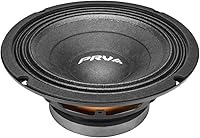
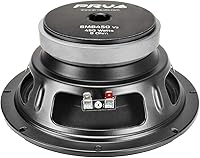
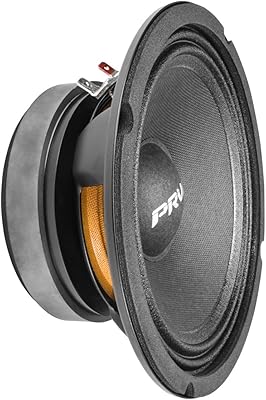
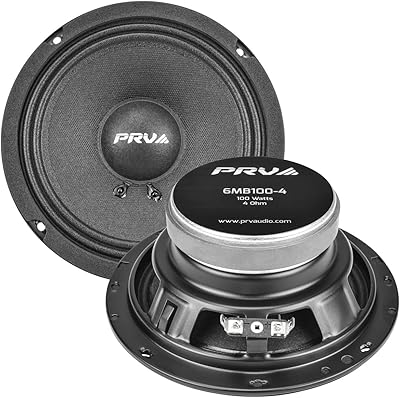
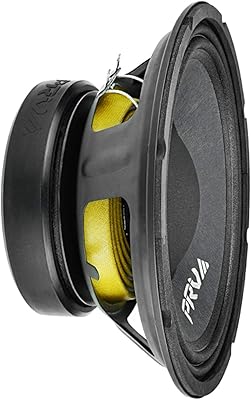
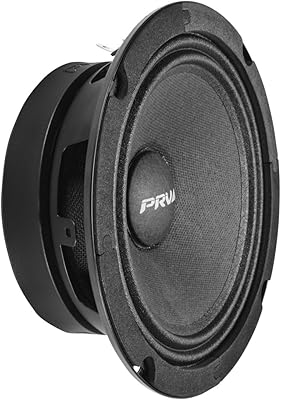
The PRV Audio 8MB450 v2 8-Inch Midbass Speaker comes from a Brazilian manufacturer that has built a loyal following in car audio and live sound circles over the past decade. The v2 revision is not a simple rebadge — PRV made tangible improvements to the cone assembly and voice coil architecture compared to the original. Running at 8-ohm nominal impedance, this midbass driver pairs well with most pro amplifiers, though buyers who need to bridge channels or run multiple drivers in parallel may prefer the 4-ohm sibling. One thing to be clear about upfront: this is a raw component. It needs an enclosure, a crossover, and some planning before it plays a single note.
Features & Benefits

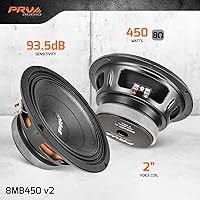
The 450W continuous RMS rating is the headline spec, and in practice it means the 8MB450 v2 has serious headroom for demanding installs — push it hard and it won't break a sweat at concert-level volumes. The voice coil uses CCAW wire, which is lighter than pure copper and reduces moving mass without sacrificing conductivity, resulting in a faster, more responsive cone. At 93.5 dB sensitivity, this PRV Audio woofer can get genuinely loud from a modest amplifier. The frequency range tops out around 7,500 Hz, so plan your crossover accordingly — and respect the 120 Hz hi-pass recommendation. Dip below that without proper filtering and you risk over-excursion damage that no warranty will cover.

Best For

This midbass driver is squarely aimed at builders who know what they're doing. In car audio, it fills the critical gap between a dedicated subwoofer and high-frequency tweeters — that mid-bass punch you feel on kick drums and hear on male vocals. It also works well as a studio monitor replacement driver in small sealed cabs, where its controlled low-end rolloff actually works in your favor. Stage monitor builders looking for a durable, high-sensitivity cone will find it a practical option at this price point. That said, newcomers to DIY audio should budget time to learn about enclosure volume and crossover slopes before committing to a purchase.

User Feedback

Across nearly 670 ratings, the 8MB450 v2 holds a 4.6 out of 5 average — and the pattern behind that score tells a consistent story. Car audio installers and pro audio builders repeatedly praise the tight midbass punch and vocal presence in the upper bass range. Build quality draws frequent mentions too; buyers say it feels surprisingly solid given its price tier. On the critical side, some users note a break-in period before the cone fully loosens up, and a few have flagged over-excursion issues when running it below the recommended crossover point — entirely preventable with proper filtering. Real-world power handling reportedly tracks closely with the rated specs, which earns genuine trust.

Pros

  • Genuinely solid 450W RMS power handling gives real headroom for loud, demanding installs without strain.
  • A 93.5 dB sensitivity rating means this PRV Audio woofer gets loud without needing a powerful amplifier behind it.
  • The CCAW voice coil reduces moving mass, resulting in a noticeably faster and tighter cone response.
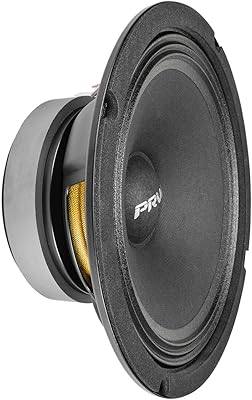
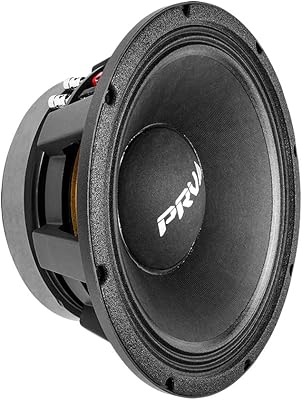
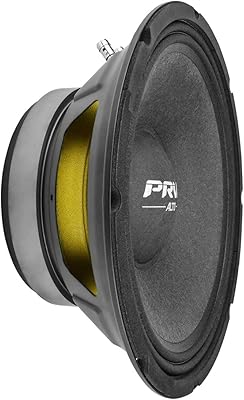
  • Alloy steel frame feels reassuringly heavy and well-constructed for the price tier.
  • Works cleanly in small sealed cabinets, making enclosure design more forgiving for DIY builders.
  • The v2 revision addresses known weaknesses of the original, not just a cosmetic refresh.
  • Frequency range up to 7,500 Hz gives enough headroom to cross over flexibly without a gap in the soundstage.
  • Strong community adoption in car audio and pro sound circles means installation advice and enclosure specs are widely available.
  • Build quality consistently earns praise from buyers relative to what the price would suggest.
  • A 4-ohm variant is available separately, making it easy to choose the right impedance for your specific amplifier setup.

Cons

  • Requires a properly designed enclosure and crossover — there is no shortcut for underprepared buyers.
  • Running the 8MB450 v2 below the 120 Hz hi-pass crossover point risks over-excursion damage that is entirely avoidable but commonly reported.
  • The 8-ohm impedance can be a poor match for many consumer car amplifiers, which are typically optimized for lower loads.
  • Break-in period is real — some buyers note the cone sounds stiff and restricted straight out of the box.
  • No meaningful waterproofing despite contradictory claims in the listing; treat this as an indoor-only driver.
  • At 4.1 pounds and 3.37-inch mounting depth, tight or shallow door installations in some vehicles will be genuinely challenging.
  • Not a full-range driver — pairing it with a tweeter and a subwoofer is a requirement, not an option.
  • Buyers unfamiliar with impedance matching or amplifier damping factor may struggle to extract the best performance.
  • Spare parts and manufacturer support may be harder to source outside of Brazil and North America.

Ratings

Our scores for the PRV Audio 8MB450 v2 8-Inch Midbass Speaker were generated by AI after analyzing hundreds of verified global buyer reviews, with spam, bot submissions, and incentivized feedback actively filtered out before any scoring was applied. The resulting ratings reflect both the genuine strengths this driver earns from experienced audio builders and the real frustrations reported by buyers who ran into its steeper learning curve. Every score — high or low — is grounded in consistent, repeatable patterns across the review pool, not individual outliers.
Midbass Sound Performance
88%
Buyers consistently describe the punch in the upper bass range as the standout quality — kick drums land with authority, male vocals have presence and body, and the transition from subwoofer to tweeter feels cohesive. Car audio enthusiasts running three-way builds especially appreciate how this midbass driver locks into the mix without muddiness.
At the very top of its range, around 6,000 to 7,500 Hz, some listeners note a slight thinning of character that makes a well-tuned crossover critical. A notable share of buyers also report that the full sound signature only emerges after a meaningful break-in period, which can produce misleading first impressions.
Build Quality
86%
The alloy steel frame and 4.1-pound heft leave a strong impression the moment this driver comes out of the box — buyers routinely describe it as feeling far more substantial than the price would suggest. Construction tolerances, particularly around the basket and surround, draw consistent praise from builders who have handled drivers at twice the price.
A few buyers note minor inconsistencies in surround adhesive finishing between units, which does not affect performance but can feel out of place on an otherwise well-built driver. Some users also wish the included grille were sturdier, describing it as the weakest element in an otherwise solid package.
Power Handling
91%
Real-world feedback strongly supports the 450W RMS rating — builders running this midbass driver at high sustained volumes in properly filtered setups report no voice coil failures or thermal issues over extended use. The headroom this provides means most installs will never come close to stressing it, which translates directly into long-term reliability.
The rated power handling is only realized when a proper hi-pass crossover is in place; buyers who skipped that requirement and pushed low-frequency content through at high volumes reported failures that the spec sheet does not protect against. A few users also found the nominal 225W figure confusing alongside the 450W RMS rating, leading to initial amplifier undersizing.
Value for Money
89%
The 8MB450 v2 punches well above its price bracket — most buyers coming from entry-level replacement drivers describe it as a meaningful step up in both sound quality and construction without the premium cost of a flagship component. Pro audio builders on a budget consistently single out value as one of the strongest reasons to recommend it.
The value case only holds when you factor in the additional cost of a proper enclosure, crossover components, and mounting hardware — buyers who did not budget for the full system sometimes felt the overall cost crept higher than expected. Those comparing it to cheaper coaxial replacements also need to account for the added complexity of a multi-driver setup.
Sensitivity & Efficiency
87%
At 93.5 dB sensitivity, this PRV Audio woofer gets impressively loud from amplifiers that more demanding drivers would leave working hard — car audio builders with modest amps appreciate not needing to throw power at it to fill a cabin. Stage monitor builders note that it holds its own at live performance volumes without requiring industrial-grade amplification.
The high sensitivity can expose noise floors in lower-quality amplifiers that a less efficient driver would mask — buyers pairing it with budget amps that have audible hiss at idle sometimes found the sensitivity worked against them in quiet listening environments. This is not a flaw in the driver itself, but it does raise the bar on associated equipment quality.
Voice Coil Design
84%
The CCAW voice coil reduces moving mass compared to a solid copper winding, giving the cone noticeably quicker transient response — buyers describe the tightness in the mid-bass as a direct result. The Kapton former adds thermal resistance that supports the claimed power handling during sustained high-volume use.
CCAW wire has slightly lower conductivity than pure copper, meaning maximum power transfer is marginally compromised compared to a full copper coil at the same diameter — a trade-off most builders will never notice in practice. This distinction matters primarily to those comparing it against pure copper voice coil alternatives at a higher price point.
Frequency Response Accuracy
79%
21%
Within its intended operating band — roughly 120 Hz to 5,000 Hz — the 8MB450 v2 reproduces midbass content accurately and without obvious peaks or dips that would require heavy equalization. Builders using it in crossed-over three-way systems report a smooth, predictable response that integrates cleanly with companion drivers.
The stated low extension to 75 Hz at -10dB creates a temptation to cross it lower than is safe, which is where distortion and over-excursion risk enter the picture. Response also rolls off meaningfully beyond 5,500 Hz, so crossover placement needs care to avoid a coverage gap between this driver and a companion tweeter.
Installation Complexity
58%
42%
Experienced installers will find the mounting dimensions well-documented and the included hardware adequate for a clean installation. The 7.17″ baffle cutout and 3.37″ mounting depth specs are clearly stated, and builders already familiar with speaker work can have this driver seated and wired in a relatively manageable session.
For buyers without prior DIY audio experience, this driver presents a genuine barrier — it needs an enclosure built to spec, a crossover network, proper amplifier matching, and often vehicle-specific mounting solutions. Reviewers without that background consistently described the installation experience as frustrating, and several returned the driver as a result.
Enclosure Versatility
73%
27%
The 8MB450 v2's parameters make it well-behaved in small sealed cabinets, and its controlled rolloff in that alignment means modest variations in box volume do not dramatically shift the sound character. This predictability is a real advantage for builders who are newer to enclosure design.
PRV designed this driver specifically for sealed enclosures, and using it in a ported or bandpass alignment is not well-supported by the published specs. Buyers who attempted vented builds without custom Thiele-Small modeling reported less predictable bass behavior, with some noting port tuning problems that required significant rework.
Crossover Compatibility
76%
24%
This midbass driver integrates cleanly with standard passive and active crossover components when set at or above 120 Hz — builders using common two-way and three-way crossover kits report smooth integration with minimal phase correction needed. Active crossover users appreciate how little equalization it requires within its intended operating band.
The strict hi-pass requirement is a real constraint for builders using entry-level head units with limited crossover frequency adjustment options. Some negative reviews trace directly to systems where the crossover could not be set at 120 Hz or higher, or where the slope was too shallow to protect the driver from low-frequency over-excursion damage.
Break-in Experience
62%
38%
Buyers who gave this driver adequate break-in time — typically 10 to 20 hours at moderate levels — consistently reported that the cone opened up noticeably, with improved bass extension and a looser, more natural suspension feel. The fully broken-in driver is broadly praised for delivering exactly the sound the specs suggest.
Out of the box, the suspension is stiff enough that first impressions can be genuinely misleading — the driver sounds constrained and lacks the low-end articulation that later characterizes it. Buyers who evaluated it immediately after unboxing and returned it based on that early experience are a recurring pattern in the one- and two-star reviews.
Longevity & Durability
83%
Builders who have run the 8MB450 v2 in continuous service — including car audio installs that endure heat cycles and road vibration — generally report no performance degradation over time when the driver stays within its rated parameters. The alloy steel frame shows no signs of structural fatigue in long-term use reports.
Durability drops sharply outside the driver's design parameters — voice coil burnout from inadequate hi-pass filtering is reported consistently enough to flag as a real pattern. There are also scattered reports of surround deterioration in installations subject to extreme and sustained temperature exposure, particularly in unconditioned vehicle environments.
Frame Rigidity
82%
18%
The alloy steel basket is one of the most consistently praised physical attributes of this driver — it resists flex during high-excursion operation and provides a stable platform that contributes directly to accurate transient behavior. Builders comparing it to stamped steel competitors at a similar price describe a tangible difference in overall rigidity.
At 4.1 pounds, the steel frame adds meaningful mass that can be a consideration in weight-sensitive installs, particularly in vehicle door panels where heavy drivers can complicate mounting or require additional reinforcement to prevent rattle. It is a minor trade-off for most builders but worth accounting for in tight or shallow installation spaces.
Amplifier Compatibility
71%
29%
The 8-ohm nominal impedance pairs cleanly with the majority of pro audio amplifiers and dedicated car audio amps designed for higher-impedance loads, giving builders a wide selection of compatible gear. The driver's high sensitivity also means a modest 8-ohm amplifier can still drive it to satisfying output levels.
The 8-ohm impedance is a genuine mismatch for a large portion of consumer car amplifiers optimized for 4-ohm or 2-ohm loads, which deliver significantly less power at 8 ohms. Buyers who did not verify impedance compatibility before purchasing found themselves with underpowered performance and the added cost of sourcing a more suitable amplifier.

Suitable for:

The PRV Audio 8MB450 v2 8-Inch Midbass Speaker is built for experienced audio builders who understand how drivers, enclosures, and crossovers work together as a system. Car audio enthusiasts constructing a three-way build will find it particularly well-suited to filling that critical midbass layer between a subwoofer and tweeters — the range where kick drums, bass guitar, and male vocals live. DIY speaker builders refreshing or upgrading studio monitors in small sealed cabinets will appreciate how the driver's controlled rolloff behaves predictably at the low end. Live sound engineers and stage monitor builders who need a durable, high-sensitivity cone that can handle real-world SPL demands without requiring a massive amplifier will also get strong value here. In short, if you already know what a crossover slope is and how to calculate enclosure volume, this midbass driver belongs on your shortlist.
Not suitable for:

Anyone expecting a ready-to-play speaker system should stop here — the 8MB450 v2 is a raw driver component, and it will not produce sound until it is properly mounted in an enclosure and crossed over at an appropriate frequency. Casual buyers looking for a simple car speaker upgrade or a desktop audio solution will find the installation requirements well beyond what a typical weekend swap entails. The 8-ohm impedance, while standard for pro audio, can be a mismatch for consumer-grade car amplifiers optimized for 2-ohm or 4-ohm loads, so amplifier compatibility needs to be confirmed before purchasing. Those who intend to run this driver without a hi-pass crossover at or above 120 Hz risk over-excursion damage fairly quickly, which the warranty will not cover. And buyers drawn in by the listing's conflicting waterproofing claims should be aware that this driver is rated for indoor use — relying on it in a genuinely wet environment would be a mistake.

Specifications

  • Driver Diameter: The nominal driver diameter is 8-inch (203 mm), with an overall frame diameter of 8.27″ (210 mm).
  • Impedance: Nominal impedance is 8 Ohm, suited for standard pro audio amplifier outputs; a separate 4-Ohm variant is also available from PRV Audio.
  • RMS Power: Continuous program power handling is rated at 450W RMS, providing substantial headroom for demanding high-volume installs.
  • Peak Power: Maximum peak power capacity reaches 900W, intended for brief transient peaks only and not sustained operation.
  • Sensitivity: Sensitivity is rated at 93.5 dB at 2.83V measured at 1 meter, allowing high output levels from a moderately powered amplifier.
  • Frequency Response: Usable frequency response spans 75 Hz to 7,500 Hz at -10dB, defining its role as a dedicated midbass driver rather than a full-range solution.
  • Voice Coil: A 2-inch (50 mm) diameter voice coil wound with CCAW (copper-clad aluminum wire) reduces moving mass while maintaining strong conductivity.
  • Former Material: The voice coil former is made from Kapton, a heat-resistant polyimide film valued in pro audio for its thermal stability under sustained high-power use.
  • Frame Material: The basket is fabricated from alloy steel, producing a rigid, flex-resistant structure that supports accurate cone movement at high excursion levels.
  • Mounting Depth: Installation requires a minimum mounting depth of 3.37″ (85 mm), which must be verified against available cavity depth before fitment in shallow enclosures or vehicle doors.
  • Baffle Cutout: The required front-mount baffle cutout diameter is 7.17″ (182 mm).
  • Item Weight: The driver weighs 4.1 pounds (approximately 1.86 kg), reflecting the density of its steel frame and magnet assembly.
  • Crossover Spec: PRV Audio recommends a hi-pass crossover at a minimum of 120 Hz using a 12dB-per-octave slope to protect the driver from low-frequency over-excursion damage.
  • Voice Coil Geometry: Voice coil winding depth is 12.0 mm against a magnetic gap depth of 6.0 mm, defining the linear excursion range appropriate for midbass duties.
  • Included Items: Each unit ships with one speaker driver, a grille, and mounting screws as standard package contents.

Related Reviews

PRV AUDIO 6MB200-4 v2 6.5-inch Midbass Speaker
85%
87%
Bass Quality
91%
Vocal Clarity
85%
Durability
82%
Power Handling
88%
Sound Detail
More
PRV Audio 6MB100-4 6.5″ Midbass Car Speakers
79%
93%
Mounting Depth & Fitment
88%
Midrange Sound Quality
71%
Bass Response
89%
Installation Ease
52%
High-Frequency Extension
More
PRV Audio 8MR450A 8-Inch Midrange Speaker
84%
93%
Sound Clarity
91%
Value for Money
88%
Power Handling
84%
Installation Ease
82%
Build Quality
More
PRV Audio 10W650A 10-Inch Woofer Speaker
87%
94%
Bass Clarity and Depth
91%
Power Handling and Output
88%
Build Quality and Durability
83%
Ease of Installation
85%
Compatibility with Enclosures
More
PRV Audio 12MR2000 12-inch Midrange Speaker
85%
92%
Sound Clarity
88%
Build Quality
94%
Power Handling
72%
Ease of Installation
89%
Durability
More
PRV Audio 10MR650A 10-Inch Midrange Speaker
87%
94%
Sound Clarity
91%
Midrange Performance
88%
Durability and Build Quality
89%
Heat Management
90%
Volume Handling
More
OSD Audio ACE850 8″ In-Ceiling Speakers
79%
83%
Sound Quality
91%
Aesthetic Design
74%
Ease of Installation
82%
Value for Money
78%
Build Quality
More
PRV Audio 6MR200A 6.5-Inch Shallow Midrange Speaker
85%
91%
Sound Clarity
94%
Shallow Mount Design
93%
Value for Money
88%
Installation Experience
79%
Build Quality
More
OSD Audio ICE830ST 8-Inch 70V Ceiling Speaker
82%
86%
Audio Clarity
79%
Bass Performance
91%
70V System Compatibility
88%
Ease of Installation
83%
Build Quality
More
Timpano TPT-MB8-4 8-Inch Shallow Midbass Speaker
79%
93%
Shallow Fitment Accuracy
84%
Midbass Output Quality
88%
Build Quality
91%
Value for Money
82%
Installation Experience
More

FAQ

The PRV Audio 8MB450 v2 8-Inch Midbass Speaker is a raw driver component — it will not produce sound until it is mounted in a properly designed enclosure and crossed over with an appropriate filter network. You will also need speaker wire, a compatible amplifier, and in most builds, a tweeter and subwoofer to cover the frequencies this driver does not handle. Think of it as one piece of a larger system, not a standalone solution.

PRV designed the 8MB450 v2 with small sealed cabinets in mind, and that is where it performs most predictably. A sealed enclosure in the range of 0.3 to 0.6 cubic feet is a common starting point for this driver diameter, but running a simulation using the driver's published Thiele-Small parameters will give you a more precise target volume for your specific listening goals.

The decision comes down to your amplifier. The 8-ohm version suits pro audio amplifiers and setups where you are running a single driver per channel at higher impedance loads. The 4-ohm variant is a better match for most consumer car amplifiers, which are typically rated for 4-ohm loads and deliver their highest wattage there. Check your amplifier's spec sheet before deciding — mismatching impedance costs you efficiency and can stress your amp.

Aim for an amplifier channel that delivers between 200W and 450W RMS at 8 ohms. Running it significantly underpowered is not necessarily safe — a clipping amplifier driven hard to compensate can damage the voice coil just as effectively as one that is too powerful. Headroom is your friend here, so a clean 300W amplifier will serve this driver better than a 100W unit pushed to its limits.

Set your hi-pass crossover at a minimum of 120 Hz using a 12dB-per-octave slope, as PRV explicitly recommends. Pushing significant low-frequency energy through this driver without that filter forces the cone beyond its mechanical excursion limits, which leads to permanent damage. Some builders prefer to cross even higher — around 150 Hz — especially in car audio installs where cabin gain amplifies the low end naturally.

No. Despite some confusing signals in the product listing, the confirmed rating for this driver is indoor use only, and it is explicitly listed as not water resistant. Do not install it in an outdoor enclosure exposed to rain, a marine vessel, or any environment where moisture contact is a realistic possibility.

Yes, and it is worth knowing about before your first listening session. Several buyers report that the cone feels stiff and the sound slightly constrained when the driver is brand new. Running it at moderate levels for roughly 10 to 20 hours allows the spider and surround to relax into their intended compliance. Do not draw firm conclusions about its sound character until after that break-in period.

It can work well in that role, particularly in monitors designed around small sealed enclosures, where this midbass driver's predictable rolloff behavior is easy to work with. Before purchasing, confirm that the baffle cutout of 7.17″ and mounting depth of 3.37″ match your cabinet's dimensions. You will also need to verify that your existing crossover network hands off cleanly to your tweeter at an appropriate frequency.

Buyer feedback consistently supports the rated specs when the driver is installed correctly with a proper hi-pass crossover in place. Users running it near the 450W RMS ceiling in properly filtered setups report no unusual issues with heat buildup or voice coil failure. The reported problems almost always trace back to missing or inadequate crossover filtering, not to inflated specs from the manufacturer.

The 225W nominal figure is a conservative continuous rating based on a steady-state test signal, while the 450W RMS is the program power rating — a more realistic measure of what the driver handles during actual music playback, which has natural dynamic variation rather than a constant tone. The 900W peak figure applies only to very brief transient spikes. For amplifier matching purposes, the 450W RMS number is the most useful and the one you should plan around.