Overview

The Platin Monaco 5.1.2 Home Theater System takes a clear stance: it's built for people who want genuine surround sound without a single wire snaking across the floor. Unlike typical wireless audio products that lean on Bluetooth — a standard that compresses your audio before it ever reaches the speaker — this wireless surround system uses WiSA-certified transmission to send uncompressed audio to each speaker independently. The 5.1.2 channel layout adds two height channels on top of the standard 5.1 configuration, which is what makes Dolby Atmos actually work as intended. Setup revolves around the included WiSA SoundSend transmitter, which plugs into your TV's HDMI port and handles the rest. It's a focused product at a premium price — genuinely compelling for the right buyer, but not a universal fit.

Features & Benefits

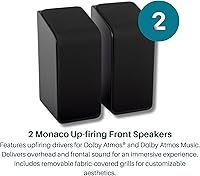
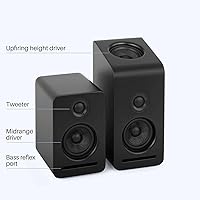
The WiSA wireless standard is worth understanding before anything else: it creates a dedicated radio network between the transmitter and each speaker, delivering 24-bit audio at up to 96 kHz — well above CD quality and meaningfully better than what any Bluetooth connection can carry. The front speakers include upward-firing drivers, which bounce sound off the ceiling to simulate overhead audio for Dolby Atmos content; it works noticeably well in rooms with standard ceiling heights. THX certification means the system was tuned against strict loudness and distortion benchmarks, not just labeled for marketing purposes. HDMI ARC or eARC handles the TV connection, so your existing remote controls volume without extra setup. The companion app lets you adjust individual speaker levels, and Direct Mode bypasses processing for a cleaner, more accurate signal.

Best For

This WiSA home theater setup is an especially strong match for renters and anyone who has ruled out cable runs entirely. If you've been living with a soundbar and keep noticing that dialogue feels flat or that effects come from the wrong direction, a proper multi-speaker layout changes that in an obvious way. It also suits smart TV owners directly — connect via HDMI ARC, and the system appears as a standard audio output without needing a separate AV receiver. That simplification matters more than it sounds. Anyone chasing Dolby Atmos on a realistic budget for a small-to-medium room will find this hits a genuine gap in the market between basic soundbars and full custom installs.

User Feedback

Owners consistently highlight two things: wireless reliability and the immediate, obvious improvement over a soundbar once the system is up and running. Most report that setup is straightforward once you understand the SoundSend pairing process, though a handful of users describe a short learning curve getting that first connection established. The subwoofer handles movie bass cleanly in average-sized rooms, but buyers with larger open spaces sometimes find it lacks the physical weight they expected — worth factoring in before purchasing. The companion app earns positive marks for speaker-level control, though occasional app connectivity quirks surface in longer-term reviews. Satellite speakers are compact, which some see as a décor advantage, but a few users note they expected larger cabinets given the price point.

Pros

  • Fully wireless speaker transmission eliminates cable runs without sacrificing audio quality.
  • WiSA technology delivers uncompressed 24-bit audio — a genuine step above anything Bluetooth can offer.
  • Upward-firing front drivers produce real Dolby Atmos height effects without requiring ceiling speakers.
  • THX-calibrated tuning means balanced, accurate sound from the first power-on.
  • Works with virtually any modern smart TV via HDMI ARC or eARC — no receiver required.
  • Compact satellites mount on standard speaker stands or wall brackets using common M6 hardware.
  • The companion app allows per-speaker level adjustments that a soundbar simply cannot match.
  • Magnetic detachable grills make the system easy to blend into most living room setups.
  • Long-term owners report stable wireless performance with no notable degradation over time.
  • Moving from a soundbar to this multi-speaker layout produces an immediately obvious improvement in surround directionality.

Cons

  • Subwoofer output feels restrained in larger rooms during demanding cinematic bass moments.
  • Initial SoundSend pairing can require multiple attempts, especially in dense wireless environments.
  • Six separate power cords undercut the clean, cable-free promise of a wireless system.
  • The companion app has documented stability issues on older Android devices and after extended idle periods.
  • No support for optical or analog TV outputs limits compatibility with older television models.
  • The WiSA wireless premium makes wired alternatives a better value if cable management is not a priority.
  • SoundSend unit feels noticeably cheaper in hand compared to the speaker cabinets it pairs with.
  • Ceiling height and texture significantly affect Atmos height performance — results vary by room.
  • Wall-mount screws are not included despite the satellites being marketed as mount-compatible.
  • Color options are limited to black, which does not suit all living room aesthetics.

Ratings

The Platin Monaco 5.1.2 Home Theater System earned its scores through AI-driven analysis of verified global buyer reviews, with spam, bot submissions, and incentivized feedback actively filtered out before a single data point was counted. What follows reflects the honest distribution of real owner experiences — including where this wireless surround system genuinely impresses and where it falls short of expectations for certain buyers and room types.

Wireless Audio Transmission
91%
Owners consistently describe the WiSA connection as rock-solid in day-to-day use — no dropout mid-scene, no lag during action sequences, and no audible compression artifacts that plague Bluetooth-based systems. For a wireless multi-speaker setup, that kind of reliability is genuinely uncommon at this price tier.
A small but recurring group of users report that initial pairing between the SoundSend transmitter and the speakers takes more trial-and-error than expected, particularly in apartments with crowded wireless environments. Once established, the connection holds — but the out-of-box experience isn't always frictionless.
Dolby Atmos Performance
84%
The upward-firing drivers in the front speakers produce a convincing height layer for Atmos-encoded content, which is something most soundbars fake through DSP processing. Viewers watching Atmos-mixed films report that overhead effects — rainfall, aircraft, falling debris — land with real directional clarity.
The height effect is noticeably room-dependent. Low or highly textured ceilings reduce the bounce effect considerably, and a few users in open-plan spaces felt the overhead imaging was diffuse rather than pinpointed. It works well under the right conditions but isn't foolproof.
Surround Sound Immersion
88%
Moving from a soundbar to a genuine 5.1.2 multi-speaker layout makes a dramatic difference that owners frequently call out unprompted. Rear satellite placement produces discrete, localized surround effects — the kind where you actually turn your head during a movie because something sounds like it came from behind you.
The satellite speakers are compact, and in larger living rooms their output can feel thin compared to floorstanding surround options. A few users noted that pushing volume higher in big rooms exposed some limitations in the satellites' low-mid frequency response.
Subwoofer Output
68%
32%
For standard movie watching and TV use in a small-to-medium room, the subwoofer handles bass cleanly and without obvious distortion. It integrates well with the satellites, and casual viewers rarely complain about the low-end balance during dialogue-heavy content or moderate action scenes.
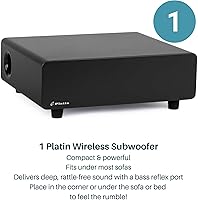
Bass enthusiasts and buyers coming from larger or ported subwoofer setups consistently flag this as the system's weakest link. In rooms over roughly 300 square feet, the sub loses authority during demanding cinematic moments — explosions and deep score passages in particular feel restrained rather than physical.
Setup & Installation
79%
21%
The included WiSA SoundSend transmitter and a single HDMI cable genuinely replace what would otherwise require an AV receiver, speaker wire runs, and a calibration routine. Most users have audio playing within 20–30 minutes, which is a meaningful advantage for buyers who dread complicated installs.
The SoundSend pairing process trips up a meaningful minority of first-time users, and the quick-start guide doesn't always provide enough detail for edge cases like older TVs with non-standard ARC implementations. Customer support responsiveness gets mixed marks in longer-term reviews.
Audio Clarity & Detail
86%
Uncompressed 24-bit transmission means the audio arriving at each speaker is exactly what left the source — no codec penalties, no re-compression. Listeners who compare this directly to a Bluetooth surround system describe a noticeably cleaner, more open midrange and better-defined high-frequency detail.
A handful of more critical listeners feel the THX tuning leans slightly toward a safe, balanced signature rather than a particularly exciting one. Audiophiles used to manually tuned systems may find the default sound profile a bit conservative out of the box before app adjustments.
THX Tuning & Calibration
82%
18%
THX certification here means the system was benchmarked against loudness, frequency response, and distortion standards that have real technical teeth — not just a logo. In practice, dialogue intelligibility is notably strong, and the tonal balance across speakers is consistent right from the first power-on.
The THX tuning targets a reference standard that not every buyer actually prefers. Users who enjoy boosted bass or a V-shaped sound profile will need to spend time in the app dialing the system away from its default calibration, which adds friction for less tech-savvy buyers.
Companion App Experience
71%
29%
When it works well, the app gives genuinely useful control — per-speaker level trimming, basic EQ adjustment, and input switching without touching the TV remote. Users who take time to explore it find it adds a meaningful layer of personalization that a standard soundbar app doesn't offer.
App stability is the most common software complaint: periodic disconnections from the speakers, slow reconnection after sleep, and occasional crashes on older Android devices surface across multiple independent reviews. The core functionality is solid, but the app feels like it needs another software revision cycle.
Build Quality & Materials
77%
23%
The cabinet finish is clean and consistent, and the magnetic grills attach firmly without rattling at higher volumes. Satellite speaker housings feel sturdy rather than hollow, and the overall physical presentation is appropriate for a system positioned above entry-level home theater options.
A few users point out that the SoundSend transmitter feels noticeably lighter and more plasticky than the speakers themselves — a minor but recurring observation. The power cable complement (six separate cords for the full system) also draws criticism given the product's otherwise tidy wireless identity.
Design & Room Integration
81%
19%
Compact satellite dimensions and the removable magnetic grills make this one of the more living-room-friendly multi-speaker setups available. The grills swap easily if you want a clean, speaker-cloth look to blend into a media cabinet or open shelving without the drivers visible.
The subwoofer is a reasonably large box, and its dimensions make tucking it completely out of sight more difficult than some buyers anticipated. The all-black color scheme works in most setups but leaves no option for buyers with lighter décor palettes.
TV Compatibility
89%
HDMI ARC and eARC cover the overwhelming majority of smart TVs sold in the last several years, and in practice the system shows up as a standard audio device — volume follows the TV remote with no additional configuration required. Owners with newer TVs using eARC report noticeably cleaner audio handoff.
Buyers with older televisions that have optical-only audio outputs or non-compliant ARC implementations face compatibility headaches. A small group of users report that their specific TV model required firmware updates or manual ARC activation before the SoundSend would register reliably.
Value for Money
73%
27%
For buyers who specifically need a cable-free Dolby Atmos surround system compatible with a smart TV — and don't want to manage an AV receiver — the Monaco 5.1.2 occupies a fairly unique position in the market. The WiSA transmitter alone represents meaningful engineering cost, and the THX tuning adds legitimate value.
Buyers comparing on raw audio performance per dollar against wired alternatives at a similar price will find the math works against the wireless premium. If you don't actively need the cable-free setup, competing wired systems deliver more speaker output and subwoofer impact for the same or less money.
Long-Term Reliability
74%
26%
The majority of owners who have lived with this WiSA home theater setup for a year or more report that the core audio performance and wireless stability hold steady — no gradual degradation in connection quality or speaker output has been widely flagged in extended ownership reviews.
A minority of users report issues with the SoundSend unit specifically over time — occasional need to re-pair, or the unit requiring a restart after extended idle periods. These are not universal experiences, but they appear frequently enough to suggest the transmitter is the system's most vulnerable long-term component.
Mounting & Placement Flexibility
78%
22%
The satellite speakers include threaded inserts compatible with standard M6 screws, meaning they can sit on commercial speaker stands or mount directly to a wall bracket without any proprietary hardware. That opens up a lot of room layout options that a soundbar simply cannot match.
The screws needed for wall mounting are not included, which requires an extra purchase and some research to match the correct specification. A few users also note that the rear satellites' power cords limit placement flexibility more than expected given the otherwise wireless nature of the system.

Suitable for:

The Platin Monaco 5.1.2 Home Theater System is built for a specific kind of buyer, and for that buyer it genuinely delivers: someone who wants real discrete surround sound — not a soundbar simulation — but cannot or will not run speaker wire across a room. Renters are an obvious fit, since the entire system operates wirelessly and the satellites can be repositioned or removed without leaving a mark. Smart TV owners with a relatively modern set featuring HDMI ARC or eARC will find the connection process straightforward, and the ability to control volume with an existing TV remote removes one of the usual friction points of adding a separate audio system. This WiSA home theater setup also suits buyers who have already tried a premium soundbar and found it lacking — particularly for surround positioning and height effects during Atmos content. Small-to-medium sized rooms, roughly up to 300 square feet, are where the system performs most confidently across all channels including the subwoofer.
Not suitable for:

The Platin Monaco 5.1.2 Home Theater System is a poor match for buyers prioritizing raw acoustic performance per dollar without a strong preference for wireless convenience. If you are comfortable running speaker cables and have space for an AV receiver, competing wired systems at a similar price point will generally offer more subwoofer impact and greater satellite output — the wireless premium here is real and significant. Bass enthusiasts or anyone setting up in a large open-plan room will likely find this WiSA home theater setup underwhelming in the low end; the subwoofer performs adequately in contained spaces but does not deliver the physical, room-pressurizing bass that dedicated subwoofer-focused setups produce. Buyers with older televisions lacking HDMI ARC should also pause, as optical or analog connections are not supported and compatibility workarounds are unreliable. Finally, anyone who wants a truly hands-off, zero-configuration experience should know that the SoundSend pairing process has a learning curve that occasionally frustrates less tech-comfortable users.
Specifications

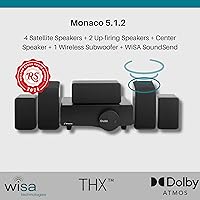
  • Channel Configuration: The system delivers 5.1.2 channels of surround sound, comprising five full-range speakers, one subwoofer, and two upward-firing height channels for Dolby Atmos.
  • Wireless Standard: Audio transmission uses WiSA-certified technology, operating on a dedicated 5 GHz radio network that is entirely separate from standard home Wi-Fi.
  • Audio Resolution: Each channel receives uncompressed 24-bit audio at 48–96 kHz, which exceeds CD-quality and avoids the lossy compression inherent to Bluetooth audio protocols.
  • TV Connection: The included WiSA SoundSend transmitter connects to a television via HDMI ARC or eARC, supporting all compatible smart TVs without requiring a separate AV receiver.
  • Certifications: The system carries both WiSA certification for wireless audio fidelity and official Dolby Atmos certification for immersive three-dimensional sound decoding.
  • Tuning Standard: Speaker calibration and tonal balance are validated against THX reference specifications, targeting accurate frequency response and controlled distortion levels.
  • Subwoofer Dimensions: The subwoofer measures 5.3″ wide × 15″ tall × 12.2″ deep, suitable for placement beside furniture in small-to-medium room setups.
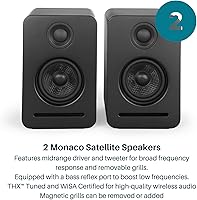
  • Satellite Dimensions: Each of the four satellite speakers measures 6.7″ × 4.3″ × 5.5″, compact enough for bookshelf or stand placement in most living room configurations.
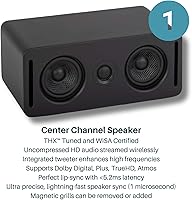
  • Center Channel: The center channel speaker measures 4.3″ × 10.2″ × 5.5″, designed for horizontal placement below or above a television display.
  • Wall Mounting: Satellite speakers include threaded inserts compatible with 12 mm long M6×1.0 screws (not included), allowing attachment to standard speaker wall brackets or stands.
  • SoundSend Dimensions: The WiSA SoundSend transmitter measures 1.0625″ (27 mm) × 4.3125″ (110 mm), small enough to sit discreetly behind or beside a television.
  • Control Methods: The system supports volume and input control via an existing TV remote through HDMI CEC, as well as per-speaker adjustments through a free companion smartphone app.
  • Grill Design: All speaker grills are magnetically attached and fully detachable, allowing removal without tools for an exposed-driver look or reattachment to suit room décor.
  • System Weight: The complete system, including all speakers and the subwoofer, has a combined weight of 46.1 pounds.
  • Color: The entire system ships in a uniform black finish across all speaker cabinets, the subwoofer, and the SoundSend transmitter.
  • In the Box: The package includes one center channel, two front satellites, two rear satellites, one subwoofer, one WiSA SoundSend, five 6-foot power cords, one 5-foot subwoofer power cord, one HDMI cable, one USB power cable, one power adapter, and a quick start guide.
  • Manufacturer: The Monaco 5.1.2 is designed by Platin, a brand operated under Hansong Technology, which specializes in WiSA-certified wireless audio products.
  • Availability Date: This product was first made available for purchase in October 2022.

Related Reviews
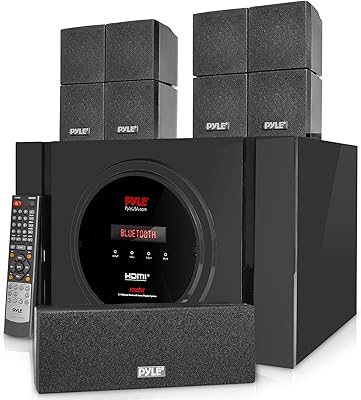
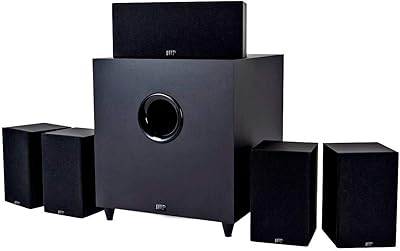
Monoprice 5.1.2 Channel Home Theater System
74%
91%
Value for Money
78%
Sound Quality
82%
Subwoofer Performance
61%
Atmos Height Effect
63%
Build Quality
More
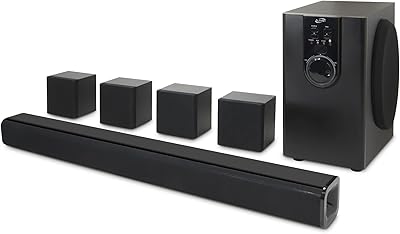
iLive IHTB159B 5.1 Home Theater System
66%
81%
Value for Money
58%
Audio Quality
44%
Bass & Subwoofer Performance
67%
Surround Sound Effect
83%
Ease of Setup
More
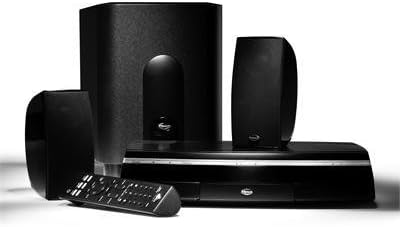
Klipsch CS-500 2.1 Home Theater System
69%
83%
Sound Clarity
74%
Bass Performance
61%
Virtual Surround Quality
91%
Ease of Setup
63%
DVD Player Reliability
More
Pyle PT589BT
Pyle PT589BT
66%
74%
Value for Money
61%
Sound Quality
72%
Subwoofer Performance
83%
Ease of Setup
53%
Build Quality
More
Monoprice 10565 5.1-Channel Home Theater System
70%
88%
Value for Money
83%
Bass Performance
76%
Surround Immersion
61%
Satellite Speaker Quality
54%
Build Quality
More
Rockville HTS56 5.1 Home Theater System
71%
67%
Sound Quality
74%
Subwoofer Performance
88%
Setup & Installation
83%
Connectivity & Compatibility
62%
Karaoke Functionality
More
Acoustic Audio AAT5005 5.1 Tower Speaker System
72%
83%
Value for Money
67%
Sound Quality
74%
Bass Performance
88%
Setup & Installation
54%
Build Quality
More
Boytone BT-326F 2.1 Bluetooth Home Theater System
72%
88%
Value for Money
83%
Sound Volume & Bass
86%
Connectivity Range
91%
Ease of Setup
61%
Audio Clarity
More
Acoustic Audio AAT1003 5.1 Tower Speaker System
70%
83%
Value for Money
88%
Setup & Installation
67%
Sound Quality
71%
Bass Performance
58%
Build Quality
More
Supersonic SC-38HT 5.1 Channel Home Theater System
71%
74%
Value for Money
58%
Audio Quality
47%
Build Quality
83%
Setup & Ease of Use
78%
Karaoke Performance
More

FAQ

No, and this is one of the more misunderstood aspects of WiSA technology. The SoundSend transmitter creates its own dedicated 5 GHz wireless network specifically for communicating with the speakers — it does not connect to or depend on your home router at all. You do not need to share your Wi-Fi password or change any network settings.

Unfortunately, no. The WiSA SoundSend transmitter requires an HDMI ARC or eARC port on your television. Optical audio outputs are not supported, and there is no adapter workaround that reliably handles the Dolby Atmos signal this system is designed around. If your TV is a few years old and lacks ARC, it is worth checking your TV's HDMI ports carefully before purchasing.

It depends heavily on your room. The upward-firing drivers in the front speakers bounce sound off the ceiling to create the impression of overhead audio, which works quite convincingly in rooms with flat ceilings at standard heights — roughly 8 to 9 feet. Vaulted, textured, or very high ceilings will reduce the effect significantly. For the right room, the height imaging during Atmos content is genuinely noticeable and not just a marketing claim.

Honestly, it depends on how large. In a contained room up to around 250–300 square feet, the subwoofer handles movie bass cleanly and integrates well with the satellite speakers. In larger open-plan spaces, many owners find it lacks the physical punch they expected from cinematic content. If deep, room-pressurizing bass is a priority for you, this system's subwoofer may leave you wanting more.

Yes, and this works well in practice. Because the SoundSend transmitter connects via HDMI ARC, the television's CEC system handles volume commands and passes them through automatically. Most users find they never need to use a separate remote for day-to-day control, which is one of the setup's genuine conveniences.

For most users, the process takes 20 to 30 minutes and involves plugging in each speaker, connecting the SoundSend to the TV via HDMI, and following the quick-start guide to pair the transmitter with the speakers. The majority of buyers complete this without issues. That said, a meaningful minority report that the SoundSend pairing requires a few re-attempts, particularly if there is significant wireless interference in the environment. Patience on the first setup pays off — once paired, the connection tends to stay stable.

Yes, as long as your smart TV or streaming device passes Dolby Atmos audio through its HDMI ARC or eARC port. Most modern smart TVs handle this automatically for apps like Netflix and Disney+ when Atmos content is available. The quality of the Atmos signal depends on the TV and the streaming plan — some platforms require a higher subscription tier to unlock full Atmos audio.

Yes, each satellite includes threaded inserts for M6×1.0 screws, which are compatible with a wide range of standard wall brackets and speaker stands sold separately. The screws themselves are not included in the box, so you will need to source 12 mm M6×1.0 hardware before mounting. It is a standard size available at most hardware stores.

For basic use — powering on, adjusting volume, switching inputs — the TV remote covers everything comfortably. The app becomes valuable if you want to trim individual speaker levels (for example, pulling the rear satellites down slightly in a reflective room), adjust EQ settings, or use Direct Mode for a more unprocessed signal path. It is not essential from day one, but worth exploring once you have lived with the system for a week or two.

The core difference is speaker placement: this WiSA home theater setup uses physically separate speakers positioned around the room, which produces discrete, localized surround effects that a soundbar — regardless of price — cannot genuinely replicate through DSP tricks alone. The trade-off is complexity: more units to place, more power cords to manage, and more initial setup time. If you have watched content on a properly set-up multi-speaker surround system before and missed that experience, this is a meaningful upgrade. If you just want better audio than your TV's built-in speakers with minimal setup, a high-end soundbar remains the simpler path.