Overview

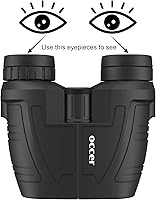
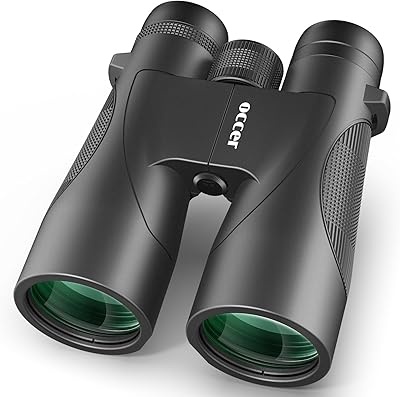
The Occer 12x25 Binoculars sit squarely in the budget-friendly tier, and that context matters before you buy. Pairing 12x magnification with a 25mm objective lens is a common entry-level compromise — you get strong zoom, but the smaller lens gathers less light than larger models. The body is ABS plastic with rubber armor, which sounds unimpressive until you pick it up and realize how light and grippy it actually feels in hand. With over 32,000 Amazon ratings averaging 4.4 stars, this budget-friendly pair has earned a level of real-world trust that is hard to fake at scale. Just go in knowing it is a capable starter, not a substitute for premium glass.
Features & Benefits

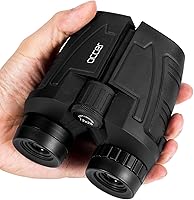
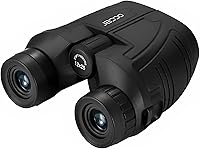
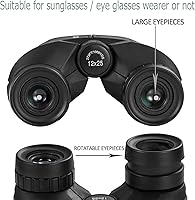
The BAK4 prism and FMC multilayer broadband coating are two specs worth understanding. BAK4 glass reduces light scatter for a cleaner, brighter image, while the multi-coated lenses boost contrast — both meaningful upgrades over cheaper alternatives. The field of view spans 273 feet at 1,000 yards, wide enough to track a bird hopping between branches without losing it. Eyeglass wearers will appreciate the adjustable rubber eyecups, which fold down to bring your eyes closer to the lens with no awkward squinting. The central focus wheel is manageable with one hand in the field. At just 13.7 ounces, these compact binoculars genuinely fit in a jacket pocket.

Best For

This budget-friendly pair is a natural fit for casual bird watchers who want something meaningful without a steep investment — think weekend walks in a nature reserve, not a professional ornithology expedition. Families with kids will appreciate the sturdy rubberized build, which handles the inevitable drops and fumbles. Travelers benefit most from the compact size; it slips into a daypack without adding noticeable weight. It also works well at sporting events, concerts, or air shows where you need to close the distance on action quickly. Where it falls short: serious wildlife photographers or anyone needing reliable low-light performance after sunset will want to look elsewhere.

User Feedback

Across more than 32,000 ratings, this budget-friendly pair maintains a 4.4-star average — a figure that is difficult to sustain without genuinely satisfying most buyers. Recurring praise centers on image brightness and clarity relative to the price, with several reviewers noting it holds its own against pairs they paid significantly more for. Glasses wearers consistently call out the eyecup system as a highlight. On the critical side, some users find the focus wheel stiff out of the box, and a portion note slight edge distortion at maximum magnification. Long-term durability seems reasonable for the price tier, though a handful of owners flag wear on the rubber coating after extended outdoor use.

Pros

  • BAK4 prism and FMC-coated lenses deliver noticeably bright, sharp images in good daylight conditions.
  • A 273-foot field of view at 1,000 yards makes tracking birds or moving subjects surprisingly easy.
  • Adjustable fold-down eyecups work well for glasses wearers, reducing vignetting without awkward repositioning.
  • At 13.7 ounces, this budget-friendly pair fits in a jacket pocket and adds almost nothing to a travel bag.
  • The rubberized exterior provides a secure, confident grip even in damp or sweaty conditions.
  • Over 32,000 verified ratings averaging 4.4 stars reflects consistent real-world satisfaction, not just launch hype.
  • Kids can operate the focus wheel and interpupillary adjustment independently after minimal instruction.
  • The price-to-feature ratio — BAK4 glass, multilayer coatings, adjustable eyecups — is hard to match at this tier.
  • One-hand focus adjustment is genuinely practical when you need to react quickly to moving subjects.

Cons

  • Focus wheel stiffness is a recurring complaint and does not fully resolve for all users even with break-in time.
  • Edge distortion is visible at full magnification, reducing the effectively usable portion of the field of view.
  • Rubber coating around the body and focus wheel shows peeling and wear after extended regular outdoor use.
  • Internal fogging has been reported by users in high-humidity environments, signaling limited weather sealing.
  • The 12x magnification amplifies hand tremor significantly, making prolonged handheld viewing tiring without a rest.
  • Included neck strap is thin and unpadded, uncomfortable for any carry longer than a short walk.
  • Low-light performance drops off sharply at dusk, despite product listing language suggesting otherwise.
  • Individual unit quality is inconsistent, with some buyers reporting loose hinges or misaligned focus mechanisms.
  • The diopter adjustment ring sits too close to the focus wheel and shifts accidentally during normal use.

Ratings

The Occer 12x25 Binoculars have been rated by our AI system after analyzing tens of thousands of verified global purchases, with spam, bot-generated, and incentivized reviews actively filtered out. The scores below reflect a honest, balanced picture — capturing what real buyers consistently praised and where they ran into frustrations. Strengths and pain points are weighted equally so you can make an informed call before buying.
Optical Clarity
83%
For a pair sitting in the budget tier, the image sharpness surprises most first-time buyers. The BAK4 prism combined with FMC multilayer coatings produces a bright, reasonably crisp center image that holds up well on sunny days for bird watching or sightseeing. Many users coming from toy-grade binoculars describe the jump in clarity as significant.
Edge sharpness falls off noticeably, with a soft, slightly distorted ring around the periphery of the view. This becomes more apparent at full 12x magnification and is a recurring complaint among users who have previously owned mid-range optics. It is a real limitation, even if expected at this price point.
Magnification Performance
78%
22%
The 12x magnification lets you pull distant subjects — a bird on a far branch, a player on the opposite side of a football field — into surprisingly usable detail. For casual use at sporting events or on a nature trail, it delivers enough zoom to feel genuinely useful without requiring a tripod.
High magnification amplifies hand tremor, and at 12x without optical stabilization, holding a steady image requires deliberate effort. Some users find prolonged handheld viewing tiring, especially older users or anyone with shaky hands. A few reviewers note they would have preferred a 10x version for steadier everyday use.
Build Quality
71%
29%
The rubber armor coating gives a secure, confident grip even in light rain or with sweaty hands on a summer hike. The body feels more solid than the ABS plastic construction might suggest on paper, and the rubberized exterior has absorbed drops and bag knocks without cracking for many owners.
Long-term owners flag wear on the rubber coating after extended outdoor use, with peeling reported around the focus wheel area after a year or more of regular activity. The plastic chassis does flex slightly under firm pressure, and the overall feel lacks the dense, premium solidity of metal-bodied alternatives — a clear trade-off for the weight savings.
Value for Money
93%
Few products in this category generate as much positive sentiment around price-to-performance as this budget-friendly pair. Buyers repeatedly note that the optical quality and feature set — BAK4 prism, FMC coatings, adjustable eyecups — would cost considerably more from a recognized brand name. For a first serious pair or a gift, the value calculus is hard to argue with.
The value story weakens if you are replacing this pair within 18 months due to durability issues, which a subset of long-term owners have experienced. Additionally, buyers who stretch the budget slightly toward the mid-range tier often report a meaningful step up in optical quality that makes the Occer feel less competitive in retrospect.
Ease of Focus
67%
33%
The central focus wheel is accessible with one hand, which matters when you are trying to quickly lock onto a moving bird or a fast-moving play on the field. Most users find rough focusing straightforward, and the diopter adjustment works well for calibrating individual eye differences.
Stiffness in the focus wheel is the single most repeated mechanical complaint across verified reviews. Out of the box, several users describe it as requiring more force than expected, and fine-tuning focus on a moving subject can feel sluggish as a result. It tends to loosen slightly with break-in use, but does not fully resolve for everyone.
Comfort for Eyeglass Wearers
86%
The twist-up, fold-down rubber eyecups are a genuine practical feature for glasses wearers. Folding them down brings the eye close enough to the lens to see the full field of view without the black vignette that plagues poorly designed eyecups. Reviewers who wear prescription glasses consistently highlight this as a standout feature for the price.
The eyecup mechanism on some units feels loose and does not hold its position reliably, occasionally collapsing during use. Users with larger frames report that the eye relief, while better than average for the tier, is still not quite generous enough to eliminate all vignetting at the edges of the field.
Portability & Size
91%
At 13.7 ounces and roughly the footprint of a large apple, these compact binoculars genuinely slip into a jacket pocket or the outer pouch of a daypack. Travelers, commuters heading to a game, and parents stuffing a bag for a school field trip all mention how little space and weight they add to the carry.
The included carrying strap is functional but basic — thin and non-padded, making extended neck carry mildly uncomfortable on longer hikes. The included pouch is similarly minimal. Neither accessory matches the quality or thoughtfulness you would find with mid-range binoculars.
Low-Light Performance
53%
47%
At dusk or in the early morning golden hour, the FMC-coated lenses gather enough light to produce a usable image for bird watching in woodland shade. Compared to uncoated budget alternatives, the difference in a dim but not dark environment is noticeable and appreciated by birders who head out at dawn.
The 25mm objective lens is simply too small to perform well once natural light drops significantly. Despite marketing language implying night-vision-adjacent capability, this pair is not a low-light tool. Multiple buyers felt misled by the product listing and were disappointed when using it after sunset, finding the image too dim and grainy to be practical.
Field of View
82%
18%
A 273-foot field of view at 1,000 yards is competitive for a 12x compact, making it easier to relocate a bird in flight or pan across a wide landscape without constantly adjusting aim. Sports spectators and wildlife watchers both call this out as a strength, especially compared to narrower 12x options they had tried previously.
While the field of view is respectable on paper, the edge distortion discussed in optical clarity reviews reduces the effectively usable portion of that view. In practice, you are mentally cropping to the sharper central zone, which narrows the real-world advantage somewhat.
Waterproofing & Weather Resistance
63%
37%
The rubber armor and basic splash resistance hold up fine for light rain, morning dew, or accidental splashes near water. Day hikers and casual boaters report using these compact binoculars in damp conditions without issue, and the construction does not feel vulnerable to light moisture exposure.
This is not a sealed, nitrogen-purged optic. Fog, heavy rain, or submersion-level exposure is a real risk, and several users report internal fogging after use in high-humidity environments over time. Buyers expecting full weather sealing comparable to dedicated outdoor optics will be disappointed by the limitations here.
Image Brightness
79%
21%
In good daylight, the combination of BAK4 prism and broadband FMC coating produces a noticeably bright image for the class. Colors appear reasonably accurate and the image does not have the washed-out or yellowish tint that plagues cheaper uncoated alternatives. Outdoor reviewers consistently rate daytime brightness as above expectations.
Brightness drops off faster than expected as light conditions deteriorate. The small exit pupil — a consequence of the 25mm objective at 12x — limits how much light reaches the eye, which is a physics constraint no coating fully overcomes. Buyers in consistently cloudy or forested environments may find the image underwhelming.
Durability Over Time
61%
39%
For casual, seasonal use — a few weekends of bird watching per year, a handful of sporting events, family vacations — the build holds up adequately. Users who treat these compact binoculars gently and store them properly report no meaningful degradation after two or more years of light use.
Buyers who use them regularly in rough outdoor conditions report wear accumulating faster than expected. Rubber delamination, focus wheel loosening, and minor misalignment after drops are recurring themes in longer-term ownership reviews. The durability ceiling is clearly lower than what a metal-chassis mid-range pair would offer.
Ease of Setup & Use
88%
There is essentially no learning curve here. Unfold, set the interpupillary distance to match your eyes, adjust the diopter once, and you are ready to go within two minutes. Kids and first-time binocular users consistently describe the experience as intuitive, making this pair genuinely accessible to the whole family.
The diopter adjustment ring is small and positioned close to the focus wheel, leading to occasional accidental shifts during focus adjustments. A few users also note that the hinge tension for adjusting eye width feels either too stiff or too loose depending on the unit, with some variability in quality between individual pairs.
Suitability for Kids
84%
The compact size and light weight make this budget-friendly pair a natural fit for younger users. Children find it easy to hold and operate without adult assistance, and the rubber coating absorbs the kind of casual abuse a kid will inevitably dish out. Parents frequently gift this as a first real optic for nature-curious kids.
The 12x magnification can be harder for younger children to keep steady, leading to frustration when they cannot hold the image still on a subject. Some parents suggest a lower magnification would actually serve kids better for relaxed, unassisted use, and a smaller interpupillary range would help for very young faces.

Suitable for:

The Occer 12x25 Binoculars are a strong fit for anyone who wants a meaningful step up from cheap, toy-grade optics without committing to a serious investment. Casual bird watchers who head out on weekend trails will find the 12x magnification and wide field of view genuinely useful for spotting and tracking birds in decent light. Families with kids are well served here too — the compact size suits smaller hands, the rubber armor absorbs the inevitable drops, and the straightforward focus wheel requires no technical knowledge to operate. Travelers and sightseers who count every ounce in their bag will appreciate a pair that slips into a jacket pocket and barely registers on the scale. This budget-friendly pair also works well at outdoor sporting events, concerts, or air shows where you want to close the distance on the action without lugging around bulky gear. For anyone buying their first real binoculars — replacing a flimsy department-store pair or picking up a gift for a curious child — these compact binoculars sit in a genuinely useful sweet spot.
Not suitable for:

Buyers with serious optical demands should look elsewhere before considering this budget-friendly pair. Wildlife photographers, dedicated birders who spend long hours scanning distant treelines, or anyone who frequently shoots in low-light conditions at dawn or after dusk will run into the hard limits of a 25mm objective lens fairly quickly. The low-light performance is functional at dusk but drops off sharply as darkness sets in — the product listing overstates this capability, and buyers expecting anything approaching night-vision performance will be genuinely disappointed. Astronomy hobbyists will find the small aperture and plastic construction wholly inadequate for scanning the night sky. Users who rely on their binoculars in extreme weather conditions — heavy rain, high humidity, or coastal salt air over extended periods — should invest in a properly sealed, nitrogen-purged optic rather than relying on this pair's basic splash resistance. And if you are replacing a well-worn mid-range binocular and expect comparable optical quality and long-term build durability, the Occer 12x25 Binoculars will likely feel like a step down rather than a lateral move.
Specifications

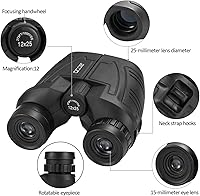
  • Magnification: These binoculars offer 12x magnification, bringing distant subjects 12 times closer than the naked eye.
  • Objective Lens: The objective lens diameter is 25mm, which determines light-gathering capacity and directly affects brightness in low-light conditions.
  • Field of View: The field of view spans 273 feet at 1,000 yards, allowing wide scene coverage useful for tracking moving subjects.
  • Prism Type: BAK4 (barium crown glass) prisms are used internally, reducing light scatter and producing a cleaner, more circular exit pupil than lower-grade BK7 alternatives.
  • Lens Coating: The objective lenses use FMC (fully multi-coated) broadband green film coating to maximize light transmission and color accuracy.
  • Eyepiece Coating: Eyepiece optics are treated with blue FMC coating to further reduce glare and improve contrast in bright outdoor conditions.
  • Eyepiece Diameter: The eyepiece measures 15mm in diameter, which is larger than many compact alternatives and contributes to a more comfortable viewing experience.
  • Eye Relief: Long eye relief is provided via adjustable twist-up, fold-down rubber eyecups that accommodate both eyeglass wearers and non-wearers.
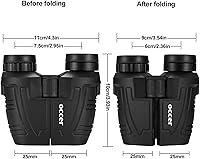
  • Dimensions: The body measures 4 × 4 × 4.4 inches when folded, making it genuinely compact enough to fit in a jacket pocket or small daypack.
  • Weight: Total weight is 13.7 ounces, light enough for extended carry without causing noticeable fatigue during a full day outdoors.
  • Body Material: The chassis is constructed from ABS plastic with a rubberized armor exterior that provides grip, minor shock absorption, and basic weather resistance.
  • Weather Resistance: The build offers basic splash and light-rain resistance but is not fully sealed or nitrogen-purged, making it unsuitable for submersion or sustained heavy rain.
  • Low-Light Use: Usable image quality extends to dusk and heavily shaded environments but drops off sharply in darkness — this is not a night-vision device.
  • Focus Mechanism: A central focus wheel enables single-hand operation, with a separate diopter adjustment ring to calibrate for differences between the left and right eye.
  • Exit Pupil: The exit pupil diameter is approximately 2.1mm (calculated as objective lens divided by magnification), which is narrow and limits performance in dim conditions.
  • Age Suitability: Designed for both adults and children, with the compact form factor and light weight making it accessible to younger users from around age 7 and up.
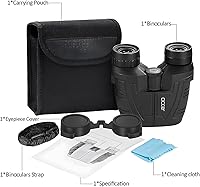
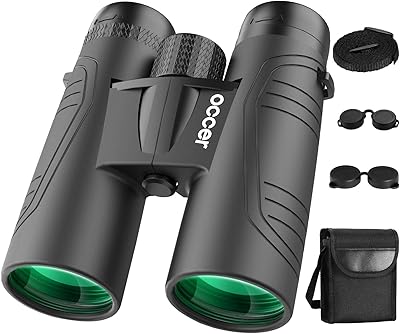
  • Included Accessories: Each unit ships with a carrying strap; a basic soft pouch may also be included depending on the retail package.
  • Manufacturer: Made by Occer, a brand focused on entry-level to mid-tier optical products, with this model first listed in August 2017.

Related Reviews
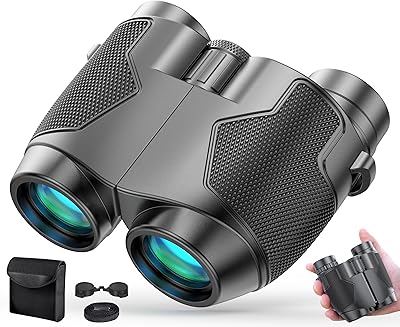
Occer 12x50 Binoculars
87%
89%
Clarity & Sharpness
85%
Ease of Use
88%
Build Quality
91%
Lightweight & Portability
67%
Focus Adjustment Speed
More
Occer 15x42 Binoculars
86%
88%
Magnification and Clarity
92%
Portability and Weight
85%
Optical Quality
87%
Build Quality
90%
Ease of Use
More
Retulgie 12x25 Compact Binoculars
75%
74%
Optical Clarity
58%
Low-Light Performance
63%
Build Quality
91%
Portability & Size
78%
Comfort & Ergonomics
More
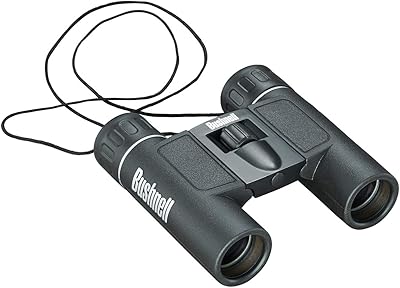
Bushnell PowerView 12x25 Binoculars
82%
80%
Performance at Distance
91%
Portability/Size
83%
Magnification Clarity
88%
Ease of Use
85%
Build Quality/Durability
More
POLDR 12x25 Compact Binoculars
79%
94%
Portability & Size
78%
Optical Clarity
52%
Low-Light Performance
91%
Ease of Use
61%
Build Quality & Durability
More
DEESOO 25x32 Binoculars
80%
78%
Optical Clarity
71%
Magnification Performance
74%
Low-Light Performance
93%
Portability & Size
69%
Build Quality & Durability
More
ZIYOUHU 20x50 Binoculars
74%
74%
Optical Clarity
71%
Light Transmission
63%
Magnification Usability
69%
Build Quality
82%
Waterproofing & Fog Resistance
More
Rodcirant 15x25 Binoculars
85%
89%
Value for Money
84%
Magnification Performance
95%
Portability and Size
90%
Durability (Waterproof/Fog-proof)
88%
Ease of Use (One-handed Operation)
More
Hontry 8x42 Binoculars
79%
83%
Optical Clarity
91%
Waterproof Performance
88%
Floating Capability
77%
Build Quality
81%
Comfort & Ergonomics
More
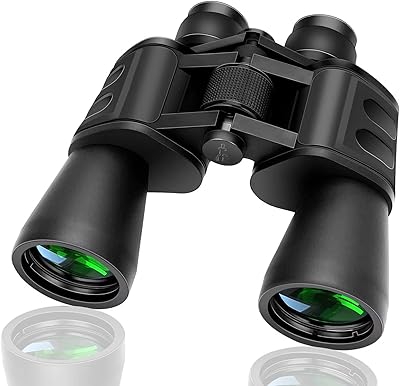
Aurosports 15x56 Binoculars
77%
83%
Optical Clarity
71%
Low-Light Performance
67%
Magnification Usability
76%
Build Quality
88%
Value for Money
More

FAQ

Yes, they are genuinely well-suited for first-time buyers. The setup is straightforward — adjust the width to match your eyes, tweak the diopter once for your vision, and you are ready to go in minutes. The image quality is a noticeable step up from toy-grade optics, which makes the learning experience rewarding rather than frustrating.

Generally yes. The fold-down rubber eyecups are specifically designed for this — roll them down to bring your eye closer to the lens, and most glasses wearers report seeing the full field of view without significant black vignetting around the edges. It works better for some frame sizes than others, but this is one of the more consistently praised features among verified buyers.

Most children aged 7 and up can operate this budget-friendly pair on their own after a quick introduction. The focus wheel is simple, the body is light enough for smaller hands, and the rubber coating handles the inevitable bumps. The 12x magnification can be a bit tricky to hold steady for very young kids, but it is manageable for most school-age children.

For casual bird watching on trails, in parks, or in the backyard, it performs well in good daylight. The wide field of view helps you locate and track birds quickly, and the 12x magnification pulls in solid detail on a perched subject. Serious birders who scan for hours or work in dense forest shade will notice the optical limitations, but for recreational use it is a capable starter pair.

Light rain and splashes are fine — the rubber armor and basic water resistance handle incidental moisture without issue. What you want to avoid is extended downpour exposure or any submersion, as the body is not fully sealed. High-humidity environments over time can also cause internal fogging, so it is worth drying and storing it properly after damp outings.

Unfortunately, yes — stiff focus wheel resistance is the most commonly reported mechanical issue with this pair. It tends to loosen slightly with regular use over a few weeks, but it does not always resolve completely. If it is genuinely difficult to turn rather than just firm, it is worth contacting the seller, as some units appear to have tighter tolerances than others.

Not really. The 25mm objective lens gathers limited light, and the 2.1mm exit pupil is too narrow for comfortable night sky viewing. You would want at least a 50mm objective — and ideally 70mm or larger — for astronomy use. These are daylight and dusk optics, and pushing them into full darkness will produce dim, unsatisfying results.

Higher magnification sounds better on paper, but there are real trade-offs. At 12x, any hand tremor is amplified noticeably, making it harder to hold a steady image without bracing against something. An 8x or 10x pair is generally easier to use handheld for extended periods. For stationary viewing — watching a stage, scanning a field from a fixed position — 12x is fine; for fast-moving subjects on the move, lower magnification is often more practical.

You get the binoculars themselves, a carrying strap, and typically a basic soft storage pouch. The accessories are minimal and utilitarian — the strap in particular is thin and unpadded, so if you plan to carry them around your neck for long periods you may want to swap it out for something more comfortable.

The jump from this budget-friendly pair to a mid-range option in the 60 to 100 dollar range typically brings meaningfully better edge sharpness, more robust weather sealing, smoother focus mechanics, and improved low-light performance. For casual seasonal use, these compact binoculars offer strong value. But if you find yourself using binoculars regularly — multiple times a week, in varied conditions — the investment in a better-built pair tends to pay off fairly quickly in both image quality and durability.