Overview

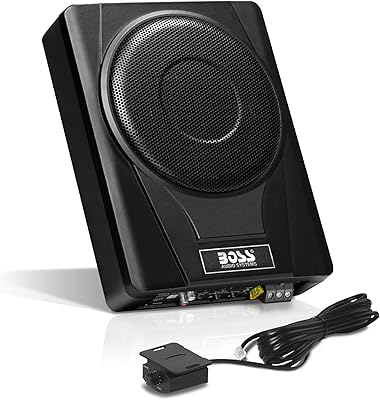
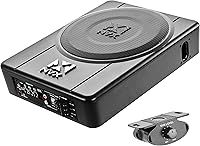
The NVX QBUS10P 10-inch Under-Seat Subwoofer System is built for drivers who want real bass without gutting their trunk or wiring in a separate amplifier. It packs a built-in amp rated at 500 watts peak into a low-profile rectangular box that slides under a front or rear seat. The ported enclosure design pushes noticeably deeper output than you'd typically expect from something this slim. It takes either speaker wire or RCA inputs, so it works with stock radios and aftermarket units alike. This is a mid-range, convenience-first product — not a competition build — and that's exactly the point.
Features & Benefits

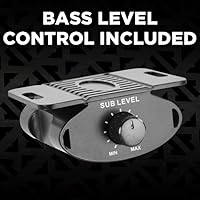
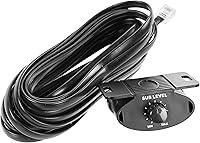
One of the standout practical touches is automatic signal sensing — the unit powers on whenever it detects audio coming from your head unit, which means you never need to run a dedicated remote turn-on wire. For anyone doing their first car audio install, that alone saves a meaningful amount of frustration. The variable low-pass filter, adjustable between 50 and 150 Hz, lets you tune how aggressively the sub blends with your door speakers. A remote bass knob ships in the box, so you can dial levels up or down from the driver's seat. At roughly 13.6 inches deep and just over three inches tall, the QBUS10P is genuinely DIY-friendly.

Best For

This compact subwoofer system makes the most sense for everyday commuters and casual listeners who want more bass without committing to a full audio overhaul. If your trunk holds groceries, gear, or a stroller and you'd rather keep it that way, the under-seat placement is a real practical win. It's also a strong pick for anyone running a factory head unit — since it accepts high-level speaker wire, there's no need to swap out the radio just to add bass. Rideshare drivers and delivery workers will appreciate the compact footprint. Just measure your under-seat clearance before ordering; the unit sits just over three inches tall, and some vehicles run tighter than you'd expect.

User Feedback

Across roughly 160 ratings, this under-seat sub holds a 4.1-star average, which tracks with what people actually say in their reviews. The most consistent praise centers on how straightforward the install is — particularly the auto turn-on, which buyers who have never wired a sub before found genuinely reassuring. Bass output gets called out as stronger than expected given the slim profile. On the flip side, some users report that pushing the bass boost too high produces a boomy, one-note sound — a trade-off common with ported designs at this price tier. There are also scattered complaints about fitment in vehicles with unusually shallow under-seat clearance.

Pros

  • No separate amplifier needed — the built-in amp keeps the install clean and simple
  • Auto signal-sensing power-on means no remote wire to run, a genuine time-saver for beginners
  • Works with factory head units via speaker-level inputs, so you keep your existing radio
  • The included remote bass knob lets you adjust volume from the driver's seat without touching the unit
  • Ported enclosure produces noticeably deeper bass than most sealed compact subs its size
  • Low-pass filter is adjustable across a wide range, making it easier to blend with different speaker setups
  • Slim rectangular profile fits under most standard passenger or rear seats without major modifications
  • Handles both RCA and speaker wire inputs, covering nearly every head unit on the market
  • At just over 11 pounds, it is light enough for a solo DIY install with basic tools
  • Solid owner satisfaction rating across a meaningful number of real-world buyers

Cons

  • Pushing the bass boost too high causes a boomy, one-note sound that some listeners find fatiguing
  • Buyers with low-clearance vehicles — certain Japanese sedans and sporty coupes especially — may find it does not fit
  • Not ideal for larger cabins where you need substantial output to fill the space
  • Limited tuning options compared to a standalone amp-and-sub pairing for more experienced users
  • Ported designs are less forgiving of placement and enclosure position than sealed alternatives
  • No wireless connectivity or app-based control; adjustments beyond the knob require physical access
  • The limited warranty offers less long-term coverage assurance than some competing brands provide
  • Bass quality at the top of the boost range lacks the definition that dedicated audio builds achieve
  • Physical dimensions leave little room for error — you must measure your under-seat space carefully beforehand
  • Not a practical upgrade path; once you outgrow it, you replace the whole unit rather than swap components

Ratings

The scores below reflect AI-driven analysis of verified global buyer reviews for the NVX QBUS10P 10-inch Under-Seat Subwoofer System, with spam, bot activity, and incentivized feedback actively filtered out before scoring. Each category is weighted against real-world usage patterns — daily commuters, first-time installers, and casual listeners form the bulk of the reviewer base. Both the genuine strengths and the recurring frustrations are factored in transparently, so the numbers tell the full story.

Ease of Installation
91%
Buyers consistently describe this as one of the easiest car audio installs they have attempted, and the auto signal-sensing power-on feature draws the most specific praise — it removes the step that trips up most beginners. Commuters who have never wired a subwoofer before report getting it running in under an hour with basic hand tools.
A small number of users struggled with routing the power wire to the battery in vehicles with tight firewall access, which is a general install challenge rather than a flaw of the unit itself. The included instructions could be more detailed for complete beginners.
Bass Output
84%
For something that slides under a seat, the low-end punch catches a lot of buyers off guard in a good way. The ported enclosure design genuinely extends the depth of bass compared to sealed compact alternatives, and most reviewers say it noticeably transforms the listening experience on daily commutes.
At higher bass boost settings, the output can become loose and one-dimensional, which is a known trade-off with ported designs at this price tier. Buyers expecting tight, textured bass rather than raw volume will find the tuning ceiling disappointing.
Sound Quality
72%
28%
Within its intended use case — adding warmth and body to a flat factory sound system — this compact subwoofer system delivers a genuinely satisfying result for most casual listeners. Blended carefully with the low-pass filter set in the 80–100 Hz range, it integrates reasonably well with stock door speakers.
Critical listeners or anyone used to dedicated audiophile builds will notice the lack of definition and texture in complex bass passages. The ported tuning prioritizes output over accuracy, which is fine for pop and hip-hop but less flattering on genres where bass detail matters.
Value for Money
88%
Buyers repeatedly point out that getting a subwoofer and amplifier in one unit, with a remote knob included, at this mid-range price point represents strong overall value. The all-in-one nature means there are no hidden add-on costs for a separate amp or enclosure.
A handful of reviewers who compared it directly against similarly priced separate component setups felt the sound quality trade-off was not worth the convenience premium. For buyers willing to do a slightly more complex install, the same budget can stretch further in terms of audio performance.
Build Quality
74%
26%
The enclosure feels sturdy enough for permanent under-seat mounting, and the overall construction holds up well to the vibrations inherent in a moving vehicle. Most long-term owners report no rattles or structural issues after months of daily use.
The unit does not feel premium to the touch — the finish and materials are clearly cost-managed, which is expected at this price but worth noting. A few buyers mentioned the grille and port area feel less robust than the main enclosure.
Fitment Compatibility
63%
37%
In the majority of standard sedans, crossovers, and mid-size trucks with typical seat clearance, the low 3-inch profile slides in without issue. Owners of common vehicles like full-size pickups and standard family sedans generally report no fitment problems.
This is the most common complaint in critical reviews — several vehicle models, particularly sporty coupes and certain compact Japanese sedans, have under-seat clearance below 3 inches, making installation impossible without modification. NVX does not publish a compatibility list, which leaves buyers to measure and hope.
Remote Bass Knob
86%
The included remote knob earns repeated positive mentions because it solves a real usability problem — once the sub is under the seat, you do not want to reach down to adjust anything while driving. Buyers appreciate that it mounts cleanly on a center console or dash and responds smoothly.
The knob is wired, not wireless, so cable routing adds a minor extra step during install. A few buyers noted the cable length could be longer to accommodate certain vehicle layouts where the ideal mounting spot is further from the seat.
Compatibility with Factory Radios
89%
The high-level speaker wire input is the feature that makes this system genuinely plug-and-play for the large portion of drivers who have never swapped out their stock head unit. It taps into the existing speaker wiring without any signal processor or line output converter needed in most cases.
In some vehicles with very low factory speaker output voltage, the auto turn-on sensitivity may not trigger reliably, requiring manual threshold adjustment if the option is available. This is an edge case but worth knowing if your factory system runs at unusually low volume.
Low-Pass Filter Usability
78%
22%
Having a physical filter adjustment rather than being locked to a fixed crossover frequency gives buyers a meaningful way to tailor how the sub blends with their specific speakers. Most users who take the time to dial it in report a noticeably more natural sound integration.
There is no detent or calibration marking on the adjustment, so finding the sweet spot is a trial-and-error process that some buyers find tedious. First-time users who do not understand crossover frequencies may leave it at default and miss out on the best the unit can offer.
Footprint & Space Saving
93%
This is where the QBUS10P genuinely earns its keep — riders in the back seat do not notice it is there, cargo capacity is unaffected, and rideshare drivers report that passengers have zero idea a subwoofer is installed. The rectangular profile makes it easier to secure than cylindrical alternatives.
The depth dimension of nearly 14 inches can be a snug fit front-to-back under seats with limited fore-aft space, particularly behind front seats in smaller vehicles. Buyers in two-door cars or hatchbacks with compact rear seat areas should measure depth as carefully as height.
Auto Turn-On Reliability
81%
19%
For the vast majority of users, the signal-sensing circuit works exactly as described — the sub comes on when you start playing audio and shuts off quietly when you stop, with no delays or ghost activations reported under normal use. This hands-free behavior is consistently praised.
Some users in vehicles with electrical noise on the speaker lines report occasional phantom activations or a brief delay before the unit recognizes a signal. These are minor nuisances rather than functional failures, but they do come up often enough in reviews to be worth mentioning.
Long-Term Durability
71%
29%
Buyers who have owned the unit for over a year generally report it still functioning without degradation in output or amp performance, which is encouraging for a budget-tier all-in-one design. The amplifier does not appear to run excessively hot under normal listening levels.
The limited warranty and relatively sparse long-term ownership data in the review pool make it hard to assess with full confidence beyond the 12–18 month mark. A few buyers experienced amp failure after aggressive use at high power levels, which suggests thermal limits are real.
Included Accessories
69%
31%
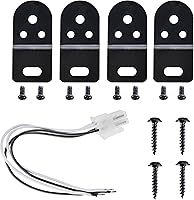
The remote bass knob being included out of the box is genuinely useful and not a given at this price point — it would cost extra on competing products. The wiring kit covers the basics needed for a standard install.
The wiring kit is adequate but not generous — power wire gauge and length may require supplementing for longer runs in larger vehicles. No quick-start guide or clear wiring diagram is included, which is a missed opportunity given the beginner-friendly positioning of the product.
Noise & Distortion Control
67%
33%
At moderate listening levels with conservatively set bass boost, the unit is clean and free of audible distortion for most buyers. The filter adjustment helps prevent the sub from muddying the midrange coming from the door speakers.
At high bass boost settings combined with high volume, clipping and distortion become noticeable, which is a limitation of the amp section rather than the driver itself. Buyers who habitually listen at maximum volume will encounter this ceiling fairly quickly.

Suitable for:

The NVX QBUS10P 10-inch Under-Seat Subwoofer System was essentially designed for the driver who wants a meaningful bass upgrade but has no interest in turning their car into a weekend project. It's a natural fit for daily commuters in sedans, compact SUVs, or smaller trucks where trunk space is either limited or simply too valuable to sacrifice. If you're running a factory head unit and assumed that meant you couldn't add a subwoofer without replacing your radio, this unit removes that barrier entirely — the high-level speaker wire input connects directly to your existing system. First-time car audio buyers will find the auto signal-sensing power especially freeing, since it eliminates one of the most confusing steps in a traditional install. Rideshare and delivery drivers who spend hours in the car each day and want better sound without altering their vehicle's usability will also find this a practical, low-commitment solution.

Not suitable for:

The NVX QBUS10P 10-inch Under-Seat Subwoofer System is not the right choice for buyers chasing serious, high-fidelity bass performance or anyone building a dedicated car audio system from the ground up. Audiophiles or enthusiasts who already own an external amplifier will find little value in the built-in amp and may prefer a standalone subwoofer with more tuning flexibility. The ported enclosure, while great for output, can sound loose and overblown if you push the bass boost aggressively — so buyers who want tight, accurate low-end reproduction may be disappointed. Physically, this unit sits just over three inches tall, and that's enough to be a dealbreaker in vehicles with unusually shallow under-seat clearance; always measure before purchasing. Anyone expecting concert-level bass in a large cabin, like a full-size SUV or van, should also look elsewhere — this compact system has real limits at room-filling volumes.

Specifications

  • Peak Power: The built-in amplifier delivers up to 500 watts peak output to drive the 10-inch driver.
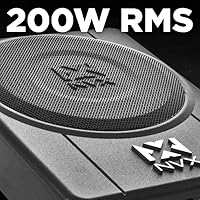
  • RMS Power: Continuous RMS power output is rated at 200 watts, reflecting real-world sustained performance.
  • Driver Size: A 10-inch dynamic driver handles low-frequency reproduction inside the ported enclosure.
  • Enclosure Type: The ported (bass-reflex) box design is tuned to extend low-frequency output and improve overall efficiency.
  • Dimensions: The unit measures 13.6″ deep by 10.3″ wide by 3.2″ tall, designed to slide under a standard vehicle seat.
  • Weight: At 11.14 pounds, the system is light enough for a straightforward solo installation.
  • Low-Pass Filter: A variable low-pass filter is adjustable between 50 Hz and 150 Hz to blend bass output with the vehicle's existing speakers.
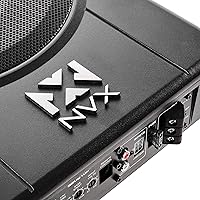
  • Input Types: Accepts both high-level speaker wire inputs and low-level RCA inputs, ensuring compatibility with factory and aftermarket head units.
  • Turn-On Method: The amplifier uses automatic signal sensing to power on and off, eliminating the need for a dedicated remote turn-on wire.
  • Bass Control: A wired remote bass knob is included, allowing the driver to adjust bass level without reaching under the seat.
  • Mounting Type: Designed specifically for under-seat installation in cars, trucks, and SUVs.
  • Power Source: Draws power from the vehicle's 12V electrical system via a corded wired connection.
  • Connectivity: All connections are wired; no Bluetooth or wireless audio transmission is supported.
  • Driver Type: Uses a dynamic driver, the standard and most common driver architecture for automotive subwoofers.
  • Frequency Response: The system is rated to reproduce frequencies up to 150 Hz, covering the full subwoofer range.
  • Surround Config: Listed as compatible with 5.1 and 7.1 surround channel configurations as a bass channel component.
  • Compatible Devices: Works with any audio source connected to the head unit, including smartphones and tablets via the radio's inputs.
  • Warranty: Covered by a limited manufacturer warranty; buyers should confirm specific terms directly with NVX or the retailer.
  • UPC: The product's Universal Product Code is 810021844442, useful for verifying the correct item before purchase.
  • Model Number: The unit's official model designation is QBUS10P, part of NVX's QBUS product family.

Related Reviews
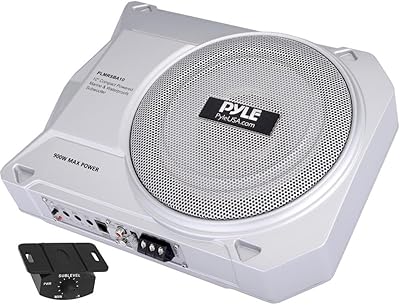
Pyle PLMRSBA10 10-Inch Amplified Subwoofer System
87%
85%
Sound Quality
88%
Bass Performance
92%
Ease of Installation
91%
Compactness/Space Saving
84%
Build Quality
More
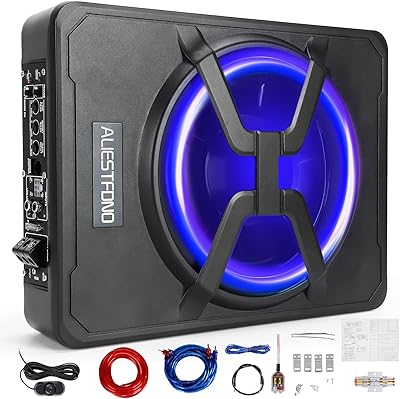
ALIESTFDNO IT-CA01 10-Inch Under-Seat Car Subwoofer
67%
82%
Ease of Installation
61%
Bass Output & Performance
78%
Value for Money
67%
Build Quality
71%
Fit & Compatibility
More
BOSS Audio CXX12 12-Inch Car Subwoofer
73%
88%
Value for Money
79%
Bass Output & Low-End Extension
61%
Power Handling (Real-World RMS)
72%
Build Quality
54%
Sound Clarity at High Volume
More
BOSS Audio CH10DVC 10-Inch Car Subwoofer
69%
88%
Value for Money
74%
Bass Output
62%
Build Quality
57%
Longevity & Durability
83%
Wiring Flexibility
More
Sound Storm US10K 10-Inch Powered Car Subwoofer
68%
83%
Ease of Installation
74%
Value for Money
61%
Bass Output & Quality
89%
Space Efficiency
57%
Build Quality
More
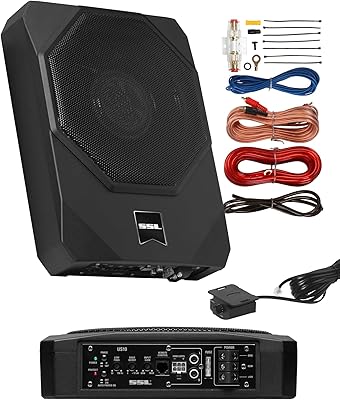
BOSS Audio BASS8 8-Inch Under-Seat Car Subwoofer
74%
83%
Value for Money
87%
Installation Ease
71%
Bass Output Quality
66%
Amplifier Performance
89%
Input Flexibility
More
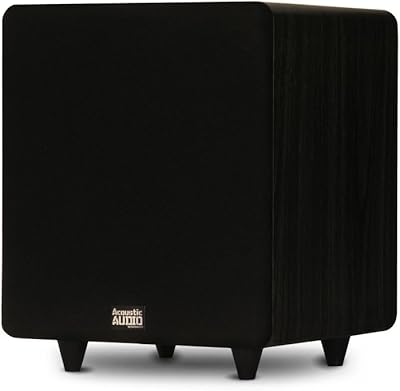
Acoustic Audio PSW400-10 10-Inch Powered Subwoofer
85%
91%
Bass Performance
88%
Ease of Setup
85%
Sound Quality
92%
Value for Money
87%
Build Quality
More
CT Sounds OZONE-10-D4 10″ Car Subwoofer
80%
88%
Build Quality
83%
Sound Quality
91%
Value for Money
79%
Thermal Durability
84%
Installation Experience
More
CT Sounds STRATO-10-D2 10 Inch Dual 2 Ohm Car Subwoofer
87%
91%
Bass Performance
89%
Build Quality & Durability
92%
Power Handling
88%
Sound Clarity
83%
Ease of Installation
More
Rockford Fosgate R2D2-10 10-Inch Car Subwoofer
82%
83%
Bass Output Quality
88%
Build Quality
91%
Value for Money
86%
Installation Ease
79%
Amplifier Compatibility
More

FAQ

It depends on your specific vehicle. The unit stands just over 3 inches tall, which clears most standard passenger seats, but some sportier cars and certain Japanese sedans run tighter than that. Before ordering, grab a tape measure and check the clearance from your floor to the bottom of the seat frame — it takes two minutes and could save you a return shipment.

No, and that's one of the strongest selling points of this compact subwoofer system. It accepts high-level speaker wire inputs, meaning you can tap directly into the wiring that already feeds your door speakers. No head unit swap required.

Normally, adding an amplifier to your car means running a small remote wire from the radio to the amp so it knows when to power on and off. The QBUS10P skips that step entirely — it listens for an audio signal and switches itself on automatically. For a first-time installer, that alone removes one of the trickier parts of the job.

Absolutely. The unit accepts both speaker-level and RCA inputs, so if your aftermarket radio has dedicated subwoofer or preamp RCA outputs, you can connect directly that way for a cleaner signal path.

A wired remote bass knob is included in the box and is designed to mount within easy reach, typically on the center console or dash. You plug it into the unit under the seat and can turn bass up or down without taking your eyes off the road for long.

It will add noticeable bass in most mid-size vehicles, but in larger cabins it starts to show its limits at higher volumes. This system is best suited for sedans, compact crossovers, and mid-size trucks — buyers with a Suburban or full-size van will likely want something with more headroom.

That is usually a tuning issue rather than a defect. Try backing off the bass boost knob and lowering the low-pass filter frequency — starting around 80 Hz is a good baseline for most systems. The ported design is efficient but can get loose-sounding if the boost is pushed too high.

NVX includes a wiring kit to get you started, but you should verify exactly what is in the box for your specific purchase, as kit contents can vary by retailer. At minimum, you will need a power wire run to the battery, a ground wire, and your signal input connection — all fairly standard items available at any car audio shop.

Most people with basic DIY comfort can handle this install. The signal-sensing auto turn-on removes the most confusing wiring step, and the inputs are straightforward. The main tasks are running a power wire to the battery, grounding the unit to the chassis, and connecting your audio signal — none of which require specialized tools.

No, it is not waterproof. This is a standard car audio component meant for interior use only. Avoid placing it in areas where it might be exposed to rain through an open window or water intrusion from floor leaks, as moisture damage would not typically be covered under the limited warranty.