Overview

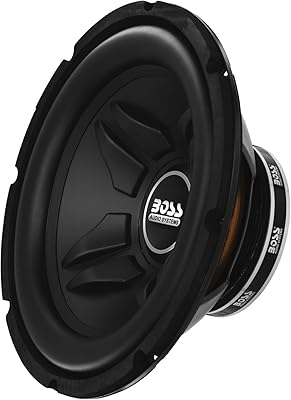
The BOSS Audio CH10DVC 10-Inch Car Subwoofer is an entry-level driver from the Chaos Series, built for buyers who want real bass without spending a fortune. This BOSS sub has been on the market since 2015 and has accumulated nearly 900 ratings — that kind of staying power usually means something. It ships as a single unit, so budget separately for an enclosure and amplifier; this isn't an all-in-one kit. The dual 4-ohm voice coil design gives you wiring flexibility most beginners appreciate. And that advertised 1500-watt figure? That's peak — your real-world RMS rating is what actually matters for daily listening.
Features & Benefits

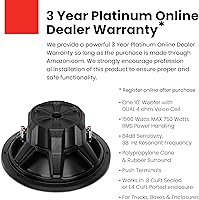
The polypropylene cone is a practical choice at this price point — it resists moisture reasonably well and stays light enough for clean bass response. Underneath, a stamped steel basket handles the structural load without adding unnecessary weight. Free air resonance sits at 38 Hz, which means the Chaos Series 10-inch driver can dig into the lower registers that hip-hop and EDM listeners actually care about. Sensitivity clocks in at 84 dB, so pairing it with a capable amplifier is non-negotiable. The 9.25-inch cutout fits most standard sealed or ported builds, and the dual voice coil lets you choose between 2-ohm or 8-ohm wiring to suit your amp's output.

Best For

This budget subwoofer is a solid match for anyone just getting into car audio who wants a real driver — not a toy — without committing to a high-end build. If you already own a mono amplifier or plan to grab one, you're already halfway there. Compact car owners tend to find that a single 10-inch sub hits a sweet spot: enough bass to feel it, small enough to not swallow your trunk. The DIY-friendly design also appeals to hobbyists who enjoy building their own boxes and experimenting with ported versus sealed tuning before deciding whether to invest in a more premium driver down the road.

User Feedback

With a 4.1-star average across nearly 900 ratings, the reception for this BOSS sub leans positive — particularly among casual listeners running it at moderate volumes. Buyers frequently highlight value for money as the standout quality, and those who mount it in ported enclosures tuned for bass-heavy music tend to be the most satisfied. On the critical side, some owners flag durability concerns under sustained high-volume use, which is worth considering if you plan to push it hard regularly. A handful of reviewers also caution that the peak wattage claim sets unrealistic expectations — careful amp matching is the real key to getting solid performance out of it.

Pros

  • Genuine dual 4-ohm voice coil design gives beginners real wiring flexibility at an accessible price point.
  • The polypropylene cone handles light moisture exposure well, which matters for installs in variable climates.
  • Free air resonance at 38 Hz means this BOSS sub can reach the low frequencies that hip-hop and EDM listeners actually want.
  • Fits standard 9.25-inch cutout enclosures, so sourcing a compatible box is straightforward and inexpensive.
  • Nearly 900 ratings with a 4.1-star average reflects a broad base of satisfied buyers, not just a handful of outliers.
  • Works well in ported enclosures tuned for bass-heavy music, where many users report noticeably better output.
  • Flush mount design keeps installation clean and compatible with most prefab and DIY box builds.
  • Lightweight at under 8 pounds, making solo installation manageable without extra help.

Cons

  • The 1500-watt peak figure is heavily inflated — actual usable RMS handling is far more modest and must be matched carefully with an amp.
  • Stamped steel basket construction is a noticeable step below cast-basket designs in rigidity and resonance control.
  • At 84 dB sensitivity, this budget subwoofer demands a well-powered amplifier to perform adequately — weak amps will leave it sounding flat.
  • Sold as a bare driver only, so factoring in an enclosure and amplifier significantly increases the real total cost.
  • Several long-term owners flag reliability issues when the sub is pushed hard consistently over months of use.
  • No enclosure or wiring hardware is included, which can catch unprepared first-time buyers off guard.
  • The wide gap between peak and real-world output can create unrealistic expectations that lead to mismatched system builds.

Ratings

Our AI-generated scores for the BOSS Audio CH10DVC 10-Inch Car Subwoofer were produced by analyzing verified buyer reviews from multiple global markets, with spam, incentivized, and bot-flagged submissions actively filtered out before scoring. The result is a balanced picture that honestly reflects where this budget sub genuinely delivers and where real buyers have run into friction. Both the strengths and the recurring complaints are transparently baked into every category score below.
Value for Money
88%
Among buyers who understood they were purchasing a bare driver at an entry-level price point, satisfaction with the cost-to-output ratio was notably high. Daily commuters who paired it with a modest mono amp consistently described it as punching above its weight class for casual bass listening.
Buyers who factored in the total system cost — amp, enclosure, and wiring — sometimes felt the overall investment crept higher than expected for the audio quality delivered. Those who expected premium output at this price tier were often disappointed.
Bass Output
74%
26%
In ported enclosures tuned for lower frequencies, this BOSS sub produced satisfying low-end rumble for hip-hop and EDM listeners during everyday driving. The 38 Hz free air resonance gave it enough reach to handle sub-bass content in popular music genres without sounding completely strained.
At higher volumes or in sealed boxes not optimally tuned, output quality dropped noticeably and some buyers described the bass as loose or muddy. It is clearly not built to compete with higher-sensitivity drivers in the same enclosure space.
Build Quality
62%
38%
The stamped steel basket held up adequately for most standard installs, and the polypropylene cone showed reasonable resistance to minor humidity exposure. For a driver at this price tier, the physical construction is functional and fits snugly into a compatible enclosure without obvious assembly flaws.
Experienced installers noted that the stamped basket and budget-grade components are a visible step down from cast-basket alternatives. A portion of longer-term owners raised durability concerns after months of sustained use at higher output levels, suggesting the build has real limits.
Longevity & Durability
57%
43%
Buyers who ran this budget subwoofer conservatively — moderate volumes with a well-matched amplifier — reported multi-year use without significant degradation. For casual listeners who are not pushing the driver hard daily, the lifespan appears reasonable given the price point.
A meaningful share of reviewers flagged premature failure or performance decline when the driver was used at or near its limits for extended periods. This is arguably the most consistent pain point across critical reviews and is worth weighing seriously for anyone planning high-output builds.
Wiring Flexibility
83%
The dual 4-ohm voice coil is a genuine practical advantage at this price tier, giving installers the option to wire to 2 ohms or 8 ohms to match a wider range of amplifiers. DIY builders and hobbyists specifically called out this feature as making system integration noticeably easier than single-coil alternatives.
Beginners unfamiliar with dual voice coil wiring occasionally found the configuration confusing without prior research. Incorrect wiring to an incompatible impedance load caused amp clipping issues for a small but notable subset of first-time users.
Power Handling Accuracy
41%
59%
The driver does handle short-term dynamic peaks without immediately failing, which gives it some margin during music transients. Buyers who researched RMS ratings before purchasing and matched their amp accordingly were generally satisfied with how it handled real-world power delivery.
The 1500-watt peak claim is widely regarded by reviewers as heavily inflated and misleading for anyone who takes it at face value. Multiple buyers reported amp-matching problems directly tied to the disconnect between the marketed peak figure and the driver's actual continuous power tolerance.
Installation Ease
78%
22%
The flush mount design and standard 9.25-inch cutout diameter made physical installation straightforward for most builders, with the driver slotting cleanly into prefab and custom enclosures alike. At under 8 pounds, it is light enough to handle solo during a typical weekend install.
The absence of any included hardware — no enclosure, no amp, no wiring kit — caught some first-time buyers off guard who assumed more was included in the box. Dual voice coil wiring also adds a small but real learning curve for true beginners.
Enclosure Compatibility
79%
21%
The 9.25-inch cutout spec aligns well with the majority of prefab 10-inch enclosures sold online, which reduced friction for buyers who did not want to build a custom box. Several users reported good results across both sealed and ported formats when the box volume was reasonably matched to the driver.
Optimal performance does require some attention to enclosure tuning, and buyers who dropped it into a poorly sized or mismatched box reported underwhelming results. The driver is more sensitive to enclosure quality than a premium sub would be at higher price points.
Sensitivity & Amp Requirement
63%
37%
Once paired with a decently powered mono amplifier, the Chaos Series 10-inch driver produced respectable output for a budget build, with enough headroom for satisfying daily listening. Buyers who did their homework on amplifier pairing rated their experience considerably higher than those who did not.
At 84 dB sensitivity, this driver genuinely needs an adequate amplifier to sound its best — it will sound weak and flat if underpowered. This dependency on external hardware is a consistent frustration for buyers who expected more self-sufficiency from the package.
Low-Frequency Extension
71%
29%
The 38 Hz resonant frequency allows the sub to reach into sub-bass territory that matters for bass-heavy music, and listeners who primarily play hip-hop, trap, or electronic genres noted satisfying depth during ported enclosure setups. It handles low-end content better than smaller or cheaper fixed-coil alternatives in the same budget range.
Below around 35 Hz, extension becomes noticeably thin and the driver starts to sound strained, which limits its appeal for listeners who want genuinely deep, cinematic bass. Audiophiles or listeners of genres with complex low-end will find the performance ceiling here frustrating.
Moisture Resistance
66%
34%
The polypropylene cone material provided adequate protection against incidental humidity and minor moisture exposure that is common in car environments across different climates. Buyers in humid regions did not report moisture-related cone damage under normal usage conditions.
The driver carries no official waterproofing or water resistance rating, and direct exposure to water or installation in wet environments is not supported. It is strictly an interior vehicle application and should not be treated as suitable for marine or open-air installs.
Packaging & Unboxing
69%
31%
The driver arrived well-protected in standard packaging for the majority of buyers, with no widespread reports of transit damage affecting the cone or voice coil. The no-frills presentation is consistent with expectations for an entry-level product sold at this price tier.
Some buyers noted that no installation guide or wiring diagram was included, which added friction for first-timers trying to figure out dual voice coil wiring on their own. The barebones unboxing experience can feel underwhelming compared to similarly priced offerings from competing brands.
Brand Reliability
64%
36%
BOSS Audio has a long track record in the budget car audio market, and the CH10DVC has maintained an active listing since 2015 with consistent availability and ongoing manufacturer support. For buyers who have used BOSS products before, the brand familiarity reduced purchase hesitation.
BOSS Audio's reputation in enthusiast communities is mixed, with experienced builders often viewing the brand as adequate for beginners but not credible for serious builds. The brand association can affect resale value and perceived system quality among more knowledgeable car audio communities.

Suitable for:

The BOSS Audio CH10DVC 10-Inch Car Subwoofer is purpose-built for entry-level car audio enthusiasts who want a real, functional driver without a premium price tag. It fits especially well for first-time builders who are just learning the ropes — someone who has picked up a basic mono amplifier and wants to feel genuine bass in their daily commute vehicle. Compact car owners in particular tend to get solid results from a single 10-inch sub, since it adds meaningful low-end presence without consuming the entire trunk. The dual 4-ohm voice coil design is also a genuine advantage for hobbyists who enjoy experimenting with wiring configurations and box tunings, as it opens up flexibility that fixed-coil budget subs simply don't offer. If you're treating this as a learning platform before eventually upgrading to a higher-tier driver, it's a financially sensible way to start.

Not suitable for:

Buyers expecting a plug-and-play bass solution will be disappointed — the BOSS Audio CH10DVC 10-Inch Car Subwoofer requires a separate amplifier and enclosure, meaning total system cost runs considerably higher than the driver price alone. Audiophiles or experienced builders chasing tight, accurate bass reproduction will likely find the stamped basket construction and modest sensitivity rating limiting compared to cast-basket alternatives in higher price brackets. Anyone planning to run the sub at sustained high volumes for extended periods should also think carefully, as a portion of long-term owners have raised durability concerns under those conditions. The advertised peak wattage figure is also easy to misread as RMS output, and buyers who wire it to an underpowered or overpowered amp without checking RMS specs may have a frustrating experience. If your goal is a competition-grade or audiophile system, this driver is not the right foundation.
Specifications

  • Driver Diameter: The subwoofer cone measures 10 inches across, making it compatible with standard 10-inch enclosure designs.
  • Peak Power: BOSS rates this driver at a maximum of 1500 watts peak, though buyers should focus on the RMS rating when matching with an amplifier.
  • Voice Coil: The dual voice coil is wound at 4 ohms per coil, allowing wiring to a combined 2-ohm or 8-ohm load depending on the installer's preference.
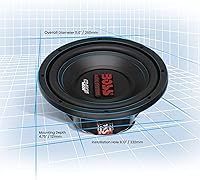
  • Mounting Depth: The driver requires a minimum mounting depth of 4.63 inches, which must be confirmed against the enclosure before installation.
  • Cutout Diameter: A 9.25-inch mounting hole is required in the enclosure baffle for a proper flush fit.
  • Resonant Frequency: Free air resonance is rated at 38 Hz, enabling the driver to reproduce low bass frequencies suited to music with significant sub-bass content.
  • Sensitivity: Sensitivity is measured at 84 dB at 1 watt per 1 meter, meaning a capable amplifier is necessary to drive it to satisfying output levels.
  • Cone Material: The cone is constructed from polypropylene, a lightweight and moderately moisture-resistant material commonly used in budget car audio drivers.
  • Basket Type: The basket is formed from stamped steel, which provides adequate structural rigidity for everyday use at a lower manufacturing cost than cast alternatives.
  • Impedance: Nominal impedance per voice coil is 4 ohms, with combined wiring options of 2 ohms (parallel) or 8 ohms (series).
  • Mounting Style: The driver uses a flush mount configuration, sitting level with the enclosure baffle surface when installed correctly.
  • Dimensions: Overall unit dimensions measure 11″ in diameter by 4.8″ in depth, as shipped from the manufacturer.
  • Weight: The driver weighs 7.72 pounds, light enough for straightforward solo installation in most enclosure types.
  • Connectivity: Connection is made via wired terminals; no wireless or powered amplifier module is included with this driver.
  • Water Resistance: This subwoofer is not rated as waterproof or water-resistant and should not be exposed to direct moisture or outdoor conditions.
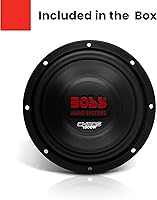
  • Included Components: The package includes only the subwoofer driver itself; an enclosure, amplifier, and wiring kit must be sourced separately.
  • Series: This driver belongs to BOSS Audio's Chaos Series, which is positioned as the brand's entry-level car subwoofer lineup.
  • Availability Date: This model has been commercially available since March 2015, reflecting a long production run with an established buyer history.

Related Reviews

Planet Audio P10AWK 10-Inch Amplified Car Subwoofer
71%
83%
Ease of Installation
71%
Bass Output & Impact
76%
Sound Tuning & Flexibility
86%
Compatibility & Input Options
58%
Build Quality & Materials
More
BOSS Audio P80DVC 8-Inch Car Subwoofer
68%
83%
Value for Money
71%
Bass Output
52%
Build Quality
48%
Durability
88%
Wiring Flexibility
More
BOSS Audio BAB10 10-inch Amplified Car Subwoofer
71%
71%
Bass Output & Sound Quality
44%
Advertised vs. Real-World Power
88%
Installation Ease
83%
Form Factor & Fitment
58%
Build Quality & Materials
More
BOSS Audio CXX12 12-Inch Car Subwoofer
73%
88%
Value for Money
79%
Bass Output & Low-End Extension
61%
Power Handling (Real-World RMS)
72%
Build Quality
54%
Sound Clarity at High Volume
More
BOSS Audio B12ES 12-Inch Powered Car Subwoofer
72%
88%
Ease of Installation
79%
Bass Output & Impact
83%
Value for Money
63%
Build Quality & Materials
81%
Remote Bass Control Usability
More
BOSS Audio Systems BASS8 8-Inch Under Seat Powered Car Subwoofer
86%
89%
Bass Quality
91%
Ease of Installation
94%
Space Efficiency
85%
Sound Clarity
88%
Power Output
More
BOSS Audio CH4330 4x10-Inch Car Coaxial Speakers
72%
83%
Value for Money
71%
Sound Quality
88%
Ease of Installation
62%
Build Quality
77%
Treble Clarity
More
BOSS Audio Systems CH4230 Chaos Exxtreme Series 4 x 10 Inch Car Door Speakers
83%
88%
Sound Clarity at High Volumes
72%
Bass Performance
85%
Durability and Build Quality
80%
Ease of Installation
92%
Value for Money
More
Acoustic Audio PSW400-10 10-Inch Powered Subwoofer
85%
91%
Bass Performance
88%
Ease of Setup
85%
Sound Quality
92%
Value for Money
87%
Build Quality
More
CT Sounds OZONE-10-D4 10-inch Car Subwoofer
84%
91%
Bass Performance
88%
Power Handling
92%
Value for Money
85%
Sound Clarity
86%
Build Quality
More

FAQ

Yes, you will need a separate amplifier. This is a passive driver only — it has no built-in power source and must be connected to an external mono amplifier to function. Budget for the amp, enclosure, and wiring kit on top of the driver cost.

Ignore the 1500-watt peak figure for matching purposes. Focus on the RMS rating instead, which is the continuous power the driver can safely handle day to day. A mono amp delivering around 300 to 500 watts RMS into the wiring impedance you choose is a sensible starting point for this class of driver.

With a dual 4-ohm voice coil, you have two practical options: wire the coils in parallel for a 2-ohm combined load, or in series for an 8-ohm combined load. Most mono amplifiers produce more power into 2 ohms, so parallel wiring is the more common choice for maximizing output. Check your amp's specs to confirm which impedance it handles best before wiring.

Most likely yes. The driver requires a 9.25-inch cutout and a mounting depth of at least 4.63 inches, which aligns with the majority of prefab 10-inch enclosures sold for car audio. Double-check the cutout and depth specs on any box you are considering before purchasing.

Both work, but ported enclosures tend to get better results from this BOSS sub, particularly for bass-heavy music like hip-hop or EDM. Sealed boxes offer tighter, more controlled bass and are a bit more forgiving if the box volume is not perfectly tuned. If you are experimenting for the first time, a ported box tuned around 35 to 40 Hz is a reasonable starting point.

That figure refers to peak power, which is the absolute maximum the driver can theoretically handle in very brief bursts under ideal conditions. Real-world, sustained power handling is considerably lower. The BOSS Audio CH10DVC 10-Inch Car Subwoofer is an entry-level driver, so treat peak wattage claims as a marketing figure rather than a guide for amplifier matching.
Yes, the driver is sold individually, so you can purchase two and run them in the same system. If you do, make sure your amplifier can handle the combined impedance load and has enough RMS output to drive both cleanly. A two-sub setup will require a larger enclosure as well.

At moderate volumes with a well-matched amplifier it tends to perform reliably over time. Where some owners have reported issues is running it consistently at or near its limits for extended periods. As with most budget drivers, treating it conservatively will extend its lifespan significantly.

It can work for other genres, but its 38 Hz resonant frequency and budget construction make it most satisfying for music that leans on sub-bass. For rock, country, or acoustic genres where tight punch matters more than deep rumble, you might find higher-sensitivity, better-damped drivers more rewarding.

BOSS Audio does offer warranty coverage on this product, though specific terms and duration should be confirmed directly with BOSS Audio or the seller at the time of purchase, as warranty conditions can vary by retailer and region.

Where to Buy