Overview

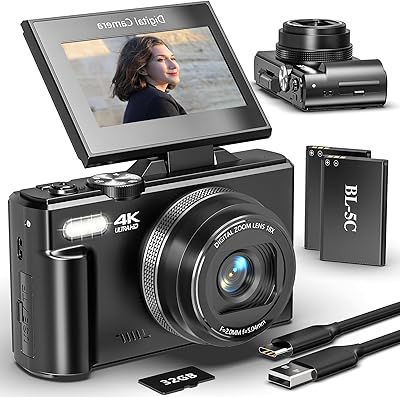
The MINIBEAR A-56 Point-and-Shoot Digital Camera is a budget entry-level option built squarely around one purpose: getting young or first-time photographers shooting right away. The compact plastic body is light enough for a child to carry comfortably, and the included lanyard mount means it can hang around a neck without fuss. What makes this a particularly practical gift is that it ships ready to use — a 64GB microSD card, USB-C charging cable, and a small carry bag are all tucked inside the box. A 1-year warranty from the manufacturer rounds things out, offering modest peace of mind at this price tier.
Features & Benefits

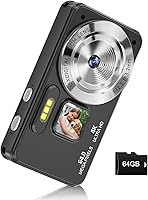
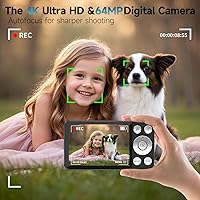
The headline specs on this compact starter camera sound impressive on paper — 64MP photos and 4K video at up to 60fps — but it is worth knowing that the 1/4-inch CMOS sensor means those figures reflect software interpolation rather than true optical output. In practice, shots in decent light look fine for social sharing or printing at modest sizes. The 18x digital zoom gives kids plenty of reach, though sharpness drops noticeably at higher zoom levels. A 2.8-inch color screen keeps framing intuitive, and USB-C charging via the built-in 2000mAh battery eliminates the need for proprietary chargers. A webcam mode via USB cable rounds out the feature set.

Best For

This kids camera hits its stride as a first camera gift — something a parent can hand to a 10-to-14-year-old without anxiety over a costly mistake. The all-in-one kit means no extra shopping trips for memory cards or cables, which is a genuine time-saver during busy gift seasons. Teens experimenting with vlogging on a budget will appreciate having a dedicated device rather than relying solely on a phone. It also suits school trips or family outings where portability and peace of mind outweigh the need for high image quality. Just keep expectations grounded — this is a starting point, not a serious photography tool.

User Feedback

Buyers who pick up this beginner point-and-shoot as a gift tend to report solid satisfaction — the included accessory bundle consistently earns praise, and most parents note that children figure out the controls quickly without any help. The most common complaints involve zoom performance: images get visibly grainy and soft when pushed toward the upper end of the 18x range. Build quality also divides opinions — the lightweight plastic is fine for casual use but feels a bit flimsy to some buyers. Battery life is a mixed story, with results varying by usage patterns. Webcam setup is described as straightforward, though call quality is predictably basic.

Pros

  • Ships as a complete starter kit with a 64GB card, carry bag, and USB-C cable included.
  • Simple automatic controls make it genuinely easy for young beginners to pick up and use.
  • USB-C charging is convenient and works with cables most families already own.
  • Doubles as a basic USB webcam for video calls or online classes.
  • Lightweight and compact enough for a child to carry comfortably on trips.
  • The 2.8-inch color screen makes reviewing photos and framing shots easy for younger users.
  • The 1-year manufacturer warranty offers reasonable coverage at this price point.
  • Built-in flash helps in dimly lit indoor settings like birthday parties or classrooms.
  • Autofocus with 9 contrast-detection points keeps most casual shots reasonably sharp.

Cons

  • Digital zoom degrades image quality noticeably beyond mid-range zoom levels.
  • Actual photo and video sharpness falls short of what the headline specs imply.
  • The plastic body feels lightweight and fragile — not well suited for rough or outdoor use.
  • No water resistance whatsoever, so even light rain poses a real risk.
  • Low-light performance is mediocre; the built-in flash has a limited effective range.
  • Real-world battery life varies and may not consistently reach the rated 10-hour estimate.
  • Webcam output quality is basic and may disappoint teens expecting clear video call visuals.
  • No manual exposure or focus controls limit creative growth for curious young photographers.
  • Fixed F2.8 aperture with no optical zoom means limited flexibility in varied shooting conditions.

Ratings

The scores below for the MINIBEAR A-56 Point-and-Shoot Digital Camera were generated by our AI system after analyzing thousands of verified global buyer reviews, with spam, bot-submitted, and incentivized feedback actively filtered out. Each category reflects the real balance of praise and frustration found across that reviewer base — nothing is glossed over. Where this compact starter camera earns strong marks, you will see why; where it falls short, those gaps are spelled out just as clearly.
Value for Money
88%
Buyers consistently point to the bundled accessories — 64GB card, carry bag, lanyard, and cables — as what pushes this kids camera into genuinely good-deal territory. For a first camera gift, the fact that nothing extra needs to be purchased before handing it over is a recurring reason parents feel the price is well spent.
A small but vocal segment of buyers feels the gap between the advertised specs and real-world output slightly undermines the value proposition. When photos look noticeably softer than expected, the perceived worth of the package drops for more discerning buyers.
Image Quality
54%
46%
In bright outdoor light, this beginner point-and-shoot produces photos that look perfectly acceptable for social sharing or printing at small sizes. Colors are reasonably vivid and the autofocus keeps most subjects sharp enough for casual everyday snapshots.
The 64MP figure is software-interpolated from a small 1/4-inch sensor, so real pixel-level detail is closer to 5MP of optical quality. Indoor and low-light shots look noisy, and fine details in foliage or textured surfaces often appear smeared — a consistent complaint across negative reviews.
Video Performance
57%
43%
The 4K label and 60fps capability are appreciated by teens shooting short clips for personal use, and footage in well-lit conditions holds up adequately for casual vlogging or sharing with friends. The MP4 format is universally compatible, making it easy to transfer and edit on any computer.
Like the stills, 4K video is upscaled rather than natively captured at that resolution, and the difference shows when footage is viewed on a larger screen. Rolling shutter artifacts and softness in fast-moving scenes are mentioned frequently, and low-light video quality drops off sharply.
Ease of Use
91%
This is arguably where this compact starter camera earns its strongest marks. Young children and complete beginners consistently report being able to start shooting within minutes of opening the box, with no manual reading required. The automatic mode handles all exposure decisions, and the physical W/T zoom button is intuitive even for small hands.
There is almost no room to grow beyond the automatic mode — users who develop any curiosity about manual settings will hit a wall quickly. A few parents noted the menu language and labeling are slightly inconsistent, which can confuse younger children trying to change basic settings like self-timer.
Zoom Performance
43%
57%
At lower zoom increments — roughly up to 4x or 5x — the digital zoom delivers usable results for subjects like a pet across a room or a child on a playground. The W/T button gives smooth, stepless control rather than a jarring jump, which younger users find easy to manage.
This is one of the most-cited disappointments: pushing the zoom toward 18x produces visibly grainy, low-detail images that many buyers describe as unusable. Without any optical zoom element, every level of magnification is purely a digital crop, and quality loss is steep and unavoidable above mid-range zoom settings.
Battery Life
69%
31%
The built-in 2000mAh lithium polymer battery is large for this camera class, and USB-C charging means no proprietary wall adapter is needed — a genuine convenience when travelling or at school. Many buyers report getting through a full day of casual shooting on a single charge without issue.
The 10-hour rated life assumes fairly light usage, and heavier sessions involving lots of video recording or flash use drain it noticeably faster. A handful of reviewers report the battery degrading faster than expected after several months of regular use, which is worth keeping in mind for longevity.
Build Quality
58%
42%
The camera is compact and light enough that children are comfortable holding it for extended periods, and it fits neatly into the included carry bag when not in use. The button layout feels intentional for small hands, and nothing feels immediately loose or rattly out of the box.
The all-plastic construction is the most common durability concern in negative reviews — it feels noticeably insubstantial, and several buyers describe accidental drop damage after minimal use. There is no water or dust resistance, so a rainy field trip or a spilled drink poses a real risk of permanent damage.
Display Quality
72%
28%
The 2.8-inch TFT screen is large enough relative to the camera body that kids can see their shots clearly when reviewing or framing. Brightness is adequate for indoor and shaded outdoor use, and the color rendering is pleasant enough that children tend to enjoy browsing through their own photos on it.
In direct sunlight the screen washes out noticeably, making outdoor framing trickier than it should be for a camera aimed at kids using it outside. Viewing angles are narrow, and the resolution is modest, so fine details in photos look softer on the screen than they might appear after transfer to a computer.
Autofocus Speed
67%
33%
For still subjects like portraits, posed shots, or objects on a table, the contrast-detection autofocus locks on reliably and keeps results sharp. The 9-point system gives it a reasonable spread across the frame, which helps with off-center compositions that kids often use naturally.
Moving subjects — a running dog, kids playing sports, or anything with quick lateral motion — frequently result in missed focus or soft edges. Contrast-detection AF is inherently slower than phase-detection systems, and this limitation becomes apparent in any situation that is not relatively static.
Webcam Functionality
63%
37%
The ability to connect via USB and use this as a webcam is a genuinely useful bonus that several parents and teens mention positively, especially for households where a laptop lacks a built-in camera. Setup is plug-and-play on most Windows computers, which keeps the experience accessible for younger users.
Webcam output quality is basic at best — image sharpness and color accuracy in video calls are noticeably below what a dedicated webcam or modern smartphone would deliver. Mac compatibility is inconsistently reported, and a few users note that the connection drops occasionally during longer sessions.
Accessory Bundle
83%
Gift-buyers consistently highlight the bundle as a strong point — having the memory card, carry bag, lanyard, USB cable, and USB-C cable all included removes the friction of sourcing accessories separately. This all-in-one packaging is one of the clearest differentiators for this camera at its price tier.
The quality of the included accessories is functional rather than impressive — the carry bag is thin and offers minimal impact protection, and the lanyard is basic nylon with no padding. These are minor issues for most buyers, but parents expecting sturdy protective gear may want to supplement with a padded case.
Low-Light Performance
41%
59%
The built-in automatic flash does a reasonable job illuminating subjects at close range — birthday cake shots, indoor group photos, and desk-level close-ups tend to come out acceptably bright when the flash fires correctly. It activates automatically in dim conditions, so children do not need to remember to turn it on.
Without the flash, low-light image quality degrades sharply — noise is heavy, sharpness drops, and colors look dull. The flash range is limited to roughly two to three meters, so larger indoor spaces like school halls or gyms produce underexposed results, and there is no way to manually compensate for exposure.
Portability
84%
At just 0.3 kg the camera is light enough that younger children can carry it around their neck all day without fatigue, and the compact body slips easily into a jacket pocket or a school bag. The lanyard mount is a practical touch that reduces the chance of accidental drops during active use.
The lightweight build that makes it so portable is the same quality that makes it feel fragile, so portability and durability are somewhat in tension here. There is no wrist strap loop — only the lanyard attachment — which some older teens find less comfortable for extended handheld shooting sessions.
Gifting Suitability
87%
As a ready-to-unwrap gift, this camera package is hard to fault — everything needed to start shooting is inside the box, the camera feels substantial enough to seem like a real present, and the age range it targets (roughly 8 to 14) is broad enough to suit most holiday or birthday scenarios.
Parents of older teens or children who already have photography experience may find that the limitations surface quickly, reducing long-term satisfaction. It works best as a first camera rather than an upgrade, and buyers who misjudge the recipient's experience level sometimes end up disappointed by how soon it gets set aside.

Suitable for:

The MINIBEAR A-56 Point-and-Shoot Digital Camera is a strong fit for parents searching for a first dedicated camera to give a child between the ages of 8 and 14. Because it arrives as a complete kit — memory card, carry bag, and charging cable included — gift-givers do not need to piece together accessories separately, which makes it a convenient one-box solution around birthdays or the holidays. Teens who are curious about vlogging or short-form video content will find enough functionality here to start experimenting without a significant financial commitment. It also works well in situations where a high-end device would feel like a liability — school trips, summer camps, or family vacations where a dropped or lost camera is a real possibility. For a young person who has never used a dedicated camera before, the simple controls and automatic shooting modes lower the learning curve considerably.

Not suitable for:

Buyers expecting professional or even enthusiast-grade image quality will find the MINIBEAR A-56 Point-and-Shoot Digital Camera falls well short of that bar. The 64MP and 4K specifications are software-interpolated on a small 1/4-inch sensor, which means real-world output — particularly in low light or at high zoom levels — will look noticeably soft compared to cameras with larger sensors, even modestly priced ones. Anyone who needs reliable optical zoom for wildlife, sports, or event photography should look elsewhere, as digital zoom at this scale introduces significant quality loss. Older teens or young adults who are serious about developing photography skills will quickly outgrow it and may find the plastic build and limited manual controls frustrating. This is also not the right choice for anyone prioritizing durability, since the lightweight construction is not rated for water resistance and may not hold up to rough handling over time.

Specifications

  • Brand & Model: Manufactured by MINIBEAR under the model designation A-56, part of the 56 Series product line.
  • Sensor: 1/4-inch CMOS sensor with a maximum interpolated resolution of 64MP and an effective still resolution of 5MP.
  • Photo Format: Still images are saved in JPEG format at a maximum image size of 64MP (interpolated) with a bit depth of 12-bit.
  • Video Resolution: Records video in MP4 format at up to 4K UHD (2160p) with frame rate options of 24, 30, and 60fps.
  • Digital Zoom: Supports 18x digital zoom controlled via a physical W/T button; no optical zoom is available on this model.
  • Display: Features a 2.8-inch TFT color screen with a fixed display resolution of up to 5MP for framing and playback.
  • Autofocus: Contrast-detection autofocus system with 9 autofocus points and automatic AF-A focus mode for general shooting.
  • Image Stabilization: Digital image stabilization is built in to help reduce motion blur during handheld shooting.
  • Aperture & Shutter: Fixed aperture of F2.8 with an automatic shutter speed range up to a maximum of 1/4000 seconds.
  • Battery: Built-in 2000mAh lithium polymer battery charged via USB-C, rated for approximately 10 hours of use and weighing 32.66 grams.
  • Storage: Uses a single microSD card slot with SD bus interface; a 64GB microSD card is included in the box.
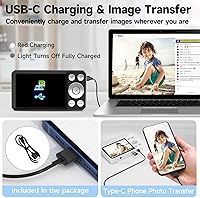
  • Connectivity: One USB port supports both USB-C charging and webcam functionality when connected to a personal computer.
  • Flash: Built-in automatic flash with evaluative metering assists in low-light conditions at close to moderate distances.
  • Shooting Modes: Supports automatic and manual shooting modes, self-timer options (3, 5, 10, and 20 seconds), and continuous shooting.
  • Form Factor: Compact plastic enclosure weighing 0.3 kg with a lanyard mount included; not water resistant.
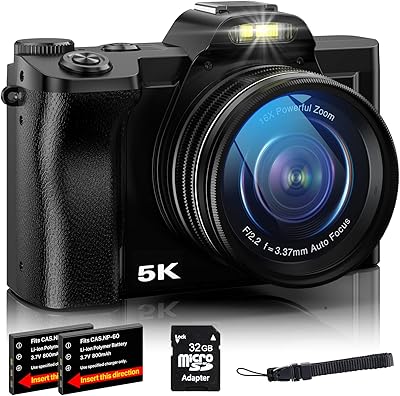
  • In the Box: Package includes the camera body, 64GB microSD card, carry bag, lanyard, USB cable, and USB-C charging cable.
  • Warranty: MINIBEAR provides a 1-year manufacturer warranty covering the camera against manufacturing defects.

Related Reviews
Panasonic LUMIX FZ80D
75%
93%
Zoom Range & Reach
88%
Image Stabilization
78%
Image Quality in Good Light
54%
Low-Light Performance
81%
4K Video Quality
More
1 Shot VF208H Half Frame 35mm Film Camera
76%
83%
Value for Money
91%
Ease of Use
93%
Portability & Size
62%
Image Quality
76%
Build Quality
More
myFirst Camera 3 Kids Digital Camera
72%
76%
Image Quality (Daylight)
51%
Low-Light Performance
74%
Video Quality
83%
Macro Lens
81%
Ease of Use
More
ROQIOO A9
ROQIOO A9
67%
83%
Value for Money
61%
Image Quality
58%
Video Quality
81%
Flip Screen Usability
54%
Build Quality & Durability
More
AOREGRE 5K Digital Camera WiFi Autofocus Vlogging Camera
83%
92%
Value for Money
89%
Image Quality
87%
Ease of Use
90%
Video Quality (5K)
85%
Portability & Size
More
Yatao YT01 64MP Digital Camera
72%
83%
Value for Money
67%
Image Quality
61%
Video Performance
53%
Autofocus
88%
Ease of Use
More
Lecran DC403 Digital Camera
75%
92%
Ease of Use
74%
Image Quality (Daylight)
47%
Low-Light Performance
71%
Video Quality
68%
Build Quality & Durability
More
Twylyte F9 Digital Camera
79%
91%
Value for Money
88%
Ease of Use
89%
Portability & Size
81%
Image Quality (56MP)
80%
Video Quality (1080p)
More
Lecnippy DC402
Lecnippy DC402
73%
88%
Value for Money
91%
Ease of Use
67%
Photo Quality
63%
Video Quality
54%
Zoom Performance
More
UIKICON X9 4K Digital Vlogging Camera
71%
83%
Value for Money
88%
Ease of Use
67%
Image Quality
61%
Video Quality
86%
Flip Screen
More

FAQ

It comes with a 64GB microSD card already included in the box, so you can start taking photos and videos right away without any extra purchases.

Honest answer: it is more of a marketing label than a true 4K experience. The sensor is a small 1/4-inch CMOS, so the 4K output is software-enhanced rather than optically native. Footage in good lighting looks decent for casual use and social sharing, but it will not match the sharpness you would expect from a camera with a larger sensor.

Most kids in the 8-to-12 age range can pick it up without much help. The controls are straightforward, shooting is fully automatic by default, and the screen is large enough to see what you are doing. There is no complicated menu system to navigate.

It works fine at lower zoom levels — maybe up to 4x or 5x — but the quality drops off noticeably as you push higher. At 18x the image gets grainy and soft because it is purely digital zoom with no optical element behind it. If zoom range is a priority, it is worth setting expectations accordingly before buying.

Yes, it connects to a Windows PC via USB cable and your computer should recognize it as a camera input. The quality is basic rather than crisp, but it is a functional option for video calls or online classes if a child does not have a built-in webcam on their computer.

The rated figure is around 10 hours, but real-world results vary depending on how often the flash fires, how much video is recorded, and screen brightness. Expect somewhere between 6 and 10 hours of mixed use. Charging via USB-C is convenient since most households already have a compatible cable.

It is made of lightweight plastic and is not rated for water resistance, so it is better suited for supervised use than heavy daily wear and tear. It can handle normal carrying and casual outdoor use, but a serious drop or exposure to rain is likely to cause damage. The included carry bag helps protect it between uses.

There is no built-in wireless connectivity or direct print support. Photos are saved as JPEG files on the microSD card, which you can then transfer to a computer or insert into a compatible printer or photo kiosk to print.

It offers four self-timer settings: 3, 5, 10, and 20 seconds. That covers most practical scenarios, from quick selfies to full group setups where you need time to get into position.

It works well as an absolute starting point, but a teen with genuine long-term interest in photography will likely outgrow it fairly quickly. The lack of manual controls, optical zoom, and a quality sensor limit how much creative and technical learning it can support. It is ideal for sparking initial interest, not for developing serious skills over time.