Overview

The Ludger LUDX-RF Refrigerator Surge Protector is built for one job — keeping your fridge running safely when the power grid misbehaves. Unlike a standard power strip, this is a purpose-built device engineered around the specific demands of refrigerator compressors. It carries ETL certification, which means it has been independently tested against recognized safety standards — not just factory self-certified. Ludger claims over a million units sold and more than a decade of engineering refinement behind the design. At its price point, it sits firmly in budget-friendly territory, and it delivers on that promise: a compact, plug-in unit that protects a single appliance without any installation complexity.
Features & Benefits

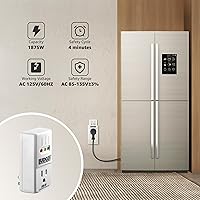
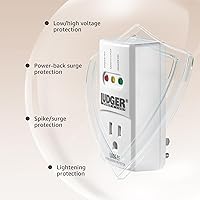
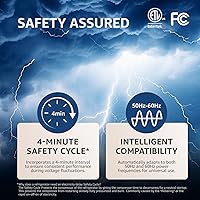
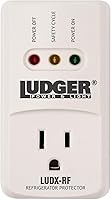
The standout feature here is the 4-minute delay cycle. When power returns after an outage, a refrigerator compressor needs time to equalize pressure before restarting — forcing it on immediately can cause serious mechanical damage. This refrigerator surge protector holds the outlet off for four minutes automatically, then restores power once conditions stabilize. It also monitors incoming voltage continuously; if the supply drops below 85V or spikes above 135V, it cuts output entirely. Three LED lights communicate current status at a glance: green means normal operation, yellow signals the delay is active, and red indicates power has been cut. The fire-resistant shell and 1875W capacity round out a well-considered feature set.

Best For

This compressor protector makes the most sense for anyone living where power reliability is questionable — coastal areas hit by storms, rural zones with aging grid infrastructure, or anywhere that sees regular brief outages. It is also a smart buy for households with a newer, high-end refrigerator where a compressor repair would cost many times more than this device. Renters will appreciate that it requires zero permanent installation — just plug it in between the wall outlet and the fridge cord, and it moves with you. If you have already lost an appliance to a surge event, this is the kind of low-cost preventive measure that is genuinely hard to argue against.

User Feedback

With a 4.2-star average across roughly 106 ratings, the LUDX-RF earns cautiously positive marks — though that review count is modest enough that the picture may still shift over time. Buyers consistently praise easy setup and the clarity of the LED indicators, and many mention genuine peace of mind during storm season. On the critical side, some users have flagged that recessed or tightly spaced outlets make the plug an awkward fit. The more substantive gap worth noting: Ludger does not publicly disclose a joule rating for surge absorption, which makes direct comparisons with competing units harder than it should be. No notable warranty or customer service complaints surfaced in recent reviews.

Pros

  • Purpose-built for refrigerators, not a repurposed generic surge strip.
  • ETL certification provides independent safety validation — not just a manufacturer claim.
  • The 4-minute restart delay actively protects the compressor after outages, addressing a real failure point.
  • Voltage monitoring cuts power automatically when supply drifts outside a safe operating range.
  • Three-color LED system makes current status instantly readable without checking an app or manual.
  • Plug-and-play setup takes seconds — no tools, no wiring, no electrician needed.
  • Fire-resistant shell adds a layer of passive safety near a kitchen appliance.
  • Lightweight and compact enough to leave permanently installed without blocking adjacent outlets.
  • Works on both 50Hz and 60Hz systems, which is useful for households with imported appliances.
  • Budget-friendly price makes the cost-versus-compressor-repair math very easy to justify.

Cons

  • No joule rating is publicly disclosed, making it impossible to objectively benchmark surge absorption capacity.
  • Only 106 ratings at time of review — too early to draw firm conclusions about long-term reliability.
  • Plug dimensions can cause fitment issues with recessed or tightly packed wall outlets.
  • Protects one appliance only; households needing broader coverage will require additional devices.
  • No surge indicator light to confirm whether a surge event has actually occurred and been absorbed.
  • Warranty terms and customer support responsiveness are not clearly communicated in product materials.
  • Most buyer reviews appear to reflect short-term impressions rather than multi-year durability data.
  • No physical on/off switch, so disconnecting requires pulling the plug entirely.

Ratings

The scores below for the Ludger LUDX-RF Refrigerator Surge Protector were generated by our AI review engine after analyzing verified global buyer feedback, with spam, incentivized, and bot-flagged submissions actively filtered out. Each category reflects a balanced synthesis of what real users consistently praised and where they ran into friction. Both the strengths and the honest shortcomings are weighted into every score you see here.
Compressor Protection Logic
88%
Buyers who understand refrigerator mechanics consistently single out the 4-minute restart delay as the most meaningful feature, noting it addresses a failure mode that generic surge strips completely ignore. Several reviewers mentioned that previous fridges died after power was restored too quickly, making this delay feel like a genuine engineering decision rather than a marketing checkbox.
A portion of buyers found the delay confusing at first, assuming the unit was malfunctioning when the fridge did not immediately restart after an outage. The lack of clear in-box explanation for why the delay exists means some users disable or bypass it before understanding its purpose.
Voltage Monitoring Accuracy
82%
18%
Users in storm-prone regions reported that the unit correctly cut power during voltage instability events and restored it without issue once the supply stabilized. The AC 85–135V monitoring window covers most real-world fluctuation scenarios seen during brownouts and grid recovery after outages.
There is no way for the end user to verify what voltage triggered a shutoff event, since no display or log exists on the device. Buyers who want confirmation that the protector actually intervened during an event have no reliable way to check after the fact.
LED Status Indicators
91%
The three-color LED system earned some of the most enthusiastic specific praise in buyer reviews, with users appreciating that a quick glance tells them everything they need to know about current status. Several noted they check the light as part of their routine after storms, and the green light has become a reassurance signal for households that experience frequent outages.
In bright kitchen environments or when the unit is tucked behind a refrigerator, the LEDs can be difficult to see without physically moving the fridge. A couple of reviewers noted the yellow safety-cycle light was dim compared to the other two, making it harder to distinguish at a distance.
Ease of Installation
94%
Reviewers across all technical skill levels consistently describe setup as taking under two minutes with zero tools required. Renters in particular appreciated that the plug-in design leaves no trace and moves with them, making it one of the few appliance protection solutions that truly requires no commitment.
The plug body can be an awkward fit in recessed wall outlets or tightly spaced outlet pairs, a complaint that appeared often enough to represent a meaningful minority of buyers. In these cases, an adapter or short extension cord is needed, which adds a small but annoying extra step.
Build Quality
74%
26%
The fire-resistant shell is a practical material choice given the device sits near a kitchen appliance, and most buyers describe the physical construction as solid and adequately sturdy for a plug-in unit. At its weight of 4.6 oz, it feels substantial enough to inspire confidence without being unwieldy.
Some reviewers noted the unit feels more plasticky than premium in hand, which matters less for function but affects the perception of durability for buyers planning long-term installation. A small number of users reported the plug pins felt slightly loose in certain outlet types, which introduced doubts about contact reliability over time.
Compatibility
83%
The 1875W capacity comfortably covers the vast majority of domestic refrigerators sold in North America, and the standard 3-pin Type B plug means there are no adapter requirements for typical households. Buyers with side-by-side, French door, and compact mini-fridge configurations all reported successful use.
The unit is not designed for refrigerators with unusually high compressor draw or commercial-grade units, which limits its applicability for buyers running larger or older high-draw appliances. A small number of users with dual-voltage or imported refrigerators found the compatibility less clear-cut than advertised.
Value for Money
86%
Most satisfied buyers frame the purchase in terms of insurance math: a compressor repair or full refrigerator replacement costs exponentially more than this compressor protector, making the price feel like a very low-stakes decision. Buyers who had previously lost appliances to power events described it as one of the easiest purchases they had made.
Buyers who are more technically minded feel the value proposition is harder to confirm without a disclosed joule rating, since there is no way to assess how many surge events the device can absorb before its protection degrades. Without that data point, repeat-purchase confidence rests largely on trust rather than verifiable specification.
Transparency of Specifications
51%
49%
The voltage range, wattage ceiling, delay cycle duration, and LED behavior are all clearly communicated, giving buyers enough information to confirm basic compatibility with their setup. The ETL certification does provide an independently verified baseline that at least confirms the device meets recognized safety benchmarks.
The absence of a published joule rating is a meaningful gap that technically informed buyers find difficult to overlook, and it came up repeatedly in critical reviews as a reason for hesitation. Without this figure, consumers have no objective basis for comparing surge absorption capacity against other products on the market, which undermines the confidence the certification is meant to build.
Long-term Reliability
67%
33%
Among buyers who have owned the unit for over six months, the majority report no issues with functionality and describe it as a set-and-forget device that simply does its job quietly. No patterns of premature failure or sudden malfunctions emerged as statistically notable in the available feedback pool.
The review base of roughly 106 ratings is still relatively modest, and many of those appear to reflect early impressions rather than verified multi-year durability experience. It is genuinely too early to draw strong conclusions about how this unit performs over a 3–5 year ownership horizon, particularly after repeated surge absorption events.
Surge Absorption Performance
69%
31%
Buyers in hurricane-affected regions and areas with aging grid infrastructure reported that the unit appeared to handle routine surge events without any sign of distress, and their refrigerators continued operating normally through storm seasons. For the everyday voltage fluctuations these devices are designed to manage, user outcomes are broadly positive.
Because Ludger does not publish a joule rating, there is no way for buyers to know how many or how severe of surge events the unit can absorb before its internal protection components are exhausted. Surge protectors degrade with each event they absorb, and without an indicator or disclosed rating, users have no signal when the device needs replacing.
Physical Footprint
88%
At 7.6 x 4.09 x 2.76 inches and under 5 oz, the unit fits neatly in the gap between wall and fridge without blocking adjacent outlets in most standard outlet configurations. Buyers with tight kitchen layouts specifically appreciated that it does not add visible bulk or require rearranging the space around the appliance.
In kitchens where the refrigerator sits flush against a side wall with minimal clearance behind it, the plug depth can make it slightly awkward to seat properly in the outlet. A right-angle or low-profile plug design would improve installation ease in constrained spaces.
Warranty & Support Clarity
53%
47%
No significant wave of negative customer service experiences surfaced in user reviews, suggesting that buyers who did reach out to the manufacturer did not encounter major obstacles. The absence of widespread complaints about post-purchase support is at least a neutral signal.
Warranty terms are not clearly or prominently communicated in the product listing, which left several buyers uncertain about what coverage they actually have if the unit fails. For a device whose entire value proposition is protection, the lack of a clearly stated connected-equipment warranty is a notable omission that competitors in this category typically address.
Noise & Passive Operation
92%
Multiple buyers explicitly noted that the unit operates completely silently, which matters when it sits in or near a living space where even minor clicking or buzzing from a plug-in device would be noticeable. The purely passive monitoring design means there is no fan, no mechanical relay noise, and no RF interference to worry about.
There is very little to criticize here in terms of passive operation, though a small handful of users reported a faint buzzing sound in older or slightly loose outlets that was attributable to the outlet fit rather than the unit itself. This is an edge case rather than a design flaw.

Suitable for:

The Ludger LUDX-RF Refrigerator Surge Protector is the right call for anyone whose home is exposed to unpredictable power — think coastal residents bracing for hurricane season, households in rural areas where the grid is aging, or anyone who has watched a thunderstorm knock out the power more than once. It is especially worth considering if your refrigerator is relatively new or was expensive to buy, since compressor replacements can run into the hundreds of dollars and the math on prevention makes obvious sense. Renters will find it particularly practical: no installation, no tools, no landlord permission required — it just plugs in between the wall and the fridge, and moves with you to the next apartment. People who have already lost an appliance to a power event are usually the fastest to see the value here, because they understand from experience what these devices are actually protecting against. If your goal is targeted, fridge-specific protection without committing to a whole-home surge system, this compressor protector fits that need precisely.
Not suitable for:

The Ludger LUDX-RF Refrigerator Surge Protector is not the right fit if you need protection for multiple appliances simultaneously — this is a single-device solution, full stop, and trying to use it as a general-purpose strip would miss the point entirely. Buyers who prioritize full technical transparency before purchasing may find the absence of a published joule rating genuinely frustrating; without that number, you cannot objectively compare its surge absorption capacity against competing products. If your home already has a whole-home surge protection system installed at the breaker panel, the incremental benefit of adding this unit may be marginal and harder to justify. It is also not suited for high-draw commercial refrigeration equipment, since its 1875W ceiling is calibrated for standard residential units. Finally, if your electrical outlets are tightly recessed or clustered in a cramped cabinet, the plug form factor may create a practical fitting problem that no amount of enthusiasm for the product will solve.
Specifications

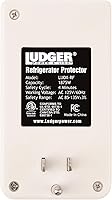
  • Model: This unit is identified by model number LUDX-RF, manufactured by Ludger.
  • Certification: The device carries ETL listing, confirming it has been independently tested to recognized North American safety standards.
  • Max Capacity: Maximum supported load is 1875 watts, suitable for standard residential refrigerators.
  • Working Voltage: Designed to operate on AC 120V at 60Hz, the standard household supply in North America.
  • Safety Range: The unit monitors incoming voltage and maintains output only within a safe window of AC 85–135V (±3%).
  • Frequency Support: Compatible with both 50Hz and 60Hz power frequencies, accommodating imported or dual-frequency appliances.
  • Delay Cycle: A built-in 4-minute safety delay holds power off after an outage before restoring output to the appliance.
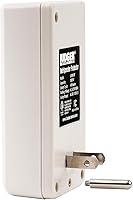
  • Outlet Type: Uses a Type B 3-pin North American plug, compatible with standard grounded wall outlets in the US and Canada.
  • Total Outlets: Provides 3 output outlets, though intended use is dedicated protection for a single refrigerator.
  • LED Indicators: Three indicator LEDs communicate device status: green for normal operation, yellow for active delay cycle, and red for power off.
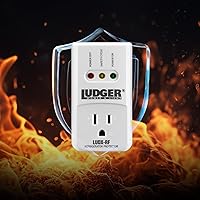
  • Shell Material: The outer casing is constructed from a fire-resistant material, adding passive safety near kitchen appliances.
  • Dimensions: The unit measures 7.6 x 4.09 x 2.76 inches, making it compact enough to fit behind most refrigerators.
  • Weight: At 4.6 oz, the device is lightweight and will not stress the wall outlet or power cord it connects to.
  • Installation: No wiring or tools are required; the unit plugs directly between the wall outlet and the refrigerator power cord.
  • Application: Engineered specifically for single residential refrigerator protection, not intended as a multi-appliance surge strip.
  • Joule Rating: A joule rating for surge absorption capacity is not publicly disclosed by the manufacturer in available product documentation.

Related Reviews
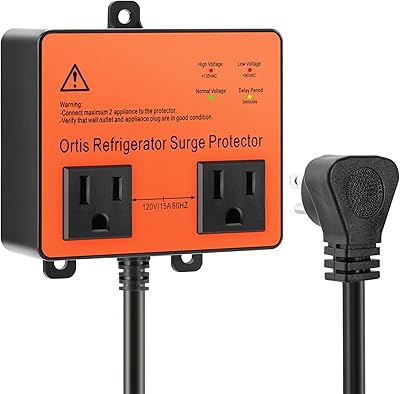
Ortis Double Outlet Refrigerator Surge Protector
78%
96%
Ease of Installation
88%
Voltage Protection Reliability
78%
3-Minute Delay Function
91%
Indicator Light Clarity
87%
Dual Outlet Utility
More
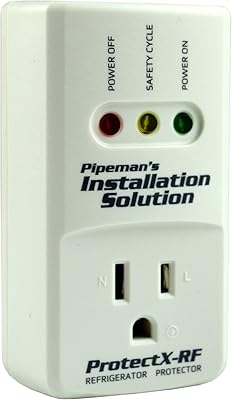
Nippon America Protect-RF Refrigerator Voltage Protector
83%
88%
Voltage Protection Effectiveness
83%
Compressor Safety Delay
93%
Ease of Installation
74%
Build Quality & Durability
86%
Indicator Feedback & Usability
More
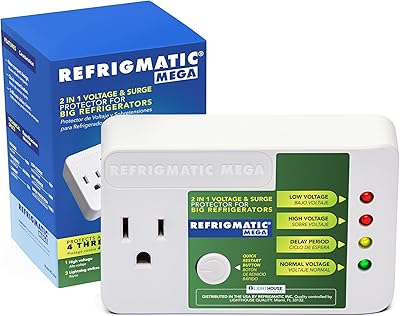
Refrigmatic MEGA Refrigerator Surge Protector
87%
93%
Voltage Protection Effectiveness
96%
Ease of Installation
89%
Compressor Delay Timer
82%
Build Quality & Durability
91%
Outlet Space Efficiency
More
Southwire Surge Guard 34931 30A Surge Protector
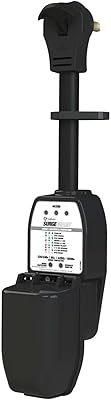
81%
93%
Surge Protection Effectiveness
89%
Build Quality
88%
LCD Display Clarity
91%
A/C Compressor Protection
86%
Ease of Setup
More
Southwire Surge Guard 50A Portable RV Surge Protector
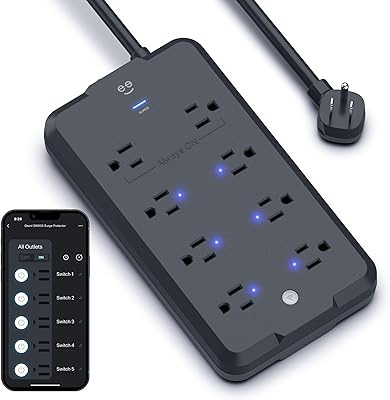
85%
91%
Surge Protection Performance
88%
Ease of Use
87%
Build Quality and Durability
84%
Diagnostic Features
70%
Portability
More
Geeni Surge Ultra 8-Outlet Smart Surge Protector
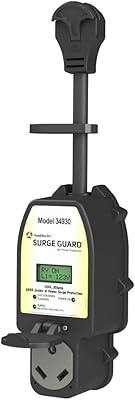
80%
88%
Ease of Setup
71%
App Performance
91%
Smart Outlet Control
84%
Voice Control
78%
Surge Protection
More
Surge Guard 34930 30A RV Surge Protector
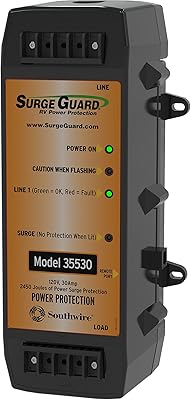
79%
93%
Surge Protection Effectiveness
91%
Fault Detection Accuracy
88%
LCD Display Usefulness
86%
Build Quality & Durability
89%
A/C Compressor Protection
More
Southwire Surge Guard 35530 30 Amp Protector
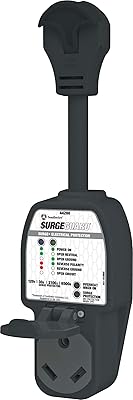
79%
91%
Protection Reliability
82%
Installation Experience
67%
Value for Money
84%
Build Quality
89%
Compressor Protection
More
Southwire Surge Guard 30 Amp RV Protector
74%
91%
Diagnostic Accuracy
93%
Ease of Use
78%
Surge Protection
74%
Build Quality
43%
Weatherproofing
More
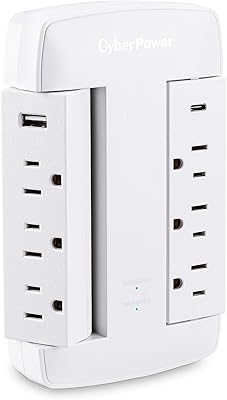
CyberPower CSP600WSURC5 6-Outlet Wall Tap Surge Protector
82%
86%
Surge Protection Reliability
91%
Outlet Design & Flexibility
71%
USB Charging Performance
67%
Physical Stability
78%
Build Quality & Materials
More

FAQ

No electrician needed at all. You simply unplug your refrigerator from the wall, plug the protector into the wall outlet, and then plug your refrigerator into the protector. The whole process takes under a minute, and nothing is permanently altered.

Refrigerator compressors build up pressure while running, and when power cuts suddenly, that pressure needs time to equalize before the compressor can safely restart. Forcing it to start too soon puts serious strain on the motor and can cause premature failure. The 4-minute delay gives the system time to normalize, which is why this feature matters more for fridges than for most other appliances.

As long as your refrigerator runs on a standard AC 120V outlet with a 3-pin North American plug and draws less than 1875 watts, it should be compatible — that covers the vast majority of domestic models including French door, side-by-side, bottom-freezer, and top-freezer configurations. If your fridge has an unusually high power draw (check the label on the back), verify that figure before using any surge protector.

When incoming voltage drifts outside the 85–135V safety range, the unit cuts power to the outlet entirely rather than passing unstable electricity to your fridge. Once voltage returns to a safe level, it enters the 4-minute delay cycle before restoring power — so the restart is protected as well, not just the initial surge.

Yellow means the unit is in its delay cycle, which is completely normal. It typically activates right after power is restored following an outage or a period of voltage instability. After 4 minutes, it should switch to green on its own. If it stays yellow significantly longer than that, it may indicate that incoming voltage is still outside the safe range.

It is designed to handle typical power surges and voltage fluctuations from the grid, including those caused by storms. However, a direct or near-direct lightning strike can produce an energy spike far beyond what any plug-in surge protector is rated to absorb. For that level of threat, a whole-home surge protector at the breaker panel is a more appropriate solution.

It is a fair question, and the honest answer is that the absence of a published joule rating does make it harder to compare this unit against competitors on paper. Joule ratings indicate how much surge energy a device can absorb before it stops protecting. Ludger has not disclosed this figure publicly, so if that level of technical transparency is important to your decision, it is worth reaching out to the manufacturer directly or factoring that gap into your evaluation.

It is specifically engineered around the power behavior of refrigerators, including that 4-minute compressor delay logic. While it might technically plug in elsewhere, using it for appliances with very different power profiles is outside its intended design scope. For washing machines or dishwashers, you would want a protector matched to those specific appliance types.

This is one of the more common complaints from buyers. The unit has a fairly standard plug body, but recessed or tight outlet configurations can make it awkward. A short extension cord or a right-angle outlet adapter can usually resolve the fitment issue without any permanent changes.

Warranty terms are not prominently detailed in the publicly available product listing, which is something worth clarifying with the seller or manufacturer before purchasing if warranty coverage is a deciding factor for you. Generally speaking, surge protectors are consumable protection devices — once they absorb a significant surge event, internal components can degrade, so periodic replacement is good practice regardless of brand.