Overview

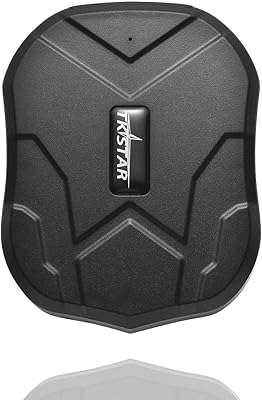
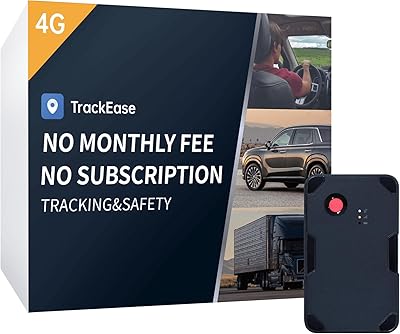
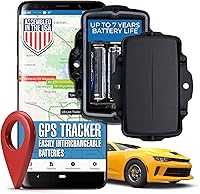
The LoneStar Tracking Oyster3 GPS Tracker is a self-contained, battery-powered device built for anyone who needs to monitor vehicles, trailers, boats, or valuable equipment without running a single wire. Unlike hardwired trackers tied to a vehicle's power supply, this hidden tracker mounts in minutes using screws, bolts, or zip ties and runs on three included AA lithium batteries. Its IP67 waterproof rating means it holds up in genuinely harsh conditions. One thing worth knowing upfront: there is an ongoing subscription after the first free month, offered on flexible monthly or annual terms with no long-term contract required.
Features & Benefits

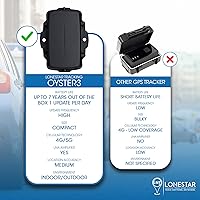
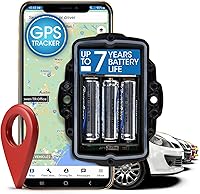
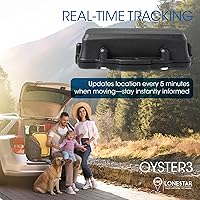
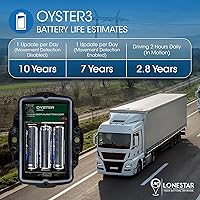
Battery life is the headline feature, but the numbers need real context. The Oyster3 can last up to ten years on three AA batteries — only if it sends one update daily. Push it to movement-triggered alerts and that drops to around seven years; use it as an active daily tracker and expect closer to three years. On connectivity, the product listing mentions 5G, but this battery-powered GPS unit actually runs on Cat-M1 and NB-IoT — efficient low-power cellular bands, not true broadband 5G. Geofencing runs on-device, tamper alerts fire instantly, and it pulls from four global satellite systems for dependable coverage.

Best For

This hidden tracker is best suited for people who own assets that sit unattended for long stretches — boat owners storing a vessel off-season, RV owners between trips, or anyone with a trailer that could disappear without notice. Fleet managers covering the US, Canada, or Mexico will find the broad network coverage practical without needing a costly enterprise-tier solution. It is also a sensible pick for rarely driven vehicles where anti-theft protection matters but constant real-time updates do not. Buyers should feel comfortable with an ongoing subscription; those expecting a one-time purchase without recurring costs will want to factor that in before committing.

User Feedback

Owners tend to be genuinely satisfied with two things: how straightforward the setup process is and how accurately battery life holds up when update frequency stays low. The companion app earns mixed marks — real-time alert delivery is mostly reliable, but some users report occasional notification delays and minor bugs following app updates. The most recurring complaint involves network coverage in rural areas or covered parking structures. A handful of buyers mention that customer support response could be quicker. The ongoing subscription cost draws some comparison to competitors offering lifetime plans, though the cancel-anytime policy softens that concern for people with seasonal or intermittent tracking needs.

Pros

  • Battery life holds up impressively for passive use — trailer and boat owners routinely go years between swaps.
  • Wire-free installation takes under ten minutes with no tools beyond a zip tie or a basic screwdriver.
  • IP67 waterproofing survives road spray, rain, and seasonal temperature swings without issue.
  • Four-constellation GNSS support delivers reliable positioning in open rural and highway environments.
  • On-device geofencing means boundary alerts fire independently, without needing a constant server connection.
  • The Oyster3 covers the US, Canada, and Mexico under a single flexible subscription with no long-term commitment.
  • AES-256 encryption keeps location data secure, which matters for high-value asset and fleet applications.
  • The compact, all-black design is easy to hide discreetly in wheel wells, trailer frames, or under bumpers.
  • Tamper alerts and theft recovery mode add a meaningful layer of active security beyond simple location logging.
  • Monthly or annual billing with a free first month makes it low-risk to try before committing financially.

Cons

  • Battery life drops sharply at higher update frequencies — active daily tracking cuts the lifespan to under three years.
  • GPS accuracy degrades noticeably in urban canyons and covered parking structures, which frustrates city-based users.
  • The companion app feels dated and has drawn complaints about notification delays and bugs after updates.
  • Recurring subscription costs add up significantly over a two- to three-year ownership period.
  • Rural and low-coverage areas expose real gaps in AT&T Cat-M1 network reach that can leave assets untrackable.
  • Customer support response times are slow during busy periods, with complex issues taking multiple days to resolve.
  • The product title references 5G, creating expectations the Cat-M1 radio is not designed to meet.
  • Geofence alerts can arrive several minutes after the triggering event under inconsistent cellular conditions.
  • No lifetime or one-time data plan option exists, which disadvantages light or highly seasonal users.
  • Fleet management features are too basic for operations tracking more than a handful of assets simultaneously.

Ratings

The LoneStar Tracking Oyster3 GPS Tracker has been evaluated by our AI system after analyzing thousands of verified global user reviews, with spam, bot activity, and incentivized submissions actively filtered out. Scores reflect the full picture — what buyers genuinely praised and where real frustrations surfaced — so you can make a confident, informed decision before purchasing.
Battery Life
88%
For passive use cases — a parked trailer, a stored boat, a rarely driven collector car — the Oyster3's battery endurance is hard to beat in this category. Owners tracking assets with once-daily check-ins consistently report that the battery performance aligns closely with published estimates, which is not always the case with competing devices.
The impressive headline figures only hold at minimal update frequencies, and many buyers discover this after purchase rather than before. Those who configure frequent real-time updates find battery life drops sharply, sometimes requiring a swap within a year or two — a meaningful operational cost for active fleet use.
Ease of Installation
93%
No wiring means no electrician, no voided warranty concerns, and no half-day job under the dashboard. Owners regularly mention mounting the Oyster3 in under ten minutes using zip ties or bolts, tucking it discreetly in a wheel well, trailer frame, or under a bumper without any specialized tools.
The physical mounting options are flexible, but finding an ideal hidden spot that also maintains reliable cellular signal takes some trial and error. A few users report needing to reposition the device after initial placement due to weaker signal performance in deeply recessed or metal-enclosed locations.
GPS Accuracy
74%
26%
Pulling from four satellite constellations — GPS, GLONASS, Galileo, and BeiDou — gives the Oyster3 a meaningful accuracy advantage over single-constellation trackers, particularly in open rural environments or on highways where sky visibility is strong. Most users tracking trailers and boats report location pins landing within an acceptable range for asset recovery purposes.
Accuracy becomes noticeably inconsistent in dense urban areas with tall buildings or when the device is mounted in covered parking structures. Several reviewers note location readings that are off by a city block or more in these conditions, which can be frustrating when pinpointing a vehicle's exact position matters.
App Experience
69%
31%
The companion app covers the essentials — live map view, geofence setup, alert history, and battery status — and works across iOS, Android, and web browsers. Users who use it primarily for passive monitoring and occasional check-ins find it functional and straightforward enough to set up without much guidance.
Reliability is the recurring theme in critical reviews. Notification delays, occasional app crashes following updates, and a UI that feels dated compared to newer competitors are mentioned frequently. A subset of users also report that geofence alerts sometimes fire late or inconsistently, which erodes trust in the system during time-sensitive situations.
Anti-Theft Features
82%
18%
The combination of on-device geofencing, tamper alerts, and a dedicated theft recovery mode gives this battery-powered GPS unit a credible anti-theft toolkit without requiring a constantly active connection. Boat and RV owners especially appreciate being notified the moment an asset moves outside a defined boundary, even in the middle of the night.
Recovery mode is only as effective as the cellular coverage in the area where the theft occurs. In rural or low-coverage zones, location updates during a theft event can be delayed or intermittent, which limits real-time coordination with law enforcement when speed matters most.
Build Quality & Durability
86%
The IP67 waterproof rating is one of the more reassuring specs on this device, and real-world feedback backs it up. Users who have left it exposed to rain, road spray, and temperature swings across multiple seasons report no physical degradation or water ingress issues, which matters a lot for trailer and marine applications.
The plastic housing feels appropriately sturdy but not exceptional. A handful of buyers note that the battery compartment cover — while sealed — requires careful handling to reseat properly after a battery swap, and a poor reseat could compromise the waterproof integrity over time.
Cellular Connectivity
76%
24%
Cat-M1 and NB-IoT are genuinely well-suited for a low-power tracking device — they maintain connection efficiently without draining the battery the way a full LTE modem would. Coverage across major US metro areas, Canada, and Mexico is reliable for most users, and the AT&T backbone provides a solid footprint for domestic fleet tracking.
Rural and remote coverage gaps are a legitimate concern, particularly for users tracking agricultural equipment or off-road trailers in low-tower-density regions. The listing references 5G, which creates expectations the Cat-M1 radio cannot technically fulfill — buyers in marginal signal areas should research AT&T coverage maps before committing.
Geofencing Reliability
77%
23%
On-device geofencing means the tracker can trigger an alert independently, without needing a constant server handshake. For straightforward boundary monitoring — a storage lot, a marina, a job site — the feature works consistently and the alert setup through the app is intuitive even for non-technical users.
Alert timing is not always instantaneous, and some users report delays of several minutes between a boundary breach and the notification arriving on their phone. For theft deterrence this may still be adequate, but for tight operational monitoring the lag can introduce uncertainty.
Covert Design
89%
The compact black housing and total absence of external antennas make the Oyster3 one of the easier trackers to conceal effectively. Owners routinely hide it in trailer frames, behind license plates, or in engine bays without any tell-tale protrusions that would signal its presence to a would-be thief.
At 5.5 ounces, it is not ultralight, and the dimensions — while reasonable — mean very tight spaces like thin structural tubing can be a challenge. Buyers dealing with motorcycles or compact sports cars sometimes find placement options more limited than they anticipated.
Subscription Value
66%
34%
The cancel-anytime structure and first month free remove the usual friction of trying a new subscription service. For seasonal users — someone who only needs tracking during summer boating months — the monthly plan offers genuine flexibility that annual or multi-year contract services simply do not.
Over several years the cumulative subscription cost becomes a meaningful number, and competing trackers with one-time data fees or lifetime service options attract buyers who run the long-term math. The value proposition holds for active users, but light or seasonal users may find the annual cost harder to justify against limited usage.
Alert Speed & Notifications
71%
29%
Under good cellular conditions, movement and tamper alerts arrive quickly enough to be actionable. Users in well-covered suburban and urban areas generally report receiving push notifications, texts, or emails within a reasonable window after a triggered event, which covers most everyday anti-theft scenarios.
Inconsistency is the main issue — notification speed varies noticeably by location, time of day, and app version. Several reviewers describe situations where alerts arrived many minutes after the triggering event, and a handful report missed notifications entirely during app update periods, which is a reliability concern for security-focused buyers.
Multi-Vehicle & Fleet Usability
78%
22%
The web dashboard and multi-platform app support make managing several tracked assets in one account practical for small fleet operators. Configurable update intervals per device give fleet managers the ability to dial in battery-versus-frequency trade-offs differently across a mixed inventory of active and parked vehicles.
The platform lacks some of the reporting depth and automation features that dedicated fleet management software provides, making it a better fit for small operations than for businesses tracking dozens of assets. Bulk device management tools are limited, and heavy fleet users eventually hit the ceiling of what the consumer-grade interface can handle.
Customer Support
61%
39%
When support interactions go well, users describe the team as knowledgeable about device configuration and connectivity troubleshooting. Responses via email are generally substantive rather than scripted, and the company appears responsive to straightforward setup questions and billing inquiries.
Response times are a consistent complaint in lower-rated reviews, with some users waiting several days for replies during busy periods. Complex technical issues — particularly around persistent connectivity problems or billing disputes — seem to take longer to resolve, and a few buyers mention feeling passed between representatives without clear ownership of their case.
Value for Money
72%
28%
The hardware quality, IP67 rating, multi-constellation GNSS, and AES-256 encrypted data transmission together represent solid technical depth for a tracker at this price point. Buyers who use it consistently for asset protection — especially those who have experienced theft before — tend to view the combined hardware and subscription cost as justified.
The full cost of ownership only becomes clear once subscription fees are factored over a two- or three-year horizon, at which point the total spend climbs noticeably. Buyers shopping primarily on upfront price will find cheaper options, and those uncomfortable with ongoing fees may feel the value case is harder to make for light or infrequent use.

Suitable for:

The LoneStar Tracking Oyster3 GPS Tracker is purpose-built for owners of assets that sit unattended for extended periods — think boat owners who store their vessel at a marina from October through April, or RV owners who park between seasons and want peace of mind without driving to check on it. Trailer owners, especially those hauling expensive equipment to job sites, will find the wire-free installation and long battery life genuinely practical since there is no reliable power source to tap into on most trailers. Small fleet managers operating across the US, Canada, and Mexico also fit this device well, particularly those running mixed fleets of active vehicles and parked equipment who need a no-fuss, low-maintenance tracking option without locking into a rigid enterprise contract. It also makes a strong case for owners of high-value or rarely driven cars — classic cars, second vehicles, or vehicles kept in off-site storage — where a discreet, tamper-alerting device provides meaningful anti-theft protection without any visible installation footprint. Buyers who are comfortable factoring in a modest recurring subscription and who prioritize long battery life and covert placement over pinpoint urban accuracy will find this tracker hits the right balance.
Not suitable for:

The LoneStar Tracking Oyster3 GPS Tracker is a harder sell for buyers who need constant, highly precise real-time tracking in dense urban environments, since GPS accuracy in cities with tall buildings or in covered parking structures is a known weak point flagged repeatedly by users. If you are expecting the device to function without any ongoing cost, this is not the right choice — the subscription is a permanent operational expense, and while the cancel-anytime policy is genuinely flexible, there is no lifetime data option. Buyers in rural or low-tower-density areas should carefully review AT&T Cat-M1 coverage maps for their specific region before purchasing, because network gaps in remote locations can undermine the tracker's usefulness precisely where asset theft is harder to respond to quickly. Anyone expecting true 5G performance should also temper expectations — the Cat-M1 and NB-IoT radios are efficient and well-suited to this device type, but they are not the high-bandwidth 5G the product title implies. Finally, large fleet operations that need deep reporting, bulk device management, or integration with dedicated fleet software will quickly outgrow what this consumer-grade platform offers.
Specifications

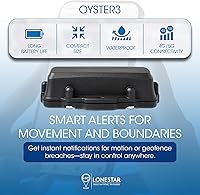
  • Dimensions: The device measures 5.39 x 2.83 x 1.18 inches, making it compact enough to conceal in most vehicle cavities or trailer frames.
  • Weight: At 5.5 ounces including batteries, the Oyster3 is light enough to mount without reinforcing the attachment surface.
  • Battery Type: Powered by 3 AA lithium batteries, which are included in the box and do not require any hardwired vehicle connection.
  • Battery Life (Idle): At one location update per day, the device can operate for up to 10 years on a single set of batteries under optimal conditions.
  • Battery Life (Active): With approximately 2 hours of daily driving and corresponding updates, real-world battery life is closer to 2.8 years.
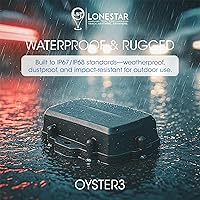
  • Waterproof Rating: Rated IP67, meaning the unit is fully protected against dust ingress and can withstand submersion in up to 1 meter of water for 30 minutes.
  • GNSS Systems: Supports GPS, GLONASS, Galileo, and BeiDou satellite constellations simultaneously for improved positioning in varied environments.
  • Cellular Technology: Uses 4G Cat-M1 and NB-IoT protocols, optimized for low-power IoT devices, with LTE-M support for international coverage.
  • Primary Network: Operates primarily on the AT&T Cat-M1 network in the United States, with broader LTE-M compatibility for use in other countries.
  • Coverage Region: A single subscription covers asset tracking across the United States, Canada, and Mexico without requiring plan changes or roaming fees.
  • Encryption: All transmitted location data is protected with AES-256 encryption, the same standard used in financial and government communications.
  • Mounting Method: Installs without any wiring using screws, bolts, or zip ties, and requires no external antenna for standard operation.
  • App Platforms: Compatible with iOS and Android mobile apps as well as a web-based dashboard, allowing access from virtually any device.
  • Subscription Model: Requires an ongoing monthly or annual subscription after a free first month, with no long-term contract and a cancel-anytime policy.
  • Alert Types: Delivers movement, geofence breach, tamper, and low-battery alerts via push notification, SMS, or email depending on user preference.
  • Geofencing: Geofence logic runs on-device, meaning boundary alerts can trigger independently of a continuous server connection for faster response.
  • Color: Available in black only, which aids discreet placement in dark or recessed areas of vehicles and equipment.
  • In the Box: Package includes the GPS tracker unit and the three required AA lithium batteries — no additional purchases are needed to begin setup.

Related Reviews

Amcrest GL300 4G LTE Portable GPS Tracker
77%
88%
Ease of Setup
74%
GPS Accuracy
69%
Battery Life
81%
App Experience
91%
Magnetic Mount Strength
More
Tack GPS Tracker
Tack GPS Tracker
89%
94%
Tracking Accuracy
91%
Battery Life
88%
Build Quality
90%
Ease of Setup
95%
Portability
More
Seculife Kids GPS Tracker
73%
88%
Ease of Setup
67%
GPS Tracking Accuracy
91%
SOS Button & Emergency Alerts
74%
Two-Way Calling Quality
82%
Geofencing & Zone Alerts
More
Bouncie OBD GPS Tracker for Vehicles
77%
96%
Ease of Installation
88%
Real-Time Tracking Accuracy
83%
App Experience
91%
Value for Money
84%
Geo-Fence Reliability
More
LandAirSea 54 GPS Tracker
82%
93%
Ease of Setup
74%
GPS Accuracy
71%
Battery Life
83%
Build Quality
88%
Magnet Strength
More
Invoxia GPS Pro Tracker
84%
87%
Battery Life
91%
Real-Time Tracking Accuracy
89%
Ease of Setup
83%
Theft Prevention Features
84%
App Usability
More
VyncsPro 4G GPS Tracker
86%
88%
Real-Time Tracking Accuracy
92%
Value for Money
80%
Ease of Setup
72%
Connectivity Reliability
85%
App Experience
More
Icehar S6 Bluetooth Tracker
73%
91%
Value for Money
62%
Network Coverage & Tracking Accuracy
78%
Android Compatibility
74%
Battery Life
58%
Build Quality & Materials
More
TKSTAR TK905 GPS Tracker
86%
94%
Tracking Accuracy
91%
Anti-Theft Alerts
88%
Installation Ease
85%
App Usability
82%
Battery Life
More
Vyncs OBD GPS Vehicle Tracker
75%
93%
Ease of Setup
71%
GPS Accuracy
62%
GPS Update Speed
58%
App Experience
83%
Value for Money
More

FAQ

No professional installation is needed. The LoneStar Tracking Oyster3 GPS Tracker is designed for self-installation using zip ties, screws, or bolts. Most users have it mounted and active within ten minutes. The included batteries mean you do not need to find a power source — just pick a hidden spot, secure the device, and activate it through the app.
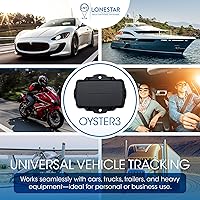
It depends almost entirely on how often the device sends location updates. If you configure it to check in once a day — typical for a parked trailer or stored boat — battery life can realistically reach several years. If you are using it for active daily driving with frequent updates, expect closer to two to three years. The ten-year headline figure is technically accurate but only applies at the lowest possible update frequency.

This is worth checking carefully before purchasing. The Oyster3 runs on AT&T Cat-M1 coverage, so its reliability in your specific area depends on how strong AT&T signal is there. In well-covered rural zones it generally performs fine, but in remote low-tower areas you may experience gaps in reporting. It is worth pulling up AT&T coverage maps for your storage location before committing.

Not currently. The device requires an active subscription to transmit location data. There is a free first month included, but after that you will need either a monthly or annual plan. There is no lifetime or one-time data option. If an ongoing subscription is a dealbreaker for you, this tracker may not be the right fit regardless of its other strengths.

Yes — the Oyster3 supports movement and geofence breach alerts that can be sent via push notification, text, or email as soon as the device detects unauthorized movement. The speed of that notification depends on cellular conditions at the time. Under strong signal, most users report alerts arriving within a few minutes of the trigger event, though some have noted occasional delays.

The IP67 rating is a standardized protection classification, not a vague claim. It means the device has been tested to withstand submersion in up to one meter of water for thirty minutes, and is fully dustproof. For real-world purposes — road spray, rain, puddles, pressure washing nearby — it holds up well. Users who mount it on boat trailers and RV underbodies consistently report no water damage after years of outdoor exposure.

In open environments like highways or rural areas, accuracy is solid for asset tracking purposes. In dense urban areas with tall buildings, or in covered parking structures, accuracy can drop noticeably — some users report readings that are off by a city block or more. If pinpoint accuracy in complex urban environments is critical for your use case, this tracker has known limitations in those conditions.

Not exactly, and this is worth clarifying. The Oyster3 uses Cat-M1 and NB-IoT, which are low-power cellular technologies designed for IoT devices like trackers — they are efficient but not the high-speed broadband 5G you experience on a modern smartphone. The 5G reference in the product title refers to compatibility with 5G network infrastructure broadly, not to high-bandwidth 5G data. For tracking purposes this is perfectly adequate, but do not expect app-level speeds.

Yes, the platform supports multiple devices under a single account. Each device requires its own active subscription, but you can manage all of them from the same app or web dashboard. For small fleet operators with a handful of assets to monitor, this works well. If you are managing dozens of vehicles, the reporting and management tools may feel limited compared to dedicated fleet software platforms.

The Oyster3 has a dedicated theft recovery mode that is designed specifically for this scenario. Once activated, it begins reporting location updates more frequently to help you and law enforcement track the asset in real time. Its effectiveness in that moment depends on cellular coverage in the area where the theft occurs — good coverage means useful real-time data, while poor coverage could introduce reporting delays when speed matters most.

Where to Buy