Overview

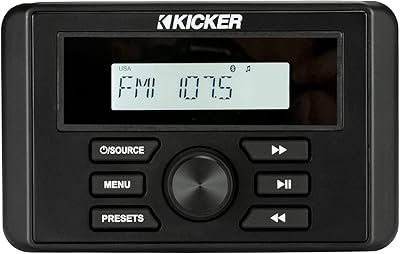
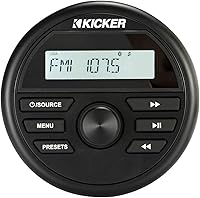
The Kicker 46KMC2 Marine Bluetooth Media Receiver takes a smart approach to boat audio by fitting directly into a standard 3-inch gauge opening — the kind already cut into most pontoon dashboards — rather than requiring a traditional DIN slot installation. Kicker, built under Stillwater Designs, has a long track record in mobile and marine audio, and this head unit reflects that experience. It carries an IPX66 weather rating, meaning it can handle sustained water jets without flinching, not merely light rain. Available since 2020 and still selling steadily, it occupies a solid mid-range position where build quality and brand reliability matter as much as raw specs.
Features & Benefits

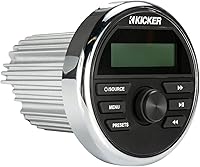
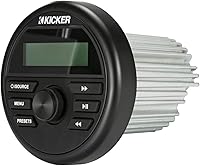
What makes this marine head unit practical day-to-day is how thoughtfully its inputs are arranged. Bluetooth pairs quickly and holds a steady connection up to roughly 30 feet — far enough that your phone can stay in a dry bag below deck. Plug in via USB or RCA if you prefer a wired link, or flip to the built-in AM/FM tuner for local weather channels. The four-channel amplifier pushes over 200 watts peak, which is a meaningful number, but buyers should know peak ratings differ from continuous RMS output. The rotary encoder controls are a genuine advantage on the water, easy to turn with wet or gloved hands without fumbling through touchscreen menus.

Best For

This boat stereo is a natural fit for pontoon owners and small-craft boaters who already have a gauge-bay opening and want to use it cleanly rather than patching in a bulky bracket-mounted unit. It also suits anglers who need audio controls they can hit quickly between casts — no multi-tap menus, just a dial and a few buttons. Buyers moving up from a bargain marine radio will appreciate the jump in build quality and sound output, while those chasing the absolute loudest system might eventually want external amplification. If touchscreen interfaces are a priority, this receiver is not the right match; if durability and simplicity are, it absolutely is.

User Feedback

Across several hundred verified purchases, the Kicker gauge receiver holds a 4.5-star average, which fairly reflects what real owners report. Bluetooth pairing draws consistent praise — people appreciate that it connects quickly and stays connected even while the boat is moving. Sound quality for a compact four-channel setup gets strong marks as well. On the critical side, some buyers found the controls slightly stiff out of the box, though most noted this eases with use. Mounting alignment requires care; a slightly off-center gauge hole can make the trim ring look uneven. A handful of users wanted more RCA flexibility or a zone 2 output, features that the higher-tier KMC5 covers if your setup demands them.

Pros

  • IPX66 certification handles sustained water jets, not just occasional spray, which matters on open water.
  • Bluetooth pairs quickly and holds a reliable connection up to roughly 30 feet away.
  • The gauge-mount design integrates cleanly into most pontoon dashboards without bracket hacks.
  • Four-channel output lets you drive a full speaker setup without a separate amplifier.
  • Rotary encoder controls are easy to operate with wet or gloved hands.
  • Built-in AM/FM tuner adds practical value, especially for marine weather channels.
  • USB and RCA inputs give you wired backup options when Bluetooth is not ideal.
  • Kicker has an established reputation in marine audio, and parts and support are accessible.
  • At 1.95 pounds, this boat stereo is light enough to avoid stressing older gauge panel cutouts.
  • A 4.5-star average across hundreds of verified buyers reflects consistently solid real-world satisfaction.

Cons

  • Controls can feel stiff out of the box and require a break-in period before operating smoothly.
  • No zone 2 RCA output limits flexibility for multi-zone audio setups on larger boats.
  • Peak power figures are advertised prominently, but continuous RMS output is the more honest performance measure.
  • Flush mounting requires precise gauge-hole alignment; an off-center cut will show around the trim ring.
  • No touchscreen or app connectivity may feel dated to buyers used to modern head unit interfaces.
  • Bluetooth range of roughly 30 feet can be restrictive on larger vessels with an enclosed helm area.
  • No built-in GPS, weather alert, or NMEA integration for boaters who want a more connected setup.
  • The comparison-table push toward the higher-tier KMC5 suggests some buyers may outgrow this unit quickly.

Ratings

The scores below reflect AI-driven analysis of verified global buyer reviews for the Kicker 46KMC2 Marine Bluetooth Media Receiver, with spam, bot-generated, and incentivized feedback actively filtered out before scoring. Each category captures both what real owners genuinely appreciated and where they ran into friction, giving you an honest picture of the unit's strengths and its real-world limitations.

Weather Resistance
93%
The IPX66 certification earns consistent real-world trust from boaters who have tested it through heavy rain, wave splash, and high-speed runs on open water. Owners frequently mention that it held up through conditions that damaged cheaper units, making it one of the most cited reasons they recommend this boat stereo to others.
A small number of buyers in coastal saltwater environments noted that long-term corrosion around the trim ring required occasional maintenance, suggesting the housing's exterior finish is less impervious than the internal electronics. Buyers operating in consistently harsh saltwater conditions may want to inspect and rinse the unit regularly.
Bluetooth Performance
88%
Pairing is quick and reliable across Android and iOS devices, and the roughly 30-foot range works well on most recreational boats where the helm and seating are close together. Owners appreciate not having to re-pair every trip, with the unit reconnecting automatically to the last paired device when powered on.
At the outer edge of the range, particularly when there are walls or a hardtop between the phone and the unit, dropouts become more frequent. A handful of users with larger enclosed helm stations found the effective usable range was closer to 20 feet in practice.
Sound Quality
84%
For a compact head unit with no separate amplifier, the four-channel output delivers noticeably better clarity and volume than most budget marine radios buyers were upgrading from. Mid and high frequencies come through cleanly at moderate volume, which is where most boaters spend their listening time anyway.
Bass response from the internal amplifier is underwhelming without a supplemental subwoofer, and the peak power rating can mislead buyers expecting concert-level output. At higher volumes, some owners noted a degree of distortion that would push serious audio enthusiasts toward adding an external amplifier.
Ease of Installation
76%
24%
For boaters with an existing 3-inch gauge opening and basic wiring experience, the installation process is genuinely straightforward and can be completed in an afternoon without professional help. The gauge-mount concept eliminates the need for any dashboard cutting or custom bracket fabrication.
Getting the trim ring to sit perfectly flush requires careful alignment during install, and a slightly off-center gauge hole can leave a visible gap that looks unprofessional. Buyers whose existing gauge openings are not perfectly round or are reinforced with backing plates have reported a more involved installation process.
Control Usability
79%
21%
The physical rotary encoder is a genuine practical advantage on the water, where wet hands and boat movement make touchscreen navigation unreliable and frustrating. Most owners adapted to the control layout within a trip or two and appreciated being able to change volume or source by feel alone.
Several buyers noted the encoder and buttons felt stiff and resistant during the first few uses, which can be disconcerting right out of the box. The control layout, while logical, takes some initial learning, and the absence of a touchscreen means navigating through radio presets or Bluetooth menus involves more button presses than modern alternatives.
Display Readability
81%
19%
In typical daylight and even in direct afternoon sun on open water, the display remains readable without requiring the user to shade it with a hand. Owners who spend time on the water during midday specifically called this out as better than expected for a unit at this price point.
At very sharp viewing angles — which can happen depending on where the gauge cluster sits relative to the captain's eye level — the display loses some contrast and becomes harder to read quickly. Night visibility is functional but not particularly vivid, which a few owners found underwhelming compared to backlit automotive-grade displays.
Input Versatility
77%
23%
Having Bluetooth, USB, RCA line-in, and AM/FM tuner all in one compact unit means most boaters can connect their preferred audio source without adapters or compromises. The AM/FM tuner adds practical utility beyond music, particularly for NOAA weather broadcasts while on the water.
The RCA input and output configuration is more limited than what audio enthusiasts building multi-zone systems will want, and the lack of a zone 2 output is a real constraint for larger boats. There is no optical audio input or advanced DSP integration, which narrows the upgrade path for buyers with more complex audio goals.
Build Quality
86%
The housing feels solid and purposeful rather than lightweight and hollow, and the overall fit and finish reflect Kicker's experience in building components meant to endure vibration, temperature swings, and humidity over multiple seasons. Long-term owners report no rattling, cracking, or degradation in the chassis after years of regular use.
The exterior trim ring finish, while visually clean at installation, can show surface scuffs and minor corrosion if exposed to saltwater spray over an extended period without rinsing. A few buyers felt the plastic surround did not quite match the perceived premium of the internal components.
Value for Money
74%
26%
Compared to budget marine head units, this boat stereo delivers a meaningful jump in weather protection, connectivity, and audio output that most buyers felt justified the price difference after a full season of use. The Kicker brand name also carries practical value in terms of parts availability and support channels.
Buyers who needed zone 2 outputs, more RCA flexibility, or louder output found themselves eyeing the higher-tier KMC5 shortly after purchase, which costs significantly more and can make the KMC2 feel like an expensive stepping stone rather than a complete solution. At its price point, the absence of a touchscreen or any app integration feels like a genuine trade-off rather than a deliberate simplicity.
Compatibility
82%
18%
Standard Bluetooth A2DP support means virtually any smartphone pairs without issues, and the RCA connectivity works with the vast majority of aftermarket marine speakers regardless of brand. Owners switching from various other head unit brands reported no compatibility headaches during the swap.
There is no support for Apple CarPlay, Android Auto, or any proprietary streaming app integration, which matters increasingly to buyers who use those ecosystems daily. The unit also lacks NMEA 2000 integration, ruling it out for boaters who want their audio system to communicate with onboard navigation or instrumentation networks.
Mounting Fit
71%
29%
The gauge-mount approach is genuinely clever for pontoons and fishing boats where a 3-inch opening is already present, and the resulting installation looks factory-clean compared to bracket-mounted alternatives. Owners consistently describe the final installed appearance as one of the highlights of choosing this unit.
The mounting system's elegance depends entirely on having a precise, correctly sized, well-positioned gauge hole to begin with — if yours is even slightly irregular, the trim ring will not sit flush. The mounting hardware provided requires careful handling, and several owners wished the kit included more shim or adjustment options to accommodate minor variations in panel thickness.
Durability Over Time
83%
Multiple owners report using this marine head unit across three or more full boating seasons without failures, which is a meaningful endorsement given the thermal cycling, UV exposure, and vibration involved in regular on-water use. Kicker's warranty support and parts availability add confidence for long-term ownership.
A small subset of owners reported unit failures after the second or third season, particularly in environments with heavy saltwater exposure and inconsistent winterization. While these represent a minority of reviews, they suggest that proper off-season care and rinsing are not optional for maximum longevity.

Suitable for:

The Kicker 46KMC2 Marine Bluetooth Media Receiver is purpose-built for pontoon boat owners, fishing boat enthusiasts, and recreational boaters who already have a standard 3-inch gauge opening in their dashboard and want to use it for a clean, integrated audio installation. If you are stepping up from a basic entry-level marine stereo and want reliable Bluetooth streaming without compromising on weather protection, this unit delivers that combination at a realistic price point. Anglers who need controls they can operate quickly and intuitively — with wet hands, in bright sunlight, without looking away from the water for long — will find the rotary encoder interface far more practical than any touchscreen alternative. It also suits boaters who want to run four speakers directly from a single compact unit without immediately investing in a separate external amplifier. Anyone who values a recognized brand with a documented track record in marine audio, and who wants a unit that has proven itself over several years of real-world use, will feel confident in this purchase.
Not suitable for:

The Kicker 46KMC2 Marine Bluetooth Media Receiver is not the right choice for boaters whose vessels lack an existing 3-inch gauge opening, since retrofitting a mounting location adds complexity and cost that undermines the unit's core advantage. Buyers chasing high-volume, whole-boat audio coverage with multiple amplified zones should look elsewhere — this marine head unit does not offer a zone 2 output, and its RCA flexibility is more limited than what serious multi-zone setups demand. If a large color touchscreen, app integration, or GPS navigation are must-haves for your on-water experience, this boat stereo simply was not designed with those features in mind. Those running larger vessels where the listening area spans a significant distance from the helm may also find that a single four-channel head unit without supplemental amplification falls short of their expectations. Finally, buyers on a tight budget who are comparing this against stripped-down marine radios should weigh whether the premium for weather certification, build quality, and brand support aligns with how demanding their actual boating environment really is.

Specifications

  • Brand: Manufactured by Stillwater Designs and sold under the Kicker brand, a well-established name in mobile and marine audio.
  • Model Number: The exact model designation is 46KMC2, which distinguishes it from the higher-output KMC5 in the same product family.
  • IP Rating: Carries an IPX66 certification, meaning it is protected against powerful, sustained water jets from any direction.
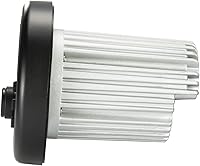
  • Mounting Style: Designed to install into a standard 3-inch round gauge opening, the same cutout used by most factory boat instrument clusters.
  • Trim Ring Size: The outer trim ring measures 3.5″ x 5.5″, covering the gauge hole and providing a finished appearance on the dashboard.
  • Mounting Depth: Requires 5″ of clearance behind the mounting surface to seat the unit fully without obstructing wiring or structural supports.
  • Dimensions: Overall product dimensions are 7″D x 5.5″W x 8″H, making it compact enough for tight helm panel installations.
  • Weight: The unit weighs 1.95 pounds, light enough to avoid placing meaningful stress on fiberglass or composite gauge panels.
  • Peak Power: The internal four-channel amplifier delivers over 200 watts of total peak power across all four channels combined.
  • Channels: Audio output is distributed across four independent channels, capable of driving up to four speakers simultaneously without an external amplifier.
  • Bluetooth Range: Bluetooth connectivity supports wireless audio streaming from smartphones and compatible devices at a range of approximately 30 feet.
  • Audio Inputs: Accepts audio via Bluetooth, USB, and RCA line-level inputs, plus a built-in AM/FM tuner for broadcast radio reception.
  • RCA Outputs: Includes RCA preamp outputs, allowing the unit to send a line-level signal to an external amplifier or powered subwoofer.
  • Display: Features a rotary encoder dial and a readable screen designed to remain legible in direct sunlight and during rough water conditions.
  • Connector Type: Primary audio connectivity uses RCA connectors for both input and output signal routing.
  • Compatible Devices: Officially compatible with smartphones and external speakers; Bluetooth pairing follows standard A2DP audio streaming protocols.
  • Frequency Response: Audio frequency response spans 20 Hz to 20 kHz, covering the full range of human hearing for accurate sound reproduction.
  • Date Released: The unit was first made available in May 2020 and remains in active production with no discontinuation announced by the manufacturer.

Related Reviews

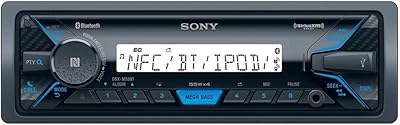
Sony DXS-M5511BT Marine Digital Media Receiver with Bluetooth
85%
94%
Bluetooth Connectivity
86%
Sound Quality
92%
Water-Resistance/Durability
68%
Ease of Installation
91%
Value for Money
More
Citreal Marine Bluetooth Stereo Receiver
74%
76%
Water Resistance
83%
Bluetooth Performance
81%
Ease of Installation
61%
Sound Quality
79%
AM/FM Reception
More
VOXXBASS Bluetooth Marine Radio Receiver
86%
92%
Durability and Waterproofing
87%
Sound Quality
90%
Bluetooth Connectivity
75%
Ease of Installation
85%
Compatibility with Devices
More
SOUNDKITS Bluetooth Marine Boat Radio Receiver
84%
85%
Bluetooth Range
70%
Sound Quality
92%
Water Resistance (IPX5)
88%
Ease of Installation
80%
Build Quality
More
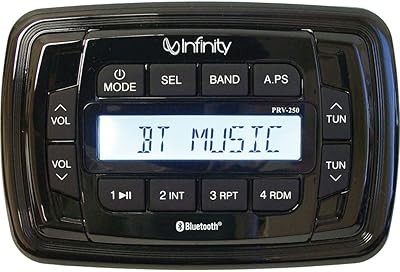
Infinity INF-PRV250 Bluetooth Marine Receiver
84%
89%
Audio Performance
72%
Bluetooth Connectivity
91%
Waterproof Durability
85%
Ease of Installation
84%
Build Quality
More
Sony DSXM55BT Marine Stereo Receiver
81%
83%
Bluetooth Connectivity
76%
Sound Quality
78%
Build & Marine Durability
89%
Ease of Installation
54%
Display Readability
More
JVC KD-X35MBS Marine Bluetooth Receiver
80%
85%
Sound Quality
76%
Ease of Installation
92%
Durability/Water Resistance
88%
Bluetooth Connectivity
87%
Value for Money
More
Kenwood KMR-D362BT Marine CD Receiver
76%
83%
Bluetooth Performance
78%
Sound Quality
81%
Water Resistance
58%
Display Readability
84%
Ease of Installation
More
GUZARE GR306 Marine Bluetooth Stereo Receiver
75%
88%
Weather & Water Protection
83%
Bluetooth Reliability
76%
Sound Quality
86%
Ease of Installation
58%
Display Readability
More
Kicker 46KMC3 Marine Bluetooth Media Receiver
81%
93%
Ease of Installation
91%
Weather & Water Resistance
78%
Sound Quality
71%
Bluetooth Performance
62%
Display Readability
More

FAQ

It is specifically engineered to drop into a standard 3-inch round gauge opening without cutting or modification. That said, you should confirm the depth behind your panel is at least 5 inches, since tight or reinforced dashes can complicate the install even when the diameter is correct.

Most owners report a solid connection at the advertised range of roughly 30 feet, which is enough for a phone sitting in a dry bag or cupholder a short distance from the helm. Open-air environments actually help Bluetooth performance compared to enclosed cars, so range tends to be reliable on typical recreational boats.

IPX66 means the unit can handle strong, directed water jets — think waves washing over the dash or heavy rain at speed — without failing. For most pontoon and fishing boat use, that is more than adequate. If you are running an offshore vessel that regularly takes green water over the bow, you might want to look at units with a higher submersion rating.

Yes, the Kicker 46KMC2 Marine Bluetooth Media Receiver includes RCA outputs that let you send a preamp signal to an external amplifier or powered subwoofer. You are not limited to just the four internal channels if you want to expand the system later.
That is genuinely one of the stronger points of this boat stereo. The rotary encoder is a physical dial, so you can adjust volume or skip tracks by feel without looking down at a screen. Several owners specifically mention this as a practical advantage over touchscreen-based units when the boat is moving.

A handful of buyers have noted this, and it appears to be a break-in characteristic rather than a defect. Regular use over the first few outings typically loosens the encoder and buttons to a more comfortable feel. If stiffness persists beyond that, it would be worth contacting Kicker support.

The unit is not brand-locked. Any four-ohm or eight-ohm marine speakers with standard wiring can be connected, regardless of manufacturer. Just match the impedance to what the head unit supports and you should be fine.

Yes, the unit includes a standard AM/FM tuner. It will receive NOAA weather radio broadcasts on the FM band if a station is available in your area, which is genuinely useful for keeping tabs on conditions while you are out on the water.

If you already have a 3-inch gauge opening and comfortable experience with basic marine wiring, the install is straightforward. The main thing to check in advance is the depth clearance behind the panel. A few buyers noted that getting the trim ring to sit flush requires precise centering, so take your time aligning it before tightening anything down.

If your current radio is a basic single-zone unit with no Bluetooth and questionable water resistance, the difference will be noticeable in everyday use — better sound, reliable wireless streaming, and weather protection you can actually trust. If you are already running a mid-tier marine stereo in good condition, the upgrade is more incremental, and you might want to consider whether the RCA expansion options or the gauge-mount fit are the specific things drawing you to this receiver.