Overview

The DAJUNGUO S350HS is a compact class-D amplifier board aimed squarely at DIY audio builders who want serious wattage without serious spending. At its core sit two Texas Instruments TPA3251 chips — a well-respected IC choice that gives this amp board real credibility in hobbyist circles. The wide voltage input range, from 12V all the way to 38V DC, means you have genuine flexibility when pairing it with different power supplies. One thing worth flagging upfront: the headlining wattage figures are peak, not RMS — actual continuous output is lower, which is standard practice across virtually every board in this price tier.

Features & Benefits

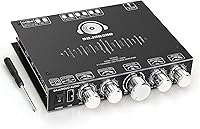
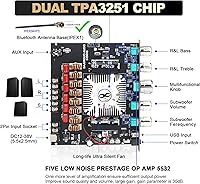
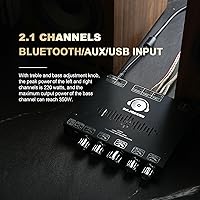
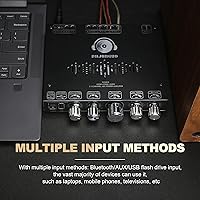
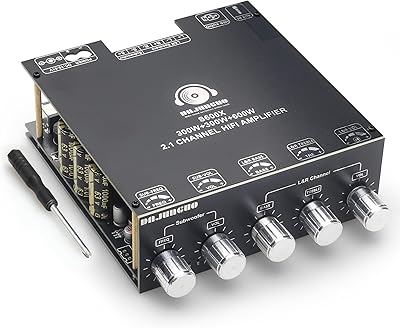
This 2.1 amplifier board handles three input types — Bluetooth, 3.5mm AUX, and USB drive — covering most practical source devices without needing an external switcher. The separate treble and bass knobs are a genuine step up over boards that give you just one volume pot; you can actually tune the sound to your specific speaker setup rather than just setting a level. An onboard cooling fan keeps temperatures in check during extended high-volume sessions, though it does produce audible noise at lower volumes — worth factoring in if your enclosure will sit in a quiet room. Built-in protection circuitry handles over-current, over-heat, and reverse-polarity situations automatically.

Best For

This amp board is a natural fit for anyone building a custom 2.1 speaker cabinet and wanting real subwoofer punch without buying a pre-built unit. It also suits upgraders moving from a lower-powered board who need more headroom for larger drivers. That said, if you expect a finished, enclosed product you can simply plug in, this is not it — the S350HS module is a bare board requiring proper mounting, wiring, and a compatible external power supply. Bluetooth works well for casual streaming, but do not expect high-res codec support; it is functional, not audiophile-grade.

User Feedback

With a 4.2-star average across nearly 500 ratings, this 2.1 amplifier board has earned a solid standing in the DIY audio community. Most positive reviewers highlight the strong output for the price and how straightforward Bluetooth pairing tends to be. On the critical side, some buyers flag that fan noise is noticeable at lower volumes — not a dealbreaker in a garage workshop, but worth considering for living-room builds. A number of users also note that running the board in the 24V–36V range yields noticeably cleaner performance than the minimum voltage, and that terminal connections need a firm tighten during installation to prevent intermittent signal issues.

Pros

  • Dual TPA3251 chips deliver credible output power for the price, especially for subwoofer-heavy 2.1 builds.
  • Wide 12V to 38V input range gives genuine flexibility when pairing with different power supplies.
  • Three input modes — Bluetooth, AUX, and USB — reduce the need for external source switching hardware.
  • Independent treble and bass knobs let you tune the sound to your specific speaker drivers, not just set a volume.
  • Built-in protection for short-circuit, reverse polarity, and over-heat provides real peace of mind during DIY builds.
  • Compact board dimensions fit neatly into space-constrained custom enclosures without modification.
  • Screw terminals grip speaker wire firmly and hold up well through repeated adjustments during a build.
  • Running the board at 24V or higher noticeably improves output clarity and low-end authority.
  • Near-500 verified buyer ratings averaging 4.2 stars reflect consistent real-world satisfaction among the target audience.

Cons

  • The headline wattage figures are peak, not continuous RMS — real-world sustained output is considerably lower.
  • The cooling fan runs at a fixed speed regardless of load, creating constant audible hum even at low volumes.
  • No Bluetooth codec support beyond standard SBC, making wireless audio noticeably compressed compared to AUX.
  • No onboard wiring guide or setup documentation is included, leaving first-time builders to figure out specs independently.
  • Potentiometer build quality is noticeably cheaper than the rest of the board and may develop channel imbalance over time.
  • Protection events trigger silently with no indicator light or display, making fault diagnosis a process of trial and error.
  • Performance at the minimum 12V input is underwhelming relative to what the specifications imply.
  • Tight terminal spacing makes attaching heavier-gauge speaker wire fiddlier than it should be.

Ratings

The DAJUNGUO S350HS has been scored by our AI system after processing hundreds of verified global buyer reviews, with spam, bot-generated, and incentivized feedback actively filtered out. The result is a transparent picture of where this 2.1 amplifier board genuinely delivers for DIY audio builders — and where it falls short. Both the strengths that keep buyers coming back and the frustrations that show up repeatedly in real-world use are reflected in the scores below.

Value for Money
88%
For a board running dual TPA3251 chips with a 2.1 output configuration, the price-to-wattage ratio is hard to argue with at this tier. Buyers building custom subwoofer cabinets consistently cite it as one of the most affordable ways to get real bass authority into a passive speaker system.
The value perception takes a slight hit once buyers realize the headline wattage is peak, not continuous RMS output. Those who expected plug-and-play completeness also felt shortchanged when they factored in the additional cost of a compatible power supply.
Audio Output Power
81%
19%
Running at 24V to 36V, this amp board drives mid-sized passive speakers and subwoofers with enough authority to fill a medium room convincingly. Builders pairing it with 6- to 8-inch sub drivers report satisfying low-end punch that outperforms similarly priced single-chip boards.
The gap between advertised peak figures and real-world continuous output frustrates buyers who do not read specs carefully. At lower voltage inputs like 12V to 15V, the board noticeably underperforms its marketing claims, leaving some users feeling misled about what they actually bought.
Sound Quality
74%
26%
For a class-D board at this price point, the audio clarity across the stereo channels is respectable, particularly when the treble and bass knobs are dialed in to suit the specific speaker load. Users building home audio cabinets report a clean midrange with no harsh distortion at moderate volumes.
The noise floor at idle is audible in quiet environments, which frustrates buyers using this board for near-field listening setups. Bluetooth audio quality is functional but noticeably compressed compared to a wired AUX connection, making it a poor fit for critical listening sessions.
Bluetooth Connectivity
71%
29%
Pairing is quick and reliable across phones, tablets, and laptops, which most buyers appreciate when they just want casual background audio without running cables. Range is adequate for a typical room, and the connection holds steady without frequent drops under normal use.
There is no support for high-quality Bluetooth codecs like aptX or LDAC, so the audio ceiling over Bluetooth is noticeably lower than through AUX. A handful of buyers also reported occasional reconnection delays after the board sits idle for a period, which gets annoying in daily use.
Build Quality
69%
31%
The board feels reasonably solid for its category, with a metal-reinforced chassis that does not flex when terminals are tightened. Most buyers report that the screw terminals grip speaker wire firmly and hold up well over repeated wiring adjustments during a build.
The plastic elements around the control knobs feel noticeably cheaper than the rest of the board, and a few buyers noted that the potentiometers developed slight channel imbalance after several months of use. The overall finish is functional rather than refined, which matters more in visible builds.
Thermal Management
66%
34%
The onboard fan does its job during extended high-volume sessions, keeping the board from throttling or triggering thermal shutdown in most real-world DIY enclosure scenarios. Builders running the board at moderate power in ventilated cabinets report stable temperatures even over multi-hour listening sessions.
The fan runs continuously rather than switching on only when needed, which means it generates audible noise even at low volumes. In a living-room setup where the enclosure is nearby, this constant mechanical hum becomes a genuine annoyance that several buyers describe as a significant oversight.
Input Versatility
83%
Having Bluetooth, AUX, and USB drive input on a single board at this price is genuinely convenient for builders who want flexibility without adding an external source selector switch. USB playback from a flash drive works reliably for users who want a self-contained system without a connected device.
There is no optical or coaxial digital input, which limits compatibility for buyers pulling audio from TVs or AV receivers. Input switching is manual with no automatic source detection, so swapping between a phone and a USB drive requires a deliberate physical action each time.
Tone Control
79%
21%
Having independent treble and bass adjustment knobs rather than a single master volume gives builders genuine tuning flexibility to compensate for different speaker driver characteristics. Users pairing the board with budget woofers report that a modest bass boost noticeably improves the overall balance of their system.
The knobs lack center-detent feedback, making it harder to reliably return to a neutral position by feel. The adjustment range, while useful, is not wide enough for buyers working with unusually bright tweeters or very bass-lean drivers who need more aggressive compensation.
Ease of Installation
76%
24%
The screw terminal layout is clearly labeled, and the board dimensions make it straightforward to mount inside a custom enclosure with standard hardware. Experienced makers report a clean installation process that does not require any modification to the board itself.
For first-time builders, the lack of any included wiring diagram or setup guide creates a real learning curve. Several less experienced buyers needed to research compatible power supply specs independently, and a few wired connections incorrectly before triggering the reverse-polarity protection.
Protection Features
84%
The multi-layer protection suite — covering over-current, over-heat, short-circuit, and reverse polarity — gives DIY builders genuine peace of mind, especially when testing a new enclosure wiring job for the first time. Several buyers specifically credited the reverse-polarity protection for saving the board from accidental miswiring during builds.
When a protection event triggers, the board does not provide any clear visual indicator to help the user diagnose what went wrong. A couple of buyers reported that the board shut down during high-load sessions without obvious cause, and troubleshooting required trial and error rather than any onboard feedback.
Voltage Flexibility
86%
The 12V to 38V DC input range genuinely opens up this board to a wide variety of power supply configurations, from repurposed laptop bricks to purpose-built 36V adapters. Builders experimenting with different supply voltages consistently report that output quality improves noticeably as voltage increases toward the upper range.
Operating at the lower end of the voltage range, around 12V to 15V, produces noticeably weaker subwoofer output and a slightly muddier low end. Buyers who only have a 12V supply available may find the performance disappointing compared to what the specs suggest the board is capable of delivering.
Fan Noise
53%
47%
The fan does keep the board cool during extended use, and for workshop or garage audio setups where ambient noise is already present, it is essentially a non-issue. Buyers using this amp board in utility-focused builds report no complaints about it at all.
In any quiet room or near-field listening environment, the constant fan hum is a persistent irritant that undermines the listening experience. Unlike temperature-controlled fans found on pricier boards, this one runs at a fixed speed regardless of load, which means it is just as audible at low volume as it is during a loud session.
Compact Form Factor
87%
At just under 6 inches long, the board fits neatly into a wide range of custom enclosures without dominating the available internal space. Builders working on space-constrained projects like bookshelf speaker bases or under-seat car audio installations appreciate how much capability fits into the footprint.
The board's compact size does mean that terminal spacing is relatively tight, which can make attaching heavier-gauge speaker wire a slightly fiddly process. A few builders working with larger enclosures also noted they would have preferred more mounting hole options for flexible positioning.

Suitable for:

The DAJUNGUO S350HS is built for a specific kind of buyer, and for that buyer it genuinely delivers. If you are constructing a custom 2.1 speaker cabinet and need a capable amplifier module to drop inside without spending heavily, this board sits at the sweet spot of affordability and raw output. It is equally well-suited to makers upgrading from a low-powered single-channel board who want real subwoofer headroom without rebuilding their entire setup. The wide voltage input range makes it practical for hobbyists working with whatever bench power supply they already own, and the triple input options mean you can wire it into a system that switches between a phone, a laptop, or a USB drive without adding a separate selector. Builders comfortable with wiring screw terminals and sourcing their own power supply will find the installation process straightforward and the performance genuinely rewarding at the right voltage.

Not suitable for:

The DAJUNGUO S350HS is not the right choice if you want a finished, ready-to-use amplifier you can unbox and plug into your speakers in five minutes. This is a bare board that requires a compatible external power supply, manual wiring, and at least a basic understanding of speaker impedance and voltage requirements — buyers expecting plug-and-play simplicity will be frustrated quickly. It is also a poor fit for critical listening environments or quiet rooms where background noise matters, because the onboard fan runs continuously and produces a constant mechanical hum that becomes hard to ignore at low volume levels. Audiophiles expecting high-resolution Bluetooth codec support will find the wireless audio quality underwhelming compared to a wired connection. And if you are sourcing a 12V supply thinking it will unlock the board's full potential, temper those expectations — real performance only shows up closer to the 24V to 36V range.

Specifications

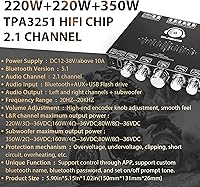
  • Amplifier Chip: The board uses two Texas Instruments TPA3251 class-D ICs, a well-regarded chip choice in the DIY audio community for its efficiency and output fidelity.
  • Output Power: Peak output is rated at 220W per stereo channel plus 350W for the subwoofer channel; continuous RMS output will be lower depending on load impedance and supply voltage.
  • Channels: The board operates in a 2.1 configuration, delivering independent stereo left and right channels plus a dedicated subwoofer output.
  • Voltage Input: Accepts DC power supply input from 12V to 38V, with real-world performance improving noticeably when operated between 24V and 36V.
  • Input Modes: Supports three audio input methods: Bluetooth wireless, 3.5mm AUX wired input, and USB drive playback for standalone operation without a connected device.
  • Tone Controls: Two dedicated rotary knobs provide independent treble and bass adjustment, allowing tonal compensation for different speaker driver characteristics.
  • Cooling System: An onboard fan provides active cooling during operation; it runs continuously at a fixed speed regardless of the current power load.
  • Protection Suite: Built-in hardware protection covers short-circuit, over-current, over-temperature, and reverse-polarity fault conditions, triggering automatically without user intervention.
  • Dimensions: The board measures 5.9 × 5.15 × 1.02 inches, making it compact enough for integration into custom speaker enclosures and space-constrained builds.
  • Weight: The assembled board weighs 11.5 ounces, light enough for flexible mounting within a variety of DIY enclosure configurations.
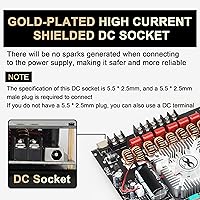
  • Mounting Type: Designed for surface mounting with screw terminals for speaker and power connections, requiring no soldering for basic installation.
  • Material: The board construction combines metal and plastic components, with a metal-reinforced chassis providing structural rigidity around the terminal areas.
  • Certification: Carries CE certification, indicating compliance with European safety and electromagnetic compatibility standards.
  • Brand & Model: Manufactured by DAJUNGUO under the model designation S350HS.
  • Output Impedance: The board is designed for use with standard 4-ohm to 8-ohm passive speaker drivers across both stereo and subwoofer outputs.
  • Bluetooth Version: Bluetooth connectivity is included for wireless audio streaming, though the board does not support high-resolution codecs such as aptX or LDAC.
  • Package Contents: The package contains the amplifier board only; a compatible external power supply and speaker wiring must be sourced separately.

Related Reviews
DAJUNGUO S600X
DAJUNGUO S600X
75%
78%
Power Output
74%
Audio Quality
83%
Bluetooth Connectivity
88%
Input Versatility
86%
Value for Money
More

FAQ

You need an external DC power supply rated between 12V and 38V. For best performance, aim for a 24V to 36V supply with enough current headroom for your speaker load — a 36V 8A adapter is a popular pairing that unlocks most of the board's output potential. The board does not include a power supply, so budget for that separately.

It is a bare board, not a finished amplifier enclosure. You will need to mount it inside a cabinet or chassis, connect your own power supply, and wire your speaker drivers to the screw terminals. It is designed for makers and DIY builders, not for buyers expecting a ready-to-use boxed unit.

The board is designed for standard 4-ohm to 8-ohm passive speakers across both the stereo and subwoofer outputs. Running speakers outside this impedance range, particularly below 4 ohms, risks triggering the over-current protection or stressing the output stage under sustained load.

In principle, yes, if you have a power supply that fits the voltage range. However, most 12V car supplies sit at the lower end of what this board handles, and output power drops significantly at 12V. For a dedicated car audio build, a higher-voltage DC-DC boost converter would help unlock more of the board's capability.

The fan is audible, especially in quiet rooms at low volume levels. It runs at a fixed speed continuously rather than spinning up only when the board gets hot, so there is no thermal-triggered quiet mode. Disabling it is not recommended without adding alternative cooling, as the TPA3251 chips generate meaningful heat at higher output levels.

No, the Bluetooth implementation on this board does not support aptX, LDAC, or similar high-resolution codecs. Standard SBC is what you get, which is functional for casual listening but will sound noticeably compressed compared to a wired AUX connection. If audio quality is a priority, use AUX.

The board shuts down the output automatically to protect the components, but it does not have any indicator light or display to tell you which protection triggered. You will need to power cycle it and troubleshoot by checking for wiring shorts, verifying your supply voltage, or reducing the load before restarting.

Yes, the USB input supports direct playback from a flash drive, which makes this amp board useful in self-contained builds where you do not want a separate device involved. Stick to standard MP3 or WAV files formatted on a FAT32 drive for the most reliable compatibility.

The manufacturer advertises peak output figures of 220W per stereo channel and 350W for the subwoofer, but these are not continuous RMS ratings. Real-world continuous output depends on your supply voltage, speaker impedance, and thermal conditions — at 36V into 4-ohm loads, expect roughly 50 to 80W RMS per channel as a realistic working estimate for the stereo channels.

No, the knobs do not have a center detent, which means you cannot reliably return to a flat neutral position by feel alone. If precise tonal calibration matters for your build, it is worth marking the neutral position on the knob face with a small dot or line after setting it by ear.