Overview

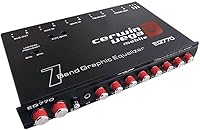
The Cerwin-Vega EQ770 7-Band Parametric Car Equalizer is a dashboard-mounted signal processor from Cerwin Vega Mobile, a brand with genuine roots in car audio. It occupies a comfortable middle ground — more capable than a basic graphic EQ unit, but without the cost or complexity of a full digital signal processor. The built-in auxiliary input is a practical touch, letting you plug in a phone or MP3 player directly at the dash rather than rerouting cables through your head unit. Metal construction keeps the chassis solid in a vehicle environment. Over 140 verified buyers have averaged 4.5 stars, which suggests the real-world experience holds up well against expectations.
Features & Benefits

Where this parametric EQ separates itself from cheaper alternatives is in how precisely you can shape your sound. A fixed graphic EQ gives you predetermined frequency bands; the EQ-770 lets you actually hunt down a resonance or a dip and address it directly. The 7-volt RMS output is genuinely useful — that extra headroom means your amplifier receives a cleaner, stronger signal, which cuts down on background hiss at higher volumes. A separate subwoofer level control lets you adjust the low end independently without disturbing your mid or high frequency settings. Running on a wired 12V connection also removes any wireless pairing complications from the equation entirely.

Best For

This dashboard equalizer rewards buyers who already have some understanding of their car audio setup. If you are running aftermarket amplifiers and a subwoofer and want to clean up a noisy signal chain, the EQ-770 addresses that problem directly. It is also a strong pick for older vehicles where the factory head unit offers little meaningful audio control. Drivers who want to connect a smartphone or portable player without reworking their entire dash wiring will find the auxiliary input genuinely convenient. This is not the right choice for a first-time installer expecting a plug-and-play experience — it suits people who know what they want to fix.

User Feedback

Most buyers who have put this parametric EQ through its paces focus their praise on two areas: the noticeable drop in amplifier noise once the higher-voltage output is in the chain, and the day-to-day usefulness of the auxiliary input. The physical build quality also earns consistent mentions — the knobs feel solid, not hollow. Installation is where the experience gets more variable. The included documentation is sparse, and several reviewers with limited car audio backgrounds found the setup more involved than anticipated. A smaller number of users flagged dashboard fitment issues depending on their specific vehicle. Still, overall buyer sentiment leans clearly positive among those who arrived with realistic expectations.

Pros

  • Parametric EQ bands let you target specific problem frequencies rather than working around fixed graphic band positions.
  • Up to 7 volts RMS output noticeably reduces amplifier hiss and background noise in demanding setups.
  • The dedicated subwoofer level control means you can adjust bass without disrupting your other tuned bands.
  • Built-in auxiliary input adds a practical connectivity option directly at the dash without extra wiring runs.
  • Metal chassis construction feels appropriately solid for a unit permanently mounted in a vehicle environment.
  • A 90dB signal-to-noise ratio is competitive and holds up well against other signal processors at this price tier.
  • Over 140 verified buyers averaging 4.5 stars reflects genuinely consistent real-world satisfaction.
  • Physical knobs and controls are reported by multiple reviewers as feeling well-built and responsive to use.
  • Wired 12V operation keeps the signal path clean with zero wireless interference risk.
  • Represents strong value for drivers who need proper parametric tuning without stepping up to a full DSP unit.

Cons

  • Installation instructions are sparse and will leave less experienced installers searching for outside guidance.
  • Dashboard fitment can be problematic depending on the specific vehicle make and model.
  • No wireless connectivity means your source device must be physically tethered via the aux input cable.
  • Buyers unfamiliar with parametric EQ concepts may struggle to get meaningful results without prior knowledge.
  • The unit is sized at 8.9″ deep, which could present clearance issues in tighter dashboard cavities.
  • No digital processing features such as time alignment or active crossover management for more advanced setups.
  • Limited to stereo output modes, which may fall short for complex multi-channel car audio configurations.
  • Lack of detailed setup documentation creates a steeper initial learning curve compared to some rivals.

Ratings

The scores below reflect our AI-driven analysis of verified buyer reviews for the Cerwin-Vega EQ770 7-Band Parametric Car Equalizer, sourced globally and filtered to remove incentivized, bot-generated, and outlier feedback. Each category is scored to transparently reflect where real users found genuine satisfaction and where they ran into friction. Both the strengths and the honest shortcomings are captured here so you can make a well-informed decision.

Sound Tuning Precision
91%
Buyers who came from graphic EQ units consistently noted how much more control the parametric band structure gave them during real listening sessions. Being able to target a specific muddy frequency on a highway commute rather than guessing at a fixed band makes a tangible difference to the end result.
Getting the most from the parametric controls genuinely requires some prior knowledge of EQ principles. Users without that background often reported feeling overwhelmed and not knowing where to start, which undercuts the unit's core strength for less experienced buyers.
Output Voltage & Signal Quality
88%
The high RMS output was one of the most frequently praised functional traits across verified reviews. Drivers running power-hungry aftermarket amplifiers reported noticeably cleaner sound with reduced background hiss once the EQ-770 was inserted into the signal chain.
The benefit is largely invisible to anyone running modest factory speaker setups without an external amplifier. In those configurations, the extra voltage headroom goes unused, and the unit does not deliver a meaningful improvement over far simpler solutions.
Value for Money
86%
Across a wide range of buyers, the consensus was that the EQ-770 punches above its price tier for what it actually delivers functionally. Getting parametric tuning and a high-voltage output in a metal-chassis unit at this price point is genuinely hard to match in the current market.
Value perception dropped significantly among buyers who struggled with installation and never got the unit performing correctly. For that group, the mid-range cost felt unjustified, particularly when the included documentation gave them little to work with.
Build Quality
83%
The metal chassis and solid rotary knobs were mentioned positively across a broad cross-section of reviews. For a unit that lives in a vehicle environment subject to heat, vibration, and daily handling, buyers appreciated that nothing felt hollow or prone to rattling loose over time.
A handful of users noted that while the core construction felt durable, some of the smaller trim elements and labeling showed signs of wear after extended use in hotter climates. It is solidly built for the price, but it is not on the level of professional-grade rack equipment.
Auxiliary Input Usability
84%
The built-in aux input was consistently highlighted as a practical daily-use feature, especially by drivers in older vehicles where the factory head unit lacked any direct connectivity option. Plugging a phone in at the dash without extra adapters or wiring runs was seen as a genuine convenience win.
The aux input is a wired-only connection, which means cable management in the cab becomes an ongoing consideration. Several buyers noted that the cable dangling from the unit looked untidy and that a cleaner routing solution would have improved the overall installation.
Noise Floor Performance
81%
19%
The 90dB signal-to-noise ratio held up well in practical use according to buyers who measured or listened critically before and after installation. In setups where amp hiss was a persistent problem at idle or low volume, the EQ-770 made an audible and appreciated difference.
A smaller subset of buyers reported that their noise situation did not improve as dramatically as expected, often traced back to grounding issues elsewhere in their system rather than the unit itself. It performs well when the surrounding install is clean, but it is not a fix for broader wiring problems.
Subwoofer Level Control
79%
21%
Having an independent subwoofer level knob available at the dashboard was seen as a practical daily convenience, letting drivers quickly adjust bass for different music genres or road noise conditions without diving into head unit menus.
Some users found the subwoofer control range slightly too aggressive at the upper end, making fine adjustments difficult without overshooting their target level. A more graduated control throw would have improved usability in fine-tuning scenarios.
Installation Experience
53%
47%
For buyers with prior car audio installation experience, the physical mounting and wiring process was described as logical and manageable. Those who understood signal routing from head unit to EQ to amp found the connection points sensible and well-laid-out on the unit itself.
The installation instructions included in the box were widely criticized as inadequate. Beginners without prior car audio knowledge frequently needed to seek help from third-party forums, video tutorials, or local installers just to get started, adding unexpected time and frustration to the process.
Dashboard Fitment
61%
39%
In the majority of standard vehicle dashboards with conventional DIN-style openings, the unit mounts without significant difficulty. The metal bracket system is functional and holds the unit securely once properly seated.
A meaningful minority of buyers encountered fitment problems tied to their specific vehicle's dash geometry or cavity depth. At 8.9″ deep, the unit requires adequate clearance behind the dash panel, and not every vehicle provides that without modification or creative mounting solutions.
Compatibility Range
77%
23%
The EQ-770 works cleanly with a wide range of source devices through its auxiliary input, and its output connects to virtually any aftermarket amplifier without proprietary connectors or adapter requirements. This broad compatibility made it a practical choice for mixed-brand car audio builds.
Buyers attempting to integrate it into factory-amplified or Bose-style OEM audio systems found compatibility more complicated, as those setups require additional signal conversion that the unit itself does not provide.
Documentation & Support
42%
58%
For buyers who were already knowledgeable enough not to need detailed instructions, the sparse documentation was a non-issue. The unit layout is logical enough that experienced installers could work through the setup without referencing a manual at all.
For anyone else, the lack of a thorough installation guide is a genuine problem. The manual that ships with the unit covers the bare minimum, and buyers frequently reported that the official support resources available online were similarly thin, leaving them reliant on community forums.
Physical Controls & Ergonomics
78%
22%
The tactile feel of the knobs and band controls was praised more often than expected in reviews. Buyers noted that adjusting settings while parked felt intuitive, and the control layout was considered well-organized relative to competing units at the same price.
Some users found the individual band controls a little closely spaced for comfortable adjustment, particularly for anyone with larger hands. Making subtle changes to one specific band without accidentally nudging an adjacent control required a degree of care and attention.
Brand Reliability
74%
26%
Cerwin Vega Mobile carries a meaningful reputation in the car audio space, and buyers who were familiar with the brand came in with reasonable confidence. For most, that trust was validated by a unit that performed consistently over extended periods of daily use.
Brand reputation alone did not offset the documentation and fitment frustrations for buyers who encountered those issues. A name carries only so much weight when the out-of-box experience creates immediate friction, and a handful of reviewers felt the brand should be holding itself to a higher support standard.

Suitable for:

The Cerwin-Vega EQ770 7-Band Parametric Car Equalizer is built for drivers who already have a solid grasp of their car audio setup and want meaningful control over how it sounds. It is particularly well-matched to anyone running an aftermarket amplifier and subwoofer combination, where the high-voltage RMS output can meaningfully clean up a noisy signal chain. Enthusiasts upgrading older vehicles with limited head unit functionality will find this dashboard equalizer fills a real gap, adding both tuning flexibility and a convenient auxiliary input for phones or portable players. Budget-to-mid custom build projects also benefit from what this parametric EQ offers — precise, band-by-band frequency adjustment that a standard graphic EQ simply cannot match. If your goal is to stop guessing at your sound and start actually shaping it, this unit is a practical and well-priced tool for the job.
Not suitable for:

The Cerwin-Vega EQ770 7-Band Parametric Car Equalizer is not a great fit for first-time car audio installers or anyone expecting a straightforward plug-and-play setup. The included documentation has been widely criticized as thin, meaning beginners will likely need to consult outside resources or forums just to get started confidently. Drivers in vehicles with unusually shaped or compact dashboards should also verify fitment carefully before purchasing, since a minority of buyers have reported physical installation challenges. If your head unit already delivers clean preamp signals and a modern aux input, the core value proposition of this dashboard equalizer becomes much harder to justify. Similarly, buyers seeking a fully digital signal processor with advanced time-alignment or crossover capabilities will find the EQ-770 is not designed to operate at that level — it is a focused, analog-style tuning tool, not a comprehensive DSP solution.
Specifications

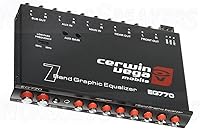
  • EQ Type: 7-band parametric equalizer allowing adjustable center frequency, bandwidth, and gain across the full audio spectrum.
  • Output Voltage: Delivers up to 7 volts RMS output, providing strong, clean signal headroom for aftermarket amplifiers.
  • Signal-to-Noise Ratio: Rated at 90dB, which is competitive for an in-car signal processor in this price class.
  • Subwoofer Control: Includes a dedicated subwoofer level control that operates independently from the main EQ band adjustments.
  • Auxiliary Input: Built-in auxiliary input enables direct wired connection from smartphones, MP3 players, or other portable audio sources.
  • Output Mode: Operates in stereo audio output mode with support for 5.1 surround sound channel configuration.
  • Power Source: Powered via corded 12V DC connection, compatible with standard automotive electrical systems.
  • Chassis Material: Constructed from metal, providing structural durability suited to permanent dashboard installation in vehicles.
  • Mounting Type: Designed for dashboard mounting, with a rectangular prism form factor to fit standard DIN-style dash openings.
  • Dimensions: Unit measures 8.9″ deep by 7.8″ wide by 8.9″ tall, so verifying dashboard cavity clearance before installation is recommended.
  • Weight: Weighs 1.75 pounds, making it lightweight enough for secure dashboard mounting without structural concerns.
  • Subwoofer Connectivity: Subwoofer output uses a wired connection, keeping the low-frequency signal path free from wireless interference.
  • Compatible Devices: Compatible with car audio systems, smartphones, and MP3 players via the onboard auxiliary input.
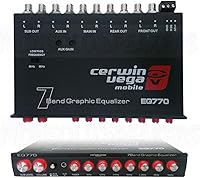
  • Control Method: Operated via physical touch controls and rotary knobs mounted directly on the unit face.
  • Wireless: No wireless communication technology is included; all signal connections are handled through wired inputs and outputs.
  • Driver Type: Uses a dynamic driver audio architecture for signal processing across its frequency bands.
  • Model: Manufactured by Cerwin Vega Mobile under the model designation EQ-770, part of the 770 series lineup.
  • Warranty: Covered by a limited manufacturer warranty; buyers should confirm specific duration and terms directly with Cerwin Vega Mobile.
  • Package Contents: Ships in standard packaging and includes the 7-band parametric equalizer unit as the primary included component.
  • Power Requirement: Requires one 12V battery connection, sourced from the vehicle electrical system rather than a replaceable consumer battery.

Related Reviews

Audiotek AT-EQ700 7 Band Car Audio Equalizer
85%
91%
Bass Control
84%
Ease of Installation
87%
Sound Quality
85%
Compatibility with Audio Devices
92%
Customizability (Frequency Bands)
More
TOPSTRONGGEAR TSG7EQ 7-Band Car Audio Equalizer
83%
87%
Sound Quality
91%
Ease of Installation
84%
Bass Control
80%
Build Quality
85%
Connectivity Options
More
Stetsom EQX764 7-Band Car Audio Equalizer
85%
91%
Sound Quality Enhancement
89%
Ease of Installation
93%
Bass Control
85%
Frequency Band Flexibility
88%
Output Channels
More
Clarion EQS755 7-Band Car Audio Equalizer
85%
89%
Sound Quality
85%
Connectivity Options
92%
Ease of Installation
87%
Build Quality
90%
Subwoofer Control
More
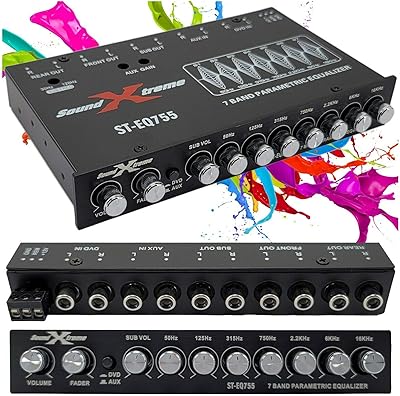
Xtremevision ST-EQ755 7-Band Car Audio Equalizer
82%
88%
Sound Quality
90%
Bass Performance
76%
Ease of Use
83%
Build Quality
71%
Setup & Installation
More
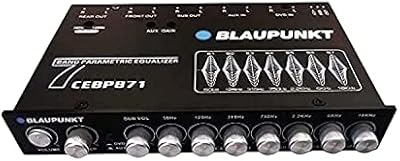
Blaupunkt CEBP871 7-Band Car Audio Graphic Equalizer
86%
89%
Sound Quality
91%
Ease of Installation
85%
Customization Options
87%
Input Versatility
82%
Build Quality
More
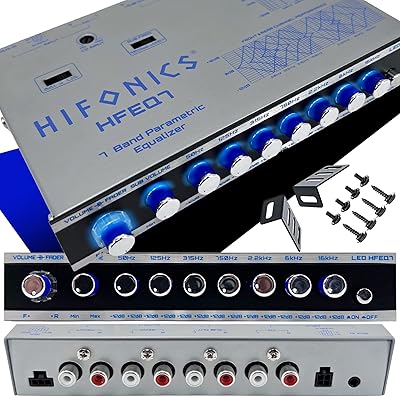
Hifonics HFEQ7 7-Band Pre-Amp Car Audio Equalizer
85%
88%
Sound Quality
94%
Ease of Installation
90%
Bass Control
85%
Build Quality
91%
Value for Money
More
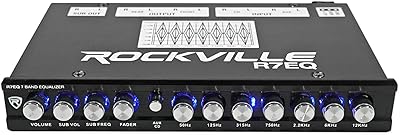
Rockville R7EQ 1/2 Din 7 Band Car Audio Equalizer
85%
89%
Bass Control
85%
Sound Clarity
72%
Ease of Setup
91%
LED Visibility
81%
Durability
More
Cerwin-Vega Vega Series V25 2.5″ Full Range Car Audio Speakers
83%
88%
Sound Quality
94%
Ease of Installation
74%
Bass Performance
80%
Build Quality
90%
Compatibility
More
DS18 EQX7 7-Band Graphic Equalizer
85%
88%
Sound Quality
90%
Bass Performance
82%
Ease of Installation
85%
Build Quality
87%
Frequency Range
More

FAQ

Honestly, it can be. The included documentation is pretty minimal, so if you are new to car audio wiring, plan to spend some time on forums or YouTube before you start. The physical installation is straightforward once you understand signal flow, but the lack of detailed instructions has tripped up more than a few first-timers.

It depends on your specific vehicle. The unit uses a standard dashboard mounting format, but the 8.9″ depth is something to check carefully before you buy. A small number of users have reported fitment issues, so measuring your available dash cavity is a smart step.

Yes, the built-in auxiliary input lets you plug a phone or MP3 player in directly at the dash. Keep in mind this unit is a signal processor, not a standalone amplifier, so you will still need your existing head unit or amplifier in the chain to actually drive your speakers.

A graphic EQ gives you a fixed set of frequency bands to boost or cut, and you work with whatever bands the manufacturer chose. A parametric EQ lets you select the actual center frequency you want to adjust, which means you can zero in on a specific problem in your sound rather than guessing. For anyone serious about tuning car audio, that distinction matters quite a bit.

Most head units output around 2 to 4 volts on their preamp lines. The Cerwin-Vega EQ770 7-Band Parametric Car Equalizer can push up to 7 volts RMS, which gives your amplifier a stronger input signal to work with. The practical result is that your amp does not need to work as hard to reach its gain levels, which typically reduces background hiss and noise at volume.
No, that is one of the more useful things about this dashboard equalizer. The subwoofer level control is independent, so you can dial your bass up or down without touching the tuning on your mid and high frequency bands.

There is no wireless functionality on this unit at all. Everything runs through wired connections, which is actually a benefit for signal integrity since there is no Bluetooth pairing to manage and no risk of wireless interference in your audio chain.

Technically yes, but the unit is really designed to sit between a source and an amplifier in a more complete car audio system. Using it purely with a factory head unit and factory speakers will give you EQ control and aux input functionality, but the full benefit of the high-voltage output only becomes meaningful when you have an amplifier downstream.

Buyers consistently describe the physical build as solid for the price point. The knobs feel substantial rather than cheap, and the metal chassis holds up well to the heat and vibration that are normal in a vehicle environment. It is not a flagship piece of hardware, but it does not feel fragile either.

If you are looking for advanced digital signal processing features like time alignment, active crossover management, or multi-channel tuning beyond stereo, this parametric EQ is not built for that. It is also not the right pick if you want a truly no-fuss installation with clear step-by-step guidance included in the box — those buyers may find the setup process more frustrating than expected.

Where to Buy