Overview

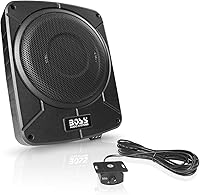
The BOSS Audio BAB10 10-inch Amplified Car Subwoofer has been quietly holding its own since its 2019 launch as one of the more practical all-in-one bass solutions for drivers who want more low-end without sacrificing trunk space. The amplifier and subwoofer share a single low-profile enclosure that slides under a seat or tucks into a tight cargo corner with minimal fuss. At its price point, it lands comfortably between throwaway budget units and proper separates. Set your expectations right: this is a solid daily-driver upgrade, not a competition-grade system, and it has the sales rank and staying power to back that positioning up.
Features & Benefits

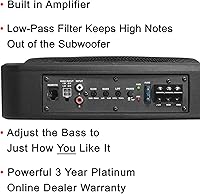
Worth knowing upfront: that 1200W figure is peak power, not continuous RMS output — real-world performance is noticeably more modest, so calibrate accordingly. That said, the built-in PWM amplifier does a competent job driving the 10-inch woofer, and the variable low-pass filter gives you genuine control over how the sub blends with your existing speakers. The dual-input design is genuinely useful: if your car still runs a factory head unit, you can tap the speaker wires directly using the high-level inputs — no RCA outputs required. Toss in the remote bass knob and variable boost, and you can fine-tune the low end from the driver's seat without crawling under anything.

Best For

This amplified sub makes the most sense for commuters and everyday drivers, particularly those in smaller cars — sedans, hatchbacks, and compact SUVs — where a traditional enclosure simply is not practical. It is also a strong starting point for anyone new to car audio who finds the idea of pairing a separate amplifier and subwoofer intimidating. Not needing an aftermarket head unit to get started removes a real barrier for factory-radio owners. If you want skull-rattling output or plan to build a more elaborate system down the road, you will likely outgrow it — but as a self-contained bass upgrade for a space-challenged vehicle, it holds up well.

User Feedback

Across more than a thousand ratings, the BAB10 holds a 4.1-star average — a score that reflects a split between satisfied daily drivers and a vocal minority with legitimate gripes. Buyers consistently praise easy installation and a noticeable improvement over factory speakers, particularly when wiring directly into OEM speaker outputs. The recurring criticism clusters around two points: real-world bass output falls well short of what the 1200-watt rating implies, and a portion of owners flag durability issues surfacing after a year or more of regular use. Not a dealbreaker for casual listeners, but worth factoring in if you tend to push the volume hard on long daily commutes.

Pros

  • Combines subwoofer and amplifier into one compact unit — no separate enclosure or external amp needed.
  • High-level speaker inputs let you connect directly to a factory radio without any extra adapters.
  • Low-profile design slides under rear seats in most compact sedans and hatchbacks without blocking legroom.
  • The included remote bass knob lets you adjust output on the fly from the driver's seat.
  • Variable low-pass filter gives you real control over blending bass with your existing speakers.
  • Most buyers with zero car audio experience report completing the install in under an hour.
  • The BAB10 delivers a genuinely noticeable improvement over factory audio at everyday listening volumes.
  • Dual RCA and speaker-level inputs mean it works with practically any head unit on the road.
  • A three-year warranty provides more coverage than many competing units in this category offer.
  • Sustained top-40 sales rank in car component subwoofers since 2019 reflects reliable everyday satisfaction.

Cons

  • Advertised peak wattage is wildly misleading — real continuous output is far lower than 1200W suggests.
  • Amplifier board failures have been reported by a notable share of owners after 12 to 18 months.
  • Bass boost control can accelerate hardware wear if used aggressively at high volume over time.
  • High-level input wiring can introduce background hiss on some older factory radio systems.
  • Filter and gain controls lack clear calibration markings, making precise tuning frustrating without test tones.
  • The remote knob cable is just barely long enough for some dash or console mounting positions.
  • Enclosure resonance and panel buzz become more common on rough roads as the unit ages.
  • Warranty coverage requires purchase through an authorized dealer — third-party marketplace buys may not qualify.
  • This amplified sub will likely feel limiting within a year for anyone planning to expand their audio system.
  • Customer service response times for warranty claims draw consistently mixed feedback from owners.

Ratings

The BOSS Audio BAB10 10-inch Amplified Car Subwoofer has been assessed using AI-driven analysis of verified global buyer reviews, with spam, bot-generated, and incentivized feedback actively filtered out to ensure the scores reflect genuine ownership experiences. Ratings span everything from installation ease and real-world bass output to long-term durability and value — strengths and pain points weighted equally. What follows is an honest breakdown of where this under-seat sub earns its reputation and where it falls short.

Bass Output & Sound Quality
71%
29%
For drivers upgrading from a factory speaker setup with zero dedicated bass, the BAB10 delivers a clear and noticeable improvement — kick drums and low-end synth lines actually register instead of disappearing into the mix. At moderate listening volumes on a daily commute, it fills the cabin convincingly for a sealed low-profile unit.
Push the volume past the midpoint and the limitations surface quickly. The output lacks the depth and authority of a properly ported enclosure, and bass-heavy genres like hip-hop or EDM can expose a certain thinness that more experienced listeners will find underwhelming.
Advertised vs. Real-World Power
44%
56%
The built-in PWM amplifier does manage the 10-inch driver capably within its actual operating range. Buyers who researched RMS figures beforehand rather than taking the peak spec at face value tend to report satisfaction with the unit's honest performance envelope.
The 1200W peak claim is the single biggest source of buyer frustration across the review base. Real continuous output is a fraction of that figure, and owners who expected near-kilowatt performance feel genuinely misled. This is a recurring theme that has visibly dragged the overall sentiment of the product.
Installation Ease
88%
The dual-input design — high-level speaker inputs alongside standard RCA — means this amplified sub works with practically any head unit on the road, factory or aftermarket. A large number of reviewers with no prior car audio experience completed the wiring in under an hour using only basic tools and the included manual.
The instructions, while functional, assume a baseline of wiring literacy that absolute beginners may not have. A handful of users reported confusion around gain setting and filter adjustment, which can lead to poor sound or clipping if left misconfigured out of the box.
Form Factor & Fitment
83%
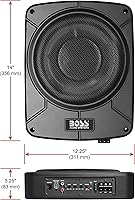
At roughly 14 by 12.3 by 3.3 inches, the BAB10 slides under rear seats in most compact sedans and hatchbacks without blocking legroom. Owners of space-challenged vehicles — Golf-sized hatchbacks, compact crossovers, older Civics — consistently cite the footprint as one of the unit's genuine strengths.
Despite the low-profile billing, fitment is not universal. Some truck and SUV owners with low-clearance underseat rails found the height just tight enough to cause installation headaches, and the unit is not truly flat enough for installations behind very shallow cargo liners.
Build Quality & Materials
58%
42%
Out of the box, the enclosure feels solid enough and the grille sits flush without obvious gaps. For moderate listening volumes in a climate-controlled daily driver, most owners get through the first year without structural complaints.
Durability beyond the 12 to 18-month mark is a legitimate concern in the community. Reports of amplifier board failures, rattling enclosures, and grille clips loosening under sustained vibration are frequent enough to pattern. Buyers who drive on rough roads or run the sub near its ceiling regularly appear to experience premature wear.
Value for Money
74%
26%
Buying an amplifier and a subwoofer separately, then building or sourcing an enclosure, would cost noticeably more and require significantly more time. As a single-purchase bass solution that ships complete and ready to wire, the BAB10 represents a genuine convenience premium that many casual buyers find worthwhile.
Buyers who compare the BAB10 to standalone component systems at a similar combined price point will find it wanting in both output headroom and long-term resilience. The value equation only holds if you genuinely need the compact all-in-one convenience rather than raw performance.
Remote Bass Control
81%
19%
The included remote knob is one of the more appreciated practical touches in the package. Being able to roll bass levels back for a phone call or a quiet street and then dial it back up on the highway — without leaning under the seat — makes a real difference in day-to-day usability.
The knob itself feels plasticky, and the cable length is just barely adequate for some dashboard or center console mount positions in longer-cabin vehicles. A few users reported the potentiometer becoming scratchy or intermittent within several months of regular use.
Low-Pass Filter Performance
76%
24%
The variable low-pass filter gives users genuine control over where the sub crosses over with the door speakers, which matters when blending with stock or lightly upgraded front-stage drivers. Most reviewers found the sweep range adequate for getting a reasonably seamless handoff.
Audiophiles used to precision parametric controls will find the filter adjustment imprecise and lacking clear calibration markings. Getting the crossover point dialed in without test tones requires patience, and a poorly set filter noticeably muddies the midrange on vocal-heavy tracks.
Bass Boost Control
69%
31%
For casual listeners who just want a bit more punch on bass-heavy playlists, the onboard boost is a quick and accessible way to add impact without overthinking signal processing. It works well at moderate settings for genres like R&B, pop, and classic rock.
Running the bass boost aggressively — especially at high volumes — pushes the amplifier noticeably harder and is likely a contributing factor in some of the early failure reports. Users who treat it as a permanent maximum setting rather than a situational tool tend to have worse long-term outcomes.
Factory Radio Compatibility
86%
The high-level input support is a practical feature that opens the BAB10 up to a huge portion of the car-owning market that never upgraded their head unit. Wiring directly into existing speaker outputs bypasses the need for a line output converter, which simplifies the job significantly.
Signal quality from high-level inputs is inherently noisier than a clean RCA source, and some users on older or lower-spec factory radios noted a faint background hiss at low volumes. It is functional, but not the cleanest signal path available.
Enclosure Resonance & Noise Control
62%
38%
Under normal listening conditions on smooth roads, the sealed enclosure stays quiet and the sub tracks cleanly without audible box resonance. New owners on freshly paved suburban routes tend to report no issues here at all.
On rougher road surfaces or in vehicles without much interior dampening, panel resonance and rattle from loose interior trim is a recurring complaint — though it is worth noting some of this is vehicle-related rather than a flaw in the unit itself. Enclosure buzz at higher bass boost settings has also been reported after extended ownership.
Warranty & Brand Support
55%
45%
A three-year warranty is a stronger commitment than many competing brands at this price tier offer, and BOSS Audio does have an established support structure for claims made through authorized channels.
The warranty is conditional on purchase through an authorized dealer, which catches some buyers off guard — particularly those who picked up the unit through third-party Amazon sellers. Customer service response times and resolution quality draw mixed reviews, with some warranty claims taking multiple weeks to process.

Suitable for:

The BOSS Audio BAB10 10-inch Amplified Car Subwoofer is the right call for drivers who want a meaningful bass upgrade without committing to a full car audio build. It is particularly well-matched for owners of compact cars — sedans, hatchbacks, small crossovers — where trunk space is genuinely limited and sliding a traditional box-and-amp setup under a seat simply is not realistic. First-time upgraders will appreciate that the whole system ships in one box and wires up to virtually any head unit, including OEM factory radios that lack RCA outputs. Daily commuters who want a bit more warmth and body in their music without overthinking crossover settings or impedance matching will find the built-in controls accessible and practical. If your goal is a noticeable step up from flat factory audio — not a competition build — this under-seat subwoofer lands squarely in its element.
Not suitable for:

The BOSS Audio BAB10 10-inch Amplified Car Subwoofer is not the right fit for buyers who take the 1200W peak spec at face value and expect anything close to that output in practice — the real continuous power is a fraction of that figure, and the disappointment from that gap is by far the most common complaint in the review pool. Enthusiasts who already own or plan to build a proper component system — separate amp, ported enclosure, quality head unit — will find the BAB10 underpowered and limiting compared to even modestly specced separates. Drivers who regularly push their audio hard, particularly fans of bass-intensive genres who want physical impact, will hit the ceiling of this unit quickly and come away unsatisfied. There are also legitimate durability questions for buyers in extreme climates or rough-road conditions, as the amplifier board appears more vulnerable to heat and vibration stress over time than higher-end alternatives. If longevity across three-plus years of heavy daily use is a priority, the build quality here warrants caution.

Specifications

  • Subwoofer Size: The woofer driver measures 10 inches in diameter, housed inside a low-profile sealed enclosure designed for tight installations.
  • Peak Power: The built-in amplifier is rated at 1200 watts maximum peak power; real-world continuous RMS output is significantly lower and more relevant for everyday listening.
  • Amplifier Type: Uses a Pulse Width Modulated (PWM) amplifier design, which improves efficiency and reduces heat compared to older class AB topologies at this form factor.
  • Dimensions: The enclosure measures 14″ in depth, 12.3″ in width, and 3.3″ in height, making it compatible with underseat mounting in most compact vehicles.
  • Weight: The complete unit weighs 11.35 pounds, which is manageable for a single-person install under a rear seat or in a cargo area.
  • Impedance: The subwoofer operates at 4 ohms, a standard impedance load compatible with the integrated amplifier and typical aftermarket signal sources.
  • Input Voltage: Powered directly from the vehicle's 12V DC electrical system via a standard power and ground wiring connection.
  • High-Level Inputs: Speaker-level (high-level) inputs are included, allowing direct connection to factory or aftermarket radios that do not have RCA preamp outputs.
  • Low-Level Inputs: Standard RCA low-level inputs are provided for connecting to aftermarket head units with dedicated subwoofer or full-range preamp outputs.
  • Low-Pass Filter: A variable low-pass filter is built in, letting the user set the frequency cutoff to blend the subwoofer cleanly with the vehicle's existing speaker system.
  • Bass Boost: An onboard variable bass boost control allows users to add additional low-frequency emphasis beyond the flat amplifier output.
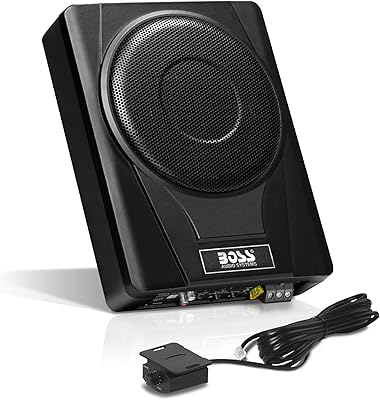
  • Remote Control: A wired remote bass level knob is included in the box, mountable within the cabin for convenient volume adjustment while driving.
  • Enclosure Type: The subwoofer uses a sealed enclosure design, which favors tight, accurate bass reproduction over the louder but less precise output of ported designs.
  • Frequency Response: The unit's frequency response is rated up to 120 Hz, covering the standard low-frequency range expected from a dedicated car subwoofer.
  • Water Resistance: The BAB10 is not water resistant and should not be installed in exposed areas subject to moisture, rain, or condensation.
  • Mounting Type: Designed for in-vehicle car mounting, secured via standard hardware to a flat surface such as a cargo floor or the underside of a rear seat frame.
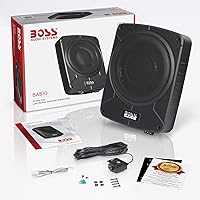
  • Included Contents: The package includes the amplified subwoofer enclosure, a wired remote bass knob, and an instruction manual.
  • Warranty: BOSS Audio provides a 3-year warranty, but coverage is conditional on purchase through an authorized online dealer — verify eligibility at the time of purchase.
  • Brand & Origin: Manufactured by BOSS Audio Systems, a U.S.-based car audio brand with an established catalog spanning amplifiers, subwoofers, and head units.
  • Availability Date: The BAB10 was first made available in January 2019 and has maintained a consistent sales presence in the car component subwoofer category since launch.

Related Reviews
Planet Audio P10AWK 10-Inch Amplified Car Subwoofer
71%
83%
Ease of Installation
71%
Bass Output & Impact
76%
Sound Tuning & Flexibility
86%
Compatibility & Input Options
58%
Build Quality & Materials
More
BOSS Audio P80DVC 8-Inch Car Subwoofer
68%
83%
Value for Money
71%
Bass Output
52%
Build Quality
48%
Durability
88%
Wiring Flexibility
More
BOSS Audio CXX12 12-Inch Car Subwoofer
73%
88%
Value for Money
79%
Bass Output & Low-End Extension
61%
Power Handling (Real-World RMS)
72%
Build Quality
54%
Sound Clarity at High Volume
More
BOSS Audio B12ES 12-Inch Powered Car Subwoofer
72%
88%
Ease of Installation
79%
Bass Output & Impact
83%
Value for Money
63%
Build Quality & Materials
81%
Remote Bass Control Usability
More
BOSS Audio CH10DVC 10-Inch Car Subwoofer
69%
88%
Value for Money
74%
Bass Output
62%
Build Quality
57%
Longevity & Durability
83%
Wiring Flexibility
More
BOSS Audio Systems BASS8 8-Inch Under Seat Powered Car Subwoofer
86%
89%
Bass Quality
91%
Ease of Installation
94%
Space Efficiency
85%
Sound Clarity
88%
Power Output
More
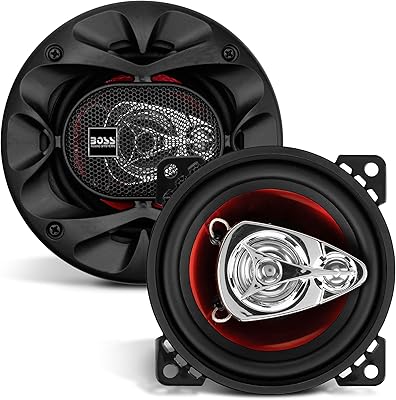
BOSS Audio CH4330 4x10-Inch Car Coaxial Speakers
72%
83%
Value for Money
71%
Sound Quality
88%
Ease of Installation
62%
Build Quality
77%
Treble Clarity
More
BOSS Audio Systems CH4230 Chaos Exxtreme Series 4 x 10 Inch Car Door Speakers
83%
88%
Sound Clarity at High Volumes
72%
Bass Performance
85%
Durability and Build Quality
80%
Ease of Installation
92%
Value for Money
More
Acoustic Audio PSW400-10 10-Inch Powered Subwoofer
85%
91%
Bass Performance
88%
Ease of Setup
85%
Sound Quality
92%
Value for Money
87%
Build Quality
More
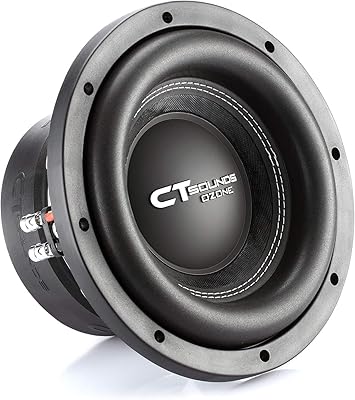
CT Sounds OZONE-10-D4 10-inch Car Subwoofer
84%
91%
Bass Performance
88%
Power Handling
92%
Value for Money
85%
Sound Clarity
86%
Build Quality
More

FAQ

That 1200W figure is peak power — the absolute maximum the amp could theoretically handle in a brief burst under ideal conditions. The continuous RMS output, which is what actually matters for real listening, is considerably lower. It is a common spec convention in budget and mid-range car audio, but worth understanding before you buy so your expectations are calibrated correctly.

Yes, and this is genuinely one of its strongest practical advantages. The high-level speaker inputs let you tap directly into the existing speaker wiring from your factory head unit — no line output converter needed, no new radio required. Just splice into the rear speaker leads and you are good to go.

It fits under the rear seats of many compact sedans, hatchbacks, and small SUVs, but clearance is not guaranteed across all vehicles. The enclosure stands 3.3 inches tall, so measure the vertical gap beneath your specific seat before ordering — some bucket seat rails and low-clearance underseat frames in certain models cut it very close.

Most first-timers complete it in under an hour with basic hand tools. You will need to run a power wire from the battery, a ground wire to the chassis, and connect either the RCA or speaker-level inputs to your head unit. The included manual walks through the steps, though watching a vehicle-specific install video on YouTube alongside it helps a lot if you are new to this.

The wired remote knob controls the subwoofer output level from inside the cabin — think of it as a dedicated bass volume dial. Most people mount it on the center console or dashboard within easy reach. It is genuinely useful for daily driving since you can roll the bass back when you need quiet and bring it up when you want impact, without touching the main unit.

Honestly, no — not at normal listening levels. This under-seat subwoofer is best described as a warm, full-sounding upgrade over flat factory audio rather than a system that will shake license plates loose. If you want physically felt, room-filling bass, you will want a higher-powered separate system. For everyday music listening, though, the improvement is real and satisfying.

Most owners get through the first year without issues. The durability concern that comes up repeatedly in the community involves the amplifier board, which some owners report developing faults after 12 to 18 months — particularly in hotter climates or in setups where the bass boost is run aggressively. Keeping the unit ventilated and not pushing it to its ceiling regularly seems to help longevity.

Technically you can leave the controls at default, but taking 10 minutes to set them properly makes a meaningful difference in sound quality and can protect the hardware. Start with the gain low, set the low-pass filter around 80 Hz, and gradually adjust by ear to blend with your front speakers. Avoid cranking the bass boost as a permanent setting — use it situationally if at all.

The three-year warranty is real, but there is a catch worth knowing: coverage applies only if you purchased from an authorized dealer. If you bought through a third-party marketplace seller rather than a verified BOSS Audio authorized listing, your warranty claim may be denied. Check your purchase source before assuming you are covered, and keep your order confirmation as proof.

On most modern vehicles the noise floor is acceptable, but some owners on older factory radios have noted a faint background hiss at low volume. This is a known limitation of high-level input connections in general — they are inherently noisier than a clean RCA signal from a quality head unit. If audio purity at low volumes matters to you, using the RCA inputs from an aftermarket radio will give noticeably cleaner results.

Where to Buy