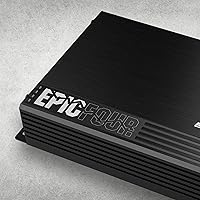
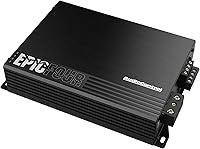
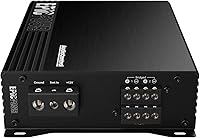
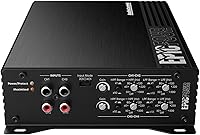
Overview

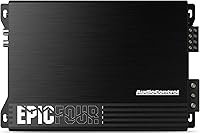
The AudioControl EPICFOUR comes from a brand that has built a strong reputation in American car audio, particularly around clean signal processing and thoughtful engineering. This compact 4-channel amp targets enthusiasts who want serious output without dedicating half their trunk to hardware. Its Class D topology is central to that promise — running cooler and drawing less current than older AB designs, which matters in tight installs. At its price tier, buyers reasonably expect more than raw wattage; they expect polish, durability, and a unit that holds up through years of daily use. One thing worth clarifying upfront: this is a full-range amplifier, not a dedicated subwoofer unit.

Features & Benefits

At its core, the EPICFOUR delivers 800W RMS total — 200 watts per channel at 2 ohms — packed into a chassis just over 12 inches long. Worth flagging early: the 2-ohm minimum load means you need to confirm your speakers are 2-ohm rated or wired accordingly; 4-ohm components paired carelessly will underperform. The variable high-pass filter (12dB/octave) gives real control over each speaker's frequency rolloff, which proves useful when tuning a multi-speaker setup. High-level inputs let you tap directly from a factory head unit's speaker outputs — no separate line output converter required. A smart auto reset circuit handles thermal, overload, and short-circuit events without needing a manual power cycle.

Best For

This compact 4-channel amp fits naturally into a few specific scenarios. Owners of newer vehicles with factory head units and no preamp outputs will find the high-level input a genuine convenience that many competing amps skip at this tier. Installers working inside compact sedans, crossovers, or tight cargo areas will appreciate the small footprint — under 13 inches long and just over 5 pounds. It also suits buyers building a staged system: run four channels for doors and dash now, then add a dedicated mono amp for a subwoofer later. If you value brand reliability and long-term build quality over chasing the highest peak-watt number on the box, this AudioControl amplifier sits in a strong position.

User Feedback

Buyers generally respond well to this AudioControl amplifier, with consistent praise focused on how it sounds at realistic listening volumes — clean, controlled, and noticeably better than stock. The OEM integration via high-level inputs draws frequent positive mentions from owners who bypassed a specialist installer entirely. On the critical side, a handful of users flag that the 2-ohm minimum load can complicate speaker selection, particularly for those carrying over standard 4-ohm components. A few noted that terminal spacing feels snug when working with thicker gauge wire. Overall, complaints are scattered rather than systemic, and the brand's reliability reputation appears to hold — returns and failure reports represent a small fraction of the overall feedback pool.

Pros

  • High-level inputs make OEM integration clean and straightforward without extra adapters or converters.
  • The compact chassis fits under seats and in tight trunk corners where full-size amps simply cannot go.
  • 800W RMS total is an honest, conservative figure — not an inflated peak-power marketing number.
  • Class D topology runs noticeably cooler and draws less idle current than equivalent Class AB designs.
  • The 90dB-plus signal-to-noise ratio means no audible hiss, even with sensitive tweeters installed.
  • Smart auto-reset protection recovers from thermal and overload events without a manual power cycle.
  • The variable high-pass filter gives meaningful control over each speaker's low-end rolloff during tuning.
  • AudioControl's brand track record adds a layer of long-term reliability confidence that generic alternatives cannot match.
  • Clean, detailed sound at highway speeds is a consistent theme across real-world owner feedback.
  • Freestanding mounting removes the need for custom brackets in most standard vehicle install locations.

Cons

  • The 2-ohm minimum load requirement limits compatibility with common 4-ohm component speaker sets.
  • Instruction manual lacks depth for less experienced installers, particularly around gain staging and crossover settings.
  • No built-in low-pass filter means a separate amp is always required for any subwoofer in the system.
  • Terminal block spacing is tighter than expected, making it awkward to route heavier gauge wiring cleanly.
  • Automatic turn-on via high-level input is not universally reliable across all OEM configurations, sometimes requiring a separate remote trigger.
  • Long-term field reliability data is limited given the product only launched in late 2024.
  • In poorly ventilated enclosed spaces, thermal protection can trigger during sustained high-volume use.
  • Buyers prioritizing spec-sheet wattage over sound quality may undervalue what this compact 4-channel amp actually delivers.

Ratings

Our scores for the AudioControl EPICFOUR were generated by AI after analyzing verified buyer reviews from multiple global markets, with spam, incentivized, and bot-driven feedback actively filtered out. The result is an honest, data-driven snapshot that reflects both what owners consistently praise and the real friction points that show up across install types and vehicle categories. Nothing here is rounded up to protect a brand — strengths and shortcomings are weighted equally.

Sound Clarity
91%
Owners repeatedly describe the audio as noticeably cleaner than anything a factory system can produce, particularly on highway drives where background noise typically masks detail. The 90dB-plus signal-to-noise ratio translates into a listening experience with virtually no hiss, even at moderate gain settings.
A small number of users note that extracting the best clarity requires careful gain-staging, which can trip up first-time installers who set levels by ear rather than with a multimeter or oscilloscope. Out of the box, improper setup can leave some of that resolution on the table.
Power Output
86%
The 800W RMS total — 200 watts per channel at 2 ohms — is a credible, honest figure that holds up in real installs rather than being a peak-power marketing number. Owners running efficient 2-ohm speakers report strong, dynamic output that fills small to mid-size cabins comfortably.
The 2-ohm minimum load is a real constraint. Buyers who already own standard 4-ohm component sets will see noticeably lower output unless they wire speakers in parallel, which is not always practical or safe depending on the cabinet configuration.
Build Quality
88%
The chassis feels dense and well-machined for a compact unit — not the hollow, flex-prone shell that sometimes shows up at this price tier. Installers comment positively on the heatsink design, noting the amp runs warm but never uncomfortably hot even after extended highway sessions.
A handful of buyers flag that the terminal block spacing feels tighter than expected, which can make routing heavier gauge power and ground wire awkward in confined install spaces. It is a minor inconvenience but worth noting if you are working in a cramped location.
OEM Integration
93%
The high-level speaker inputs are the standout practical feature for anyone upgrading a modern vehicle with a factory-locked head unit. Owners of newer cars — where aftermarket head unit swaps are complicated or impossible — describe this as the feature that made the install straightforward without extra adapters.
There is no built-in signal sensing for automatic turn-on via the high-level input on all configurations, so some users have had to run a separate remote wire or use a voltage-sensing relay. Not a dealbreaker, but it adds a step for purely OEM installations.
Compact Footprint
92%
At just over 12 inches long and under 5.5 pounds, this amplifier fits in spots where full-size units simply cannot go — under seats, in shallow trunk corners, or behind rear seat panels in compact crossovers. Installers working on space-constrained builds specifically call this out as a decisive factor.
The compact dimensions do mean the cooling fins are smaller than on a full-size equivalent, and in truly enclosed spaces with no airflow, thermal throttling is a theoretical concern under sustained high-volume use. Most real-world installs do not push it to that extreme.
Thermal Management
83%
Class D efficiency means the amp generates significantly less waste heat than an equivalent Class AB design, and the smart auto-reset protection handles thermal events without requiring a manual restart. Owners running the unit in sealed enclosures report no unexpected shutdowns during normal listening.
In very hot climates, particularly in vehicles parked in direct sun, a few users have noted occasional thermal protection triggers during the first few minutes of high-volume playback before the cabin cools down. Adequate ventilation around the unit largely eliminates this.
Protection Circuitry
89%
The auto-reset protection circuit covers thermal, short-circuit, and overload conditions, and the self-recovery behavior means the system comes back online without the owner needing to pull a fuse or power cycle the vehicle. Several installers note this saved them diagnostic time during initial setup tweaks.
A very small number of users report the protection circuit triggering under conditions that seemed within normal operating parameters, suggesting sensitivity calibration may occasionally be conservative. In most cases, reviewing impedance matching resolved the issue.
Installation Ease
79%
21%
The combination of high-level inputs and clearly labeled terminals makes this a relatively accessible install for a DIY enthusiast with basic tools and patience. The freestanding mount style also removes the need for precision bracket fabrication in most applications.
The instruction manual has been described as thin on detail for less experienced installers, particularly around gain structure and crossover setup. Without a solid understanding of those settings, buyers may not realize the amp's full potential after install.
Value for Money
84%
At its price point, the combination of an honest RMS rating, high-level inputs, compact chassis, and a reputable American brand behind it represents strong value compared to lesser-known alternatives making inflated power claims. Buyers who have owned budget amps previously tend to rate this favorably by comparison.
Competitors at a slightly lower price do offer 4-channel amps with similar wattage claims, and buyers who do not prioritize OEM integration or brand pedigree may feel the premium is harder to justify on specs alone. The value story is strongest for specific install scenarios.
Signal-to-Noise Ratio
91%
The 90dB-plus SNR is not just a spec-sheet number — owners with sensitive tweeters confirm there is no audible noise floor at idle, which matters in quiet cabins during low-volume listening. This is one area where the engineering quality of the brand genuinely shows through.
Achieving a clean noise floor in practice still depends heavily on proper grounding and routing signal cables away from power wires. Users who skipped those fundamentals occasionally blamed the amp for noise that was actually an install issue.
Crossover Flexibility
77%
23%
The variable high-pass filter gives installers meaningful control over where each speaker's low-end rolls off, which is particularly useful when running door speakers that would otherwise strain on bass-heavy content. The 12dB-per-octave slope provides a smooth, natural transition.
The absence of a built-in low-pass filter option and the single crossover type limits versatility for installers who want to run a blended front-stage and subwoofer system entirely through this one unit. A dedicated sub output would have made this a more complete solution.
Channel Configuration
85%
Four discrete channels give real flexibility for powering a front and rear speaker setup independently, or bridging a pair for more focused power delivery to a specific zone. Daily driver builds benefit from this without needing a second amplifier in the trunk.
Bridging two channels to mono reduces the minimum impedance headroom, and users who attempt to run a subwoofer this way with a 4-ohm woofer may find themselves outside the safe operating range. The manual could be clearer in flagging this scenario.
Energy Efficiency
90%
The ultra-low idle draw is a genuine practical benefit for vehicles used on short urban trips where the alternator does not fully recharge the battery between starts. Owners who previously ran Class AB amps comment on a measurable reduction in electrical system strain.
Efficiency advantages are most noticeable at moderate output levels. Pushing the amp hard for extended periods narrows the gap versus Class AB, though it remains more efficient overall. In stock electrical systems without a capacitor or upgraded alternator, high-demand listening still warrants attention.
Long-Term Reliability
86%
AudioControl has a track record that extends well beyond this single product, and that brand history appears to carry real weight in how buyers perceive durability. Failure reports and premature fault stories represent a small fraction of the overall feedback pool across verified purchases.
As a product released in late 2024, the long-term reliability data is still limited compared to models with several years of field history. Early adopter feedback is positive, but buyers looking for decade-long performance data simply do not have it yet.

Suitable for:

The AudioControl EPICFOUR is a strong match for daily drivers who are done tolerating a lackluster factory sound system but do not want to gut their dashboard to swap in an aftermarket head unit. It fits particularly well in modern vehicles where the OEM stereo is deeply integrated into the infotainment system — the high-level inputs let you tap directly from existing speaker wires without any additional signal converter. Compact car owners, crossover drivers, and anyone working with limited trunk or under-seat real estate will appreciate that the chassis is genuinely small enough to disappear into an install. It also suits the hobbyist building a system in stages: run four speakers cleanly now, then add a dedicated mono amp for a subwoofer down the line without redesigning the whole setup. Buyers who prioritize brand accountability and honest power ratings over inflated peak-watt claims will feel at home here.

Not suitable for:

The AudioControl EPICFOUR is the wrong tool for anyone whose primary goal is driving a subwoofer — it is a full-range amplifier, and there is no low-pass filter on board to support a dedicated sub channel cleanly. Buyers with an existing set of standard 4-ohm component speakers should also think carefully before purchasing, since the 2-ohm minimum load means those speakers will not receive full rated power without rewiring them in parallel, which is not always practical. If you are building a high-output competition system and need a single amp to do everything — including bass — this compact 4-channel unit will leave gaps in the setup. Budget-focused shoppers who are comparing raw wattage numbers across brands may also find the value proposition harder to justify without understanding why honest RMS ratings and build quality matter in the long run. Finally, buyers who want a plug-and-play experience with zero tuning involvement may be frustrated, since proper gain structure and crossover settings require at least a basic understanding of amplifier setup.

Specifications

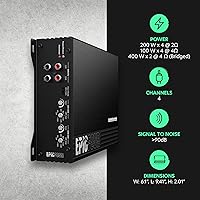
  • Total RMS Power: The amplifier delivers 800W RMS total, rated at 200 watts per channel into a 2-ohm load across all four channels simultaneously.
  • Topology: Class D digital switching design provides high efficiency and reduced heat output compared to traditional Class AB amplifiers.
  • Channels: Four fully independent output channels support a complete front and rear speaker setup from a single compact unit.
  • Minimum Impedance: Full-range operation requires a minimum 2-ohm load per channel; bridged mono configuration supports a minimum 1-ohm load.
  • High-Pass Filter: A variable high-pass filter with a 12dB-per-octave slope allows per-install tuning of each speaker's low-frequency rolloff point.
  • Signal-to-Noise Ratio: Rated at 90dB or higher, ensuring the noise floor remains inaudible even when the system is driven at moderate output levels.
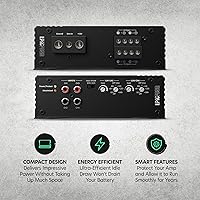
  • High-Level Inputs: Onboard high-level speaker inputs accept signal directly from factory or OEM head unit speaker output wires without requiring a separate line output converter.
  • Protection System: Smart Auto Reset Protection monitors for thermal overload, short-circuit, and general overload conditions, recovering automatically without requiring manual intervention.
  • Operating Voltage: Designed to operate at 14V DC, consistent with standard 12V automotive electrical systems under normal alternator charging conditions.
  • Dimensions: The chassis measures 12.4 x 7.8 x 3.11 inches, making it one of the more compact full 4-channel amplifiers in its power class.
  • Weight: The unit weighs 5.27 lbs, light enough for under-seat or shallow trunk installs without structural reinforcement concerns.
  • Mounting Type: Freestanding mounting design eliminates the need for custom fabricated brackets in most standard vehicle installation locations.
  • Idle Current Draw: Ultra-low idle current draw minimizes parasitic battery drain during short trips, city driving, or periods when the vehicle is parked with audio on.
  • Brand Origin: AudioControl is a USA-based car audio and signal processing manufacturer with an established reputation in the enthusiast and installer community.
  • Model Number: The official model designation is EPICFOUR, part of AudioControl's Epic Series product line.
  • Release Date: The product was first made available for purchase in October 2024, making it a recent addition to the AudioControl lineup.
  • Package Dimensions: The retail package measures approximately 12.4 x 7.8 x 3.11 inches and ships at a total weight suitable for standard carrier delivery.

Related Reviews
AudioControl The EPICENTER Bass Restoration Processor
86%
93%
Bass Performance
88%
Ease of Use
82%
Installation Process
85%
Build Quality
91%
Remote Control Functionality
More
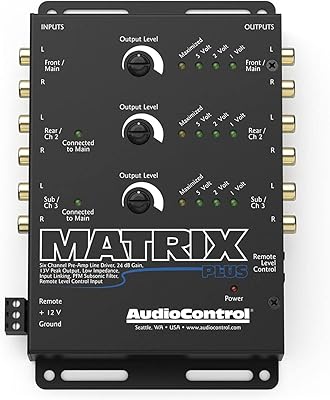
AudioControl Matrix Plus Six Channel Line Driver
90%
96%
Audio Clarity
94%
Noise Reduction
91%
Signal Consistency
89%
Remote Level Control
93%
Build Quality
More

FAQ

Yes, and this is one of the more practical things about this compact 4-channel amp. The high-level speaker inputs let you tap directly into the speaker wires coming out of your OEM head unit, so you do not need to buy a separate line output converter to get a signal into the amp. Just make sure your factory stereo output wires are accessible, and you are most of the way there.

They will work, but you will not get the full rated power output. The AudioControl EPICFOUR is rated at 200 watts per channel at 2 ohms, and at 4 ohms that number drops noticeably. If you already own 4-ohm speakers and cannot rewire them in parallel to hit 2 ohms, the amp will still drive them cleanly — just not at peak rated power. It is worth factoring in before purchasing if maximum output is your priority.

You will generally need to run a remote turn-on wire from your head unit or use a voltage-sensing relay for fully automatic operation. The high-level input does not universally handle auto turn-on across all OEM configurations, so planning for a dedicated remote wire during install is the cleaner approach.

Not ideally. There is no onboard low-pass filter, which is what you need to send only bass frequencies to a subwoofer. You could technically bridge two channels and run a sub, but without a low-pass filter you would be sending full-range signal to it, which is not good for the woofer or the sound. A dedicated mono subwoofer amp paired alongside this one is the right approach.

In most cases, yes. The chassis is just over 12 inches long and under 3.5 inches tall, which clears the under-seat profiles of most modern sedans and crossovers. That said, it is worth measuring your specific under-seat clearance before installing, since some vehicles with powered or low-profile seats leave very little vertical room.

No, that is actually where the smart auto-reset protection earns its name. If the amp triggers a thermal or overload protection event, it shuts down temporarily and then resets itself once conditions normalize, without you needing to power cycle the vehicle or pull a fuse. Most users never even notice it happened.

A few installers have noted that the terminal spacing is tighter than they expected, which can make routing 4-gauge or heavier power and ground cable a bit awkward. Most installs at this power level use 4-gauge wire, and it fits, but it may require some patience. If you are planning an especially tidy build with thick cable runs, factor in a little extra time for wire management around the terminal block.

For the vast majority of daily listening in a standard cabin, yes — 200 watts per channel at 2 ohms is more than enough to fill a mid-size car with clean, detailed sound at volumes well above highway noise. The caveat is speaker efficiency: more efficient speakers will sound louder at the same wattage, so pairing matters.

Generally yes. Class D efficiency means it generates considerably less waste heat than an older Class AB design at equivalent output, and the heatsink manages temperature well under normal sustained use. If the amp is installed in a fully enclosed space with zero airflow, heat can build up over extended high-volume sessions, so leaving some ventilation around the unit is always a good idea.

It is actually a sensible way to stage a build. Run this 4-channel amp for your door and dash speakers now, dial in the sound, and then add a separate mono amp for the subwoofer when your budget allows. The two units can share the same power and ground run if you size the wire appropriately upfront, which saves rework later.