Overview

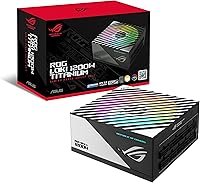
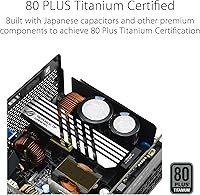
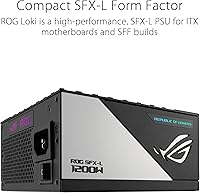
The ASUS ROG Loki SFX-L 1200W Power Supply is ASUS's flagship compact power unit, built for enthusiasts who refuse to compromise when going small. Getting 1200 watts into an SFX-L frame is genuinely rare — most competing units tap out well below that ceiling. The 80 Plus Titanium certification means the unit operates at up to 94% efficiency, translating to less wasted energy and less heat trapped inside an already tight case. Backing it all up is a 10-year warranty, a rare commitment that signals real confidence in the hardware. If you are planning a compact ITX or mATX build around a flagship GPU, this compact PSU was designed with exactly that scenario in mind.
Features & Benefits

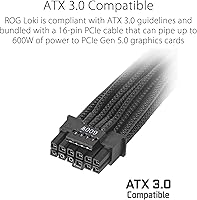
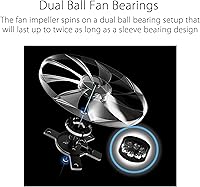
What separates the ROG Loki 1200W from budget SFX alternatives is not just raw output — it is how intelligently that power gets delivered. The included 16-pin PCIe 5.0 cable handles the sharp transient power spikes that modern GPUs demand, with no clunky adapter required thanks to full ATX 3.0 compliance. Below 40% load, the fan stops entirely — genuinely silent during casual use. When it does spin up, dual ball bearings and Lambda Standard++ noise certification keep it under 35 dB. ASUS also fitted ROG heatsinks to critical internal components, which keeps temperatures in check during long sustained loads and should meaningfully extend the operational lifespan of the unit.

Best For

This SFX-L power supply is purpose-built for a specific type of builder — someone squeezing serious GPU muscle into a compact chassis. Pairing it with an RTX 4090 or RX 7900 XTX makes practical sense; the native PCIe 5.0 connector and 1200W headroom give those cards everything they need without workarounds. It also suits quiet workstation or gaming setups where idle fan noise actually matters. The ARGB fan and Aura Sync support are genuine bonuses for RGB-focused builds, not cosmetic filler. One important caveat: verify your case explicitly supports the SFX-L standard before buying — not every compact enclosure does, and that compatibility check is critical before committing.

User Feedback

Across more than 1,300 ratings, the ROG Loki 1200W holds a strong 4.6-star average, and the praise is consistent. Most buyers call out near-silent operation as the biggest real-world win, with the fan barely registering during everyday use. Owners also report that temperatures inside their builds dropped noticeably compared to previous or lower-rated units in the same case. The ARGB fan earns approval from those already in the Aura Sync ecosystem. On the critical side, some users mention cable lengths feeling tight in certain compact cases, and a portion of buyers question whether the price premium over a full-size ATX unit at equivalent wattage is justified when space constraints are not a hard requirement.

Pros

  • Hitting 1200W in an SFX-L footprint is genuinely rare — most compact units cap out far lower.
  • 80 Plus Titanium efficiency keeps energy waste and internal heat low during long gaming sessions.
  • The native 16-pin PCIe 5.0 cable handles next-gen GPU power spikes cleanly, no adapter needed.
  • Fan stops completely below 40% load, making the ROG Loki 1200W effectively silent during light use.
  • Lambda Standard++ certification confirms noise stays below 35 dB even under real sustained load.
  • Fully modular design means you only route the cables your build actually needs, reducing clutter.
  • Dual ball bearing fan construction is expected to outlast sleeve bearing designs by a significant margin.
  • A 10-year warranty is an unusually strong commitment that reflects genuine confidence in component quality.
  • Aura Sync ARGB fan integrates cleanly into existing ASUS RGB ecosystems without extra software hassle.
  • Over 1,300 buyer ratings hold at 4.6 stars, reflecting a broad and consistent base of satisfied owners.

Cons

  • The SFX-L form factor is not universally supported — many compact cases only fit the shorter standard SFX size.
  • The price premium over full-size ATX alternatives at equivalent wattage is substantial and hard to ignore if space is not a constraint.
  • Modular cable lengths can feel tight in certain compact cases, requiring careful planning before routing.
  • 1200W is overkill for mid-range builds, and buyers pay for capacity they will realistically never approach.
  • ARGB lighting adds cost and complexity that purely performance-focused builders gain nothing from.
  • Availability can be inconsistent, making it harder to time purchases around sales or bundle deals.
  • Heavier than many SFX-L competitors at around 4.7 pounds, which can matter in ultra-compact chassis with weight considerations.
  • No international voltage switching documentation is prominently communicated, which can create confusion for buyers outside standard markets.

Ratings

The scores below were generated by AI after analyzing verified buyer reviews worldwide for the ASUS ROG Loki SFX-L 1200W Power Supply, with spam, incentivized feedback, and bot activity actively filtered out to reflect genuine ownership experiences. Across more than 1,300 confirmed ratings, this compact PSU earned strong marks in most categories — but not without some real-world friction points that are worth knowing before you commit. Both the standout strengths and the honest shortcomings are reflected transparently in every scorecard below.

Power Delivery Stability
94%
Builders pairing this unit with RTX 4090s and other power-hungry flagship GPUs consistently report rock-solid voltage regulation even during GPU transient spikes. The ATX 3.0 compliance means the unit was designed from the ground up to handle those aggressive, instantaneous power demands that tripped up older PSUs.
A small number of users in extremely hot ambient environments noted marginally higher rail fluctuation during extended summer sessions with poor case airflow, though this appears to be an edge case rather than a design flaw.
Noise Level
91%
The 0dB fan mode is one of the most praised aspects across reviews — during browsing, streaming, or light gaming sessions, the PSU contributes absolutely nothing to ambient system noise. Even under full gaming load, the Lambda Standard++ certified sub-35 dB output is barely audible next to a typical GPU cooler.
Under sustained, heavy computational workloads such as rendering or stress testing, some users noted the fan ramps up more aggressively than expected, briefly becoming the loudest component in the build before settling back down.
Efficiency & Heat Output
93%
The 80 Plus Titanium rating translates into real, measurable benefits inside a compact chassis — reviewers frequently mention lower overall case temperatures after switching to this unit compared to their previous Gold or Platinum PSUs. Less wasted energy means less heat, and in an ITX build where airflow is already constrained, that matters enormously.
The efficiency advantage narrows at very low loads, where Titanium-rated units are not always as dominant over high-quality Platinum alternatives as the certification gap implies, making the premium harder to justify for lightly loaded systems.
Build Quality
92%
The physical construction earns consistent praise — the housing feels dense and precisely finished, and the fully modular connector panel has a satisfying, secure engagement. ROG heatsinks on internal components signal that ASUS invested in longevity rather than just hitting a wattage spec.
At 4.73 pounds, this compact PSU is noticeably heavier than some rivals in the SFX-L class, which can complicate installation in chassis with weight-sensitive PSU mounting brackets or bottom-mounted configurations.
Case Compatibility
67%
33%
For cases explicitly designed for SFX-L — such as the Lian Li A4, NZXT H1, and similar enthusiast ITX enclosures — the fitment is clean and purposeful, with the unit dropping in exactly as intended.
This is the single most common complaint across reviews: buyers who assumed SFX and SFX-L were interchangeable discovered too late that the longer form factor does not fit standard SFX enclosures. Case compatibility must be verified explicitly before purchasing, and ASUS could do more to communicate this distinction prominently.
Cable Quality & Length
72%
28%
The included cable set is well-sleeved and flexible enough to manage in most SFX-L chassis, and the native 16-pin PCIe 5.0 cable is a genuine convenience that removes the need for any third-party adapter solutions.
Multiple reviewers flagged that certain cable runs — particularly to SATA drives mounted at distance from the PSU — felt uncomfortably short in some popular compact cases. Users with non-standard internal layouts should measure cable runs against the included lengths before finalizing their build plans.
Value for Money
71%
29%
For builders who genuinely need the SFX-L form factor and flagship GPU support, the combination of Titanium efficiency, ATX 3.0 compliance, and a 10-year warranty constructs a reasonable long-term cost argument — the PSU is unlikely to need replacing within a decade of normal use.
Buyers not constrained by case size repeatedly point out that comparable wattage in a full ATX format costs meaningfully less, making the price premium feel steep unless compact form factor is a hard requirement rather than a preference.
Modular Cable System
83%
Full modularity is well-executed here — connectors seat firmly with no wobble, and the ability to use only the cables you need is a genuine quality-of-life improvement in tight SFX-L cases where cable management space is essentially nonexistent.
The proprietary cable connector layout means you cannot substitute cables from other fully modular ASUS PSUs without risking pinout mismatches, so losing or damaging a cable later may require sourcing direct replacements from ASUS rather than off-the-shelf alternatives.
RGB & Aesthetics
81%
19%
The ARGB fan delivers a clean, vibrant lighting effect that integrates naturally with Aura Sync setups, and the black finish pairs well with the interior of most modern ITX cases that have a side panel window.
Users who do not use ASUS motherboards or the Armoury Crate software ecosystem lose much of the Aura Sync benefit, and a handful of reviewers felt the RGB premium added cost they could not fully utilize in their specific build configuration.
Installation Experience
78%
22%
Within a compatible SFX-L case, the installation process is straightforward — the unit slides in cleanly, the modular connections are clearly labeled, and the included documentation covers the key steps without requiring deep technical knowledge.
First-time SFX builders occasionally found the tighter connector clearances and limited cable routing space more demanding than they anticipated coming from ATX builds, and the heavier weight makes one-handed maneuvering inside a small chassis awkward.
Fan Longevity
88%
Dual ball bearing construction is a meaningful specification in a PSU fan — under real-world conditions it significantly outlasts sleeve bearing alternatives, and the 0dB mode further reduces total fan operating hours by keeping it off during lighter use.
Since this is a relatively recent product, long-term field data on actual fan lifespan is still limited, and the 10-year warranty window means buyers are trusting engineering specifications rather than decades of community-validated durability evidence.
PCIe 5.0 Readiness
96%
The native 16-pin connector and ATX 3.0 compliance position this compact PSU well ahead of most older units still in circulation — there is no reliance on daisy-chained or adapter-based solutions, which have been associated with connector damage on some high-draw cards.
For buyers currently running PCIe 4.0 GPUs, this forward-looking feature offers no immediate benefit, and the cost premium associated with this specification cannot be recouped until a PCIe 5.0 compatible GPU enters the build.
Thermal Management
89%
The ROG heatsinks on internal components are not just cosmetic — reviewers who monitored component temperatures over extended periods report the unit staying well within comfortable operating ranges even during back-to-back gaming and workload sessions.
In passively cooled or very low-airflow SFX-L cases, the PSU's reliance on ambient case air for some of its heat dissipation means enclosure cooling design meaningfully impacts how well the thermal management performs in practice.
Warranty & Support
87%
A 10-year manufacturer warranty is a genuinely rare commitment in consumer electronics, and buyers cite it as a major confidence factor — it signals that ASUS expects this hardware to remain functional across multiple GPU generations.
Some users reported that navigating the ASUS warranty registration and RMA process required patience, with support response times varying considerably by region, which slightly tempers the headline appeal of the warranty duration.

Suitable for:

The ASUS ROG Loki SFX-L 1200W Power Supply was built for a very specific kind of builder, and it delivers best when that builder is working within its intended context. If you are assembling a compact ITX or mATX system around a flagship GPU — an RTX 4090, an RX 7900 XTX, or anything else at the top of the power-demand curve — this compact PSU gives you the headroom to run that hardware without constantly flirting with the unit's ceiling. The native PCIe 5.0 connector means you are not relying on adapters that have caused headaches for other high-end GPU owners. Enthusiasts who care about system noise will also find it a strong match; the fan stops entirely under light loads, and even under sustained gaming it stays measurably quiet. Long-term builders who treat their power supply as infrastructure rather than a throwaway component will appreciate the 10-year warranty backing the investment.
Not suitable for:

The ASUS ROG Loki SFX-L 1200W Power Supply is not the right call for everyone, and the biggest dealbreaker is a straightforward compatibility issue: your case must explicitly support the SFX-L standard. SFX-L is longer than standard SFX, and many compact enclosures only fit the shorter format — buying this unit without confirming that detail first is an expensive mistake. Budget-conscious builders should also think carefully here; the price premium over a capable ATX unit at equivalent wattage is real, and if you are not constrained by case size, a full-size alternative could serve you just as well for meaningfully less money. Similarly, anyone building a mid-range or modest system where 1200W is far beyond practical need should look at lower-wattage SFX-L options rather than paying for overhead they will never use. If RGB integration and Aura Sync hold zero appeal, that aesthetic premium is simply not adding value to your build.
Specifications

  • Form Factor: This unit follows the SFX-L standard, measuring 125 x 125 x 63.5 mm — physically larger than standard SFX but significantly smaller than any ATX power supply.
  • Output Wattage: Rated at a continuous 1200W, which is among the highest outputs available in the SFX-L form factor category.
  • Efficiency Rating: Carries 80 Plus Titanium certification, achieving up to 94% energy efficiency under typical load conditions.
  • ATX Standard: Fully compliant with the ATX 3.0 specification, which defines stricter transient power handling requirements suited to modern GPU architectures.
  • GPU Connector: Includes a native 16-pin PCIe 5.0 connector capable of delivering up to 600W directly to compatible graphics cards.
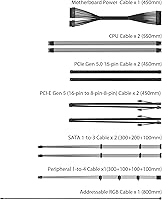
  • CPU Connectors: Ships with two 4+4-pin EPS CPU power connectors, supporting both standard and high-end motherboard configurations.
  • PCIe Connectors: Provides four 6+2-pin PCIe connectors for compatibility with a wide range of discrete graphics cards and expansion devices.
  • SATA Connectors: Includes six SATA power connectors, sufficient for multi-drive storage configurations within compact builds.
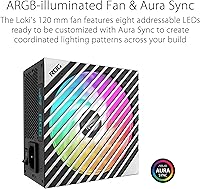
  • Fan Configuration: Uses a 120mm PWM fan with ARGB lighting and dual ball bearings, rated for substantially longer service life than sleeve bearing alternatives.
  • Fan Stop Mode: The fan remains completely off when system load falls below 40%, enabling true silent operation during idle and light workloads.
  • Noise Certification: Holds Lambda Standard++ certification, independently confirming acoustic output stays below 35 dB during operation.
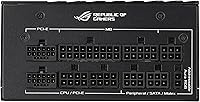
  • Modularity: Fully modular design allows users to connect only the cables required by their specific build, reducing internal clutter.
  • RGB Ecosystem: ARGB fan header is compatible with ASUS Aura Sync, allowing lighting synchronization with other Aura-enabled components via ASUS software.
  • Internal Cooling: ROG-branded heatsinks are applied to critical internal power components to manage thermal load and extend component longevity.
  • Bearing Type: Dual ball bearing fan construction is specified to last up to twice as long as comparable sleeve bearing fan designs.
  • Warranty: Covered by a 10-year manufacturer warranty, which is among the longest standard warranties offered on a consumer power supply.
  • Weight: The unit weighs approximately 4.73 pounds (2.15 kg), which is notable for its size class and reflects robust internal component construction.
  • Color: Available in black, with the ARGB fan providing dynamic lighting as the only visible color element during operation.

Related Reviews

ASUS ROG Loki SFX-L 750W Platinum Power Supply
90%
95%
Performance
91%
Build Quality
94%
Quiet Operation
92%
Efficiency
90%
Cable Management
More
ASUS ROG Loki SFX-L 850W Power Supply
86%
93%
Acoustic Performance
91%
Power Delivery Stability
88%
Build Quality
87%
Thermal Management
89%
Efficiency Under Load
More
ASUS ROG Loki SFX-L 1000W Platinum
88%
92%
Performance
96%
Efficiency (80+ Platinum)
89%
Build Quality
91%
Cooling & Noise
88%
Cable Management
More
SilverStone SX700-LPT 700W SFX-L Power Supply
81%
88%
Build Quality
63%
Value for Money
84%
Noise Level
91%
Power Delivery
71%
Form Factor Fit
More
ASUS ROG Thor 1000W Platinum II Power Supply
89%
95%
Power Performance
92%
Efficiency
88%
Noise Levels
91%
Build Quality
90%
Cooling Performance
More
ASUS ROG Thor 850W Platinum II Power Supply
89%
93%
Performance
91%
Quiet Operation
94%
Build Quality
90%
Energy Efficiency
88%
Ease of Installation
More
be quiet! SFX L 600W 80 Plus Gold Power Supply
87%
94%
Quiet Operation Under Load
88%
Modular Cable Management
91%
Power Efficiency
90%
Size and Form Factor
89%
Compatibility with Small Builds
More
ASUS ROG Strix 750G ATX Power Supply
88%
94%
Build Quality
92%
Noise Level
74%
Value for Money
96%
Warranty & Support
89%
Cable Management
More
ASUS ROG Strix 1000W Gold Aura Edition Power Supply
89%
94%
Power Delivery
91%
Energy Efficiency
89%
Cooling Performance
88%
Noise Level
92%
Modular Design & Cable Management
More
SilverStone SX800-LTI 800W SFX-L Power Supply
85%
94%
Power Delivery Stability
91%
Efficiency & Certification
89%
Noise Level
93%
Build Quality & Component Selection
82%
Cable Management & Modularity
More

FAQ

That depends on whether your case supports SFX-L specifically, not just SFX. SFX-L measures 125 x 125 x 63.5 mm, which is longer than the standard SFX format. Many popular ITX cases list SFX-L compatibility, but you should confirm in your case specifications before purchasing — this is the most common mistake buyers make with this unit.

No. The ROG Loki 1200W ships with a native 16-pin PCIe 5.0 cable, so you can plug directly into an RTX 4090 or any other card using the 16-pin connector without relying on a third-party adapter. This is one of its genuine advantages over older PSUs that require adapter cables.

It is genuinely quiet. Below 40% load the fan does not spin at all, so at idle or during light tasks you will hear nothing from the PSU. Under sustained gaming load, the Lambda Standard++ certification means measured noise stays below 35 dB, which is quieter than most full-size ATX units under the same conditions.

For most single-GPU builds, even with a flagship card, 850W to 1000W is often sufficient. The 1200W ceiling makes most sense if you are running a power-hungry GPU alongside a high-core-count CPU, plan to overclock both aggressively, or simply want a large headroom buffer to keep the PSU operating efficiently in the lower half of its range. If your realistic peak draw is well under 900W, a lower-wattage option may offer better value.

The ASUS ROG Loki SFX-L 1200W Power Supply carries a 10-year warranty directly from ASUS. In practice, this means you register the product with ASUS and contact their support if a hardware fault develops within that window. It is worth keeping your purchase receipt and registering the product promptly after buying to make any future claim straightforward.
Yes. The fan operates normally for cooling regardless of whether the ARGB header is connected to anything. The lighting simply will not activate if left unconnected. You do not need an Aura Sync motherboard or ASUS software to use the PSU itself.

For most SFX-L compatible cases, the cable lengths are adequate, but some users building in particularly tight or unconventional chassis have reported that routing certain cables — especially to front-mounted drive bays — requires careful planning. If your case has an unusual internal layout, it is worth cross-referencing cable lengths in the product documentation against your chassis dimensions before assuming everything will reach comfortably.

The 0dB mode keeps the fan off only when system draw stays below roughly 40% of the unit's rated capacity. During active gaming with a high-end GPU, you will almost certainly exceed that threshold and the fan will spin up. That said, it stays below 35 dB under load, so it is unlikely to be noticeable in a typical gaming environment with any ambient noise present.

The 80 Plus Titanium rating means this unit wastes very little power as heat — up to 94% of what it draws becomes usable output. In practice, buyers switching from a less efficient PSU often report lower ambient temperatures inside their cases. The ROG heatsinks on internal components also help manage the heat that is generated, which matters more in a compact chassis where airflow is restricted compared to a full-size tower.

If compact size is a hard requirement and you are running genuinely power-hungry hardware, the Titanium efficiency and ATX 3.0 compliance do provide tangible, measurable benefits. The 10-year warranty also shifts part of the calculation — it is effectively buying peace of mind over a very long ownership window. That said, for moderate workloads or users not constrained by case size, a Gold or Platinum full-size ATX unit at equivalent wattage will almost certainly cost less and perform adequately.

Where to Buy