Overview

The Akia Screens 125″ Fixed Frame Projector Screen is built for one purpose: turning a dedicated room into a proper home theater. At 125 inches diagonal, it occupies the kind of wall space that makes movies feel genuinely large rather than just bigger than your television. Priced in the mid-range, it sits above flimsy pull-down alternatives while stopping well short of boutique-tier screens costing several times more. The EdgeFree design removes the outer frame lip from the viewing area, so the image runs edge-to-edge without visual interruption. It is a serious screen for serious setups — not a luxury product, but a capable, well-considered one.
Features & Benefits

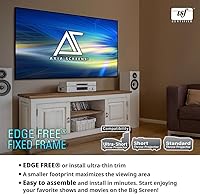
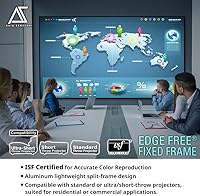
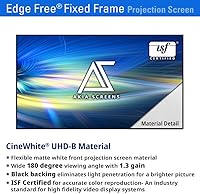
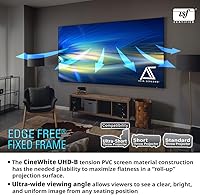
The screen material is where this fixed frame screen earns its keep. CineWhite UHD-B is Akia's name for a white-surface fabric with a 1.3 gain rating — in practical terms, the image looks slightly brighter than a neutral screen without narrowing the viewing angle. You can sit off to the side and still get a clean picture, which matters in rooms where seating is not perfectly centered. The full black backing prevents light from passing through and washing out dark scenes. ISF certification means the color calibration has been independently verified — not just a marketing claim. The 6-piece aluminum frame splits down for easier shipping, and sliding wall brackets let you nudge the whole screen left or right after it is hung.

Best For

This home theater screen is purpose-built for light-controlled rooms — dedicated theaters or media rooms where you can pull curtains or kill the lights during a screening. If you are upgrading from a pull-down or motorized screen, the flat, tensioned surface brings a noticeable improvement in image uniformity. Owners of 4K or HDR projectors will appreciate that the screen material does not impose any color shift or resolution ceiling. Assembly involves basic wall mounting and frame snapping, manageable for someone comfortable with DIY tasks, though the 44-pound assembled weight makes a second pair of hands useful. Households that watch regularly rather than occasionally will get the most out of a permanent install like this.

User Feedback

The Akia 125-inch screen carries a 3.9-out-of-5 rating across over 500 reviews — slightly below some of Akia's own comparable models, and that gap deserves honest context. On the positive side, buyers consistently highlight the flat image surface, straightforward assembly, and strong value relative to the screen size. The friction comes from a recurring cluster of complaints: shipping damage to the frame, minor alignment issues when joining frame sections, and occasional border tension inconsistencies. A few buyers noted the screen picks up ambient light more than expected in rooms without full blackout. Customer support response gets mixed marks — some report fast resolution, others describe longer waits despite the lifetime support promise.

Pros

  • The flat, tensioned surface eliminates the waviness and sagging common with pull-down screens, improving image sharpness noticeably.
  • At 125 inches diagonal, the viewing size is genuinely immersive for dedicated home theater rooms.
  • CineWhite UHD-B material supports 4K, HDR, and active 3D without color distortion or resolution loss.
  • The 1.3 gain provides a moderately brighter image while keeping viewing angles wide — useful for off-center seating.
  • ISF certification gives independent backing to the color accuracy claims, which matters for critical viewers.
  • The 6-piece aluminum frame ships in manageable sections and assembles without specialized tools.
  • Sliding wall brackets let you shift the entire screen horizontally after mounting, which saves frustration during final positioning.
  • The full black backing prevents light bleed, helping dark scenes retain depth and contrast.
  • Compatible with a wide range of projector types, so buyers are not forced into a specific throw configuration.
  • Two-year warranty plus lifetime tech support via phone and chat adds a reasonable safety net for a permanent install.

Cons

  • Several buyers report shipping damage to frame sections, suggesting packaging could be more protective for a large item.
  • Frame alignment during assembly can be fiddly — minor mismatches between sections have come up repeatedly in user feedback.
  • Border tension inconsistencies appear in a subset of units, which can affect edge uniformity on the finished screen.
  • Customer support responsiveness is inconsistent despite the lifetime support promise — some users report slow follow-through.
  • At 44 pounds, mounting safely without a second person is awkward and increases the risk of installation mistakes.
  • The screen is not suitable for rooms with ambient light, limiting its usability outside dedicated, darkened spaces.
  • The 3.9-star aggregate rating is slightly below comparable models in the Akia lineup, suggesting quality consistency is not fully uniform.
  • No carry bag or protective storage solution is included, which complicates repositioning or moving the screen later.

Ratings

The scores below reflect an AI-driven analysis of verified global buyer reviews for the Akia Screens 125″ Fixed Frame Projector Screen, with spam, incentivized, and bot-flagged submissions actively filtered out before scoring. Each category is rated on real-world performance patterns drawn from hundreds of confirmed purchases, giving equal weight to praise and frustration. The results are transparent — where this home theater screen genuinely delivers, the scores reflect it, and where buyers have run into consistent issues, those are surfaced just as clearly.

Image Quality
84%
Buyers running 4K and HDR projectors consistently report that the CineWhite UHD-B surface reproduces colors cleanly without any visible tinting or hue shift. The ISF certification holds up in practice — critical viewers note that skin tones and shadow detail look accurate rather than skewed toward warm or cool.
In rooms with any residual ambient light, the 1.3 gain material struggles noticeably, and the image loses punch and depth quickly. A handful of buyers with particularly bright projectors also noted that gain uniformity was not perfectly consistent edge-to-edge on their units.
Screen Flatness
88%
Flatness is the most commonly praised attribute across buyer feedback, with many reviewers specifically comparing it favorably to their previous pull-down or motorized screens. The rigid aluminum frame holds the material under firm, even tension in the majority of units, producing a surface that stays smooth during extended viewing sessions.
A recurring minority of buyers report border tension inconsistencies where one edge sits slightly looser than the others, creating a subtle but visible warp near the corners. This appears to be a quality consistency issue rather than a design flaw, but it is worth noting for buyers who are particular about edge-to-edge uniformity.
Ease of Assembly
79%
21%
The 6-piece split frame design makes the package manageable to unbox and stage, and most buyers with basic DIY confidence report completing the full assembly and wall mount in under two hours. The included hardware kit covers everything needed without requiring a separate trip to the hardware store.
Frame section alignment during assembly draws repeated complaints — the joints do not always sit flush without some fiddling, and a few buyers describe needing to apply pressure to get sections to lock cleanly. Solo installation of the full assembled frame onto wall brackets is physically awkward given the width and weight involved.
Build Quality
72%
28%
The aluminum frame feels solid once assembled, and the overall construction quality reads as meaningfully above budget-tier screens at a similar size. The black-backed screen fabric is taut and well-finished on units that arrive undamaged, with clean stitching along the border strips.
Shipping damage to frame sections appears often enough in buyer feedback to be a genuine pattern rather than isolated incidents — bent corners and dented rails are the most common complaints. The frame joints, while functional, do not feel particularly precise, and some buyers describe a slightly plasticky feel to the locking connectors.
Value for Money
81%
19%
At its price point, this fixed frame screen offers a surface size and material specification that would cost considerably more from premium brands — buyers consistently describe it as strong value when measured purely by viewable area per dollar spent. For households building a first dedicated theater room on a realistic budget, the math is hard to argue with.
The value equation softens somewhat when factoring in the quality consistency issues some buyers experience — a screen that arrives with a damaged frame or tension problems requires time-consuming support interactions that partially erode the savings. Buyers who end up needing replacement parts or a full return describe the experience as frustrating relative to the initial price appeal.
Ambient Light Performance
41%
59%
In a properly darkened room, the 1.3 gain material does its job well, adding brightness without introducing hotspots or narrowing the effective seating range for viewers sitting off-axis. For buyers who have already committed to a blacked-out home theater setup, this limitation is simply not relevant to their use case.
This is the most significant functional limitation of the screen, and buyer feedback in lit or semi-lit environments is consistently negative. The CineWhite UHD-B material has no ambient light rejection properties, and buyers who expected usable daytime performance were frequently disappointed — it is categorically the wrong material choice for bright rooms.
Projector Compatibility
86%
The screen works cleanly with the full range of throw distances — standard, short, and ultra-short throw projectors all pair without issues according to buyer reports across multiple projector brands and models. There are no throw-angle restrictions that would limit placement flexibility in typical room layouts.
A small number of buyers using older or lower-resolution projectors note that the screen material is revealing enough to make projector limitations more visible than they expected — this is technically a strength of the screen, but it catches some buyers off guard when their projector becomes the bottleneck.
Installation Hardware
74%
26%
The sliding wall mount brackets are a genuinely useful design feature that most competing screens at this price point do not include — being able to shift the screen horizontally after hanging saves significant time and frustration during final positioning. The full hardware kit means buyers rarely need to source additional mounting components.
Wall anchor quality and bracket rigidity draw some criticism, with a few buyers noting that the included wall anchors are not adequate for all wall types and that stud mounting is strongly advisable for a frame of this weight. Instructions are serviceable but lack the clarity that first-time installers would benefit from.
Customer Support
57%
43%
Akia offers a relatively comprehensive support structure for a mid-range screen brand — U.S.-based agents reachable by phone, email, and web chat, backed by a lifetime support commitment that adds confidence when making a permanent installation purchase. Some buyers report prompt and helpful resolutions to shipping damage claims.
Responsiveness is inconsistent enough that it comes up repeatedly as a pain point in buyer reviews, particularly for shipping damage cases that require back-and-forth documentation. The lifetime support promise sets a high expectation that the actual service experience does not reliably meet, according to a notable portion of reviewers.
Warranty Coverage
68%
32%
A 2-year manufacturer warranty from an ISO 9001-certified facility is a reasonable coverage window for a permanent installation product, and it provides more formal protection than many competing screens offer at this price level. The combination of warranty plus lifetime tech support is a meaningful commitment on paper.
The warranty's practical value depends heavily on the support experience, which as noted is inconsistent — a warranty is only as useful as the process for invoking it. Some buyers describe difficulty getting clear warranty resolutions for frame damage that occurred during shipping, which falls into a gray area regarding coverage responsibility.
Viewing Angle
83%
The 180-degree viewing angle claim holds up in real-world use — buyers with wider seating arrangements or L-shaped couch setups consistently report that image quality remains strong without significant color shift or brightness falloff at the edges of the seating range. This makes it a practical choice for households where multiple people watch from different positions.
At extreme off-axis angles beyond roughly 60 to 70 degrees from center, some brightness variation becomes perceptible, though this is consistent with the gain rating rather than a material defect. Buyers sitting directly to the side at near-90-degree angles will notice more degradation than the broad spec implies.
Packaging & Shipping
53%
47%
The screen ships in sections due to the split-frame design, which reduces the risk of damage to individual components compared to screens that ship as a single rigid unit. Most buyers receive their orders intact and report the packaging as adequate for standard handling.
Shipping damage is the single most common complaint category in buyer feedback, with bent frame sections and scratched rails appearing frequently enough to suggest that the packaging does not provide sufficient protection against typical carrier handling. Buyers should inspect all components immediately on delivery and document any damage before signing off.
Screen Maintenance
82%
18%
The ability to clean the surface with soap and water is a practical advantage for a screen that will be in regular use — fingerprints, dust, and occasional smudges from pets or children can be addressed without specialty cleaning products or risk of surface damage. Several buyers specifically mention this as a selling point over more delicate screen materials.
The white surface does show dust accumulation between cleanings more visibly than darker or textured screen materials, which means buyers in dusty environments will need to clean it more frequently. There is also limited guidance in the documentation about cleaning pressure and technique, which leaves some buyers uncertain about how aggressively they can clean without risking material damage.
Size Accuracy
91%
Buyers consistently confirm that the stated dimensions are accurate in practice — the 125-inch diagonal and the listed frame and viewing area measurements match what arrives, which matters when planning room layout and projector throw distance in advance. This kind of dimensional reliability is not guaranteed across all screen brands at this size.
A few buyers working with very precise room dimensions note that the overall assembled footprint, including the border and frame, is slightly larger than they anticipated when relying solely on the diagonal measurement — a common projection screen purchasing mistake, but one that the product listing could do more to prevent.

Suitable for:

The Akia Screens 125″ Fixed Frame Projector Screen is the right call for anyone building or refining a dedicated home theater space where ambient light can be controlled. If you have a basement media room, a blacked-out bonus room, or any space where you regularly dim the lights for movie nights, this screen rewards that setup with a flat, tensioned surface that pull-down screens simply cannot match consistently. Buyers upgrading from a motorized or roller-style screen will notice the difference in image uniformity right away — no ripples, no sagging, no drift. It pairs broadly with standard, short throw, and ultra-short throw projectors, so you are not locked into a specific hardware path. The CineWhite UHD-B material handles 4K and HDR signals without imposing any color distortion, making it a smart pairing for anyone who has already invested in a quality projector and wants the screen to keep up.
Not suitable for:

The Akia Screens 125″ Fixed Frame Projector Screen is a poor fit for rooms that cannot be properly darkened. The 1.3 gain material is not designed to fight ambient light — buyers who want to watch with lamps on or in a bright living room will be disappointed with the washed-out results, and should instead look at higher-gain or ambient-light-rejecting screen options. The sheer size and weight also make it impractical for renters, frequently rearranged spaces, or anyone who needs a portable or retractable solution. Solo installation is doable but not easy — at 44 pounds assembled across a large aluminum frame, this is genuinely a two-person job, and buyers who are not comfortable with wall mounting and basic hardware should factor in installation help. Finally, if you only watch occasionally or in a casual setting, the permanence and effort of a fixed frame install may simply be more than the use case demands.
Specifications

  • Diagonal Size: The viewable screen area measures 125″ diagonally, providing a large-format cinematic surface suited to dedicated home theater rooms.
  • Aspect Ratio: The screen uses a 16:9 widescreen aspect ratio, which aligns with standard HD, 4K, and most streaming content formats.
  • Viewing Area: The active viewing surface measures 61.3″ in height by 109″ in width, excluding the frame and border strips.
  • Assembled Size: The fully assembled unit, including the aluminum frame and border, measures 62.2″ high by 109.9″ wide.
  • Screen Material: The projection surface uses CineWhite UHD-B fabric, a white-matte material certified by ISF for accurate color reproduction.
  • Gain Rating: The screen has a gain of 1.3, meaning it reflects slightly more light toward the audience than a reference neutral screen.
  • Viewing Angle: The CineWhite UHD-B material supports a 180-degree viewing angle, maintaining consistent image quality across wide seating arrangements.
  • Frame Material: The frame is constructed from aluminum and ships as a 6-piece split design for easier transport and handling during installation.
  • Screen Backing: The rear of the projection fabric features a full black backing that blocks light transmission and helps improve on-screen contrast.
  • Projector Compatibility: The screen is compatible with standard throw, short throw, and ultra-short throw projectors, covering the most common home projector configurations.
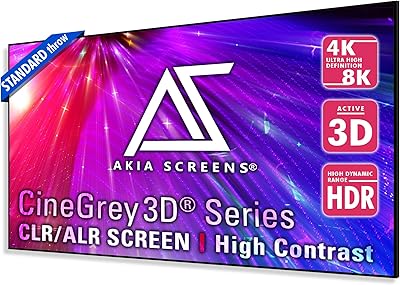
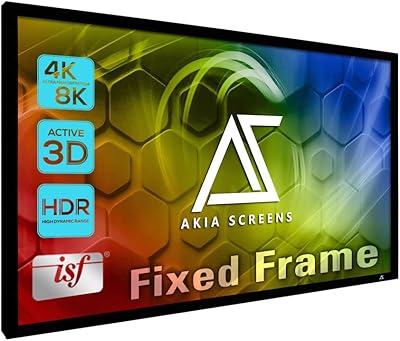
  • Resolution Support: The screen material is rated for use with 8K, 4K Ultra HD, and active 3D projection sources without introducing resolution or color limitations.
  • Mounting Type: Installation uses an inside-mount configuration with sliding wall brackets that allow horizontal repositioning of the screen after the initial hang.
  • Item Weight: The assembled unit weighs 44 pounds, which requires secure wall anchoring and is most safely installed with two people.
  • Certification: The screen carries ISF (Imaging Science Foundation) certification, an independent standard verifying that color accuracy meets professional calibration benchmarks.
  • Warranty: Akia provides a 2-year manufacturer warranty covering defects, backed by an ISO 9001-certified production facility.
  • Tech Support: Lifetime technical support is available via toll-free phone, email, and web chat through a U.S.-based customer service team.
  • Cleaning: The screen surface can be cleaned with mild soap and water, making routine maintenance straightforward without specialized products.
  • Installation Kit: The package includes all mounting and hanging hardware, an optional ultra-thin bezel frame, and sliding wall mount brackets for centering.

Related Reviews
Akia Screens 110-inch Fixed Frame Projector Screen
82%
91%
Image Clarity & Color Accuracy
93%
Screen Surface Flatness
88%
Build Quality & Frame Construction
71%
Installation & Setup Experience
86%
Value for Money
More
Akia Screens 100-inch Fixed Frame Projector Screen
79%
88%
Image Flatness
91%
Color Accuracy
57%
Ambient Light Performance
83%
Assembly Experience
79%
Wall Mounting System
More
Akia Screens 103-inch CineGrey 3D ALR Fixed Frame Projector Screen
86%
92%
Image Quality
90%
Ambient Light Rejection
88%
Build Quality
85%
Installation Process
91%
Color Accuracy
More
Akia Screens 125-inch Motorized Projector Screen
81%
88%
Ease of Installation
79%
Screen Material Quality
86%
Motor & Retraction Performance
71%
Remote & Control System
83%
12V Trigger Integration
More
Elite Screens SF100HW2 100″ Fixed Frame Screen
81%
91%
Image Quality
94%
Screen Flatness
88%
Build Quality
76%
Ease of Installation
58%
Ambient Light Performance
More
Elite Screens AR120WH2 120″ Projector Screen
78%
88%
Image Surface Quality
91%
Screen Flatness & Tension
78%
Build Quality
76%
Installation Ease
74%
Value for Money
More
Elite Screens SF120HW2 120″ Fixed Frame Screen
80%
88%
Image Quality
83%
Build Quality
81%
Ease of Assembly
86%
Screen Flatness
84%
Value for Money
More
AWOL VISION MW-120 120″ Projector Screen
80%
88%
Image Surface Quality
91%
Screen Flatness & Tension
83%
Assembly & Setup Experience
79%
Compatibility with Non-AWOL Projectors
86%
Viewing Angle Performance
More
Akia Screens 110-inch Motorized Projector Screen
79%
86%
Ease of Installation
78%
Screen Image Quality
74%
Motor & Automation
81%
Build Quality
83%
Remote & Control System
More
Akia Screens Manual B 110-Inch Projector Screen
80%
88%
Image Clarity
74%
Screen Flatness
86%
Installation Ease
71%
Auto-Lock Mechanism
78%
Build Quality
More

FAQ

Not ideally. The CineWhite UHD-B material performs best in controlled lighting conditions — a darkened or fully blacked-out room is where it genuinely shines. In a room with lamps or windows letting in daylight, the image will look noticeably washed out. If your viewing space cannot be properly darkened, you would be better served by a screen with ambient light rejection properties.

Technically a solo install is possible, but it is not easy. The assembled frame is 44 pounds and spans over 109 inches wide, which makes lifting it into position on wall brackets genuinely awkward by yourself. Having a second person hold the screen while you adjust and lock the sliding brackets will save you a lot of frustration and reduce the risk of damaging the frame during hanging.

Yes, it is rated as compatible with ultra-short throw, short throw, and standard throw projectors. The CineWhite UHD-B material does not impose any throw-distance restrictions, so you have flexibility in how you position your projector relative to the screen.

Flatness is one of the consistent strengths buyers mention about this fixed frame screen. The rigid aluminum frame holds the material under tension, which eliminates the rippling and sagging that are common complaints with roller-style pull-down screens. A small number of users have noted minor border tension inconsistencies, but the majority report a smooth, flat viewing surface straight out of the box.

At 1.3 gain, hotspotting is unlikely under normal home theater conditions. It is a modest gain increase over a neutral 1.0 screen — enough to add some brightness without the concentrated bright center that higher-gain screens can produce. If your projector is particularly powerful, you may want to dial down the brightness setting slightly, but for most setups it should not be an issue.

ISF stands for Imaging Science Foundation, which is an independent organization that sets professional standards for display calibration. When a screen carries ISF certification, it means the material has been tested and verified to reproduce colors accurately without adding unwanted tinting or shifting hues. It is a meaningful third-party credential rather than a self-applied marketing label.

Yes, the surface can be wiped down with mild soap and water. Use a soft, lint-free cloth and gentle pressure to avoid damaging the material. For routine dust, a dry microfiber cloth is usually sufficient. Avoid harsh chemicals or abrasive cleaning pads.

Shipping damage to the frame sections is one of the more common complaints in buyer feedback for this home theater screen. If pieces arrive bent or dented, the recommended path is to document the damage with photos immediately and contact Akia's customer support team. The company offers U.S.-based support by phone, email, and chat, though response times can vary, so reaching out promptly and through multiple channels is advisable if the issue is significant.

Most buyers report the full assembly taking between one and two hours. The 6-piece aluminum frame slots together without specialized tools, and the included hardware covers everything needed for wall mounting. The trickiest part for most people is the initial wall bracket placement and getting the screen level before final tightening.

It works well for gaming, particularly if you are playing in a darkened room. The wide 180-degree viewing angle means players sitting off to the side still get a good image, and the screen handles fast-moving content cleanly. The 4K and active 3D compatibility also means it keeps pace with current gaming hardware without any material-side bottleneck.