Overview

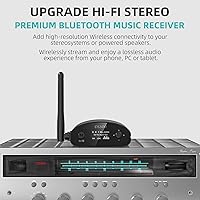
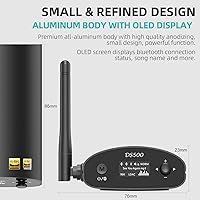
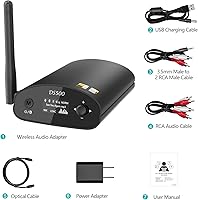
The 1Mii DS500 is a compact Bluetooth 5.1 receiver built for one purpose: giving older wired stereo systems a genuine wireless upgrade without replacing what already sounds good. It sits in the mid-range audiophile accessory space — not a cheap dongle, but not an extravagance either. What makes this Bluetooth HiFi receiver stand out is the codec support. LDAC and aptX HD together at this price is genuinely uncommon. Throw in an external antenna for real-room range and a crisp OLED display on the front panel, and it already looks more serious than most of its competition sitting on a shelf.

Features & Benefits

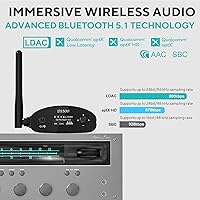
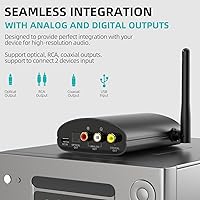
The built-in DAC is arguably the most important detail here. Most Bluetooth receivers at this level hand the conversion job off to your amplifier, but the DS500 handles it internally with an audiophile-grade chip — meaning the analog signal reaching your RCA inputs is already clean. LDAC streaming at up to 990kbps is the headline codec, though it only activates when your phone supports it and the connection negotiates correctly. For TV use, aptX Low Latency keeps lip sync intact. Three outputs — RCA, optical, and coaxial — cover nearly every legacy setup, and volume and EQ control directly on the unit itself is a practical daily convenience.

Best For

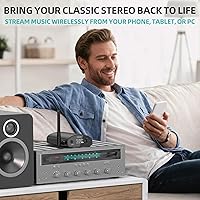
This wireless audio adapter is a natural fit for anyone running a vintage integrated amplifier or a classic AV receiver that predates the Bluetooth era. If your goal is adding wireless without removing hardware you love, this is worth serious consideration. It also suits listeners frustrated by budget receivers that drop mid-album or quietly default to AAC when you actually want hi-res audio. The external antenna makes a real difference in larger spaces — most basic adapters handle a single room fine, but the DS500 holds up better when walls and distance enter the picture. Physical controls on the unit are a small but genuinely appreciated bonus.

User Feedback

Most buyers come away impressed, especially noting how much cleaner the audio sounds compared to generic Bluetooth adapters they replaced. The OLED screen and responsive controls earn consistent praise — people appreciate seeing which codec is active without digging through a phone app. On the downside, a few users report that getting LDAC to engage reliably requires some fiddling: the right phone settings, the right app, occasionally a re-pair. Build quality draws the odd comment too — the plastic casing feels functional rather than premium. Overall, satisfaction sits high relative to buyer expectations at this price point, with most framing the purchase as a smart, targeted upgrade to an existing system.

Pros

  • LDAC support enables genuine hi-res wireless streaming for Android users with compatible phones.
  • Three output types — RCA, optical, and coaxial — connect to virtually any existing home stereo setup.
  • The built-in DAC cleans up the signal before it reaches your amplifier, which older receivers especially benefit from.
  • External antenna holds a stable connection across large rooms where cheaper adapters regularly drop out.
  • OLED display confirms the active codec at a glance — no app required, no guessing.
  • Physical volume and track controls on the unit mean you rarely need to reach for your phone.
  • aptX Low Latency keeps audio in sync for casual TV and video use without noticeable lag.
  • Built-in EQ modes let you tailor the sound to your speakers without touching your source device.
  • This wireless audio adapter covers a wide range of legacy gear with no adapters or converters needed.
  • Compact footprint fits neatly on a shelf next to full-size hi-fi components without looking out of place.

Cons

  • iOS users are locked out of LDAC entirely, limiting audio quality to AAC regardless of settings.
  • Getting LDAC to engage reliably often requires manual adjustments in Android developer options.
  • The plastic casing feels noticeably budget-grade next to the amplifiers and receivers it typically connects to.
  • aptX Low Latency only activates when the source device also supports the codec — far from guaranteed.
  • No firmware update path means pairing quirks or codec issues cannot be patched after purchase.
  • Multi-device households may experience reconnection conflicts when more than one paired device is nearby.
  • Antenna placement significantly affects real-world range, but setup guidance on this point is minimal.
  • EQ customization is limited to preset modes rather than adjustable bands, which narrows its usefulness for critical listening.
  • Button layout requires memorizing press combinations for less common functions, which takes time to feel natural.
  • Users with strong wireless congestion nearby may see range performance well below the advertised specification.

Ratings

The 1Mii DS500 scores below are generated by AI after analyzing verified buyer reviews from global markets, with spam, incentivized, and bot-flagged submissions actively filtered out. The result is an honest, balanced picture of where this Bluetooth HiFi receiver genuinely excels and where real users have run into friction. Both the standout strengths and the recurring pain points are reflected transparently in every category.

Audio Quality
88%
Buyers consistently report a noticeable jump in clarity and depth compared to the basic Bluetooth adapters they replaced — particularly in the midrange. When LDAC negotiates successfully with a compatible Android phone, the improvement over AAC streaming is audible even on modest speakers.
A handful of users note that the sonic gains are less dramatic on systems that already have a quality DAC in the amplifier. The internal DAC is strong for the class, but expectations need to stay calibrated to what a device at this tier can realistically deliver.
LDAC & Codec Performance
82%
18%
For buyers with LDAC-capable phones, getting the codec to lock in genuinely transforms the listening experience — 990kbps wireless audio is a real step up. The OLED screen showing the active codec gives welcome confirmation that you are actually getting the quality you set up for.
LDAC does not activate automatically on every phone or app. Several users report needing to dig into Android developer settings or switch streaming apps before it would engage consistently. iOS users are limited to AAC, which is a meaningful ceiling for Apple ecosystem households.
Connectivity & Range
84%
The external antenna is not just cosmetic — users in open-plan living areas and larger rooms report solid, stable connections where cheaper adapters would stutter or drop. Streaming from a kitchen or bedroom to a living room setup holds up well in most real-world reports.
A minority of users in environments with heavy wireless congestion — dense apartment buildings or offices with many competing networks — report occasional dropouts. Range through multiple walls also degrades more than the 100-foot spec suggests in practice.
Output Versatility
93%
Three simultaneous output types — RCA, optical Toslink, and coaxial S/PDIF — cover virtually every home stereo scenario in one box. Buyers regularly mention being able to connect it to gear they assumed would be incompatible, from vintage integrated amps to modern AV receivers.
The outputs cannot all be used simultaneously in all configurations, and a few users found the output switching behavior slightly unintuitive at first. The manual could do a better job explaining which output takes priority and how to switch between them cleanly.
Setup & Ease of Use
81%
19%
For the majority of buyers, initial pairing was fast and the OLED display made the process straightforward without needing a phone app. Physical volume and track controls on the unit itself were frequently praised as a daily convenience that similar devices often skip.
Getting LDAC to engage reliably adds a setup step that less technical users find confusing. A few buyers also noted that the output selection and EQ mode cycling through a single button takes some getting used to before it feels natural.
Build Quality
67%
33%
The unit feels solid enough on a shelf and the OLED screen has a quality look that punches above typical budget-tier plastic. The overall form factor is tidy and does not look out of place next to proper hi-fi equipment.
The ABS plastic casing is the most common point of disappointment in user reviews — it reads as functional rather than premium, especially next to metal-bodied competitors. A few buyers also flagged that the antenna connection point feels less robust than ideal for a device that gets occasional adjustment.
DAC Performance
86%
Having the DAC built in rather than relying on the downstream amplifier is a meaningful practical advantage, and buyers with older receivers specifically note the audio feels more refined as a result. It removes one variable from the signal chain in a useful way.
Audiophiles comparing this to a dedicated external DAC costing significantly more will hear a difference. The internal DAC is well-suited for this device class, but users arriving with very high expectations based on the audiophile marketing language occasionally feel slightly oversold.
Latency & AV Sync
79%
21%
aptX Low Latency mode works as advertised for most users who pair it with a TV or projector setup. Lip sync holds up well during casual video watching, which is more than many comparable receivers manage at this price.
aptX LL requires the source device to also support the codec, and several users discovered their TV or streaming device defaulted to standard SBC. In those cases, latency is noticeably worse and the low-latency benefit disappears entirely.
OLED Display
88%
The display earns more praise than might be expected for what sounds like a minor feature. Being able to glance across the room and confirm the active codec, volume level, and input status turns out to be genuinely useful in daily use rather than just a cosmetic differentiator.
The display is not adjustable in terms of brightness, which a small number of users in dark listening rooms find slightly intrusive. Font size is also compact enough that reading it from across a large room requires some effort.
EQ & Sound Customization
71%
29%
The built-in EQ modes give users a real ability to tailor the output to their speakers and listening preferences without touching the source device. For systems without their own EQ, this is a practical addition that gets used regularly by buyers who take the time to explore it.
The EQ options are preset modes rather than a parametric or graphic equalizer, which limits how precisely you can tune the sound. Buyers who wanted fine-grained control found the options useful but not deep enough for serious critical listening adjustments.
Value for Money
87%
Relative to what it includes — LDAC, aptX HD, a built-in DAC, three outputs, an OLED display, and an external antenna — buyers broadly agree the DS500 represents strong value. Most frame it as a capable, purpose-built upgrade rather than an impulse purchase they regret.
It is priced noticeably above basic Bluetooth adapters, and users who do not have an LDAC-capable phone will not access the headline feature. For that subset of buyers, the effective value proposition narrows, since they are paying partly for a codec they cannot use.
Pairing Stability
76%
24%
Day-to-day pairing with a primary device is generally reliable once the initial setup is complete. Most buyers report that reconnection after standby is fast and the receiver remembers paired devices without issues across normal home use patterns.
Multi-device households occasionally run into conflicts where the receiver latches onto the wrong device or struggles to re-pair after another phone connects to it first. A few users also note that firmware has no update path, leaving any pairing quirks permanently unresolved.
Physical Controls
83%
Having volume adjustment and track skipping directly on the unit — not requiring a phone or remote — comes up repeatedly as a quality-of-life feature that buyers did not know they wanted until they had it. It makes the receiver genuinely usable as a standalone control point.
All functions run through a minimal button layout, which means some actions require multiple presses or press-and-hold combinations. Users who interact with the unit frequently occasionally find the button mapping less intuitive than a dedicated remote would allow.
Antenna Design
78%
22%
The detachable external antenna is a meaningful differentiator from flat-bodied competitors. Users who positioned it upright and away from obstructions consistently reported better range and fewer dropouts than they experienced with previous adapters in the same room setup.
Antenna positioning matters more than the packaging implies, and buyers who placed the unit in an enclosed cabinet or with the antenna folded flat saw range that barely exceeded much cheaper alternatives. The optimal placement takes some trial and adjustment to find.

Suitable for:

The 1Mii DS500 is a strong match for anyone who owns a wired stereo system — a vintage integrated amplifier, a classic AV receiver, a set of powered bookshelf speakers — and wants to stream music wirelessly without retiring equipment they already love. It makes the most sense for Android users with LDAC-capable phones, since that is where the audio quality argument becomes genuinely compelling rather than theoretical. People with large living spaces or open-plan homes will appreciate the external antenna, which provides meaningfully better range than the flat-bodied adapters that dominate this category. Home theater enthusiasts who need a clean way to add Bluetooth input to a receiver with optical or coaxial inputs will find the output flexibility hard to match at this price. And if you have ever been frustrated by a Bluetooth adapter that gives you no feedback on what it is actually doing, the OLED display and physical controls here are a real quality-of-life improvement that becomes part of your daily routine quickly.

Not suitable for:

The 1Mii DS500 is a harder sell for iPhone users or anyone deeply embedded in the Apple ecosystem — iOS caps Bluetooth audio at AAC, which means the headline LDAC feature is simply off the table, and paying a premium for a codec you cannot access is a difficult value proposition to justify. It is also not the right choice for buyers expecting a plug-and-play experience with zero configuration; getting LDAC to negotiate reliably can require adjusting developer settings on Android, and switching between outputs or EQ modes involves a learning curve with the button layout. Buyers looking for a premium physical build — something with a metal chassis that feels as serious as the amplifier it sits next to — will likely be put off by the ABS plastic casing, which reads as functional rather than refined. Those who already own a high-quality external DAC in their signal chain will not see the same gains from the built-in conversion as users with older, more basic receivers. And anyone expecting TV lip sync to work automatically without checking whether their source device supports aptX Low Latency may be disappointed by the default SBC fallback.

Specifications

  • Bluetooth Version: The DS500 uses Bluetooth 5.1, which provides improved connection stability and reduced interference compared to older Bluetooth generations.
  • Supported Codecs: Supported audio codecs include SBC, AAC, aptX Low Latency, aptX HD, and LDAC, covering the full range from standard to hi-res wireless audio transmission.
  • Audio Outputs: Three output types are available simultaneously on the rear panel: stereo RCA, optical Toslink, and coaxial S/PDIF, covering virtually all home stereo and AV receiver connection standards.
  • Audio Input: Audio input is exclusively via Bluetooth; the USB port on the unit is used solely for power delivery and does not accept audio signals.
  • Built-in DAC: An audiophile-grade digital-to-analog converter is integrated into the unit, handling signal conversion internally before the analog signal reaches the connected amplifier or receiver.
  • Display: A small OLED screen on the front panel shows the currently active codec, volume level, and operational status during use.
  • Antenna: A detachable external antenna is included and attaches to the rear of the unit to extend wireless range and improve connection stability across larger rooms.
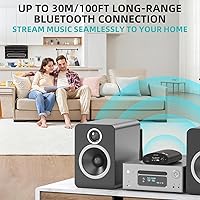
  • Wireless Range: The manufacturer specifies a maximum wireless range of up to 100 ft (approximately 30 m) in open, unobstructed conditions with the antenna properly positioned.
  • EQ Modes: Several built-in equalizer presets are accessible directly on the unit, allowing users to adjust tonal balance for different music genres without using a phone or external app.
  • Volume Control: Hardware volume adjustment and basic track control (skip forward and back) are available via physical buttons on the unit itself.
  • Power Source: The DS500 is powered via a corded USB connection, compatible with any USB power adapter or powered USB port delivering sufficient current.
  • Dimensions: The unit measures 3.39 x 2.99 x 0.91 inches, making it compact enough to sit unobtrusively on a shelf or equipment rack alongside full-size components.
  • Weight: The DS500 weighs 13 oz (approximately 368 g), which gives it a stable desk or shelf presence without requiring any mounting hardware.
  • Casing Material: The outer shell is constructed from ABS (Acrylonitrile Butadiene Styrene) plastic, a common engineering-grade thermoplastic used across consumer electronics for its durability and light weight.
  • Bluetooth Pairing: The unit supports standard Bluetooth pairing and retains memory of previously paired devices for faster reconnection after standby or power cycling.
  • Brand & Model: Manufactured by 1Mii, the DS500 is the company's dedicated HiFi Bluetooth receiver designed specifically for home stereo and AV receiver integration.
  • First Available: The DS500 became available for purchase in May 2023, placing it within the current generation of Bluetooth 5.1 audio accessories.

Related Reviews
1Mii DS220 Bluetooth Receiver
78%
88%
Sound Quality
81%
Wireless Range & Stability
74%
Codec Support & Negotiation
91%
Output Versatility
86%
OLED Display & Interface
More
1Mii Y8+
1Mii Y8+
78%
91%
Value for Money
72%
Active Noise Cancellation
78%
Sound Quality
93%
Battery Life
87%
Comfort & Fit
More
1Mii SafeFly Pro Bluetooth Transmitter Receiver
81%
91%
Ease of Setup
88%
OLED Display Usefulness
83%
Audio Latency Performance
74%
Airplane Compatibility
86%
Dual Headphone Sharing
More
1Mii RT5066Pro 2-in-1
73%
91%
Ease of Setup
78%
Audio Quality
63%
Wireless Range (Indoors)
82%
Latency & Audio Sync
86%
Connection Flexibility
More
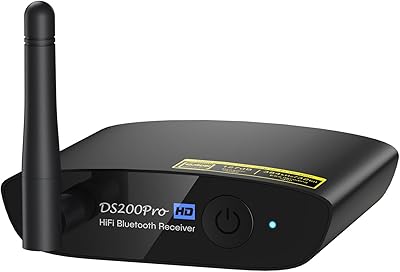
1Mii DS200Pro HiFi Bluetooth 5.3 Music Receiver
85%
94%
Sound Quality
91%
Bluetooth Range & Stability
89%
Ease of Use / Setup
90%
DAC Performance
93%
Audio Codec Support (LDAC, aptX HD)
More

FAQ

It genuinely supports LDAC, but there is an important catch: LDAC only activates when your source device also supports it and both sides negotiate the codec successfully. On Android, this usually requires enabling LDAC in the Bluetooth audio codec settings under developer options. If your phone does not support LDAC — or if you are on iOS — the connection will fall back to AAC or SBC instead.

Almost certainly yes. The DS500 offers RCA, optical Toslink, and coaxial S/PDIF outputs, which covers the connection standards found on virtually every AV receiver and integrated amplifier produced over the past few decades. Just match the output type to whichever input your receiver has available and you should be good to go.

Yes, it pairs and works with iOS devices, but you will be limited to AAC as the highest quality codec since Apple does not support LDAC or aptX. The audio will still sound better than many basic Bluetooth adapters thanks to the built-in DAC, but the hi-res LDAC capability is an Android-only benefit in practice.

Go into your phone's developer options (usually found by tapping the build number in About Phone seven times), then look for the Bluetooth audio codec setting. Set it to LDAC rather than leaving it on the default automatic option. After re-pairing or reconnecting, the OLED display on the unit should confirm which codec is active.

The unit is powered via USB and stays on as long as it has power. There is no built-in automatic standby or sleep timer, so most users either leave it on continuously or manage power via a switched USB port or power strip. It draws minimal power at idle, so continuous operation is not a concern for most setups.

In a typical living room without too many walls in the way, 30 to 50 feet is a realistic expectation for a stable connection. The advertised 100-foot range applies to open, unobstructed environments. Walls, appliances, and competing wireless signals will reduce effective range, so antenna positioning matters — keep it upright and away from enclosed cabinets if range is a priority.

If your powered speakers have RCA inputs, optical, or coaxial inputs, this wireless audio adapter will connect to them directly. It works with any device that accepts those signal types, whether it is a full AV receiver, an integrated amplifier, or a self-powered speaker system.

If your source device supports aptX Low Latency and the codec is active, lip sync is generally fine for casual viewing. The problem is that not all smart TVs or streaming sticks support aptX LL, so they may fall back to standard SBC and introduce more noticeable delay. It is worth checking your TV's Bluetooth codec support before assuming low-latency mode will be available.

The EQ presets are tuned for broad genre categories — rock, pop, jazz, and similar — rather than precise frequency adjustment. They are genuinely useful for nudging the tonal balance of a system that sounds a bit bright or a bit dull, but they are not a substitute for a parametric equalizer. Most users find one preset they prefer and leave it there.

The ABS plastic casing is solidly put together but does read as consumer-grade rather than premium. The OLED screen and button assembly feel reliable in everyday use, and the unit is not handling any mechanical stress since it just sits on a shelf. Longevity concerns tend to center more on Bluetooth chipset or software issues than physical wear, and user reports so far do not flag any unusual failure rates.