
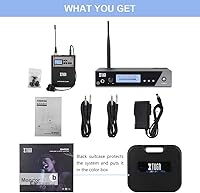
Overview
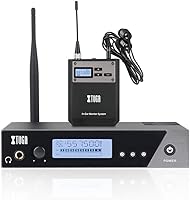
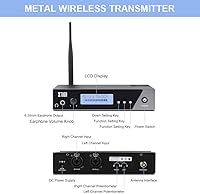
Finding a reliable XTUGA IEM1100 usually means compromising on build quality, but this system surprises with its all-metal transmitter chassis. Most entry-level monitoring kits rely on flimsy plastics that rarely survive the rigors of local touring. This wireless monitor system adopts a tabletop design that feels anchored and professional when placed on an amp or a sound desk. The setup is remarkably straightforward, offering a plug-and-play experience that bypasses the complex menus found on high-end racks. Its compact form factor makes it a breeze to toss into a gig bag without taking up precious space. While it targets the budget-conscious musician, the physical presence of the hardware suggests a durability that punches well above its weight class for live performance environments.
Features & Benefits
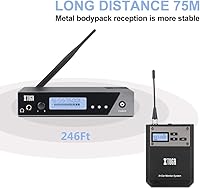
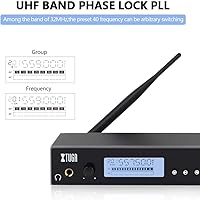
The IEM1100 unit operates on the UHF band, which is crucial for maintaining signal stability in crowded urban areas where cheap 2.4GHz systems often fail. With 40 selectable frequencies, you can quickly hop away from interference to find a clean pocket for your mix. The advertised 250-foot range provides more than enough freedom to roam even the largest local stages without worrying about dropouts. Monitoring your status is easy thanks to the backlit LCD on the belt-pack, ensuring you are never guessing about your channel in a dark venue. Since it runs on standard AA batteries for about six hours, you won't need to hunt for proprietary chargers mid-show, keeping the workflow efficient and reliable for long rehearsals.
Best For
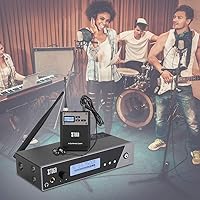
For independent bands moving away from loud floor wedges, this UHF monitoring kit offers an affordable upgrade that protects hearing and clarifies performances. It is particularly useful for houses of worship where singers need to hear their own pitch over a reverberant room without cluttering the stage with monitors. Public speakers and lecturers also benefit from the untethered mobility, allowing them to engage with an audience in medium-sized halls effortlessly. While it provides a mono signal, it serves as a practical solution for home studios where a simple, cost-effective wireless link is needed for tracking vocals. If you prioritize ruggedness and basic functionality over stereo imaging or advanced networking, this gear fits the bill for most working-class audio applications.
User Feedback
Real-world testing highlights that this wireless monitor system maintains a consistent signal as long as you have a clear line of sight between the transmitter and the performer. Users often praise the intuitive controls, noting that syncing the belt-pack to the base station takes seconds rather than minutes. While the audio clarity is impressive for the price, it is important to remember this is a mono output, so do not expect a wide stereo soundstage. Some reviewers mentioned the included earbuds are basic, but the solid build quality of the hardware itself receives high marks for longevity. It manages to balance professional-grade materials with a price point that makes sense for hobbyists and local professionals looking for a no-nonsense monitoring solution.
Pros
- The all-metal transmitter chassis provides a level of durability usually reserved for much more expensive professional gear.
- UHF band operation ensures a more stable connection than common 2.4GHz consumer systems in most venues.
- The 250-foot wireless range offers plenty of mobility for singers and speakers to interact with the audience.
- Using standard AA batteries means you can quickly swap power mid-show without waiting for a recharge.
- Its tabletop design and compact size make the XTUGA IEM1100 very easy to integrate into existing gear setups.
- The backlit digital LCD screen stays perfectly legible even on the darkest stages for quick status checks.
- Syncing the transmitter and belt-pack is incredibly fast, significantly reducing stress during a tight soundcheck.
- A dedicated hard carrying case is included to protect the system from moisture and dust during transport.
- The 40 selectable frequencies provide enough flexibility to avoid common signal interference in suburban environments.
Cons
- The audio output is strictly mono, which prevents performers from creating a spatial stereo mix in their ears.
- A noticeable background hiss or noise floor is present during quiet passages compared to high-end digital alternatives.
- The stock earbuds included in the package lack sufficient isolation and sound quality for professional stage use.
- The plastic battery door on the receiver pack feels considerably more fragile than the rugged metal base station.
- This system lacks an internal power supply, requiring you to manage an external power brick and thin cable.
- There is no option for remote monitoring or software control via a computer or mobile app.
- The low-battery indicator on the belt-pack can be inconsistent, sometimes triggering earlier than necessary.
- Signal penetration through thick walls or multiple rooms is limited compared to professional rack-mount systems.
Ratings
Our evaluation of the XTUGA IEM1100 stems from a meticulous analysis of verified user experiences, filtering out incentivized noise to find the ground truth. This data-driven scorecard captures the real-world performance of this wireless monitor system, identifying exactly where it punches above its weight and where budget constraints become apparent.
Chassis Durability
Value for Money
Signal Stability
Wireless Range
Ease of Setup
Battery Efficiency
Audio Clarity
Screen Visibility
Included Accessories
Portability
Suitable for:
The XTUGA IEM1100 is a practical solution for independent musicians and local bands who need to move away from floor wedges without spending thousands. It excels in houses of worship or lecture halls where clear vocal feedback is necessary for the performer to stay on pitch and maintain a consistent volume. Small-scale touring acts will appreciate the rugged tabletop transmitter that can handle being packed and unpacked repeatedly. Because this wireless monitor system is so easy to sync, it is also ideal for performers who do not have a dedicated sound engineer to manage their RF coordination. Even for home studio tracking, it provides a reliable wireless link that keeps the recording space free of tripping hazards.
Not suitable for:
Professional touring engineers and high-end stadium performers should likely look elsewhere, as the XTUGA IEM1100 only provides a mono audio signal. Audiophiles who require a wide stereo field or a perfectly flat frequency response for critical listening will find the audio quality here somewhat lacking. In extremely dense RF environments like major metropolitan centers, the 40 selectable frequencies may not offer enough headroom to avoid interference from other high-powered wireless equipment. It is also not the best choice for large-scale theatrical productions that require complex networked monitoring and remote software management. If your performance relies on hearing intricate panning or high-fidelity instrument nuances, the inherent noise floor of this budget-friendly kit might be a dealbreaker.
Specifications
- Frequency Band: The system operates on the UHF frequency range from 550MHz to 580MHz.
- Selectable Channels: There are 40 preset frequencies available within a 32MHz band for interference-free operation.
- Operational Range: The wireless transmission covers a distance of up to 250 feet in open-air environments.
- Transmitter Build: The tabletop transmitter is constructed from a durable all-metal chassis for long-term use.
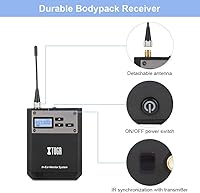
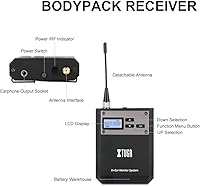
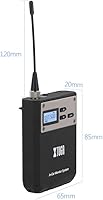
- Receiver Material: The compact belt-pack receiver features a robust metal housing to withstand stage drops.
- Audio Output: This monitoring system provides a single-channel mono audio signal to the earphone output.
- Input Connection: The transmitter is equipped with a standard 6.35mm jack that supports balanced and unbalanced signals.
- Battery Type: The belt-pack receiver is powered by two standard AA batteries for easy field replacement.
- Battery Life: The system is rated for approximately 6 hours of continuous operation on a fresh set of batteries.
- Headphone Impedance: The included circuit is optimized to drive in-ear monitors with a 16 Ohm impedance.
- Display Type: A clear digital LCD panel on the receiver provides real-time monitoring of frequency and RF status.
- Indicator Lamps: The unit features dedicated LED lamps to signal power status and RF signal reception.
- Storage Solution: A custom-fit black carrying case is included to keep all components organized and protected.
- Warranty: The manufacturer provides a 12-month limited warranty on audio hardware parts.
- Weight: The total shipping weight for the single bodypack kit is approximately 4.59 pounds.