Overview

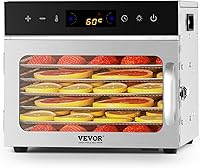
The VEVOR 6-Tray Stainless Steel Food Dehydrator entered the market in early 2025 as a mid-range option that punches above its price point in one meaningful area: materials. Where most machines at this level rely on plastic bodies and plastic trays, this stainless steel dehydrator uses actual 304-grade steel throughout — a real difference for anyone running batches regularly or concerned about long-term durability. At 400W with six trays, it has enough capacity and power for serious home use. One thing worth clarifying upfront: despite the phrase freeze dryer appearing in its listing, this is a conventional hot-air dehydrator — an entirely different process. Solid everyday performer, not lab equipment.
Features & Benefits

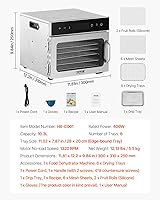
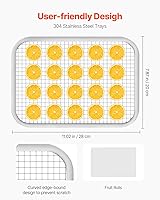
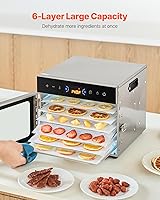
The six trays each measure just over 11 by 8 inches — roughly the footprint of a standard sheet of printer paper — so you can fit a respectable amount of food per layer across all six at once. The rear-mounted fan pushes warm air in a full circle rather than blasting from one side, which matters more than it sounds: edge pieces dry at the same rate as center pieces. Temperature runs from a gentle 86°F up to 194°F, covering everything from delicate herbs to thick meat strips, and the 24-hour timer means you can set a batch before bed without babysitting it. Trays go straight into the dishwasher; the smooth interior just needs a quick wipe.

Best For

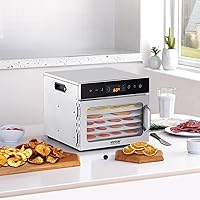
This six-tray machine fits naturally into a few specific kitchens. If you make beef jerky at home with any regularity, the stainless trays are a real advantage — no plastic odor, no staining, no wondering what leaches into the meat during a long drying run. Gardeners who end up with more basil, rosemary, or sliced tomatoes than they can use fresh will appreciate having six layers of capacity to work through a harvest in one go. Pet owners making homemade dog treats get the same benefit. It also makes a strong case for anyone coming from a cheap plastic dehydrator who has grown tired of warped trays or uneven drying results.

User Feedback

Since launching in early 2025, the VEVOR dehydrator has earned a 4.2-star average — respectable for a newer product, though the review pool is still growing, so treat that number as directional rather than settled consensus. On the positive side, buyers consistently mention even drying across all six trays and praise how solid the unit feels compared to plastic alternatives. Cleanup draws favorable comments, particularly from people who use it weekly. On the downside, a handful of reviewers note that dialing in the right temperature and time for denser foods like thick-cut jerky takes some trial and error. The LED viewing window lands as a genuine convenience rather than a gimmick — people actually use it.

Pros

  • All-steel construction means no plastic smell, staining, or warping even after months of regular use.
  • Six trays offer enough capacity to dry a meaningful batch of jerky, fruit, or herbs in a single run.
  • The rear fan circulates air evenly, so food on the outer edges dries at the same rate as food in the center.
  • A 24-hour timer lets you run overnight batches without waking up to check on anything.
  • Trays are dishwasher-safe, which makes cleanup after a messy batch of fruit or marinated meat much less of a chore.
  • Temperature range stretches from 86°F to 194°F, covering delicate herbs at the low end and thick meat cuts at the high end.
  • The built-in LED and viewing window let you check progress without opening the unit and disrupting airflow.
  • The motor runs quietly enough that most users leave it running during the day or overnight without it becoming an annoyance.
  • Ranked in the top 100 dehydrators on Amazon despite only launching in early 2025, which suggests strong early traction.

Cons

  • The product listing incorrectly uses the term freeze dryer, which misleads buyers looking for true freeze-drying functionality.
  • The review base is still relatively small given the March 2025 launch, so long-term reliability data is limited.
  • Getting the right temperature and drying time for thick or dense foods requires trial and error — no preset programs.
  • At around 12 pounds and 15 inches across, it is not easy to tuck away in a small kitchen without dedicated storage space.
  • The machine body requires hand wiping rather than dishwashing, which adds a step after particularly messy drying sessions.
  • Six trays may feel restrictive for anyone regularly processing large harvests or running a high-volume prep routine.
  • No built-in preset modes for common foods means newer users are left to research times and temperatures on their own.

Ratings

The scores below for the VEVOR 6-Tray Stainless Steel Food Dehydrator were generated by our AI system after analyzing verified purchase reviews from buyers worldwide, with spam, bot-submitted, and incentivized feedback actively filtered out before scoring. Each category reflects the full spectrum of real user experiences — not just the highlights — so both the genuine strengths and the recurring frustrations are accounted for in every number you see here.

Build Quality
86%
The all-stainless construction is the single most praised aspect across buyer feedback. Users coming from plastic-bodied machines consistently note how solid the unit feels when handling it — no creaking, no flex in the trays, and no warping after repeated heat cycles. For a machine in this price range, that tactile quality matters.
A smaller subset of buyers noted that some exterior panels showed minor surface marks or slight finish inconsistencies out of the box. Nothing structural, but for a machine with premium material claims, first-impression finish quality could be tighter.
Drying Evenness
83%
The rear fan and 360-degree airflow design translates into noticeably even results across all six trays in most drying sessions. Users making fruit leather or herb batches report that pieces on the outer edges of the tray finish at roughly the same time as those in the center — which is not a given on cheaper machines.
A portion of reviewers found that very thick food pieces, particularly dense cuts of meat, dried unevenly unless sliced thinner than expected. The fan does its job well, but the physics of moisture in dense foods can still outpace the airflow on longer cycles.
Temperature Control
78%
22%
The digital control panel covers a wide enough range — from a gentle 86°F up to 194°F — to handle practically every common dehydrating application without switching machines. Users drying delicate herbs at the low end and curing jerky at the high end both report the temperature holding reasonably steady throughout a cycle.
There are no food-specific presets, which puts the burden of research on the user. Beginners frequently report that their first few batches involved guesswork, and actual measured temperatures occasionally run a few degrees off the displayed setting — not a dealbreaker, but worth keeping a thermometer handy initially.
Timer & Auto-Shutoff
88%
The 24-hour auto-shutoff timer is one of the features buyers genuinely appreciate in day-to-day use. Starting a batch before leaving for work or before bed — knowing the machine will stop on its own — removes the anxiety of running an appliance unattended. Users consistently describe this as freeing rather than just functional.
The timer interface is straightforward but not particularly refined — adjusting in precise increments takes a bit of button-pressing patience. A couple of reviewers also noted that the display is not the easiest to read at an angle, which becomes mildly frustrating during repeated adjustments.
Tray Usability
84%
The curved edge-bound rim on each tray is a thoughtful design detail that users loading and unloading hot trays genuinely appreciate — no sharp corners catching fingers mid-session. The trays slide in and out cleanly, and six of them stacking inside the unit without fighting for clearance is a better experience than comparable machines where tray slots feel flimsy.
The individual tray surface area — roughly the size of a sheet of printer paper — is practical for most home batches but limits how much you can do in a single run if you are processing a large garden harvest or a bulk meat order. Users with high-volume needs outgrow the capacity relatively quickly.
Ease of Cleaning
81%
19%
Tossing all six stainless trays into the dishwasher after a messy batch of marinated jerky or sticky fruit slices makes the post-session cleanup far less of a chore than with machines requiring hand-only care throughout. The smooth, flat interior walls wipe down in under two minutes with a damp cloth.
The machine body itself is hand-wash only, and the area directly behind the fan grille can collect residue that requires a narrow brush or cotton swab to reach properly. It is not difficult, but users expecting fully automated cleanup will find that final step slightly tedious.
Noise Level
79%
21%
For an appliance running a fan continuously for up to 24 hours, most users find the noise output genuinely manageable. Running overnight in a kitchen that adjoins a bedroom is workable for the majority of buyers, and daytime use in an open-plan kitchen rarely draws complaints from household members in adjacent rooms.
It is not silent. Users in very quiet apartments or small homes where the kitchen is directly connected to the main living space do notice the hum during evening hours. Those with high noise sensitivity or light sleeping partners may find overnight runs more disruptive than the average review suggests.
Viewing Window & LED
77%
23%
The combination of a large front window and a built-in LED light proves more useful than buyers initially expect. Being able to assess color and texture changes — the primary visual cues for doneness — without cracking the door and losing heat is a meaningful practical benefit, especially on long overnight cycles.
The LED illumination is adequate rather than excellent — it lights the interior well enough for a general check but does not provide the clarity needed to inspect fine details on food near the back of the trays. A slightly brighter or better-positioned light source would make this feature more consistently reliable.
Capacity
74%
26%
Six trays stacked vertically gives home preppers enough room to dry a meaningful batch of one food type — or run two or three different foods simultaneously on separate tray levels. For the target user making weekly batches of jerky or seasonal herb preservation, the capacity hits a practical sweet spot.
Anyone processing large volumes regularly — a full garden tomato harvest, bulk meat orders, or frequent double batches — will find themselves running the machine in back-to-back cycles. The overall interior volume is honest for a home machine but will frustrate buyers who underestimate how much fresh food shrinks into a fraction of its original volume after drying.
Value for Money
82%
18%
At its price point, getting an all-stainless body, dishwasher-safe trays, a 24-hour timer, and 360-degree airflow in a single machine represents genuinely strong value compared to similarly priced plastic alternatives. Buyers upgrading from entry-level dehydrators consistently rate the material jump as worth the cost difference.
Compared to established brands with longer track records and wider accessories ecosystems, paying a similar amount for a machine launched only months ago involves some uncertainty around long-term support and parts availability. The value proposition is strong today, but buyers seeking proven longevity data are working from a limited sample.
Setup & Learning Curve
69%
31%
Physical assembly is minimal — the trays slot in, you plug it in, and you are running within minutes. The digital interface is simple enough that most users get through their first batch without consulting the manual for the basic controls, which keeps the initial frustration level low.
The absence of preset programs or a detailed included guide for common foods means that getting reliable results requires outside research. New dehydrator users frequently report wasted batches early on — either under-dried meat or over-dried fruit — before settling into a reliable personal calibration. The machine is easy to start; it takes longer to master.
Food Versatility
83%
The temperature range is wide enough to cover the full spectrum of common dehydrating applications — herbs and flowers at the low end, dense meat and dog treats at the high end — without any single category feeling like a stretch. Users report consistent results across fruit chips, vegetable powders, mushrooms, and jerky.
It handles hot-air dehydrating well across food types, but the product listing's use of the phrase freeze dryer continues to create confusion. Buyers expecting freeze-drying results — the shelf-stable, light texture associated with true freeze-dried food — will be disappointed, as this machine cannot replicate that process at all.
Safety Features
80%
20%
The curved edge-bound tray rims meaningfully reduce the chance of accidental cuts during loading and unloading — something users with kids in the kitchen or who simply move quickly through kitchen tasks genuinely notice. The auto-shutoff adds a layer of safety for unattended long cycles that buyers consistently find reassuring.
Beyond the timer shutoff and edge design, the safety feature set is fairly standard for the category. There is no thermal runaway protection or automatic fault alert system mentioned, which is not unusual at this price point but is worth noting for buyers who intend to leave the machine running overnight or while away from home.
Brand Reliability
66%
34%
VEVOR has a broad catalog of home and workshop tools, and buyers familiar with the brand describe their products as dependable for regular home use. The machine itself shows no structural red flags in early feedback, and its Amazon ranking in the dehydrator category has climbed steadily since launch.
The March 2025 launch date means there is simply not enough long-term data yet to assess how well this specific model holds up after 12 to 24 months of regular use. Heating elements and fan motors are the most common failure points in dehydrators, and no meaningful failure-rate patterns have emerged yet — which cuts both ways.

Suitable for:

The VEVOR 6-Tray Stainless Steel Food Dehydrator makes the most sense for home cooks who dehydrate regularly enough to care about what their trays are made of. If you make beef jerky a few times a month, preserve garden herbs at the end of the season, or dry fruit in bulk for snacking or baking, the all-steel construction means you are not dealing with plastic discoloration, warping, or lingering odors over time. Pet owners who make homemade dog treats will find the materials particularly reassuring — no plastic contact during long, warm drying runs. It also fits well for anyone stepping up from a cheap entry-level machine who wants more capacity and a sturdier build without spending on professional equipment. The six-tray layout and 24-hour timer make it practical for larger prep sessions where you want to load it up, set a time, and walk away.
Not suitable for:

Despite the word freeze dryer appearing in its product listing, the VEVOR 6-Tray Stainless Steel Food Dehydrator is a conventional hot-air dehydrator — buyers looking for true freeze-drying capability, which requires a vacuum chamber and produces shelf-stable food with much lower moisture content, should look elsewhere entirely. If you need to process very large volumes consistently — think commercial prep, catering, or serious homesteading at scale — six trays will feel limiting fairly quickly. The footprint is also meaningful: at roughly 15 inches on each side, it takes up real counter or cabinet space, so small kitchens with limited storage may find it awkward to store between uses. And if you are a complete beginner who expects plug-and-play results on the first batch, expect a learning curve around matching temperature and drying time to different foods — dense meats in particular require some experimentation.
Specifications

  • Brand & Model: Manufactured by VEVOR under model number H6-C001.
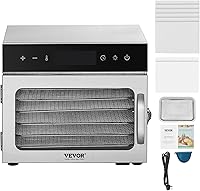
  • Tray Count: Comes with six removable trays arranged in a vertical stack inside the unit.
  • Tray Material: Each tray is made from food-grade 304 stainless steel with a curved edge-bound rim to reduce sharp edges.
  • Tray Size: Each individual tray measures 11.02 x 7.87 inches (28 x 20 cm) of usable drying surface.
  • Wattage: The heating element draws 400W during operation.
  • Temperature Range: Adjustable from 86°F to 194°F (30°C to 90°C) via a digital control panel.
  • Timer: Built-in digital timer runs for up to 24 hours and shuts the unit off automatically when the cycle ends.
  • Airflow System: A rear-mounted fan combined with a thickened heating tube circulates warm air 360° around all tray levels simultaneously.
  • Body Material: The outer housing and interior walls are constructed from stainless steel throughout.
  • Unit Dimensions: The assembled unit measures 15.16 x 14.57 x 14.17 inches (L x W x H).
  • Unit Weight: The machine weighs 12.13 pounds fully assembled without food loaded.
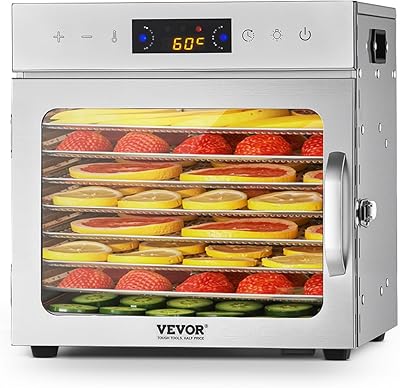
  • Viewing Window: A large front-facing window paired with an interior LED light allows visual monitoring without opening the door.
  • Tray Care: Trays are dishwasher-safe; the interior walls and exterior housing require hand wiping only.
  • Noise Level: The motor is described by the manufacturer as low-noise, suitable for kitchen environments during daytime or overnight runs.
  • Market Availability: First listed for sale in March 2025, making it a relatively recent addition to the dehydrator category.

Related Reviews

VEVOR Food Dehydrator H8-C001, 8-Tray, 400W
87%
89%
Drying Performance
86%
Ease of Use
92%
Build Quality
94%
Capacity
90%
Maintenance & Cleaning
More
Aifeiter Barbicide 42 oz Disinfectant Jar with Stainless Steel Tray
85%
88%
Effectiveness at Disinfecting Tools
85%
Ease of Use
91%
Durability of Materials
89%
Stability and Safety (Anti-Slip Base)
82%
Size/Capacity for Multiple Tools
More
DRGSKL Devil Shears 6″ Hair Cutting Scissors
78%
83%
Sharpness Out of the Box
61%
Edge Retention
77%
Build Quality
86%
Ergonomics & Comfort
88%
Value for Money
More
Erbe Stainless Steel Portable 6-Teeth Manual Nose Hair Trimmer for Men
86%
85%
Ease of Use
93%
Portability
88%
Effectiveness
90%
Painless Trimming
94%
Battery-Free Design
More
Mehaz Schamberg Extractor Stainless Steel
85%
91%
Effectiveness in Removing Blackheads
85%
Ease of Use
80%
Skin Compatibility
93%
Durability of Material
88%
Control & Precision of Tool
More
Rubis 1F002 Cuticle Scissors
79%
92%
Build Quality
89%
Blade Sharpness
88%
Cutting Precision
61%
Value for Money
84%
First Use Experience
More
Tweezerman Stainless Steel Nail Scissors
82%
93%
Blade Sharpness
91%
Build Quality
89%
Cutting Precision
66%
Ergonomics & Grip
77%
Value for Money
More
Parker SRX Straight Razor
84%
93%
Build Quality
88%
Blade Security
84%
Shave Performance
67%
Ease of Use
71%
Blade Loading
More
Rubis Sauro 1F007 Toenail Scissors
80%
93%
Blade Sharpness
91%
Cutting Precision
89%
Build Quality
84%
Ergonomics & Comfort
61%
Value for Money
More
Tweezerman Stainless Steel Slant Tweezer - Lapis Blue
87%
94%
Precision and Accuracy
91%
Durability and Build Quality
88%
Grip and Comfort
85%
Ease of Use
87%
Aesthetic and Design
More

FAQ

No, and that part of the listing is genuinely misleading. The VEVOR 6-Tray Stainless Steel Food Dehydrator is a conventional hot-air dehydrator — it removes moisture using circulated warm air. True freeze dryers use a vacuum chamber and sub-zero temperatures to sublimate moisture, producing a very different result. If you need actual freeze-drying capability, this machine will not do that.

Yes, that is the practical point of the rear-mounted fan design. By pushing air in a full circular path rather than from a single side, the airflow reaches all six levels without you needing to rotate trays mid-cycle. That said, overloading individual trays by piling food too thick will always slow things down regardless of the fan setup — a single even layer per tray works best.

Most users describe the noise level as comparable to a quiet kitchen appliance — noticeable if the room is silent, but not disruptive. Running it overnight in a kitchen while sleeping nearby in an adjacent room is generally fine. If your kitchen is open-plan and connects directly to a living space, you may notice the hum during quiet evenings, but it is not the kind of fan noise that demands attention.

The stainless steel trays are genuinely dishwasher-safe — 304-grade steel handles the heat and detergents without warping or corroding. The machine body, however, is not. For the interior walls, a damp cloth or non-abrasive sponge wipe-down after each use is all it needs. The smooth flat interior makes that process quick.

The temperature range covers a wide variety of foods. Low settings around 95°F to 115°F work well for fresh herbs, edible flowers, and raw-food applications. Mid-range temperatures handle fruit slices, vegetables, and mushrooms. The upper range approaching 160°F to 194°F is where you want to be for meat jerky and dog treats to reach safe internal temperatures. It handles all of these without issue, though thicker meat cuts require longer cycles and some experimentation.

Each tray gives you roughly the surface area of a standard sheet of paper, and you have six of them. In practice, most home jerky makers can fit around 1.5 to 2 pounds of pre-sliced raw meat across all trays in a single run — enough for a meaningful batch without needing a commercial unit. Thinner slices naturally fit more and also dry faster.

It turns out to be genuinely useful. The ability to glance at your food mid-cycle without cracking the door open — which releases heat and extends drying time — is a small but real convenience. The LED illuminates the interior well enough to see the texture and color of the food clearly, which is how experienced dehydrators judge doneness. Not a gimmick.

The machine itself does not come with built-in presets, so you will need to reference a dehydrating guide or chart. Most seasoned food preservation resources recommend 95°F to 115°F for herbs, 125°F to 135°F for fruits and vegetables, and 155°F to 165°F for meat. Times vary widely based on thickness and moisture content, so your first few batches with a new food type will likely involve checking every couple of hours until you find your rhythm.

It shuts the machine off completely when the timer runs out. This is important for overnight or unattended drying sessions — you do not need to be in the kitchen when the cycle finishes. It is a straightforward auto-off, not just an alarm.

The main differences come down to durability, hygiene, and long-term performance. Plastic-bodied dehydrators at this price point tend to absorb odors over time, can warp under sustained heat, and raise more questions about material safety during extended high-temperature runs. This six-tray machine eliminates those concerns with an all-steel build. The trade-off is weight — at over 12 pounds, it is heavier than plastic alternatives — but for regular users, the material quality makes a meaningful practical difference.