Overview

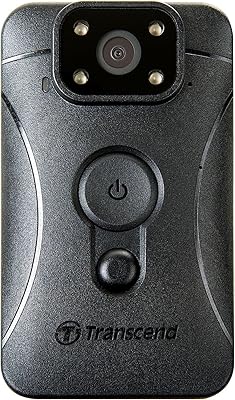
The Transcend DrivePro Body 40 128GB Body Camera is Transcend's push into a market long dominated by enterprise vendors like Axon and Motorola Solutions. Transcend built its name on dashcams and storage products, so this body-worn camera represents a calculated step toward professional security hardware — with pricing that small municipal departments and independent contractors can actually justify. Launched in late 2024, it's still relatively early in its firmware lifecycle, which is worth noting. Buyers should expect solid core performance — particularly in video clarity and build durability — but approach software-side features with measured expectations until the ecosystem matures further.
Features & Benefits

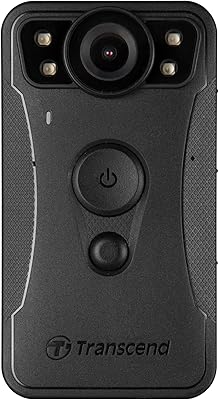
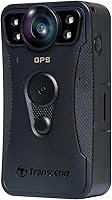
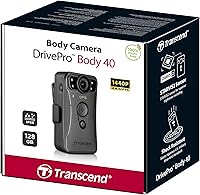
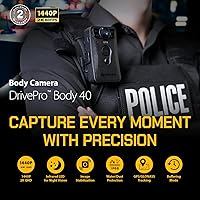
The DrivePro Body 40 centers its technical case on Sony's STARVIS 2 image sensor, which genuinely outperforms cheaper CMOS sensors in low-light conditions — producing clear, usable footage where others deliver noise. The four built-in infrared LEDs handle complete darkness at close range, useful for stairwells and nighttime patrol stops. IP68 weatherproofing combined with military-grade drop resistance means this camera survives rain shifts and concrete drops without drama. The battery comfortably covers a full standard shift on a single charge. GPS geotagging adds critical documentation integrity when footage becomes evidence, and the wide 130-degree field of view captures more of any given scene without distortion.

Best For

This body-worn camera makes the most sense for people who need professional-grade recording without signing up for expensive enterprise contracts. Small police departments, independent security firms, and loss-prevention teams working retail or logistics environments are the obvious fit. Delivery drivers dealing with disputed handoffs or porch incidents will find the geotagged footage particularly useful. It also suits buyers skeptical of cloud-only solutions — the DrivePro Body 40 stores footage locally, which simplifies chain-of-custody management and avoids recurring subscription fees. If you're running a large fleet with centralized evidence management software, though, this camera's ecosystem may feel limited compared to enterprise-grade alternatives.

User Feedback

Buyer reviews for Transcend's law enforcement cam are still accumulating given its late 2024 release, so patterns are early but directionally useful. Consistent praise centers on build quality and daytime footage clarity, with several buyers noting the camera survived weather conditions they hadn't expected it to handle. Night vision draws more mixed reactions — it works, but IR range is limited, which some field users find restrictive in large open spaces. A few reviewers flag the companion app's learning curve and slower-than-expected WiFi transfer speeds. Overall value sentiment leans positive, though some buyers feel the software side needs further polish to fully match what the hardware itself delivers.

Pros

  • Sony STARVIS 2 sensor delivers noticeably cleaner footage in low-light and daylight conditions than budget-tier alternatives.
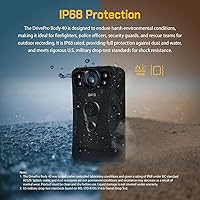
  • IP68 weatherproofing and military drop-test compliance provide genuine durability for outdoor and high-risk environments.
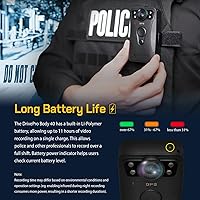
  • Battery capacity comfortably covers a full standard shift without needing a mid-shift recharge.
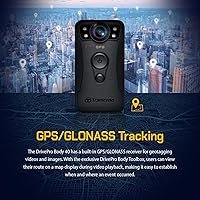
  • Built-in GPS geotagging timestamps and location-stamps every clip, adding meaningful chain-of-custody documentation.
  • At under 135 grams, the DrivePro Body 40 is light enough to wear for an extended shift without fatigue.
  • 128GB of onboard storage means no mandatory cloud subscription — footage stays fully under the user's control.
  • A 130-degree field of view captures wide scenes without requiring precise aiming during fast-moving incidents.
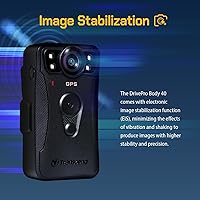
  • Electric image stabilization keeps moving footage clear and watchable even during active patrol.
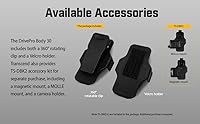
  • Arrives with both a rotatable clip and a Velcro holder, covering the most common mounting needs immediately.
  • Infrared LEDs enable genuine darkness recording in close-range environments like stairwells and vehicle interiors.

Cons

  • The companion app has a noticeable learning curve that can slow down initial deployment for non-technical users.
  • WiFi footage transfer speeds are slower than expected, making quick offloads between shifts genuinely inconvenient.
  • Infrared night vision range is limited — useful in tight spaces but underwhelming across large open areas.
  • As a late 2024 release, firmware is still maturing and early adopters may encounter software inconsistencies.
  • No native integration with major evidence management platforms like Axon Evidence or Motorola CommandCentral.
  • Some users have raised concerns about clip mount durability under repeated physical stress during active use.
  • The standalone ecosystem offers no centralized fleet management, remote monitoring, or multi-device administration capability.
  • Connectivity features like WiFi and Bluetooth offer narrower functionality than what enterprise-tier body cam systems provide.

Ratings

The scores below are generated by AI after analyzing verified buyer reviews for the Transcend DrivePro Body 40 128GB Body Camera from global sources, with spam, bot-submitted, and incentivized feedback actively filtered out before scoring. Each category reflects the genuine patterns that emerged from real-world professional use — patrol officers, security guards, and field workers — not marketing claims. Where this camera earns high marks you will see exactly why, and where it falls short, that is reflected just as plainly.
Video Quality
88%
The Sony STARVIS 2 sensor delivers sharp, color-accurate 1440P footage that holds up well when reviewed on a larger screen during incident analysis. At 60 frames per second, fast-moving subjects — a running suspect or a quick hand gesture — stay legible rather than dissolving into blur.
In direct harsh sunlight, some users report minor overexposure in high-contrast scenes, washing out fine detail at the frame edges. The wide field of view also introduces slight peripheral distortion, though it rarely undermines the footage's core usefulness for documentation purposes.
Night Vision Performance
73%
27%
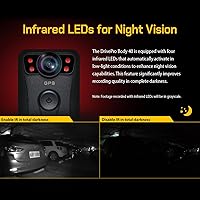
In close-range dark environments — a dimly lit hallway, a building stairwell, or inside a vehicle — the infrared LEDs produce workable, identifiable footage that would otherwise be completely black on a standard camera. For indoor patrol work and confined spaces, the night vision performs reliably enough to document incidents.
Open outdoor spaces expose the biggest limitation: the IR LEDs simply do not throw enough light to cover a large parking lot or open field at night, leaving distant subjects in darkness. Officers who regularly work exterior night patrol on open terrain will find the night vision range insufficient for their needs.
Build Quality & Durability
91%
The IP68 weatherproofing and military drop-test compliance translate directly into real shift confidence — buyers consistently report the camera surviving rain storms, accidental drops onto pavement, and the general rough handling that comes with physical security work. For a camera in this price tier, the housing quality is genuinely impressive.
A recurring criticism is the durability of the rotatable clip mount rather than the camera body itself — some users report the clip loosening or wearing down over time with repeated attachment and removal cycles. The camera body holds up; the accessories around it are where durability concerns tend to surface.
Battery Life
86%
For most standard 8-to-10-hour shifts, the battery holds through without requiring a mid-shift charge, which is the single most practical thing you can ask of a body camera battery. Security guards and patrol officers covering long outdoor shifts report returning to base with meaningful charge remaining.
Heavy simultaneous use of GPS tracking, WiFi, and continuous recording can shorten the effective runtime noticeably — buyers who run all features at once during extended shifts occasionally report the camera not quite making it to the end of a 12-hour rotation. Cold weather also impacts battery endurance, as it does with most lithium cells.
App & Software Experience
62%
38%
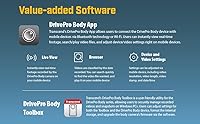
The companion app does provide useful functionality once configured — footage review, basic settings control, and WiFi pairing work as described. Users who take time during a non-critical setup session to learn the interface generally report getting comfortable with it within a few uses.
The app's learning curve is steep enough that multiple buyers mention it as a frustration during initial deployment, and stability reports are inconsistent across devices. For time-pressed professionals who need to configure a new camera quickly before a shift, the software experience feels underdeveloped relative to the hardware's quality.
WiFi Transfer Speed
58%
42%
WiFi transfer functionality works and allows wireless footage access without physically connecting a cable, which is useful for spot-checking a short clip after an incident. For smaller file sizes — a brief encounter or a single documented event — the wireless transfer is perfectly usable.
Transferring a full shift's worth of 1440P footage over WiFi is where this feature struggles — buyers consistently describe the process as slower than expected, often significantly so. Most experienced users default to a direct USB-C connection for end-of-shift offloads, treating WiFi transfer as a secondary convenience at best.
Value for Money
84%
For small departments, independent contractors, and loss-prevention teams that cannot justify enterprise body cam licensing costs, the hardware you get at this price is hard to beat — a capable sensor, IP68 housing, GPS, and no subscription fees represent genuine value per dollar spent.
Buyers who factor in the software ecosystem's current limitations — no enterprise platform integration, slow WiFi transfers, and an app that needs refinement — may find the value proposition softens once they are in active deployment. The hardware is priced fairly; the overall ecosystem maturity does not quite match it yet.
GPS & Geotagging Accuracy
83%
The dual GPS and GLONASS receiver provides reliable location tagging on recorded footage, which matters considerably when clips may be reviewed days later in a disciplinary or legal context. Multiple buyers noted that geotagged data matched expected routes accurately during post-shift review, which builds trust in the evidence chain.
GPS lock can take a moment to establish at the start of a shift, meaning the very first few minutes of recording may not carry location data if the camera has not had time to acquire a satellite signal. Indoor environments also limit GPS reliability, as with any satellite-dependent system.
Image Stabilization
78%
22%
The electric image stabilization makes a real difference when reviewing footage from active patrol situations — walking-pace movement is smoothed considerably, and clips from dynamic encounters are more watchable than unstabilized alternatives at this price point. For most everyday use cases, EIS delivers on its promise.
During high-intensity physical activity — sprinting, a physical restraint situation, or rough vehicle travel — the stabilization reaches its limits and footage can still become choppy or disorienting. EIS at this level is a meaningful improvement over nothing, but it is not comparable to optical stabilization found in premium action cameras.
Mounting & Wearability
76%
24%
At under 135 grams, the camera is light enough that most users report forgetting they are wearing it after the first hour, which is exactly what you want from a body-worn device during a long shift. The included 360-degree rotatable clip offers flexible positioning across different uniform types.
The clip mount's long-term grip strength has drawn criticism from users in physically active roles — repeated movement can gradually loosen the mount, creating a real concern about camera positioning during an incident. A Velcro holder is included as a backup, but it is a less secure solution for high-movement environments.
Low-Light Performance
81%
19%
In transitional lighting — dusk patrols, dimly lit parking structures, or interior spaces with partial lighting — the STARVIS 2 sensor handles exposure challenges better than most sensors in this category, pulling out usable detail without switching to full infrared mode. This is a practical benefit for evening shift workers.
Colors in dim conditions can shift toward a warmer, slightly washed tone, and shadow areas lose crispness compared to well-lit footage. Buyers expecting the kind of twilight performance associated with premium action cameras may find the results slightly underwhelming, though for its price tier the sensor performs above average.
Field of View Coverage
82%
18%
The 130-degree viewing angle is wide enough to capture the full context of most incident scenes without requiring precise camera aiming — a meaningful advantage in dynamic situations where deliberate positioning is not always possible. Most professional buyers find the coverage width practical and appropriate for their needs.
At the outer edges of the frame, some geometric distortion is noticeable, which can occasionally complicate accurate judgments about spatial relationships in footage. For most documentation purposes this is minor, but it is worth noting for anyone who may use clips in formal proceedings where positional accuracy matters.
Storage Flexibility
87%
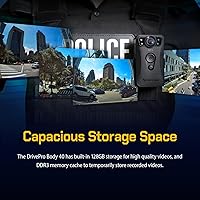
128GB of onboard storage holds a substantial volume of 1440P footage, enough for most users to run multiple shifts before needing to offload anything — reducing the daily administrative burden considerably. Micro SDXC expansion support means storage capacity can grow without having to replace the device.
There is no automatic footage management or intelligent overwrite functionality, meaning storage cleanup remains a fully manual responsibility — something small teams without dedicated IT support may find adds meaningfully to their administrative workload. Buyers coming from enterprise systems with automated retention policies will notice the gap immediately.
Ease of Setup
67%
33%
The physical setup — mounting the camera and powering it on — is quick and intuitive, requiring no tools and no prior technical experience. For basic recording operations, most users are up and running within a few minutes of taking the camera out of the box.
Configuring the companion app, pairing via WiFi, and adjusting recording modes or GPS preferences takes considerably more time and patience than the hardware setup alone. Several buyers recommend treating the first use as a dedicated configuration session rather than a quick pre-shift setup, which is not always realistic in operational environments.
Connectivity Reliability
66%
34%
USB-C wired connectivity is stable and consistent across user reports — when buyers connect directly to a computer or charger, the connection behaves predictably without intermittent failures or driver conflicts. This is the connection method most buyers end up relying on for daily footage management.
WiFi pairing with the companion app is where connectivity reliability gets shaky — intermittent disconnects, slow sync speeds, and occasional pairing failures appear across user feedback. Bluetooth functionality works for basic operations but is limited in range and feature depth compared to what the wireless specs might suggest.

Suitable for:

The Transcend DrivePro Body 40 128GB Body Camera is a strong fit for professionals who need reliable, field-ready documentation without the overhead of enterprise vendor contracts or recurring subscription fees. Small police departments and private security firms with limited procurement budgets will find it hits a practical sweet spot — capable hardware at a price that doesn't require a committee approval. Security guards covering outdoor posts in unpredictable weather benefit directly from the IP68 rating and military-grade drop resistance, since those aren't theoretical specs but genuine daily insurance against the unexpected. Delivery drivers and field service workers dealing with disputed handoffs or on-site incidents will appreciate the GPS-geotagged footage, which provides timestamped, location-verified records that hold up under scrutiny. Nonprofits, loss-prevention teams, and independent contractors who need locally stored footage — rather than video locked behind a cloud platform — will find the generous onboard storage and expandable memory slot give them full control over their own evidence. If covering a full shift without scrambling for a charger is a priority, this camera's battery capacity makes that a realistic expectation.
Not suitable for:

The Transcend DrivePro Body 40 128GB Body Camera is not the right choice for large agencies or enterprises that depend on centralized evidence management software, real-time footage streaming, or fleet-wide device administration — the ecosystem simply is not built for that scale. Buyers who require guaranteed long-range infrared coverage, such as officers patrolling wide-open outdoor spaces at night, may find the built-in IR LEDs fall short; they perform well in confined areas but lose effectiveness across open fields or large parking lots. If plug-and-play companion app performance is a firm requirement from day one, the software side of this camera may frustrate users who aren't willing to invest time in a learning curve during active deployment. This body-worn camera is also a poor match for buyers who need certified integration with specific evidence platforms like Axon Evidence or Motorola CommandCentral — Transcend's ecosystem operates independently, and compatibility with those systems is not guaranteed. Finally, anyone expecting fast WiFi offloads between shifts should temper their expectations, as current user reports suggest the transfer process takes longer than most would find convenient.
Specifications

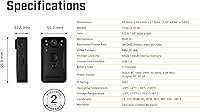
  • Video Resolution: Records in 2K QHD 1440P at 60 frames per second in MP4 format, producing fluid, high-detail footage suitable for incident documentation.
  • Image Sensor: Equipped with a Sony STARVIS 2 CMOS sensor designed for enhanced sensitivity in low-light conditions and a wide dynamic range across varying exposures.
  • Night Vision: Four built-in infrared LEDs activate automatically in darkness, providing usable monochrome footage in close to mid-range low-light environments without an external light source.
  • Weatherproofing: Carries an IP68 rating for water and dust resistance, meaning the housing is sealed against submersion in water beyond shallow depths under standard test parameters.
  • Drop Resistance: Meets U.S. military drop-test standards, confirming the camera body has been tested to survive impacts onto hard surfaces from operational working heights.
  • Battery Life: The integrated rechargeable lithium battery supports up to 11 hours of continuous recording on a single charge under standard operating conditions.
  • Storage: Includes 128GB of built-in flash memory and supports additional Micro SDXC cards for expanded storage capacity beyond the onboard limit.
  • Location Tracking: A built-in GPS and GLONASS receiver automatically geotags all recorded video clips and photos with precise coordinates and route data at time of capture.
  • Field of View: Captures a 130-degree wide-angle field of view, broad enough to frame most encounter scenes without the pronounced barrel distortion of ultra-wide fisheye optics.
  • Stabilization: Electric image stabilization (EIS) compensates for camera movement during active wear, keeping footage more coherent during walking, running, or physical engagement.
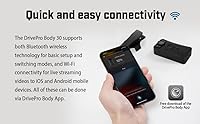
  • Connectivity: Supports WiFi, Bluetooth, and USB Type-C for wireless footage review and transfer, device pairing via companion app, and wired charging or direct file offload.
  • Dimensions: The camera body measures 1.09 × 2.06 × 3.78 inches, compact enough to mount on a shirt, vest, or jacket without adding significant bulk.
  • Weight: Weighs 135 grams (approximately 4.8 ounces), light enough for extended all-day wear across a full shift without causing meaningful discomfort.
  • Video Format: All footage is saved as standard MP4 files, broadly compatible with most video review platforms, evidence management tools, and editing software.
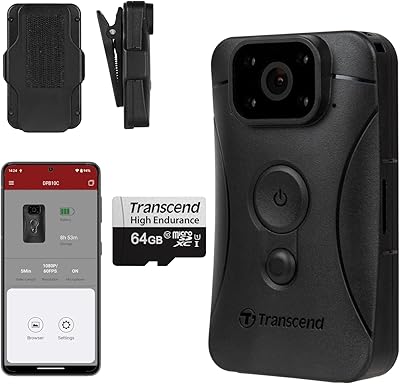
  • In the Box: Package includes the camera body, a 360-degree rotatable clip, a Velcro holder, a USB Type-C to Type-A cable, and a USB Type-C to Type-C cable.

Related Reviews

Transcend DrivePro Body 10 Body Camera
74%
83%
Night Vision Performance
58%
Daytime Video Quality
47%
Battery Life
86%
Ease of Use
54%
Build & Durability
More
Transcend DrivePro Body 30 64GB Body Camera
83%
91%
Video Quality
85%
Battery Life
88%
Build Quality
90%
Weatherproofing
86%
Night Vision Performance
More
HONGHOO 128GB 4K Body Camera
85%
94%
Video Quality (4K Resolution)
88%
Night Vision Performance
78%
Battery Life
91%
Portability & Weight
84%
Ease of Use & Setup
More
Transcend TS32GDPB10A Body Security Camera
82%
85%
Night Vision Performance
80%
Build Quality & Durability
88%
Ease of Use
70%
Wi-Fi Connectivity
75%
Battery Life
More
BOBLOV A22 128GB Body Camera
76%
88%
Battery Life
84%
Value for Money
67%
Night Vision Performance
91%
Ease of Use
72%
Video Quality (Daytime)
More
BOBLOV A23 128GB Compact Body Camera
76%
83%
Battery Life
72%
Video Quality
58%
Night Vision
86%
Ease of Use
84%
Value for Money
More
Meoilkolnm H88 128GB Body Camera
72%
93%
Portability & Form Factor
88%
Mounting System & Accessories
76%
Video Quality (Daylight)
44%
Low-Light Performance
91%
Built-in Storage (128GB)
More
LTZXTC 128GB 1080P Mini Body Camera
72%
91%
Ease of Setup
67%
Video Clarity
54%
Battery Life
61%
Build Quality
63%
Motion Detection
More
BOBLOV A28 Body Camera 2K 128GB
84%
87%
Battery Life
91%
Ease of Use
88%
Video Quality
75%
Night Vision
80%
Build Quality
More
CAMMHD F6 128GB 4K Body Camera
78%
91%
Battery Life
86%
Night Vision
88%
Waterproofing
74%
Video Quality
78%
Build Quality
More

FAQ

It's built to handle exactly that scenario. The DrivePro Body 40 meets U.S. military drop-test standards, meaning it went through structured impact testing onto hard surfaces from working heights. In normal operational conditions — the kinds of bumps, falls, and knocks that happen during patrol or security work — it holds up. That said, no camera is unconditional: extreme corner-on impacts from significant heights can exceed any device's tolerance, so treat it durably but not recklessly.

The rated figure is up to 11 hours of continuous recording, which covers most standard shifts comfortably. In practice, real-world battery life depends on usage patterns — heavy GPS tracking, active WiFi use, or cold ambient temperatures will all reduce that ceiling somewhat. For a typical 8-to-10-hour shift without aggressive wireless use, most buyers find the battery makes it through without issue.

Not natively. Transcend's law enforcement cam operates as a standalone device and has no certified integration with enterprise platforms like Axon Evidence, Motorola CommandCentral, or similar systems. Since footage is recorded as standard MP4 files, you can manually import clips into most software — but there's no automatic sync, direct API connection, or plugin support. If your agency depends on a specific platform with tightly integrated device management, confirm compatibility before committing to a purchase.

128GB holds a substantial amount of 1440P footage — more than enough for several shifts before you need to offload anything. The camera also accepts Micro SDXC cards if you want a larger buffer. One practical tip: if you go the expansion route, use a high-endurance card rated for continuous write cycles, since standard consumer-grade cards wear out faster in a body camera's sustained recording environment.

The infrared LEDs work well in close-range dark environments — stairwells, hallways, vehicle interiors, and doorways are where this capability genuinely shines. The limitation shows up in large open spaces: if you're working an outdoor patrol in a wide parking lot or open terrain at night, the IR range won't deliver useful detail at distance. It's a real feature, not a marketing checkbox, but its effectiveness is tied to the size and layout of the space you're in.

The camera records geotagged, timestamped MP4 files stored locally on the device — a solid technical foundation for evidentiary use. The GPS and GLONASS geotagging adds location integrity, and because footage never passes through a mandatory third-party cloud server, you maintain direct physical control of the recording. That said, the camera supports good chain-of-custody practice; it doesn't replace it. Your internal policies for securing, documenting, and transferring footage matter just as much as the hardware itself.

The most reliable method is a direct wired connection via USB Type-C — fastest and most stable, with no pairing steps. WiFi transfer through the companion app is available but consistently flagged in user reports as slower than expected, which makes it less practical for offloading a full shift of footage. If turnaround time matters at the end of a shift, plan your workflow around USB rather than wireless.

None. The Transcend DrivePro Body 40 128GB Body Camera stores all footage directly on the device, and there is no mandatory cloud account, licensing fee, or ongoing subscription required to use it. This is a meaningful advantage for small teams, independent contractors, and organizations that want to avoid the recurring software costs common with enterprise body cam vendors. You own and manage your footage outright.
Physically mounting and powering the camera is genuinely straightforward — it ships with the clips and holders you need, and recording can be started without touching any software. The learning curve shows up in the companion app: configuring settings, reviewing footage remotely, and getting comfortable with WiFi pairing takes some time. Several buyers recommend running through the full setup on a non-critical day before relying on it in an active deployment, which is good advice for any field device.

The IP68 rating puts it well beyond a light-splash level — it has been tested for submersion in water under defined conditions, not just rain exposure. For outdoor work in heavy rain, muddy conditions, or brief water contact, this body-worn camera is built to function normally. If you work outdoor security or patrol in consistently harsh weather, the weatherproofing here is a genuine practical benefit rather than a marketing qualifier.

Where to Buy