


Overview

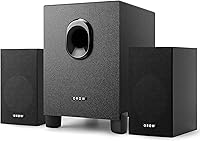
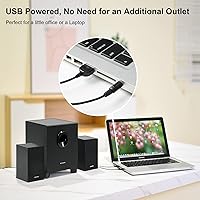
The OROROW S211 is a compact 2.1 speaker system that punches above its price bracket by combining a USB-powered design with a genuine wooden subwoofer enclosure. No wall adapter needed — just plug into a free USB port, connect via the 3.5mm input, and you are ready to go. That simplicity makes it a practical pick for anyone dealing with a cluttered desk or limited outlets. It is aimed squarely at users ready to leave behind the thin, hollow sound of built-in laptop or monitor speakers, and for a small desktop or dorm room setup, it delivers on that promise without asking much in return.

Features & Benefits

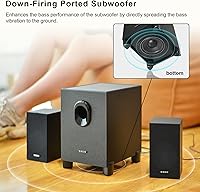
The subwoofer cabinet is built from 9mm thick wood, and that detail matters more than it might sound. Wood dampens internal vibration better than plastic, which keeps the bass tighter and less boomy. The downward-firing woofer channels low frequencies toward the desk surface, giving the bass a physical presence you can actually feel. At 16W total, this speaker set is loud enough to fill a small bedroom without straining. The satellite speakers sit neatly beside a monitor, and a touch-sensitive control keeps your desk looking clean. Background hiss is minimal for this price tier, which makes quiet listening sessions noticeably more comfortable.

Best For

This desktop speaker combo makes the most sense for PC users tired of flat, lifeless audio who do not want to spend big or deal with installation headaches. Students setting up a dorm room or first apartment will appreciate that it draws power from USB, eliminating the need to hunt for a spare outlet. Gamers on a PS4 or entry-level PC build get a real bass boost without needing a receiver or amplifier. It also pulls double duty as a bedroom TV companion for casual listening. If the goal is simple, no-fuss audio with an actual subwoofer, this speaker set covers the basics without overcomplicating anything.

User Feedback

Across hundreds of reviews, the S211 system earns its 4-star rating fairly. The most consistent praise centers on bass output — buyers are routinely surprised by how much low-end punch comes from such a small cabinet. The wooden subwoofer box also gets credit for feeling more solid than the price would suggest. That said, the feedback is not uniformly positive. At higher volumes the treble can turn thin or harsh, which is a real limitation for listeners who push the system hard. Short cable runs between the subwoofer and satellites make positioning awkward for some desk arrangements. A small number of buyers have also reported channel imbalance straight out of the box, flagging inconsistent assembly as an occasional concern.

Pros

  • USB power means one less outlet used — a genuine convenience for crowded desks and dorm setups.
  • The wooden subwoofer cabinet keeps bass tight and resonance-free in a way all-plastic rivals cannot match.
  • Plug-and-play setup requires zero software, zero drivers, and zero configuration — it just works.
  • Bass output regularly surprises buyers who expect little from a speaker set at this price point.
  • Compact satellite speakers fit neatly beside most monitors without eating into workspace.
  • Touch volume controls give the desk a cleaner look compared to old-school knob-and-dial interfaces.
  • Compatible with PCs, Macs, PS4, TVs, tablets, and smartphones via universal 3.5mm input.
  • The subwoofer is small enough to tuck under a desk or beside a bed without rearranging furniture.
  • Build quality on the subwoofer box feels noticeably more solid than competing budget systems.
  • A 4.0-star average across hundreds of verified reviews reflects broad real-world satisfaction.

Cons

  • Treble hardens and loses detail at higher volume levels, making extended loud listening fatiguing.
  • Satellite-to-subwoofer cable length is short, limiting placement flexibility for wider desk arrangements.
  • Quality control is inconsistent — a meaningful share of buyers report channel imbalance straight out of the box.
  • Satellite speakers are plastic, which undercuts the premium feel the wooden subwoofer box establishes.
  • No Bluetooth or digital audio input, so wireless or optical TV connections require a separate adapter.
  • Bass definition drops on thick carpet because the downward-firing port relies on a hard reflective surface.
  • Touch controls can be unresponsive with slightly damp fingers or in low-light environments.
  • Ground hum occasionally surfaces when connected to budget motherboard audio outputs on some PCs.
  • No dedicated subwoofer volume dial makes bass-to-satellite balance adjustment awkward for fine-tuning.
  • Warranty coverage is limited, which adds risk given the reported QC inconsistency across units.

Ratings

The OROROW S211 has been evaluated by our AI rating engine after processing hundreds of verified global buyer reviews, with spam, bot-generated, and incentivized feedback actively filtered out before scoring. Each category below reflects what real users consistently experienced — strengths and frustrations alike — so you get a transparent picture before committing to a purchase. Scores skew neither optimistic nor harsh; they land where the evidence points.

Bass Performance
83%
For a USB-powered desktop system at this price, the low-end output genuinely surprises most buyers. The wooden subwoofer cabinet keeps bass from sounding loose or muddy, and the downward-firing design adds a physical punch that makes gaming explosions and bass-heavy music feel grounded rather than thin.
It is still a budget subwoofer, so do not expect the kind of deep sub-bass that a dedicated powered woofer would produce. Audiophiles and home theater enthusiasts will find the low-frequency extension limited below around 80Hz.
Treble & Midrange Clarity
61%
39%
At moderate listening volumes, dialogue in movies and vocals in music come through clearly enough for casual use. The satellite drivers handle midrange frequencies reasonably well for desktop listening at arm's length, which is the primary use case this speaker set was designed around.
Push the volume past the midpoint and the highs start to harden and thin out noticeably. Cymbals and high-frequency synths can develop a brittle edge, which becomes fatiguing during longer sessions. This is where the budget driver quality shows most plainly.
Build Quality
78%
22%
The wooden subwoofer box is the standout construction detail — it feels noticeably more solid than competing all-plastic systems in this price bracket. Buyers regularly mention that the cabinet does not rattle or flex under moderate bass loads, which speaks to the 9mm panel thickness doing its job.
The satellite speakers are plastic, and while they are not flimsy, they do feel lightweight. A small number of buyers reported cosmetic inconsistencies or slightly misaligned grilles, suggesting assembly quality is not perfectly uniform across every unit.
Value for Money
89%
When you factor in the wooden subwoofer, USB power convenience, and touch controls, the price-to-feature ratio is genuinely strong for this category. Most buyers feel they received more than they paid for, particularly those upgrading from built-in laptop or monitor speakers for the first time.
The value calculation shifts slightly if you receive a unit with a channel imbalance or QC issue, since dealing with returns erodes the cost advantage. A small but consistent minority of buyers have flagged this as a real post-purchase headache.
Volume & Room Filling Ability
77%
23%
The 16W system output is more than adequate for a small bedroom, dorm room, or single-person office. Most users can run it at 60 to 70 percent volume comfortably, leaving headroom to spare. It handles background music, gaming audio, and casual video streaming without struggling.
It will not fill a living room or open-plan space convincingly. Shared apartments or common areas where you need audio to carry across a larger distance will expose the system's ceiling fairly quickly.
Setup & Ease of Use
93%
Plug the USB into any port, connect the 3.5mm jack, and you are done — no software, no drivers, no pairing process. Buyers who have dealt with finicky Bluetooth speakers or complicated receiver setups consistently describe the S211 system as a refreshing no-fuss experience.
There is no volume knob, only touch controls, which some users find less intuitive when making quick adjustments mid-session. A couple of reviewers noted the touch sensitivity can feel slightly inconsistent, requiring a firm press rather than a light tap.
Cable Management & Length
54%
46%
The cables connecting the satellites to the subwoofer are functional and tidy enough for a standard desk setup where everything sits within roughly two feet of each other. For a straightforward centered desktop arrangement, most buyers have no issues.
The satellite cables are a recurring frustration for users who want more flexible speaker placement. If you need to spread the satellites wider than roughly 18 inches apart, or if your subwoofer sits on the floor, the cable length becomes a real constraint. This is one of the most cited practical complaints across the review base.
Connectivity & Compatibility
86%
The 3.5mm input works with virtually every device buyers are likely to connect — PCs, Macs, PS4 consoles, televisions, tablets, and smartphones. No format limitations, no compatibility headaches. For a desk speaker, universal analog input is often more practical than Bluetooth.
There is no Bluetooth or optical input, so users who want wireless connectivity or want to connect modern TVs via digital audio outputs will need a separate adapter. It is a wired-only system, which suits most buyers but does limit flexibility for some setups.
Noise Floor & Background Hiss
74%
26%
At idle or during quiet passages, the speaker set maintains a reasonably clean noise floor. The 70dB signal-to-noise ratio translates to a listening experience where hiss is present but not distracting under normal conditions, which is acceptable for this segment.
On certain PC or laptop audio outputs with a weaker signal, some users pick up a faint ground hum or static, particularly at low volume. This is partly source-dependent, but it surfaces often enough in reviews to be worth noting for users with budget motherboard audio.
Design & Aesthetics
72%
28%
The combination of a wood-finish subwoofer and matte black satellite speakers gives the set a cleaner, more considered look than most budget desktop audio. It does not draw attention to itself in a workspace, which is exactly what most buyers want from desk peripherals.
The overall aesthetic is functional rather than distinctive. Buyers looking for RGB lighting or a more aggressive gaming-focused look will find the design too understated. The plastic satellites also visually undercut the premium feel the wooden subwoofer box establishes.
Touch Control Responsiveness
67%
33%
Touch controls keep the top panel clean and give the system a more modern feel compared to the dial-and-button interfaces common on competing budget speakers. Volume adjustments during music playback or gaming sessions generally register without any noticeable lag.
The touch surface is not as reliable as a physical knob. Several reviewers describe needing to tap multiple times to register a command, particularly when hands are slightly damp. Under-desk mounting or low-light environments make finding the controls by feel more difficult.
Subwoofer Placement Flexibility
69%
31%
The compact subwoofer footprint means it fits under most desks and in tight spaces without requiring any real rearrangement. Buyers in small rooms appreciate being able to tuck it away while still benefiting from the bass output it produces.
The downward-firing port design works best on hard floor surfaces or firm desk surfaces. Users who place it on thick carpet report a noticeable reduction in bass definition, as the soft surface absorbs rather than reflects the low-frequency output the design relies on.
Quality Control Consistency
58%
42%
The majority of buyers receive a unit that works correctly out of the box, and for most of those users, the experience is trouble-free from day one. When it works as intended, the S211 system performs consistently throughout its ownership period.
A meaningful minority of reviews describe units arriving with one satellite louder than the other, or with intermittent crackling during the first few days of use. For a product in this price range, the QC variance is higher than ideal, and it comes up frequently enough to factor into the buying decision.
Gaming Audio Performance
81%
19%
For console and PC gaming at a desktop, the speaker set delivers directional audio and impact effects convincingly. The bass adds genuine weight to in-game explosions, and the stereo separation from the two satellites is wide enough to help with basic spatial awareness in games.
Competitive FPS gamers who rely on precise audio cues will find the treble roll-off at high volume a real limitation. Footsteps and high-frequency directional sounds lose detail, which matters in ranked play even if it is largely irrelevant for casual gaming.
Long-Term Durability
66%
34%
Buyers who have owned the S211 system for over a year generally report no major degradation in sound quality. The wooden subwoofer enclosure appears to hold up well structurally, and there are no widespread reports of driver failure under normal use conditions.
The touch control surface and cable joints are the most likely failure points over time, based on longer-term reviews. A few users noted the USB cable connection loosening slightly after extended use, which is worth keeping in mind for a product without a premium warranty backing.

Suitable for:

The OROROW S211 is a strong fit for anyone who needs a real audio upgrade on a tight budget and a compact desk. Students furnishing a dorm room, remote workers stuck with a cluttered power strip, and casual gamers on PS4 or entry-level PC builds will all find this speaker set hits a practical sweet spot — it draws power straight from USB, connects in seconds via a 3.5mm jack, and delivers noticeably more bass presence than any built-in laptop or monitor speaker can. If your room is small, your desk is tight, and your priority is simply getting richer, fuller sound without buying an amp or receiver, this desktop speaker combo makes a sensible, low-friction choice. It also works well as a bedroom TV companion for anyone who finds their television's built-in audio flat and unsatisfying during late-night viewing sessions.

Not suitable for:

Buyers who prioritize high-fidelity audio, extended listening sessions at loud volumes, or flexible speaker placement should look elsewhere before committing to the OROROW S211. The treble becomes harsh at high volume levels, which is a real problem for anyone who listens to detail-rich genres like classical, jazz, or acoustic music at room-filling levels. The cables connecting the satellites to the subwoofer are short, meaning you cannot spread the stereo image as wide as a proper bookshelf speaker setup would allow. Competitive gamers who depend on precise high-frequency audio cues — footsteps, distant gunfire — will find the speaker set too limited for ranked or serious play. And anyone furnishing a living room, open-plan kitchen, or shared common area should understand that 16W simply will not carry convincingly across a large space.

Specifications

  • System Configuration: 2.1 stereo setup consisting of two satellite speakers and one subwoofer unit sold as a complete set.
  • Total Output Power: The system delivers 16W of combined output across the 2.1 configuration, suitable for small to medium-sized rooms.
  • Power Source: Powered entirely via USB at 5 volts, eliminating the need for a dedicated AC wall adapter.
  • Audio Input: Connects to source devices through a standard 3.5mm stereo jack, compatible with the headphone output of most PCs, TVs, consoles, and mobile devices.
  • Subwoofer Enclosure: The subwoofer cabinet is constructed from 9mm thick wood panels, which reduce internal resonance compared to all-plastic alternatives.
  • Woofer Diameter: The subwoofer driver measures 17cm (approximately 6.7 inches) across its active cone area.
  • Satellite Drivers: Each satellite speaker houses a 4-inch dynamic driver with a 0.75-inch tweeter for handling higher frequency content.
  • Signal-to-Noise Ratio: Rated at 70dB, keeping background hiss at an acceptable level for near-field desktop listening under normal conditions.
  • Subwoofer Design: The subwoofer uses a downward-firing port that channels bass vibration toward the desk or floor surface for a more physical low-end response.
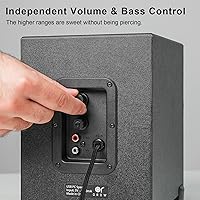
  • Volume Control: System volume is managed via a touch-sensitive control panel rather than a traditional rotary knob.
  • Product Dimensions: The full system footprint measures 8.66″ deep by 14.96″ wide by 6.69″ tall when fully assembled on a desk.
  • Item Weight: The complete packaged unit weighs 5.06 pounds, making it straightforward to transport or reposition between desk setups.
  • Compatible Devices: Works with personal computers, televisions, PS4 consoles, DVD players, smartphones, and tablets — any device with a 3.5mm headphone output.
  • Material: The subwoofer enclosure is made of wood; the satellite speaker housings are constructed from plastic.
  • Color: Available in black with a matte finish across both the satellite speakers and the subwoofer cabinet.
  • Included Components: Each package contains three units: one subwoofer and two satellite speakers, along with the necessary connecting cables.
  • Warranty: Covered by a limited manufacturer warranty; buyers should confirm current warranty terms directly with the seller at time of purchase.
  • Indoor Use: Designed and rated for indoor use only; the system is not water-resistant and should not be used outdoors in wet or humid conditions.
  • Frequency Response: Manufacturer-rated frequency response starts at 100Hz on the upper end of the bass range, reflecting a system tuned for desktop near-field listening.
  • Date Available: The S211 model has been available for purchase since May 2021 and holds a Best Sellers Rank of number 153 in the Computer Speakers category.

Related Reviews

FAQ

It runs entirely off USB power at 5 volts, so you do need a USB port to use it. Any standard USB port on your PC, laptop, or even a USB wall charger will work fine. There is no separate power brick in the box.

Yes, as long as your TV has a 3.5mm headphone output or audio output jack. Most modern TVs do, but if yours only has optical or HDMI audio outputs, you would need a separate digital-to-analog converter adapter to bridge the connection.

It handles small rooms well — a bedroom, dorm room, or single-person home office is the sweet spot. A large living room or open-plan space is a stretch; at that scale the volume ceiling becomes apparent and the sound loses impact over distance.

Honestly, this is one area where the speaker set shows its budget roots. At moderate volumes the highs are acceptable, but push it past about 70 percent and the treble starts to harden and thin out. If you regularly listen loud and care about detail in the upper frequencies, you may find it fatiguing over time.

The satellite cables are on the short side, which is one of the most common complaints from buyers. If you want to spread your speakers wider than roughly 18 inches apart, or if your subwoofer sits on the floor while your satellites are on a desk, you may run into length issues. It works well for a standard compact desk setup, less so for anything more spread out.

Yes, provided your PS4 controller or console has a 3.5mm output available. Most setups connect through the controller headphone jack or via an adapter from the TV output. No drivers or configuration needed on the console side.

For most users connected to a decent audio output, the noise floor is minimal. However, a subset of buyers connected to budget PC motherboard audio report a faint ground hum, particularly at low volumes. If you use a dedicated sound card or USB DAC, this is much less likely to be an issue.

No, the speaker set does not have a dedicated bass dial or EQ controls. You get a single touch-based volume control. If you want to shape the sound, you would need to use the equalizer software on your connected device.

It will work, but the downward-firing subwoofer design performs noticeably better on hard surfaces like wood or tile floors. On thick carpet, the bass output becomes more muffled and less punchy because the soft surface absorbs rather than reflects the low-frequency energy. A firm surface underneath makes a real difference.

Unfortunately, yes — channel imbalance is a recurring complaint from a minority of buyers and appears to be a quality control issue rather than a design flaw. If your unit arrives with uneven output between the two satellites, contacting the seller for a replacement is the right move, as most affected buyers report that a replacement unit resolves the problem.