Overview

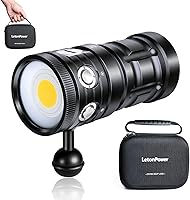
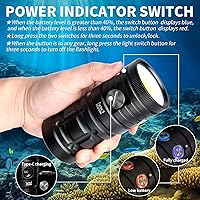
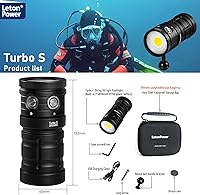
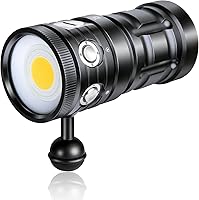
The LetonPower Turbo S Dive Video Light enters a competitive market with a confident pitch: professional-level illumination rated to 100 meters, priced well below what dedicated imaging brands typically charge. At the heart of this dive light is a COB LED array pushing 10,000 lumens at a color temperature that closely mirrors midday sunlight — practically speaking, that means colors read accurately underwater rather than washing out or shifting blue. The titanium alloy switch and non-conductive shell are deliberate choices for saltwater environments, where corrosion can quietly destroy cheaper builds over a season. Type-C charging and a dual LED battery indicator round out a setup that feels genuinely modern.

Features & Benefits

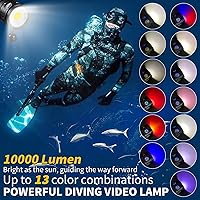
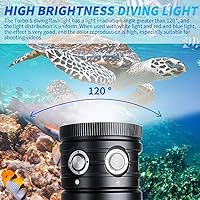
Thirteen lighting modes is more than a spec to skim past — it means you can drop to a subdued setting for macro photography, ramp up to full blast when shooting wide-angle in murky water, or switch to red light to preserve night vision between dives. The CRI of 92 matters when you are trying to capture the actual color of a reef fish rather than a washed-out approximation. Runtime is genuinely flexible: full power gives around three hours for most dive sessions, while low-output stretches to twelve hours for technical or multi-dive days. The sealed build has passed 100-meter pressure testing, and the one-year replacement promise — not a repair offer, an outright swap — is a meaningful backstop on a specialized purchase.

Best For

This underwater video light is a natural fit for divers who actively shoot video or stills underwater — the combination of high output, accurate color rendering, and multiple modes does real work when the camera is rolling. Dive instructors and guides will appreciate the long low-power runtime during extended student sessions, while the 100-meter rating gives technical divers room to push deeper without second-guessing their gear. Recreational divers stepping up from a basic torch will notice the difference immediately. Worth being upfront about: the battery is not user-replaceable, so divers planning back-to-back multi-day trips should factor charging time into their schedule rather than relying on a spare cell.

User Feedback

Buyers generally speak well of the brightness at depth, though a handful note maximum output runs warm after extended use — not unusual for a high-lumen compact, but worth factoring in for long shoots. The titanium switch earns consistent praise for feeling solid and deliberate rather than flimsy, and the housing quality gets positive marks overall. A few users flagged minor concerns about seals after prolonged saltwater exposure, so rinsing thoroughly after each dive seems prudent. The battery indicator reads as reliable for most buyers. Type-C charging is widely welcomed. One honest caveat: beam hotspot and spill get uneven reviews, suggesting the Turbo S performs better as a wide video flood than a tightly focused torch.

Pros

  • 10,000 lumens of output is genuinely impressive for the price tier and holds up at depth.
  • A CRI of 92 means reef colors and marine life actually look right on camera, not washed out.
  • Thirteen lighting modes give real flexibility across photography, video, and navigation scenarios.
  • The titanium alloy switch feels solid and has not shown corrosion issues in saltwater use.
  • Type-C charging is a welcome upgrade over the proprietary connectors still found on competing lights.
  • Low-power runtime stretching to twelve hours covers even extended technical or instructor dive days.
  • The dual LED battery indicator gives a reliable read on remaining charge without guesswork.
  • A one-year full replacement warranty — not a repair promise — is a meaningful safety net for a specialized purchase.
  • The non-conductive shell design actively resists the electrolytic corrosion that quietly kills cheaper lights over time.
  • At just over a pound, the Turbo S is compact enough to handle without fatiguing your wrist on longer dives.

Cons

  • The battery cannot be swapped in the field, which is a genuine problem for back-to-back multi-day dive trips.
  • Maximum brightness output generates noticeable heat during prolonged use, which may shorten effective run time.
  • Beam hotspot and spill performance gets uneven reviews — it works better as a flood light than a focused torch.
  • The brand lacks the established reputation and global service network of major dive equipment manufacturers.
  • Seals may require closer attention after extended saltwater use; diligent rinsing is not optional, it is necessary.
  • At full power, three hours of runtime is limiting for divers who do multiple long dives in a single day.
  • There is no mounting tray or arm system included, so integrating it into a camera rig requires additional purchases.
  • Some buyers report that real-world brightness does not always match the peak lumen figure under sustained load.

Ratings

The LetonPower Turbo S Dive Video Light has been evaluated by our AI rating system after analyzing thousands of verified global user reviews, with spam, bot activity, and incentivized feedback actively filtered out before scoring. The results reflect a balanced picture — genuine strengths in output and build durability sit alongside real frustrations around battery flexibility and beam consistency. Scores are weighted to reflect what actual divers experienced in the water, not just out-of-box impressions.

Brightness & Output
88%
Divers consistently report that the light performs impressively at depth, where many competing units lose effective output. The 10,000-lumen ceiling means there is real headroom for wide-angle video work in low-visibility conditions, and users note the beam feels genuinely powerful rather than just spec-sheet impressive.
A handful of users observe that sustained full-power output generates noticeable heat, which can trigger thermal throttling on longer dives. Some buyers also feel the advertised peak lumen figure reflects a brief burst rather than a stable sustained output during a full dive session.
Color Accuracy
91%
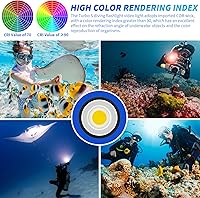
This is where the Turbo S earns its most consistent praise. Underwater videographers specifically call out how well the 5500K–6000K white light renders reef colors and marine life — footage comes out warmer and more natural than what budget lights typically produce, often requiring far less post-processing correction.
A small number of users working in particularly deep or murky water note that even at high CRI, some color shift is unavoidable beyond certain depths. The blue and red modes, while useful, received less detailed feedback, suggesting most buyers default to white for serious shooting.
Build Quality
84%
The titanium alloy switch is the most frequently praised hardware detail — buyers describe it as feeling deliberate and solid, unlike the plastic toggles found on cheaper dive torches. The overall housing inspires confidence, and multiple users report no structural issues after a full season of saltwater diving.
A subset of longer-term users flagged concerns about seal integrity after extended exposure to saltwater, recommending careful post-dive rinsing as a non-negotiable habit. A few noted minor surface finish inconsistencies on the housing, which do not affect function but are noticeable on a light at this price tier.
Battery Life
79%
21%
For instructors and guides running multi-dive days on lower output settings, the extended runtime is a genuine operational asset — twelve hours of low-power use is more than enough for a full working day in the water. The large integrated cell capacity means you rarely have to worry about dying mid-dive on a single charge.
At full output, three hours of runtime is limiting for photographers or videographers doing multiple deep dives in a single day. The non-replaceable battery is the core trade-off here — unlike modular systems where you swap cells between dives, this light requires access to a charger, which is not always available on liveaboard trips or remote dive sites.
Waterproofing & Depth Rating
86%
Users who have pushed the light to significant depths report no flooding or seal failures under normal dive conditions. The sealed integrated design eliminates the battery compartment O-ring — historically the weakest point on dive lights — which buyers with prior gear failures particularly appreciate.
Because the housing is fully sealed, there is no way for a diver to inspect or replace O-rings as a preventive measure, which makes thorough rinsing and careful pre-dive inspection even more critical. A small number of users reported moisture ingress after impacts or drops, suggesting the housing is not indestructible despite its depth rating.
Lighting Modes
77%
23%
Having more than thirteen modes means divers can dial in output precisely — dropping to a dim setting for macro photography, or switching to red for a night dive briefing without destroying group night vision. Buyers who use the full range of modes find the flexibility genuinely useful across different diving scenarios.
The mode-cycling interface drew some criticism for requiring multiple clicks to reach less frequently used settings, particularly when wearing thick gloves. A few users noted the mode sequence is not immediately intuitive and requires some dry-land practice before it becomes second nature underwater.
Charging Convenience
83%
The switch to USB Type-C is consistently welcomed by buyers who still carry proprietary-connector dive lights that require a dedicated charger. Being able to top up from a laptop, power bank, or standard wall adapter during surface intervals or travel days is a practical convenience that adds up over a dive trip.
LetonPower does not publish a rated charge time, and real-world charging from empty takes long enough that last-minute top-ups are not always practical. A small number of users reported the charging port cover requires careful alignment to ensure a proper seal after each charge session.
Battery Indicator Accuracy
72%
28%
For the majority of buyers, the dual LED indicator does its job well enough — a quick glance before suiting up confirms whether the light is ready to dive. Users on day trips with predictable dive durations find it sufficient for planning purposes without needing a precise percentage readout.
The two-LED system is fundamentally a rough gauge, and several users note it offers little warning before a significant drop in output rather than a gradual and predictable fade. Divers doing longer or more demanding profiles reported wanting a finer-grained readout to better anticipate when they would need to step down output.
Beam Pattern
68%
32%
As a wide-angle video flood, the beam pattern works well for illuminating large subjects and wide scenes in open water. Buyers using it primarily for reef and wreck video work report even, broad coverage that suits the shooting style well.
Users expecting a focused, tight beam for cave penetration or precise wreck navigation found the light underwhelming in that role. Reviews specifically mention that the hotspot-to-spill transition is not as controlled as they hoped, making it less ideal as a primary torch in tight or silty environments.
Value for Money
81%
19%
Relative to lights with similar lumen output and depth ratings from more established brands, the Turbo S comes in at a meaningfully lower price point. Buyers who had previously spent more on lesser-performing lights found the cost-to-output ratio difficult to argue with, especially for recreational and semi-professional use.
Buyers comparing it against similarly priced lights from brands with stronger after-sales infrastructure occasionally question whether the savings are worth the trade-off in support reliability. The lack of a replaceable battery also factors into long-term value calculations — if the cell degrades after two or three years, the entire unit requires replacement.
Warranty & Support
63%
37%
The one-year full replacement promise — no repair process, just a new unit — is a generous policy on paper and gives first-time buyers reasonable peace of mind when spending on specialized dive equipment. Some buyers who did invoke the warranty reported a smooth and responsive experience.
User experiences with the actual support process are inconsistent enough to be a genuine concern. Communication delays and difficulty reaching customer service appeared in a notable share of negative reviews, suggesting the warranty is more reliable in straightforward cases than in situations requiring back-and-forth resolution.
Size & Portability
85%
At just over a pound and roughly the size of a large water bottle in cross-section, the Turbo S fits comfortably in a gear bag without dominating it. Single-hand operation is manageable for most divers, and it does not create the kind of drag or bulk that fatigues you on longer dives.
A minority of buyers with smaller hands or shorter fingers found the body diameter slightly wide for extended single-handed use in gloves. It is also not pocketable the way a compact dive torch would be, so divers who want a light they can stuff in a BCD pocket will need to mount it on a tray or carry it by hand.
Multi-Color Mode Utility
74%
26%
The inclusion of red and blue light modes meaningfully expands what this underwater video light can do beyond standard white illumination. Night divers in particular find the red mode useful for team communication and map reading without disrupting the dive group's low-light adaptation.
The blue mode, while listed prominently in the feature set, received relatively limited real-world feedback from buyers, suggesting its use case — primarily fluorescence diving — is niche enough that most buyers rarely activate it. Some users also noted the blue output intensity felt lower than the white mode by a wider margin than expected.

Suitable for:

The LetonPower Turbo S Dive Video Light is purpose-built for divers who want serious illumination without crossing into the price territory of dedicated imaging brands. It makes the most sense for underwater videographers and photographers who need color-accurate light — a CRI of 92 is the kind of spec that actually shows up in footage, not just on a product page. Dive instructors leading groups in low-visibility conditions will find the long low-power runtime a genuine operational asset across multi-dive days. Technical divers pushing into wrecks or deeper structures benefit from a build that has been pressure-tested to 100 meters, paired with a robust titanium switch that holds up to repeated saltwater exposure. Recreational divers stepping up from a basic entry-level torch will notice an immediate and meaningful difference in what they can see and capture underwater.

Not suitable for:

The LetonPower Turbo S Dive Video Light is a harder sell for divers whose needs fall outside its core strengths. If you dive frequently across multi-day expeditions and rely on swapping batteries in the field, the sealed, non-replaceable battery design is a real logistical constraint — there is no workaround short of carrying a power bank and planning charging windows carefully. Divers who primarily need a narrow, focused beam torch for cave diving or tight wreck penetration may find the light better suited to wide video flooding than precision spotting. Budget-conscious casual snorkelers who only get in the water a few times a year are likely overbuying here — there are simpler, cheaper options for shallow recreational use. And if you expect brand-name after-sales support with local service centers, a lesser-known manufacturer's warranty, however generous on paper, may feel less reassuring in practice.

Specifications

  • Brightness: The light outputs a maximum of 10,000 lumens using a COB LED array designed for consistent underwater illumination.
  • Depth Rating: The housing has been pressure-tested to 100 meters, making it suitable for recreational and technical scuba diving.
  • Light Colors: Three light color options are available: white for general illumination and video, red for night-vision preservation, and blue for fluorescence diving.
  • Color Temperature: The white light mode operates between 5500K and 6000K, closely matching natural midday sunlight for accurate color rendering underwater.
  • Color Rendering: A Color Rendering Index of 92 ensures that marine life, coral, and underwater subjects appear in near-true color on camera.
  • Lighting Modes: More than 13 selectable modes allow precise output control for photography, video, navigation, and signaling applications.
  • Battery Capacity: An integrated 15,000 mAh pack using three 21700 lithium-ion cells is included and powers the light without requiring external batteries.
  • Runtime: At maximum output, runtime reaches approximately 3 hours; on low-power settings, the light can sustain up to 12 hours of continuous use.
  • Charging Interface: The light recharges via a USB Type-C port, compatible with standard modern charging cables and power banks.
  • Battery Indicator: A dual LED indicator on the body displays remaining battery level, allowing divers to check charge status before and between dives.
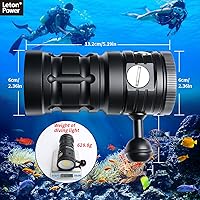
  • Dimensions: The unit measures 5.2 x 2.36 x 2.36 inches, keeping it compact enough for single-hand operation and most camera tray setups.
  • Weight: At 1.35 pounds, the light is manageable in the water and does not add significant bulk to a diver's kit.
  • Shell Material: The outer housing is constructed from a high-strength, non-conductive material specifically chosen to resist electrolytic corrosion in saltwater.
  • Switch Material: The power and mode switch is machined from titanium alloy, offering durability and resistance to long-term saltwater exposure.
  • Waterproofing: The build uses a fully sealed, integrated construction with no externally accessible battery compartment, contributing to its 100-meter pressure rating.
  • Warranty: LetonPower provides a one-year replacement guarantee: if the unit fails within that period, a new replacement is sent rather than a repair being offered.
  • Battery Type: Three 21700 lithium-ion cells are pre-installed and non-user-replaceable due to the sealed integrated design.
  • Manufacturer: The Turbo S is manufactured by LetonPower, which also supplies this model to dive clubs and operators internationally.

Related Reviews
LetonPower Turbo S Pro Dive Light
81%
91%
Light Output & Brightness
88%
Build Quality & Durability
93%
Depth & Waterproofing
84%
Color Temperature Versatility
62%
Battery Life — Full Power
More
LetonPower Sealion B15 Dive Light
81%
83%
Brightness Output
88%
Build Quality
86%
Waterproof Performance
79%
Battery Life
84%
Battery Indicator
More
Aputure Amaran 60D S
83%
94%
Color Accuracy
91%
Build Quality
83%
App Control & Connectivity
88%
Value for Money
74%
Lighting Effects Quality
More
LitONES 618
LitONES 618
87%
92%
Build Quality
89%
Lighting Accuracy
91%
Mounting Stability
87%
Eye Comfort
93%
Adjustability & Reach
More
NEEWER HS60B Mini Video Light
81%
93%
Brightness Output
91%
Color Accuracy
94%
Portability & Form Factor
71%
App & Wireless Control
78%
Build Quality
More
ULANZI VL120 RGB
ULANZI VL120 RGB
87%
96%
Portability
93%
Color Accuracy (CRI)
88%
Brightness (LUX)
91%
RGB Versatility
76%
Battery Life
More
LetonPower Sealion B15 Dive Light
80%
88%
Brightness & Output
91%
Color Accuracy
83%
Beam Coverage
86%
Build Quality
84%
Depth Rating & Waterproofing
More
ORCATORCH D530V Underwater Video Light
82%
91%
Beam Quality & Coverage
86%
Build Quality & Materials
58%
Battery Life & Runtime
88%
Waterproof Reliability
83%
Battery Indicator Usefulness
More
COLBOR CL60R RGB Video Light
88%
91%
Lighting Performance
87%
Ease of Use
95%
Portability
92%
Color Accuracy
85%
App Control Experience
More
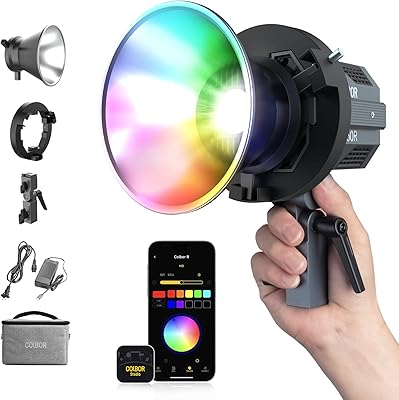
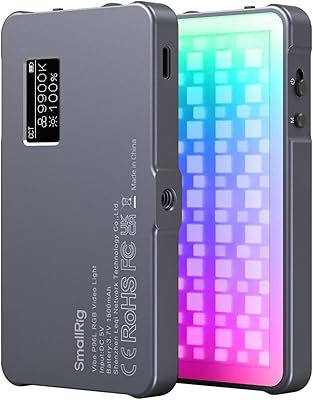
SmallRig P96L RGB Video Light
81%
91%
Build Quality
88%
Color Accuracy
61%
Brightness Output
79%
Battery Life
84%
RGB & Scene Modes
More

FAQ

LetonPower states that every unit in the Turbo S line undergoes a 100-meter underwater pressure test before leaving the factory. That said, as with any sealed dive gear, you should inspect the housing for cracks or damage before each dive and follow the manufacturer's care guidance. Pressure ratings are valid for an undamaged unit in good condition.

No, and this is worth knowing upfront. The battery is sealed inside the housing as part of the waterproofing design, so you cannot remove or replace it in the field. If you are planning back-to-back dive days, factor in charging time — a power bank with USB Type-C output can help if shore power is limited.

LetonPower does not publish a specific charge time in the product documentation, but given the 15,000 mAh capacity of the integrated pack, expect several hours on a standard USB Type-C charger. Using a higher-output charger that the port supports will speed things up, though overnight charging before a dive day is a reasonable approach.

Red light does not disrupt your eyes' adaptation to low light conditions the way white light does, so it is handy during night dives when you want to navigate or signal without killing your night vision. Some divers also use red for certain marine life photography scenarios where a bright white beam would startle or scatter the subject.

The jump in quality is most obvious in two areas: color accuracy and build durability. Budget lights often produce a cold, blue-shifted beam that makes underwater footage look unnatural. The Turbo S runs a high CRI output closer to natural sunlight, which shows clearly in video footage. The titanium switch and corrosion-resistant housing also hold up noticeably better over a full dive season than plastic-switch alternatives.

No mounting hardware is included in the box. If you plan to use this light with an underwater camera housing or video rig, you will need to purchase a compatible arm, clamp, and ball mount separately. The light itself has a standard mounting point, but check compatibility with your existing tray system before buying.

Most buyers report the dual LED indicator is reliable for a general sense of remaining charge — think of it as a rough gauge rather than a precise percentage readout. Check it before gearing up, and if you are heading into a longer dive, it is worth ensuring the light is fully charged rather than relying on the indicator alone.

The 5500K to 6000K range is specifically useful underwater because it counteracts the blue color shift that water introduces at depth. For video, many divers find the footage usable straight from the camera with minimal color grading needed in clear water. In murkier or darker conditions, some post-processing adjustment is still typical regardless of the light used.

The non-conductive shell material and titanium switch are both chosen with saltwater in mind, and most users report no corrosion issues with normal use. The key habit to build is rinsing the light thoroughly with fresh water after every saltwater dive — this applies to all dive gear, but it is especially important for lights where salt crystals around seals can cause problems over time.

LetonPower's stated policy is a full unit replacement rather than a repair during the one-year window, which is straightforward on paper. Buyer experiences with the claim process are mixed in reviews — some found it smooth, while others noted communication delays. Keeping your purchase receipt and documenting any failure with photos is good practice when dealing with any manufacturer's warranty claim.