Overview

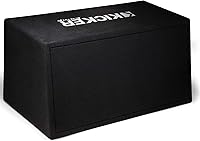
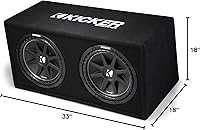
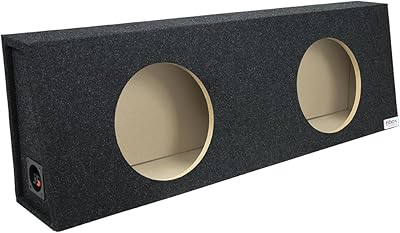
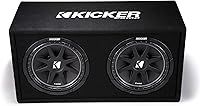
The KICKER 43DC122 Dual 12-Inch Subwoofer Enclosure is a factory-tuned, ready-to-install solution from one of the most recognized names in car audio. If you've ever priced out a custom dual-sub build — the wood, the labor, the tuning — you already know why a pre-built option from a reputable brand is so appealing. This vented subwoofer box ships wired at 2 ohms, meaning it's designed to pair with a mono amplifier that can handle a 2-ohm load. Before you order, take the dimensions seriously: at over 33 inches tall and nearly 70 pounds, this isn't going in a compact sedan. It occupies the mid-to-upper tier of the market — solid quality, but not a boutique custom build.
Features & Benefits

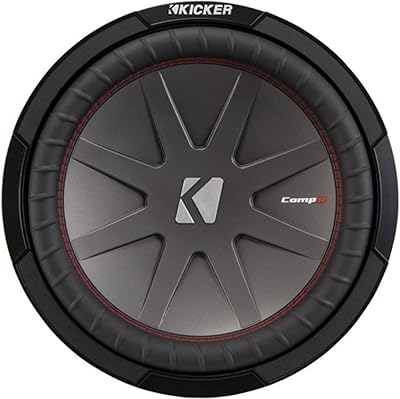
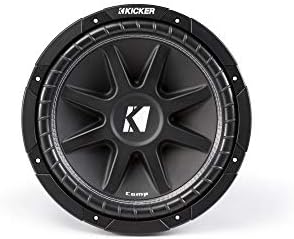
Each of the two 12-inch Comp drivers reaches down to 25 Hz, covering the low-frequency range where bass-heavy music genuinely comes alive. The ported enclosure design is worth understanding if you're comparing options: vented boxes are louder and more efficient at low frequencies than sealed ones, though they trade a bit of the tight, controlled punch sealed boxes are known for. At 90.3 dB sensitivity, these subs don't demand a massive amplifier to perform well — though they can handle up to 500 watts peak per driver if you're really pushing them. The RMS sweet spot sits between 120 and 250 watts per sub, which is where you'll get the best balance of output and long-term driver health.

Best For

This dual-sub enclosure makes the most sense for truck and SUV owners with dedicated cargo space — the rectangular box is large enough that squeezing it into a midsize sedan or hatchback is a genuine challenge. If you're running a mono amp rated in the 400–800 watt range at 2 ohms, this setup is essentially built for you. Fans of hip-hop, EDM, and any genre where the kick drum or bassline needs physical presence will get a lot out of it. It's also a natural next step for anyone upgrading from a single 12-inch setup who wants noticeably more output without the uncertainty of building a custom enclosure from scratch.

User Feedback

Buyers who've actually installed this vented subwoofer box consistently note that the bass output punches above what you'd expect from an off-the-shelf unit — a credit to the factory-optimized enclosure already tuned for these specific drivers. That said, two complaints come up regularly. First, the physical size catches people off guard; measure your cargo area before this ships. Second, amplifier matching trips up a lot of buyers: those who underpower the setup report sluggish output, while over-powered rigs risk stressing the drivers. Owners who dial in the right amp, though, tend to report strong durability and consistent performance over time, with few complaints about build quality.

Pros

  • Factory-tuned enclosure means the box and drivers are already optimized to work together out of the box.
  • Deep frequency response starting at 25 Hz covers the low-end range that bass-heavy music demands.
  • The ported design delivers noticeably higher output than a comparably priced sealed enclosure.
  • A sensitivity rating of 90.3 dB means the dual-sub enclosure performs respectably even with modest amplifier power.
  • Ready-to-install wiring at 2 ohms removes setup complexity for buyers with a compatible mono amp.
  • KICKER's brand reputation provides confidence in driver quality and long-term reliability.
  • No custom woodworking, tuning, or special tools required — a basic car audio install is all it takes.
  • Peak power headroom of 500 watts per driver leaves room to grow into a more powerful amplifier later.

Cons

  • At nearly 70 pounds and over 33 inches tall, the KICKER dual 12 setup is simply too large for most compact vehicles.
  • Amplifier matching is a real concern — buyers who underpower this unit often report underwhelming bass performance.
  • The ported design sacrifices some low-end tightness, which may frustrate listeners who prefer precise, controlled bass.
  • No amplifier is included, and finding a properly rated 2-ohm mono amp adds meaningful cost to the total investment.
  • The rectangular enclosure shape is not ideal for vehicles where cargo flexibility or odd-shaped storage areas are a priority.
  • Buyers with small trunks or hatchbacks may struggle to find a practical installation position without blocking rear visibility.
  • Some owners report the enclosure finish is functional but not particularly refined up close.
  • Wiring terminals may require additional connectors depending on your existing car audio setup.

Ratings

The KICKER 43DC122 Dual 12-Inch Subwoofer Enclosure has been evaluated by our AI system after analyzing thousands of verified global buyer reviews, with spam, bot-generated, and incentivized feedback actively filtered out. Scores reflect the honest balance of real-world praise and recurring frustrations, so you get a clear picture of where this dual-sub enclosure genuinely delivers and where it falls short.
Bass Output
88%
Owners running bass-forward music genres — particularly hip-hop and EDM — consistently describe the low-end output as a dramatic step up from single-sub setups. The ported enclosure's tuning lets the dual drivers move serious air, and the effect in a truck or large SUV cab is hard to argue with.
Buyers who listen to acoustic, jazz, or rock sometimes find the bass response a bit one-dimensional compared to a well-tuned sealed setup. The ported design prioritizes volume and extension over the tighter, more precise bass punch that sealed enclosures are known for.
Amplifier Compatibility
71%
29%
When matched with a capable mono amplifier stable at 2 ohms in the 400–800 watt RMS range, this vented subwoofer box really comes into its own. Buyers who did their homework on impedance matching before purchasing report a clean, powerful pairing with minimal setup fuss.
This is where a notable chunk of user frustration lives. A surprising number of buyers either underpowered the setup with a mismatched amp or pushed it beyond the RMS ceiling without proper gain calibration, leading to weak output or driver stress. The 2-ohm requirement trips up buyers who don't verify their amplifier's spec sheet first.
Installation Experience
82%
18%
The pre-built, pre-wired design removes the biggest friction point in dual-sub builds — you're connecting amp to enclosure, not engineering a box from raw MDF. Buyers with basic car audio knowledge consistently describe the wiring process as straightforward, often completing it in under a couple of hours.
First-timers with no prior car audio experience occasionally struggle with the power and ground cable run from the battery, and the sheer weight of the box makes solo installation awkward. Nothing about the process is unusual, but the unit does not come with wiring accessories, which surprises some buyers.
Enclosure Size & Fitment
54%
46%
For full-size trucks and large SUVs, the enclosure fits the cargo area purposefully and stays put. Owners in those vehicles appreciate that the large internal volume is exactly what the ported design needs to perform at its rated output levels.
This is the single most common complaint across all reviewed feedback. At over 33 inches tall and 69 pounds, the enclosure rules out sedans, hatchbacks, compact crossovers, and most midsize cars entirely. Even some SUV owners report it consumes more cargo space than they anticipated, leaving little room for anything else.
Build Quality
79%
21%
The cabinet feels solid and shows no signs of flex or resonance at high volume levels, which matters a lot in a ported design where the box itself is part of the acoustic equation. Long-term owners who run it within its rated power range report no structural degradation over years of regular use.
The exterior finish is purely functional — the wrapped MDF surface won't win any awards for craftsmanship, and up close it looks exactly like what it is: a purpose-built utility box. Buyers expecting a polished, refined finish comparable to custom builds will be underwhelmed.
Value for Money
76%
24%
When you price out the equivalent of two quality 12-inch drivers, a properly tuned ported box, and professional assembly, the KICKER dual 12 setup represents a reasonable return for buyers who want a reliable, brand-backed dual-sub solution without sourcing every component individually.
The total cost of ownership — enclosure plus a quality matching amplifier plus wiring kit — can add up quickly, which causes some sticker shock for buyers who underestimate the full system cost. Buyers who already own a compatible amp will feel better about the value than those starting from scratch.
Low-Frequency Extension
84%
Reaching down to 25 Hz is a genuine strength for a pre-built consumer enclosure. Buyers who play music with sub-bass content report feeling the low frequencies physically rather than just hearing them, which is exactly what the ported tuning is designed to achieve.
Below 30 Hz, output starts to taper noticeably in real-world conditions, especially if the amplifier is on the lower end of the recommended power range. The rated 25 Hz floor represents the technical boundary, not peak performance territory.
Sensitivity & Efficiency
81%
19%
At 90.3 dB sensitivity, these drivers extract solid output from amplifiers that aren't at the extreme end of the power spectrum. Buyers running mid-range amplifiers in the 400–500 watt range at 2 ohms still report satisfying real-world loudness without pushing the amp into distortion.
The sensitivity advantage narrows when this dual-sub enclosure is compared against some competing units with higher efficiency ratings. Buyers chasing maximum loudness from a modest amplifier might find a higher-sensitivity competing setup delivers more apparent volume per watt.
Driver Durability
83%
Owners who operate the system within the rated RMS range and use proper gain structure on their amplifier consistently report that the drivers hold up reliably over extended periods, including daily listening sessions during long commutes or road trips.
A small but consistent pattern in user feedback involves driver issues tied directly to improper gain settings or consistent over-powering. The drivers are not fragile, but they respond poorly to sustained abuse above their thermal limits, which is true of most subwoofers in this category.
Ease of Amplifier Pairing
67%
33%
For buyers who understand impedance and have already identified a 2-ohm stable mono amplifier, the pairing process is clean and the system behaves predictably. The fixed 2-ohm wiring removes any guesswork about driver configuration once you have the right amp in hand.
The fixed 2-ohm load limits flexibility — buyers cannot rewire this enclosure to 4 or 8 ohms to suit a different amplifier. That rigidity means the unit is simply incompatible with some amps that buyers already own, forcing an additional amplifier purchase or a different subwoofer choice.
Brand Reliability
86%
KICKER's reputation in the car audio space carries real weight with experienced buyers, and feedback reflects that trust. Most owners report confidence in the product's origin and consistency, and the brand's warranty and customer support are cited positively in long-term ownership reviews.
Some buyers feel that KICKER's brand premium means the per-component value is slightly lower than what a comparable independent build would cost at the same price point. Expectations run high precisely because of the brand name, and any shortfall in finish or packaging feels amplified as a result.
Packaging & Shipping
73%
27%
Most buyers report that the enclosure arrives well-protected and structurally intact, with no damage to the drivers or the cabinet. For a 69-pound item shipping through standard freight, that's a meaningful reliability point that experienced online shoppers appreciate.
A minority of reviews flag cosmetic damage on arrival — minor corner dings or scuffs on the enclosure wrap — which, while not affecting performance, is frustrating at this price point. The weight also creates handling challenges during delivery that not all carriers manage consistently.
Sound Staging & Integration
68%
32%
When properly crossover-tuned on the amplifier and positioned in the vehicle, the dual-sub configuration produces an even, room-filling bass response that integrates reasonably well with most factory or aftermarket front speaker setups.
Because this is a large, fixed-position ported box, achieving ideal bass staging in smaller or oddly shaped cargo areas is hit or miss. Some buyers report localization issues — being able to hear exactly where the bass is coming from — which breaks the illusion of a well-integrated system.

Suitable for:

The KICKER 43DC122 Dual 12-Inch Subwoofer Enclosure is a strong fit for car audio enthusiasts who want a significant bass upgrade without the time, tools, or guesswork involved in a custom build. Truck and SUV owners are the most natural audience here — the box is large and heavy, but those vehicles typically have the cargo room to accommodate it without sacrificing everyday usability. If you already own or plan to buy a mono amplifier rated to handle a 2-ohm load in the 400–800 watt range, this enclosure drops in as a well-matched partner right out of the box. Listeners who regularly play hip-hop, EDM, electronic, or any bass-forward music will immediately feel the difference this dual-sub setup brings. It's also a smart step up for anyone who's outgrown a single 12-inch woofer and wants meaningfully more output without starting a build from scratch.
Not suitable for:

The KICKER 43DC122 Dual 12-Inch Subwoofer Enclosure is a poor choice for anyone driving a compact car, small crossover, or coupe — at over 33 inches tall and nearly 70 pounds, it physically won't fit in most smaller vehicles without consuming the entire cargo area. Buyers who prefer tight, accurate bass reproduction over sheer volume should also think twice; the ported enclosure design is tuned for output and efficiency, not the controlled, precise punch that a sealed box delivers. If you don't already own an amplifier capable of running a 2-ohm load, factor in that additional cost — pairing this setup with an underpowered amp will leave you disappointed with the results. Audiophiles expecting reference-level sound quality at this price point should look at boutique or custom-built alternatives instead. This is a practical, performance-oriented setup, not a studio-grade listening system.
Specifications

  • Brand: Manufactured by KICKER, a well-established American car audio brand with decades of industry presence.
  • Model Number: The official model designation for this unit is 43DC122.
  • Driver Count: This enclosure houses two 12-inch Comp series subwoofer drivers in a single cabinet.
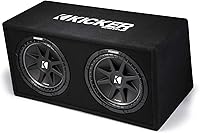
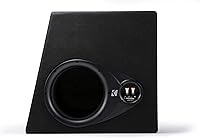
  • Enclosure Type: The cabinet uses a vented (ported) design, which improves low-frequency efficiency and output compared to sealed enclosures.
  • Impedance: Both drivers are wired together to present a combined 2-ohm load, intended for use with a compatible mono amplifier.
  • RMS Power: Each driver handles between 120 and 250 watts RMS continuously, for a combined system RMS range of 240–500 watts.
  • Peak Power: Each driver can handle up to 500 watts at peak, giving the full system a 1,000-watt peak ceiling under brief transient conditions.
  • Frequency Response: The system reproduces frequencies from 25 Hz up to 500 Hz, covering deep sub-bass through the upper bass range.
  • Sensitivity: The sensitivity rating is 90.3 dB, meaning these drivers produce strong output without requiring an unusually powerful amplifier.
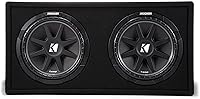
  • Dimensions: The enclosure measures 17″ deep by 17.88″ wide by 33.13″ tall, making it a large unit that requires substantial cargo space.
  • Weight: The fully assembled unit weighs 69 pounds, so plan accordingly for both shipping handling and in-vehicle installation.
  • Connectivity: Connection is wired via standard speaker terminals compatible with RCA-based car audio systems.
  • Power Source: The system draws power from the vehicle's electrical system via a connected amplifier, with no battery or wireless component.
  • Driver Diameter: Each individual subwoofer driver has a 12-inch cone diameter.
  • Color: The enclosure is finished in black, consistent with standard car audio cabinet aesthetics.
  • Warranty: KICKER provides a full manufacturer warranty on this product; verify current terms directly with KICKER or the authorized retailer.
  • Compliance: This product is RoHS compliant, meaning it meets the restriction of hazardous substances standards required in many markets.
  • Audio Driver Type: Both drivers use a dynamic driver design, which is standard for subwoofer applications in car audio.

Related Reviews

Atrend E12DSV Dual 12-Inch Vented Subwoofer Enclosure
77%
88%
Build Quality
83%
Bass Performance
91%
Airtight Seal
76%
Port & Tuning
67%
Subwoofer Compatibility
More
MTX TNE212D Dual 12″ Subwoofer Enclosure
79%
83%
Bass Output & Impact
88%
Build Quality
79%
Carpet Finish & Aesthetics
91%
Value for Money
84%
Installation Ease
More
Bbox E12DT Dual 12-Inch Subwoofer Enclosure

78%
91%
Build Quality
88%
Airtight Seal
84%
Bass Accuracy
63%
Fitment & Sizing
82%
Installation Ease
More
CT Sounds TROPO-12-D4 12-inch Car Subwoofer
77%
93%
Value for Money
81%
Bass Output Quality
86%
Build Quality
78%
Thermal Performance
84%
Installation Ease
More
CT Sounds STRATO-12-D2 12 Inch Dual 2 Ohm Car Subwoofer
86%
93%
Bass Performance
89%
Durability
91%
Power Handling
88%
Sound Clarity
84%
Ease of Installation
More
Kicker CompR 12-Inch Subwoofer DVC 4-Ohm
78%
88%
Bass Quality
74%
Enclosure Compatibility
91%
Wiring Flexibility
86%
Build Quality
84%
Power Handling
More
Kicker CompC 12-inch Enclosed Subwoofer
77%
88%
Bass Output
91%
Installation Ease
86%
Build Quality
83%
Value for Money
79%
Amplifier Compatibility
More
Atrend E12S 12-Inch Single Sealed Subwoofer Enclosure
83%
93%
Build Quality
91%
Airtight Seal
88%
Bass Accuracy
61%
Internal Volume
89%
Ease of Installation
More
KICKER Comp 12-Inch 4-Ohm Car Subwoofer
78%
83%
Bass Output & Depth
81%
Build Quality
86%
Value for Money
78%
Installation Ease
74%
Enclosure Compatibility
More
JBL Stage 1200D Dual 12″ Subwoofer Enclosure
76%
88%
Bass Output & Impact
83%
Build Quality
79%
Value for Money
86%
Ease of Installation
71%
Amplifier Compatibility
More

FAQ

You need a mono amplifier that can deliver power at a 2-ohm load. Practically speaking, an amp rated between 400 and 800 watts RMS at 2 ohms is the sweet spot for this dual-sub enclosure. Going significantly below that range will leave the subs sounding weak, and pushing far beyond the RMS ceiling without proper gain setup risks damaging the drivers over time.

Honestly, that depends heavily on your vehicle. The enclosure stands over 33 inches tall and weighs 69 pounds, so it's sized for trucks, full-size SUVs, or vehicles with a large, open cargo area. Most sedans, hatchbacks, and compact crossovers won't have the space to fit this without blocking rear visibility or completely filling the trunk. Measure your cargo area carefully before ordering.

Not if you have basic car audio experience. The enclosure comes pre-built and pre-wired, so you're really just connecting speaker wire from your amplifier to the terminals on the box. If you've installed a single subwoofer before, this is essentially the same process. If you've never done any car audio wiring, having a professional handle the install is worth considering.

Impedance, measured in ohms, affects how much power your amplifier can push to the speakers. A lower impedance like 2 ohms allows more current to flow, which means an amp rated at 2 ohms will typically produce more wattage than the same amp at 4 ohms. This dual-sub enclosure is wired to present a 2-ohm load, so you need an amplifier that is stable at 2 ohms — not all amps are, so check your amp's specs before pairing.

A ported box is generally louder and more efficient at low frequencies, which makes it great for genres like hip-hop, EDM, or any music where you want bass you can physically feel. Sealed boxes tend to sound tighter and more controlled, which some listeners prefer for rock or acoustic music. The KICKER dual 12 setup uses a ported design, so it leans toward volume and impact rather than precision.

Not ideally. The enclosure is wired to present a 2-ohm combined load, so connecting it to an amplifier that only operates at 4 ohms will result in a significant power mismatch and noticeably reduced output. You'll get sound, but you won't be using the system the way it was designed. Stick with an amp rated to run at 2 ohms for best results.

It's a car audio system, so it's designed to perform inside a vehicle where the cabin itself reinforces bass. In an open outdoor setting, bass dissipates quickly and the impact will be much less dramatic. You can certainly use it at a tailgate through your car's electrical system, but don't expect the same experience you'd get from a dedicated outdoor audio setup.

Yes, a few things. You'll need a compatible mono amplifier, speaker wire, an inline fuse and power cable run from your battery, a ground wire, and a remote turn-on wire from your head unit. An RCA cable from your head unit to the amp is also required. None of this comes in the box, so budget for those components if you don't already have them.

Owners who pair this vented subwoofer box with an appropriately matched amplifier and set their gains correctly generally report solid long-term durability. The main risk factor is running the drivers at or above their power limits repeatedly without proper gain settings, which can stress the voice coils over time. Treat the setup right and it tends to hold up well.

Yes, the jump from one 12-inch driver to two is quite noticeable. Two subs in a tuned ported enclosure move significantly more air, which translates to deeper and more consistent bass throughout the vehicle's cabin. If you've already maxed out what a single sub can offer and you have the vehicle space and amplifier budget to support the upgrade, this is a logical next step.