Overview

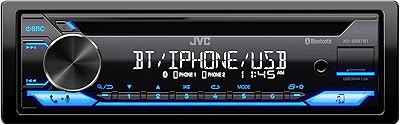
The JVC KD-X280BT Single DIN Car Stereo Receiver is JVC's answer to the growing crowd of drivers who want modern Bluetooth connectivity without paying for a touchscreen they may not need. It fits the classic single DIN slot found in older trucks, sedans, and SUVs where double DIN units simply won't go. JVC has been a fixture in car audio for decades, and this head unit sits comfortably in their mid-range — honest performance at a fair price. The detachable faceplate is a practical nod to theft deterrence. Just know going in: no Apple CarPlay, no touchscreen, no CD drive. It trades those for simplicity and solid core features.
Features & Benefits

The KD-X280BT connects to two phones simultaneously via Bluetooth — handy if you and a passenger both want to stay reachable without swapping connections mid-drive. The included mic handles hands-free calling without requiring extra purchases. On the audio side, the 13-band EQ paired with K2 Technology is worth understanding: K2 reconstructs high-frequency detail stripped away during digital compression, so your MP3s sound noticeably closer to the source recording. The USB port charges at 1.5A, keeping your phone alive on longer trips. One real limitation: the wireless Pandora and Spotify controls only work with Android — iPhone users can still stream over Bluetooth but lose in-dash app control entirely.

Best For

This single DIN receiver is a natural fit for anyone pulling out an old factory head unit from a late-90s or 2000s-era vehicle where a double DIN simply won't slot in. Android users who rely on Pandora or Spotify will get the most out of it, since the wireless app integration actually works as advertised on that platform. If you already run a local music library on a USB drive or just plug in your phone, the broad format support — including FLAC — is genuinely useful. It also suits anyone planning to add an external amplifier, thanks to the 2.5V preamp outputs. iOS users and anyone expecting CarPlay should look elsewhere.

User Feedback

Sitting at 4.2 stars from over 300 ratings, the KD-X280BT earns its marks primarily through straightforward installation and reliable day-to-day Bluetooth performance — two things buyers tend to care about most. The LCD display draws consistent praise for readability in direct sunlight. Where things get more mixed: a notable number of iPhone owners flag frustration that wireless Spotify and Pandora controls don't extend to iOS. Some buyers also feel the physical button interface looks dated when touchscreen rivals exist at only a modest price jump. Wiring harness compatibility comes up occasionally too, so checking vehicle fitment before purchasing is genuinely worth a few minutes of research.

Pros

  • Fits single DIN slots cleanly — ideal for older vehicles where double DIN units simply won't go.
  • Dual-phone Bluetooth pairing means two people can stay connected without constantly swapping devices.
  • K2 Technology genuinely improves the sound of compressed audio files, not just a marketing label.
  • The 13-band EQ gives real tuning flexibility, well beyond the basic bass and treble found on cheaper units.
  • USB port charges at 1.5A, so your phone actually gains battery on long drives instead of slowly draining.
  • FLAC file support is a nice bonus for listeners who store high-resolution audio on a USB drive.
  • Detachable faceplate is a practical anti-theft measure that takes seconds to use and costs nothing extra.
  • Included hands-free mic works reliably out of the box — no additional accessories needed for calls.
  • 2.5V preamp outputs make it a capable base unit for anyone building a system with an external amplifier.
  • JVC brand reliability offers meaningful peace of mind over anonymous budget alternatives at a similar price.

Cons

  • Wireless Spotify and Pandora controls are Android-only — iPhone users get basic Bluetooth streaming, nothing more.
  • No Apple CarPlay or Android Auto support, which is a hard dealbreaker for many modern drivers.
  • The physical button interface looks and feels dated compared to touchscreen rivals in a similar price range.
  • No CD drive, and there is no way to add one — buyers with large disc collections need to plan accordingly.
  • Wiring harness compatibility can vary by vehicle, requiring an adapter that adds cost and installation time.
  • Voice recognition depends entirely on your phone — the unit itself has no onboard voice assistant.
  • The LCD display, while readable, lacks the visual appeal and intuitiveness of even entry-level touchscreen units.
  • Peak power rating of 50W per channel is a marketing figure; real-world output is considerably lower.

Ratings

Our AI rating system analyzed verified buyer reviews for the JVC KD-X280BT Single DIN Car Stereo Receiver from multiple global sources, actively filtering out incentivized, duplicate, and bot-generated feedback to surface what real drivers actually experience. The scores below reflect both the genuine strengths and recurring frustrations reported by owners across a range of vehicles and use cases. Nothing here is rounded up to look good — the pain points are represented just as honestly as the praise.
Bluetooth Performance
83%
Most owners report a stable, consistent Bluetooth connection that pairs quickly on startup and rarely drops during daily commutes or longer highway drives. The dual-phone pairing is genuinely useful for couples or anyone who switches between a work and personal device.
A subset of users note occasional lag when switching between audio and call modes, and the Android-only limitation for Spotify and Pandora wireless control frustrates a meaningful portion of the buyer base who use iPhones.
Sound Quality
78%
22%
The 13-band EQ gives experienced listeners real control over the sound profile, and JVC's K2 Technology does a noticeable job of filling in the high-frequency detail that MP3 compression removes — particularly appreciated by drivers who store music locally on USB drives.
At flat or default EQ settings, the out-of-box sound can feel a bit hollow, requiring some manual tuning to get the best out of it. The 50W peak rating is a ceiling figure and real-world output to factory speakers is more modest than that number implies.
Ease of Installation
81%
19%
Buyers with basic DIY experience consistently describe the physical installation as uncomplicated — the unit slides into a standard single DIN slot cleanly, and the wiring layout is logically organized. For those who've done even one head unit swap before, the process is usually under an hour.
First-timers frequently discover they need a vehicle-specific wiring harness adapter that isn't included, which adds cost and a separate research step. A few owners of certain vehicle models report minor fitment issues with the surrounding trim panel.
Value for Money
86%
At its price point, the KD-X280BT delivers a feature set — dual Bluetooth pairing, K2 processing, 13-band EQ, FLAC support, and a detachable faceplate — that would cost meaningfully more from competing brands. Buyers upgrading aging factory radios consistently describe it as money well spent.
The value argument weakens slightly for iPhone users who lose the app control feature, and for anyone comparing it to touchscreen units that are only a modest step up in price and offer a substantially more modern interface.
Interface & Usability
62%
38%
The physical buttons are tactile and responsive, and drivers who prefer not to look at a screen while driving actually appreciate having dedicated controls they can operate by feel after a short learning curve.
The menu navigation feels dated compared to modern touchscreen rivals, and new users often find the initial setup process — particularly EQ configuration and Bluetooth pairing — requires a careful read of the manual. The LCD, while clear, shows limited information at once.
Display Clarity
74%
26%
The high-contrast LCD is readable in most lighting conditions, including moderate direct sunlight, which is a step above the washed-out displays found on cheaper single DIN units. Track names and station info display without excessive truncation at normal scroll speeds.
At night, some users find the display brightness either too dim at lower settings or slightly distracting at higher ones, with limited granularity in the brightness adjustment. The display simply can't match the visual clarity or information density of even entry-level touchscreen units.
Hands-Free Calling
76%
24%
Call quality is consistently described as clear enough for practical use, and the included microphone means there's no additional purchase required to get hands-free functionality working on day one. Voice recognition passthrough to the phone works reliably for dialing.
Microphone placement matters significantly — owners who mount it near the sun visor report better results than those who tuck it closer to the dash. In noisy vehicle cabins or at highway speeds, callers on the other end occasionally report hearing wind interference.
USB Functionality
79%
21%
The front-facing USB port handles large flash drives without issue and supports FLAC playback, which is a genuine plus for listeners with high-resolution audio libraries. The 1.5A charging rate is enough to meaningfully top up a phone during a commute rather than just slow the drain.
There is no rear USB input, which limits mounting flexibility for those who prefer to hide cables. Navigation through large USB libraries with many nested folders can be slow, and some users report the unit struggles to organize libraries the way a phone or dedicated player would.
App Integration
57%
43%
For Android users running Pandora or Spotify, the wireless in-dash control works as advertised — changing tracks and adjusting volume without touching the phone is a practical convenience on daily drives.
The Android-only limitation is a real and recurring source of frustration that affects a large portion of the buyer base. iOS users receive no equivalent functionality, and there is no indication this gap will be bridged through a firmware update, making it a permanent limitation rather than a temporary one.
Build Quality
72%
28%
The chassis feels solid for the price tier, and the faceplate mechanism — both the detach button and the reattachment click — operates smoothly without any obvious flex or looseness after repeated use. JVC's manufacturing consistency is generally reliable at this level.
The front panel plastics have a budget feel up close, and the overall aesthetic is functional rather than premium. A few long-term owners have noted the button labels can show wear after extended daily use in high-humidity or high-temperature vehicle environments.
Detachable Faceplate
82%
18%
The faceplate pops off and reattaches in seconds, and drivers who park in urban areas genuinely use it as a daily theft deterrent. It stores flat enough to slip into a glovebox or center console without adding bulk.
Buyers who park in secure locations find it more of a minor inconvenience than a useful feature and tend to leave it on permanently. Over time, the release mechanism can develop a slight looseness, though this appears to be a long-term wear issue rather than a defect out of the box.
Format Compatibility
88%
Support for MP3, WMA, WAV, AAC, and FLAC from USB covers virtually every format a consumer music library is likely to contain, and FLAC support in particular stands out as uncommon at this price tier. Buyers who have moved away from streaming and maintain local libraries find this especially valuable.
There is no support for video files or streaming from cloud storage services beyond the Bluetooth app integration, which is expected at this price but worth noting for buyers who want a more versatile media player.
AM/FM Tuner
71%
29%
Signal reception is described as solid in most urban and suburban environments, with clean audio on strong stations and a preset memory that holds favorites reliably across power cycles. For drivers who still rely on talk radio or local stations, it covers the basics well.
In rural areas or regions with weaker broadcast signals, reception sensitivity is average rather than impressive, and a few users coming from higher-end OEM radios notice a drop in weak-signal performance. There is no HD Radio or satellite radio capability.
Preamp Output Quality
84%
The 2.5V rear and subwoofer preamp outputs deliver a clean, low-noise signal that audio hobbyists running external amplifiers consistently praise. For a head unit at this price, having usable preamp outputs at all is genuinely uncommon and adds real long-term upgrade flexibility.
There are only two preamp output channels, which limits routing options for more complex multi-amplifier setups. Audiophiles running high-end amplification chains may find the 2.5V output level on the lower end compared to aftermarket units specifically marketed for amplifier integration.

Suitable for:

The JVC KD-X280BT Single DIN Car Stereo Receiver is a strong match for drivers upgrading an older vehicle that only has a single DIN opening in the dash — think late-90s and 2000s-era trucks, sedans, and SUVs where a double DIN unit physically won't fit. If you've already ditched CDs in favor of streaming from your phone or playing music off a USB drive, this head unit covers all of that without asking you to pay for features you won't use. Android users in particular will get real value from the wireless Pandora and Spotify controls, which actually simplify in-car listening without touching your phone. The 2.5V preamp outputs make it a practical foundation for anyone planning to wire in an external amplifier down the line. And if you park in a city or anywhere theft is a concern, the detachable faceplate adds a layer of practical deterrence that budget units often skip.
Not suitable for:

The JVC KD-X280BT Single DIN Car Stereo Receiver is the wrong call for anyone who relies on Apple CarPlay or Android Auto — it supports neither, and there's no workaround. iPhone users should also know upfront that wireless Spotify and Pandora controls are Android-only; on iOS, you can still stream over Bluetooth, but you lose the in-dash app integration entirely. If your dash has a double DIN opening and you want a touchscreen interface, this unit won't fill that slot physically or functionally. Buyers who frequently listen to CDs will need to look elsewhere, since there's no disc drive and no way to add one. Finally, if you're comparing options and a touchscreen rival is only a modest price bump away, the KD-X280BT's button-based interface may feel noticeably dated by comparison.
Specifications

  • Form Factor: Single DIN chassis fits the standard 2-inch tall, 7-inch wide head unit slot found in a wide range of older and modern vehicles.
  • Dimensions: Installation dimensions measure 182 x 53 x 100mm (W x H x D), with an overall product footprint of approximately 7.19″ x 3.94″ x 2.06″.
  • Display: High-contrast LCD screen provides clear readback of track info, radio station, and menu settings, with improved legibility in direct sunlight compared to standard LCD panels.
  • Power Output: Rated at 50 watts per channel across 4 channels (peak), delivering amplified output to front and rear speakers without a separate amp.
  • Preamp Output: Two-channel preamp outputs deliver 2.5 volts (rear and subwoofer), providing a clean line-level signal for connecting an external amplifier.
  • Bluetooth: Built-in Bluetooth supports simultaneous pairing with two phones, enabling audio streaming and hands-free calling without switching connections.
  • USB Port: Front-facing USB port supports playback of compatible audio files and charges connected devices at up to 1.5 amps.
  • Audio Formats: Plays MP3, WMA, WAV, AAC, and FLAC files from USB storage devices, including lossless FLAC for higher-fidelity local libraries.
  • Equalizer: 13-band graphic equalizer with digital time alignment allows precise tuning of audio frequencies and speaker timing for a more balanced sound stage.
  • Sound Technology: JVC K2 Technology analyzes and reconstructs high-frequency detail lost during digital audio compression, improving perceived audio quality on MP3 and other lossy formats.
  • Tuner: Built-in AM and FM tuner with standard preset memory for saving favorite radio stations.
  • Aux Input: Front-facing 3.5mm auxiliary input allows wired connection of any audio source that outputs a standard headphone-level signal.
  • App Control: Wireless Pandora and Spotify control is available via Android devices only; iOS users can stream audio over Bluetooth but cannot control apps from the unit.
  • Voice Recognition: Voice dialing is supported by passing commands through to the connected smartphone's native voice recognition system.
  • Hands-Free Mic: An external microphone is included in the box and connects to the unit to enable hands-free calling without additional accessories.
  • Faceplate: The front panel is fully detachable and can be removed and stored when leaving the vehicle, reducing the visual appeal of the unit to potential thieves.
  • CD Player: This unit does not include a CD or disc player; audio playback is exclusively through USB, Bluetooth, auxiliary input, or AM/FM tuner.
  • Weight: The unit weighs approximately 1.3 pounds, making it straightforward to handle and position during installation.

Related Reviews

JVC KD-T920BTS Bluetooth CD Car Stereo Receiver
75%
88%
Bluetooth Reliability
76%
Sound Quality
83%
Ease of Installation
81%
Display Clarity
84%
Value for Money
More
Hengweili KH6610 Single-Din Car Stereo Receiver
69%
83%
Value for Money
86%
Ease of Installation
78%
CD & DVD Playback
67%
Bluetooth Performance
59%
Sound Quality
More
ABSOSO Single Din Bluetooth Car Stereo
72%
88%
Value for Money
81%
Bluetooth Performance
63%
Sound Quality
56%
Build Quality
62%
Display & Visibility
More
JVC KW-M180BT Double DIN Car Stereo Receiver
78%
81%
Touchscreen Quality
84%
Bluetooth Performance
73%
Android Integration
88%
Audio Tuning Depth
79%
Value for Money
More
JVC KW-M150BT Bluetooth Car Stereo Receiver
75%
83%
Sound Quality
79%
Touchscreen Responsiveness
86%
Bluetooth Performance
88%
Value for Money
66%
USB Compatibility
More
JVC KW-X850BTS
JVC KW-X850BTS
87%
92%
Bluetooth Stability
78%
Voice Assistant Integration
89%
Sound Customization
94%
Device Charging Speed
86%
Display Visibility
More
JVC KW-R940BTS Double DIN Car Stereo Receiver
82%
88%
Bluetooth Performance
91%
Sound Quality
61%
Display Readability
83%
Ease of Installation
87%
Value for Money
More
Mantian Single Din Car Stereo DVD Player
66%
74%
Value for Money
78%
Bluetooth Performance
51%
Build Quality
71%
Ease of Installation
76%
Media Playback
More
DWMM Single Din Bluetooth Car Stereo System
83%
87%
Ease of Installation
91%
Bluetooth Connectivity
75%
Sound Quality
89%
Value for Money
84%
User Interface & Display
More
JVC KW-R950BTS Car Stereo Receiver
79%
83%
Sound Quality
86%
Bluetooth Performance
84%
Value for Money
61%
Display Readability
88%
Multi-Device Pairing
More

FAQ

Bluetooth audio streaming and hands-free calling work fine with both iPhone and Android. The limitation is specifically with wireless Spotify and Pandora app control — that feature only works with Android devices. If you use an iPhone, you can still play music over Bluetooth, but you'll control playback from your phone rather than the head unit.

Yes, the JVC KD-X280BT Single DIN Car Stereo Receiver is designed specifically for single DIN openings — the standard 2-inch tall slot. It won't physically fit a double DIN opening without a dash kit adapter, so confirm your slot size before ordering. Most vehicles from the late 1990s through mid-2010s have single DIN or convertible dash configurations.

Almost certainly yes. The unit uses a standard ISO wiring connector, but most factory-installed stereos in North American vehicles use a proprietary connector. You'll need a vehicle-specific harness adapter — they're inexpensive and widely available — to plug into your car's existing wiring without cutting cables. Check your vehicle's year, make, and model against a harness compatibility chart before buying.

Yes, and it's actually well-suited for that. The KD-X280BT has two-channel preamp outputs running at 2.5 volts, which is a solid output level for feeding an external amp or powered subwoofer. Just connect RCA cables from the rear preamp outputs to your amplifier's inputs and you're set.

The faceplate pops off with a button press and snaps back on securely. It takes about three seconds in each direction once you're used to it. Whether it's annoying depends on your habits — if you park in a busy city and want the deterrence, it becomes second nature quickly. If you're parked in a private garage, you'll probably leave it on and forget about it.

K2 is JVC's proprietary DSP processing that attempts to restore high-frequency audio content that gets stripped out when music is compressed into MP3 or AAC format. In practice, it can make compressed audio sound a bit fuller and less flat, particularly noticeable on cymbals and higher vocal ranges. It's not a substitute for higher-quality source files, but it's a genuine improvement over doing nothing with compressed audio.

Yes, plug any USB drive into the front port and the unit will read audio files directly. Supported formats include MP3, WMA, WAV, AAC, and FLAC — that last one being particularly useful if you keep a lossless music library. Just make sure the drive is formatted as FAT32 or NTFS, and avoid drives with extremely large file counts, which can slow navigation.

Based on user feedback, the Bluetooth connectivity is one of this receiver's stronger points. Most buyers report stable connections with minimal dropout during normal use. Like any Bluetooth device, walls, interference from other wireless devices, or very large vehicles can occasionally cause hiccups, but it's not a reported pattern of concern.

It charges at 1.5 amps, which is enough to keep most phones topped up during a drive or slowly gain charge on a longer trip. It won't match a dedicated 3-amp fast charger, but it's meaningfully better than a standard 0.5A USB port. For most daily commuters, it's sufficient to keep the phone from draining while using navigation or music apps.

Generally yes, assuming you have the right wiring harness adapter and dash kit for your vehicle. The unit itself is straightforward to wire up — most of the work involves identifying the correct harness adapter for your car. JVC includes a basic wiring diagram, and there are plenty of vehicle-specific installation guides available online. If you've never done it before, budget an afternoon and watch a few tutorial videos specific to your car model.

Where to Buy