Overview

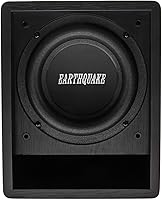
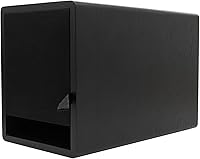
The Earthquake Sound FF6.5 6.5-Inch Subwoofer occupies an interesting niche in the powered sub market — compact enough to tuck under a desk or into a tight cabinet, yet serious enough to add real low-end weight to a home theater or custom car install. Unlike down-firing designs that rely on floor coupling and room placement, front-firing orientation pushes bass directly into the listening space, giving more predictable results regardless of surface type. The acrylic cabinet looks sharp and resists the resonance coloration you sometimes hear from MDF enclosures. Earthquake Sound isn't a household name, but among dedicated audio hobbyists it has genuine credibility. Just go in clear-eyed: a 6.5-inch driver has real physical limits and won't rattle walls the way a 10- or 12-inch sub would.

Features & Benefits

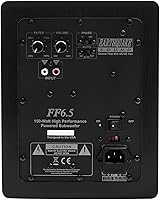
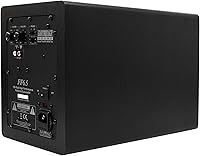
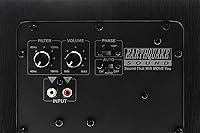
The on-board 150-watt Class AB amplifier runs warmer and draws more current than a Class D equivalent, but many listeners prefer the richer character it lends to mid-bass frequencies. The variable low-pass filter covers 40 to 180 Hz, which is genuinely useful — dial it down for full-range speakers, or open it up to fill the bottom end of small bookshelf drivers. Automatic signal detection means the FF6.5 powers on when it senses audio and shuts off during silence, a practical touch that reduces unnecessary wear. Connectivity is straightforward RCA in and out, plugging into nearly any receiver or head unit without adapters. LED indicators confirm power and signal status at a glance, a small but appreciated detail in a dark theater setup.

Best For

This front-firing sub is a strong pick for small to medium rooms where a larger subwoofer would dominate the space both sonically and physically. It works especially well paired with compact bookshelf speakers or desktop monitors that lack meaningful low-end extension — the wide crossover range means you can blend it cleanly with most two-way systems. Car audio enthusiasts building a custom install will appreciate the self-contained form factor that tucks into tight spaces where a separate amp and passive driver simply won't fit. It's also a sensible step up for anyone moving away from a soundbar setup for the first time. That said, if your speakers already reach down to 50 Hz reasonably well, the FF6.5 risks overlapping rather than supplementing.

User Feedback

With 113 ratings averaging 3.8 stars, the consensus on this compact powered subwoofer is genuinely mixed in the best way — not a disaster, not a home run. Buyers consistently praise the easy plug-and-play setup and the clean, tight mid-bass response it adds to desktop and bookshelf speaker systems. The compact footprint earns repeated mentions: people are happy to find a sub that actually fits under a desk or inside a cabinet. The frustrations are equally consistent: those expecting cavernous output below 40 Hz will be let down, and a few users flagged that the auto-detection circuit can be slow to wake or occasionally miss a weak input signal. Amplifier longevity is a minor concern in some older reviews. With a moderate review pool, this is directionally trustworthy but not conclusive.

Pros

  • Front-firing driver placement makes positioning predictable and room-friendly — no floor-coupling tricks required.
  • The wide 40 to 180 Hz crossover range pairs cleanly with almost any satellite or bookshelf speaker system.
  • Automatic signal detection handles power cycling for you, reducing manual effort and unnecessary standby energy draw.
  • At under 10 inches tall and roughly 8 inches wide, the FF6.5 tucks neatly under desks and into media cabinets.
  • RCA connectivity works out of the box with virtually every AV receiver, stereo preamp, or car head unit.
  • Class AB amplification delivers a warmer, more natural mid-bass character compared to typical budget Class D designs.
  • The acrylic cabinet resists resonance coloration and looks noticeably cleaner than standard vinyl-wrapped MDF enclosures.
  • LED status indicators let you confirm power and signal state at a glance in dimly lit setups.
  • Self-contained amplifier design means no separate external amp is needed, keeping vehicle and desktop installs straightforward.
  • Earthquake Sound has maintained parts and support availability longer than many comparably niche audio brands.

Cons

  • Bass extension drops off noticeably below 40 Hz, limiting its punch during film soundtracks heavy on deep sub-bass.
  • The 150-watt rating can be misleading — real-world output is modest and won't pressurize rooms much beyond 150 square feet.
  • Auto-detection sensitivity can be inconsistent; some users report delayed wake times or missed triggers on weak input signals.
  • No wireless connectivity of any kind, which feels like an omission at this price tier in today's market.
  • At 16.5 pounds, it is heavier than its compact dimensions suggest, which can complicate tight vehicle mounting situations.
  • Only 113 ratings exist to draw from, making long-term reliability patterns harder to assess with real confidence.
  • Amplifier durability has been flagged in several older reviews, with a handful of units developing faults after extended use.
  • Requires a 12V DC input, meaning home users depend entirely on the bundled power supply — a single point of failure.
  • No high-level speaker wire input is provided, cutting out users whose amplifiers lack a dedicated preamp or subwoofer output.

Ratings

Our AI-generated scores for the Earthquake Sound FF6.5 6.5-Inch Subwoofer were produced by analyzing verified buyer reviews from multiple global markets, with automated filtering applied to remove suspicious, incentivized, and bot-generated submissions. The ratings capture both the genuine strengths and the recurring pain points that emerged consistently across that feedback pool — nothing has been smoothed over or selectively highlighted. What you see below reflects the full picture of real ownership experience.

Bass Performance
62%
38%
For a 6.5-inch driver, the mid-bass punch is genuinely impressive — listeners pairing this with bookshelf speakers or desktop monitors consistently report a satisfying sense of weight and fullness that their main speakers alone could not deliver. The Class AB amplifier contributes a warmth to the upper bass range that works particularly well with acoustic music and vocals.
Anything below 40 Hz — the deep cinematic rumble of an explosion, the sub-bass drop in electronic music — is largely absent, and that gap becomes obvious when watching action-heavy films in even a modest living room. Buyers expecting the 150-watt rating to translate into serious depth will likely feel shortchanged compared to a 10-inch sub at a similar price.
Sound Quality
79%
21%
The Class AB amplifier gives the FF6.5 a noticeably warmer tonal character than budget Class D designs at a similar price point, and owners regularly note that mid-bass textures — kick drums, bass guitar, low piano notes — come through with good definition. Paired with the right crossover setting, it integrates cleanly without muddying the lower registers of the main speakers.
At higher volume levels some owners detect a slight boxiness or cabinet resonance, likely the result of the acrylic enclosure interacting with certain frequencies. The sub also struggles to maintain tonal composure when pushed hard in larger rooms, where the limited driver surface area becomes a more audible constraint.
Build Quality
73%
27%
The acrylic cabinet gives this compact powered subwoofer a more refined appearance than the standard vinyl-wrapped MDF boxes dominating this price tier, and the overall construction feels solid with no obvious panel flex or cheap plastics. First impressions out of the box tend to be positive, and the finish holds up well in typical home or office environments.
A handful of longer-term owners have raised questions about the integrated amplifier's durability, with a few reporting failure after a year or two of regular use. The acrylic cabinet, while visually appealing, shows fingerprints and minor scuffs more readily than matte-finish alternatives — a real consideration for desk setups where the unit is handled frequently.
Value for Money
69%
31%
For a first-time home theater upgrader who has never owned a dedicated subwoofer, the FF6.5 delivers a clear and immediate improvement over a soundbar or satellite-only setup without requiring a major financial commitment. The self-contained design — amplifier included — removes the need to budget separately for a power amp, which keeps the total system cost manageable.
More experienced buyers who compare it against similarly priced 8- or 10-inch competitors may feel the value equation tips the other way, since larger drivers at similar prices offer noticeably more bass extension. The limited review pool also makes it harder to assess whether long-term reliability fully justifies the investment versus more established sub brands.
Ease of Setup
87%
Buyers consistently describe setup as one of this front-firing sub's clearest strengths — a single RCA cable, a power supply connection, and a crossover adjustment is all it takes. There are no firmware updates, app pairing, or calibration tools to wrestle with, making it a particularly welcoming option for buyers adding a dedicated subwoofer to their system for the first time.
The only real setup friction comes from the auto-detection circuit, which some users find can be slow to recognize a signal or fail to wake from a low-level input. Buyers without a dedicated subwoofer output on their amplifier will also need a Y-splitter or line-level converter — a minor but non-obvious hurdle for newcomers.
Placement Flexibility
83%
The front-firing driver is a genuine advantage in tight quarters — unlike down-firing subs, sound output stays consistent whether the unit sits on hardwood, carpet, or inside a media cabinet. Owners in small apartments have specifically praised how little room experimentation the placement required compared to conventional designs they had used previously.
The lack of any adjustable feet or isolation pads means that on hard surfaces the unit can transmit noticeable vibration into the furniture or shelf it sits on, particularly at higher volume settings. There is also no wall-mount option, so placement is strictly floor or surface-based — a real constraint in very tight layouts.
Amplifier Character
76%
24%
Class AB operation gives this compact powered subwoofer a warmer, more organic tonal character compared to the leaner output of Class D designs, which many listeners find more pleasing with acoustic instruments, jazz, and classic rock. The amp runs warm to the touch under normal use but does not generate the kind of heat that would concern most users in typical home environments.
The Class AB design draws more standby current than modern Class D counterparts, which is a minor but real inefficiency over long run times. A small number of owners have also flagged intermittent distortion at higher gain settings, suggesting the amp section performs better at moderate listening levels than under sustained high-output use.
Crossover Control
84%
The 40 to 180 Hz variable filter is among the widest in this class, and owners pairing it with systems ranging from tiny desktop satellites to larger bookshelf speakers consistently find a workable blend point. Users who have moved it between a desktop rig and a living room TV setup particularly appreciate having that range of tuning flexibility available.
The filter dial is analog and lacks detents or clear markings beyond the frequency endpoints, so finding and repeating an exact crossover setting after repositioning the unit is largely guesswork. There is also no phase adjustment control, which leaves users in rooms where phase tuning would help without any remedy.
Auto-Detection
58%
42%
When it works well — which is the majority of the time with strong input signals from AV receivers and head units — the auto-detection feature adds genuine convenience, sparing users the need to manually power the sub on and off. For most buyers, initial setup is smooth and the auto-on behavior performs exactly as described.
A recurring theme in user reviews is that the detection circuit can be slow to respond — some describe a noticeable delay before the sub joins in after audio starts, which is particularly apparent during quiet film openings. A small but vocal group also reports that the unit occasionally fails to detect weak signals at all, requiring a manual workaround.
Connectivity
67%
33%
RCA connectivity is the universal standard across home audio and car audio equipment, and nearly every AV receiver, stereo preamp, and aftermarket head unit has a compatible line-level output. For users building a traditional wired system, this approach keeps setup friction to an absolute minimum and avoids any pairing or compatibility headaches.
There is no high-level speaker wire input, which rules out use with integrated amplifiers and receivers that lack a dedicated preamp output — a common scenario with older or budget stereo equipment. The absence of any wireless option also stands out at this price point, where Bluetooth-enabled competitors are becoming increasingly common.
Cabinet Aesthetics
77%
23%
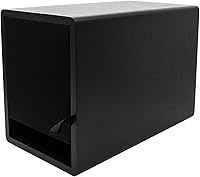
The acrylic cabinet gives the FF6.5 a more distinctive, modern look than the ubiquitous black-box MDF subwoofers this price tier is flooded with, and for desk setups where the unit is visible that visual difference is genuinely appreciated. The clean rectangular profile keeps it unobtrusive even when placed openly on a media console or shelf.
The glossy acrylic surface picks up fingerprints noticeably and requires more frequent wiping than a matte-finish cabinet would — a real consideration for desk setups where the unit is within arm's reach. Some users also note that the all-black finish makes the product look nearly identical to budget alternatives, which diminishes the premium impression the acrylic material is meant to convey.
Compact Footprint
91%
At 7.7 inches wide and under 10 inches tall, this compact powered subwoofer fits in spaces that simply reject larger alternatives — under a computer desk, inside a media rack opening, or in a vehicle footwell without blocking sight lines. Users frequently cite the footprint as the single deciding factor that made the purchase make sense for their specific situation.
At 16.5 pounds, the unit is noticeably heavier than its compact dimensions suggest, which surprises buyers expecting something lightweight and easy to reposition frequently. The narrow driver also means that while the cabinet is physically small, bass output cannot keep pace with much larger subs — compactness is a genuine trade-off, not a free benefit.
Long-term Durability
61%
39%
Under normal use conditions — moderate volume levels, typical indoor temperatures, and no physical abuse — the majority of owners report no issues through the first year or so of ownership. The wired-only design has fewer potential failure points than Bluetooth-equipped alternatives, and the basic circuit layout is not inherently fragile.
A notable minority of reviews — particularly from buyers who have owned the unit for more than 18 months — describe amplifier failures or degraded output, suggesting the internal amp may not be built for sustained high-duty-cycle use. With only 113 total ratings in the pool, the true long-term failure rate remains statistically difficult to assess with real confidence.
Noise Floor
70%
30%
In typical listening environments with moderate ambient room noise and normal listening distances, this front-firing sub operates without any intrusive self-noise, and the clear majority of owners make no mention of hiss or hum in their reviews — a reasonable baseline expectation that is met here.
A small number of users — particularly those with high-sensitivity desktop monitors in very quiet rooms — report a faint hiss during silent passages when seated close to the unit. The Class AB topology, which keeps the output stage partially conducting at idle, is the likely contributor, and it becomes more apparent when the gain dial is set high.
Brand & Support
63%
37%
Earthquake Sound has been in the audio market long enough to have built a genuine, if modest, community of enthusiasts who share troubleshooting advice and setup tips in online forums. The brand's longevity relative to fly-by-night audio labels gives some confidence that support and replacement parts remain accessible should something go wrong.
Earthquake Sound is absent from most mainstream retail channels, meaning warranty claims and service requests require direct brand contact rather than a convenient local option — a friction point when something does fail. Online support resources are sparse compared to larger audio brands, and the warranty documentation included in the box offers limited clarity on how to initiate a claim.

Suitable for:

The Earthquake Sound FF6.5 6.5-Inch Subwoofer is a smart buy for anyone who needs meaningful bass reinforcement without dedicating significant floor space to the hardware. It is particularly well-matched to desktop listening rigs and bookshelf speaker systems that roll off around 80 to 100 Hz — the wide crossover range gives you real tuning headroom to blend cleanly with most two-way speakers. Apartment dwellers and home theater builders working within tight room dimensions will appreciate a sub that slides under a media console or desk without demanding a dedicated corner. Car audio enthusiasts doing a custom install also fall squarely into the target audience, since the self-contained amplified design removes the need for a separate external amp and keeps things tidy. First-time home theater upgraders stepping away from a soundbar will find this front-firing sub delivers a clear, noticeable improvement in low-end presence without a steep setup learning curve.

Not suitable for:

The Earthquake Sound FF6.5 6.5-Inch Subwoofer is not the right tool for anyone chasing deep, room-pressurizing bass below 40 Hz — that kind of output requires more driver surface area and cabinet volume than this unit can physically deliver. If your primary use case involves action films, electronic music, or anything that leans heavily on sub-30 Hz rumble, a ported 10- or 12-inch sub will outperform it by a significant margin. Audiophiles with dedicated listening rooms or large open-plan living spaces will likely find this sub underpowered and unable to hold its authority at higher playback levels. Anyone expecting wireless convenience or app-based control should also look elsewhere, as this is a fully wired unit with zero Bluetooth or Wi-Fi capability. Finally, if your existing speakers already extend down to 50 Hz or below, adding this sub risks creating overlap and muddiness rather than genuine bass extension.

Specifications

  • Driver Size: The woofer cone measures 6.5 inches (16.51 cm) in diameter, mounted in a front-facing orientation within the cabinet.
  • Amplifier Power: An integrated 150-watt Class AB amplifier drives the woofer, prioritizing tonal warmth over the higher efficiency typical of Class D designs.
  • Driver Orientation: The driver fires forward rather than downward, reducing reliance on floor-surface reflections for bass dispersion and making room placement more predictable.
  • Low-Pass Filter: A variable low-pass crossover adjusts continuously between 40 Hz and 180 Hz at a roll-off slope of 12 dB per octave.
  • Signal Detection: Built-in automatic signal detection powers the unit on when an audio signal is present and switches it off after a sustained period of silence.
  • Connectivity: Audio input and output are handled via standard RCA connectors, compatible with line-level preamp outputs on AV receivers, stereo amplifiers, and car head units.
  • Input Voltage: The unit requires a 12V DC power input, making it compatible with both household power adapters and standard automotive electrical systems.
  • Cabinet Material: The enclosure is built from acrylic, which resists the resonance coloration commonly associated with vinyl-wrapped MDF cabinets at this price tier.
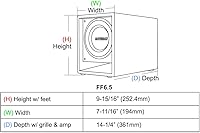
  • Dimensions: The cabinet measures 14.2″ deep, 7.7″ wide, and 9.9″ tall, making it compact enough to fit under most desks and media consoles.
  • Weight: The unit weighs 16.5 pounds, which is moderately heavy relative to its footprint due to the integrated amplifier and acrylic cabinet construction.
  • Status Indicators: LED indicators on the unit provide at-a-glance confirmation of power state and active signal reception.
  • Wireless: No wireless technology of any kind is included; all audio connections are made exclusively via physical RCA cables.
  • Surround Support: The subwoofer is designed to integrate into 5.1 and 7.1 surround sound configurations as well as standard two-channel stereo setups.
  • Mounting Type: The unit is intended for floor-standing placement only; no wall-mount brackets or hardware are included.
  • Warranty: A limited warranty is included with the unit; specific terms and duration are detailed in the documentation provided by Earthquake Sound.

Related Reviews
CT Sounds TROPO-6.5-D2 6.5″ Car Subwoofer
77%
83%
Bass Output for Size
88%
Value for Money
79%
Build Quality
76%
Thermal Management
84%
Installation Ease
More
CT Sounds Meso-6.5-D4 6.5 Inch Dual 4 Ohm Car Subwoofer
83%
90%
Bass Performance
85%
Power Handling
88%
Build Quality
65%
Installation Ease
92%
Cooling System Effectiveness
More
Toro Tech Fierce 6 6.5-inch Car Subwoofer
77%
83%
Bass Output & Impact
88%
Build Quality
84%
Value for Money
91%
Power Handling Accuracy
52%
Sensitivity & Efficiency
More
KEF KC62 Compact Powered Subwoofer
82%
93%
Bass Extension & Depth
61%
Output Level & Loudness
91%
Accuracy & Tonal Precision
88%
Build Quality & Materials
96%
Form Factor & Size
More
KEMIMOTO 6.5-Inch UTV Overhead Sound Bar
76%
88%
Weatherproofing & Durability
67%
Sound Volume at Speed
74%
Installation & Fitment
71%
Bluetooth Connectivity
69%
Build Quality of Control Panel
More
Lanzar VW64 6.5-Inch Car Subwoofer
65%
72%
Value for Money
67%
Bass Output
46%
Build Quality
81%
Installation Ease
53%
Sound Clarity
More
Pyle PLPW6D 6.5-inch Car Subwoofer
73%
88%
Value for Money
74%
Bass Output & Sound Quality
61%
Build Quality
91%
Installation Ease
83%
Amplifier Compatibility & Wiring Flexibility
More
CT Sounds TROPO65-4 6.5″ Midrange Speaker

76%
87%
Sound Clarity
91%
Value for Money
88%
Fitment & Installation
72%
Build Quality
61%
Crossover Requirement
More
Pyle PLMW63 6.5-inch Car Subwoofer
68%
83%
Value for Money
88%
Ease of Installation
67%
Bass Output
61%
Build Quality
59%
Sound Clarity
More
Sound Storm Laboratories EX365 6.5″ Car Speakers
69%
83%
Value for Money
61%
Sound Quality
53%
Bass Response
88%
Ease of Installation
58%
Build Quality
More

FAQ

Yes, as long as your receiver has a dedicated subwoofer preamp output or any standard RCA line-level output, the FF6.5 connects directly without adapters. Most modern AV receivers include a subwoofer output as a matter of course, so for the majority of home theater setups this is genuinely plug-and-play.

A good starting point is to set the crossover dial roughly 10 to 20 Hz above the lower frequency limit your main speakers are rated for. If your bookshelf speakers are rated down to 80 Hz, try starting around 90 to 100 Hz and adjusting by ear using familiar music. Small movements on the dial make a bigger audible difference than you might expect, so take your time.

For most users it works well — power your source on, and the sub detects the signal within a few seconds and wakes up. That said, a handful of owners have found that the detection circuit can be slow to respond to very quiet passages or weak input signals. If that becomes an issue, many AV receivers allow you to keep a continuous low-level signal active on the subwoofer output, which effectively bypasses the problem.

The Earthquake Sound FF6.5 6.5-Inch Subwoofer handles mid-bass and upper-bass frequencies solidly, providing genuine impact with music, moderate action content, and general home theater use. A 6.5-inch driver cannot physically reproduce frequencies much below 40 Hz, so the chest-rattling depth you get from cinematic explosions and deep electronic bass lines is largely outside its range. For small rooms and desktop setups the low-end presence is satisfying, but if deep sub-bass impact is a priority, a 10- or 12-inch sub in a larger enclosure is a better fit.

Car installs are genuinely one of this front-firing sub's strengths. It runs on 12V DC, the same as any standard vehicle electrical system, and the built-in amplifier means a single RCA run from your head unit is all it takes to get it operational. The compact footprint also makes it easier to place in a trunk corner or under a seat compared to bulkier powered subs.

A down-firing design aims the driver at the floor, using surface reflection to disperse bass into the room — carpet type, flooring material, and proximity to walls all affect how it sounds. A front-firing design projects bass directly outward from the driver face, making room placement less finicky and the character of the low-end more consistent regardless of what surface it is sitting on. For renters or anyone without control over their room acoustics, that predictability is a real practical advantage.

Earthquake Sound is a niche brand, but they have been in business for decades and have a genuine following among home audio and car audio hobbyists. They are not as widely distributed as mainstream names, so you will not find them at most big-box retailers, but parts availability and manufacturer support are accessible. Their continued presence in a competitive market over many years is a reasonable indicator of stability.

No — this is a fully wired unit with no wireless capability whatsoever. All audio input is via RCA cable, and there is no Bluetooth, Wi-Fi, or app-based control of any kind. If wireless subwoofer integration is important to your setup, you will need to look at a different product entirely.

The box contains the subwoofer unit itself and a user manual. RCA cables are not included, so have a pair ready before you start setting up. If you are using it at home rather than in a vehicle, also confirm that a 12V DC power supply is included with your specific purchase, as bundled accessories can vary between sellers and regional listings.

Technically yes, provided your receiver or preamp has dual subwoofer outputs or you use a Y-splitter on the output. In practice, though, running two of these compact powered subs in a small to medium room tends to produce a muddier, boomier low end rather than a deeper or more extended one, since both units share the same driver size and frequency limitations. You will usually get better results by stepping up to a single, larger sub rather than doubling up on smaller units.

Where to Buy