


Overview

The CPTEA F400 arrived in late 2024 as a serious challenger in the crowded budget office headset market, and it has quickly earned real credibility — sitting at #90 in On-Ear Headphones with a 4.0-star average across 281 ratings. At under thirty dollars, this wireless office headset stands out by including Bluetooth 5.4 and multipoint pairing, features you typically pay considerably more to get. It weighs just 144g, which matters more than people realize when you're wearing something for six or eight hours a day. It's not a premium product, but it doesn't pretend to be, and that honesty is part of its appeal.

Features & Benefits

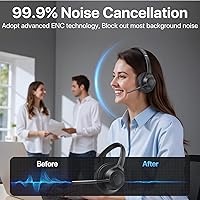
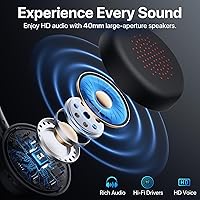
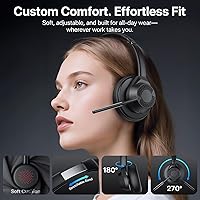
The headline spec here is the noise-canceling microphone — and it's worth clarifying what that actually means. The mic filters background noise on the outbound audio, so your callers hear you clearly even in a busy room. It is not an active noise cancellation system for the listener. Beyond that, the 40mm dynamic driver delivers competent, functional audio for calls and background music, though audiophiles should look elsewhere. Battery life is where this budget Bluetooth headset genuinely impresses: up to 35 hours of listening on a two-hour charge is a bold claim, and even if real-world use trims that somewhat, you're unlikely to reach for the cable often. The 270° rotatable mic and 49-foot wireless range add meaningful day-to-day flexibility.

Best For

This wireless office headset is well-suited for remote workers and call center staff who prioritize mic clarity over music fidelity. If you're jumping between your laptop and phone throughout the day, multipoint connectivity alone makes it worth a look — no manual re-pairing needed. Students who need a reliable headset for online classes without spending much will find it more than adequate. It's also a smart pick for commuters who want something light and long-lasting. Where it's less ideal is for anyone expecting rich, immersive sound for music listening; at this price and driver spec, the F400 is built for communication first, entertainment second.

User Feedback

With 281 ratings and a 4.0-star average, the overall reception is positive but measured. Buyers consistently praise call audio clarity and battery longevity, with many noting that the headset holds up across full workdays without a mid-afternoon charge scramble. Comfort is generally well-received for shorter sessions, though a few users mention the ear cushions feel less plush after several hours. The plastic build draws some criticism — it feels lightweight in both senses of the word. Connection reliability is mostly solid, though a handful of reviewers encountered occasional Bluetooth dropout. Overall, it delivers what it promises at this price point, which for most buyers turns out to be exactly enough.

Pros

  • Multipoint Bluetooth 5.4 lets you stay connected to a laptop and phone simultaneously without re-pairing.
  • The noise-canceling boom mic keeps outbound audio clear in moderately noisy home offices and shared workspaces.
  • Battery longevity is a genuine strength — most users get through multiple full workdays between charges.
  • At under 150g, this budget Bluetooth headset is light enough to wear all morning without neck fatigue.
  • A two-hour charge time means a lunch break top-up is all it takes to restore most of the battery.
  • The 270° rotatable mic arm works equally well for left- and right-side preference without any adjustment hassle.
  • Pairing with laptops, phones, and tablets across both Apple and Android ecosystems is consistently trouble-free.
  • The wireless range holds up reliably across a typical home office or small commercial workspace.
  • For first-time wireless headset buyers, the out-of-box experience requires no setup learning curve whatsoever.
  • The overall feature-to-price ratio is hard to beat for buyers whose primary need is clear call communication.

Cons

  • The all-plastic build feels noticeably cheap and develops minor creaks with regular adjustment.
  • Ear cushion padding loses comfort past the four- to five-hour mark, especially for glasses wearers.
  • No USB-C charging port — the micro-USB connector feels outdated in a device launched in late 2024.
  • Bass response is thin and the soundstage is narrow, making music listening a mediocre experience.
  • Multipoint switching can hesitate or lag when both connected devices receive audio at the same time.
  • No carrying case is included, leaving the headset unprotected when tossed into a bag for travel.
  • Button controls require firm, deliberate presses — making quick in-call adjustments slightly awkward.
  • The boom arm joint can loosen over weeks of repeated rotation, affecting long-term mic positioning.
  • Real-world battery life at higher volumes tends to fall noticeably short of the advertised maximum.
  • No mic mute indicator light means there is no quick visual confirmation that the mic is actually silenced.

Ratings

The scores below reflect an AI-driven analysis of verified global user reviews for the CPTEA F400, with spam, bot-generated, and incentivized submissions actively filtered out to ensure the results represent genuine buyer experiences. Every category captures both what real users celebrated and where frustrations surfaced — nothing is glossed over. Whether this budget Bluetooth headset earns a place on your desk or falls short of your needs, the ratings below give you an honest, well-rounded picture before you commit.

Microphone Clarity
83%
Call center users and remote workers consistently report that colleagues and clients can hear them clearly even in moderately noisy environments, which is the core job this headset was built to do. The outbound noise filtering holds up well on Zoom and Teams calls, reducing keyboard clatter and ambient office hum noticeably.
A subset of reviewers working in very loud environments — open-plan offices with heavy foot traffic or construction nearby — found the mic struggled to filter everything out. It performs best in moderate noise, not extreme conditions, so the 99% blocking claim should be taken with some skepticism.
Battery Life
88%
For a headset at this price point, battery performance is one of the standout strengths. Many users report getting through multiple full workdays on a single charge, with the two-hour top-up being quick enough that it rarely becomes an inconvenience even for heavy daily users.
Real-world results do vary — users who listen at higher volumes or maintain constant call activity report figures closer to 25 hours than the advertised 35. The battery life is still strong, but treating the maximum figure as a guaranteed outcome sets up false expectations.
Comfort & Fit
74%
26%
At 144g, the F400 is light enough that most users forget they are wearing it during the first few hours of a workday. The adjustable padded headband distributes weight reasonably well, and early feedback from students and remote workers wearing it through back-to-back classes or meetings is generally positive.
Extended sessions beyond four or five hours reveal the limits of the ear cushions, which some users describe as firmer than expected for an on-ear design. People with larger ears or who wear glasses report noticeable pressure buildup, which detracts from the all-day comfort promise.
Multipoint Connectivity
79%
21%
The ability to stay connected to both a laptop and a smartphone simultaneously is genuinely useful in professional settings, and most users find switching between an incoming phone call and a Teams meeting happens without manual re-pairing. For the price tier, this feature feels like a genuine upgrade over older budget competitors.
A recurring complaint involves occasional lag or hesitation when switching between active devices, particularly when both devices receive audio signals at the same time. A handful of reviewers also noted that re-establishing the dual connection after powering off required manual intervention more often than expected.
Build Quality
61%
39%
The headset feels adequately sturdy for everyday desk use, and the hinge mechanism on the ear cups has not been a common failure point in early reviews. For buyers who treat their gear carefully, the F400 should hold up fine through normal daily handling.
The all-plastic construction is the most consistently noted weakness across user feedback. It feels noticeably lightweight in a cheap rather than minimalist sense — flexing under mild pressure and producing creaks when adjusted. Anyone expecting even a hint of premium build texture will be disappointed.
Bluetooth Stability
76%
24%
Bluetooth 5.4 delivers a noticeably stable connection within typical home office distances, and most users report no meaningful dropout during calls or audio playback when within about 30 feet of the connected device. The initial pairing process is described as fast and straightforward across both Android and iOS.
Signal reliability drops off beyond 30 to 35 feet in environments with thick walls or heavy Wi-Fi interference. A smaller segment of users experienced intermittent disconnects even at close range, though this appears to be a minority experience rather than a systemic flaw.
Audio Quality for Music
63%
37%
For casual background music during work, the 40mm dynamic driver delivers acceptable clarity in the mid and high ranges. Users who primarily use it for calls and treat music playback as a secondary function report being satisfied enough not to reach for a second pair of headphones.
Bass response is thin and the overall soundstage is narrow — both predictable traits at this price point, but worth stating plainly. Anyone who listens critically to music will find the audio flat and underwhelming, and this headset should not be marketed — or purchased — with music fidelity as a priority.
Ease of Use
84%
The button-based controls are simple and intuitive, covering volume, call answer and end, and power without requiring a companion app or lengthy onboarding. Most users report being fully operational within minutes of opening the box, which matters for professionals who need to get up and running quickly.
With only physical push-button controls, there is no touch surface or smart gestures available, which can feel limiting compared to slightly pricier competitors. A few users also noted that buttons require a fairly deliberate press, making in-call adjustments slightly awkward without looking at the headset.
Wireless Range
77%
23%
The advertised 49-foot range holds up well in open-plan environments, giving users enough freedom to step away from their desk, walk to the printer, or move around a home office without losing the call. This is genuinely useful for people who need mobility without being tethered to their device.
In multi-room home setups or offices with several walls between the headset and device, the effective range shrinks considerably. Users relying on range for larger spaces like warehouses or sprawling open offices found the real-world performance fell noticeably short of the advertised maximum.
Charging Speed & Convenience
81%
19%
A two-hour full charge is genuinely fast for a headset offering this level of battery capacity, and users appreciate being able to top up over a lunch break and return with a fully ready device. The USB cable included in the box covers the basics without requiring any proprietary accessories.
The headset does not support wireless charging or USB-C, relying instead on a micro-USB connection, which feels increasingly outdated in 2024 and 2025 devices. Users who have standardized on USB-C across their setup find the need for a separate cable mildly irritating.
Microphone Flexibility
78%
22%
The 270-degree rotating boom arm is a practical touch that left-handed and right-handed users alike appreciate, since it eliminates the frustration of a fixed-side mic that doesn't suit your setup. Rotating it out of the way when not on a call is quick and does not require removing the headset.
The boom arm lacks a mute indicator light, so users cannot confirm at a glance whether their mic is live or muted during calls — a detail that causes occasional awkward moments in meetings. The arm also feels slightly loose at the joint after extended use, which may affect long-term mic positioning reliability.
Compatibility
86%
Pairing with Windows laptops, Macs, Android phones, and iOS devices is consistently described as trouble-free, with no driver installation or configuration required. This plug-and-play reliability is especially valued by users who switch between work-issued and personal devices throughout the day.
A small number of users reported inconsistent behavior on older Bluetooth 4.x devices, with audio occasionally defaulting to a lower quality codec. Compatibility is broad, but users with legacy hardware should verify their device supports a modern Bluetooth profile before assuming a flawless experience.
Value for Money
91%
Measured against what you actually get — Bluetooth 5.4, multipoint pairing, a noise-canceling boom mic, and a strong battery — the F400 punches well above its price class. Buyers who came from wired desk headsets or older single-point Bluetooth models frequently express genuine surprise at the feature set.
The value calculation depends heavily on your expectations. If you compare this headset against similarly priced options from established brands like Jabra or Poly, the build quality and audio refinement gap becomes apparent quickly. The F400 wins on specs per dollar, not on craftsmanship or brand reliability.
Weight & Portability
82%
18%
At under 150g, this budget Bluetooth headset is genuinely easy to toss into a bag for commuting or travel, and the lightweight design means it doesn't become a burden during long haul flights or train journeys. Frequent travelers specifically call out the weight as one of the stronger selling points.
There is no included carrying case or pouch, which means the headset is unprotected in a bag and more susceptible to scratches or minor damage in transit. For a headset positioned partly as a travel companion, that omission is a missed opportunity that would cost very little to address.

Suitable for:

The CPTEA F400 is a strong fit for remote workers, call center agents, and students who need a reliable communication headset without spending a lot. If your primary use case is Zoom calls, Teams meetings, or phone conversations throughout the workday, this wireless office headset covers the essentials better than most competitors in its price range. The multipoint Bluetooth pairing is a genuine workflow convenience — if you're constantly toggling between a laptop and a smartphone, not having to manually re-pair each time adds up to real time saved. Travelers and daily commuters will appreciate how little it weighs and how long the battery lasts between charges, making it a practical companion for long transit days or back-to-back remote sessions. Anyone moving away from a wired desk headset for the first time will find the setup process refreshingly straightforward, with no apps or drivers required.

Not suitable for:

The CPTEA F400 is not the right choice for buyers who prioritize audio quality for music listening or who need active noise cancellation for their own ears in a loud environment — the noise filtering here applies only to the outbound microphone signal, not to what the wearer hears. If you work in an extremely loud setting like a busy warehouse or a loud open office, the mic may not suppress enough background noise to meet professional standards. People who wear headsets for six or more hours daily may find the ear cushion pressure becomes uncomfortable over extended sessions, particularly if they also wear glasses. The all-plastic construction means it is not a headset that will age gracefully under rough treatment — if durability matters to you, a more premium build from an established brand is worth the extra investment. Music enthusiasts or podcasters who need warm, detailed audio reproduction will find the sound profile too flat and narrow for their needs.

Specifications

  • Model: The headset is identified as the F400, part of CPTEA's 400 series lineup.
  • Bluetooth Version: Uses Bluetooth 5.4, one of the most current wireless standards available in consumer headsets as of late 2024.
  • Wireless Range: Maintains a stable connection up to 15 meters (approximately 49 ft) in open, unobstructed environments.
  • Multipoint: Supports simultaneous pairing with two devices, allowing automatic switching between a connected laptop and smartphone.
  • Driver Size: Equipped with a 40mm dynamic driver featuring a custom-tuned diaphragm for voice-optimized audio reproduction.
  • Impedance: Rated at 32 Ohm, making it compatible with standard consumer audio outputs without requiring an amplifier.
  • Battery Life: Rated for up to 35 hours of listening time and up to 30 hours of continuous talk time on a full charge.
  • Charge Time: Reaches a full charge in approximately 2 hours via the included USB cable.
  • Standby Time: Advertised standby time exceeds two months, making it practical for intermittent or travel use without frequent top-ups.
  • Weight: The headset weighs 144g (approximately 5 oz), keeping fatigue minimal during extended wear.
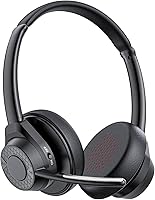
  • Microphone: Features a 270° rotatable boom arm microphone with outbound noise-canceling technology to filter ambient background sound.
  • Ear Style: On-ear design with soft ear cushions and an adjustable padded headband for a customizable fit.
  • Controls: Managed entirely through physical push-button controls with no companion app required.
  • Charging Port: Charges via a micro-USB cable, which is included in the box alongside the headset and a user manual.
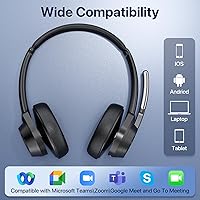
  • Compatibility: Works with smartphones, tablets, laptops, and desktops across both Android and Apple ecosystems via Bluetooth.
  • Noise Control: Hybrid noise cancellation is applied to the microphone output only; there is no active noise cancellation for the listener.
  • Color: Available in Black only at the time of this review.
  • Package Contents: Each unit ships with the headset, a USB charging cable, and a printed user manual.
  • Battery Type: Powered by a built-in lithium polymer battery, which is included and not user-replaceable.
  • Dimensions: Packaged dimensions measure approximately 7.83 x 7.17 x 2.24 inches, reflecting a compact form factor suited for travel.

Related Reviews
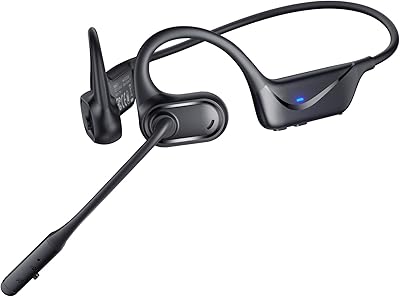
CPTEA G3 Bluetooth Headset
85%
88%
Noise Cancellation
91%
Comfort for Long Sessions
85%
Battery Life
89%
Ease of Use (Pairing & Switching Devices)
83%
Sound Quality
More

FAQ

It only applies to the microphone — meaning the people you call will hear you more clearly in a noisy room, but you won't get any passive or active blocking of the noise around you. If you're hoping to block out office chatter or background noise for yourself, this headset won't do that.

Yes, the multipoint feature lets you stay paired to two devices simultaneously. In practice, you can keep your laptop and phone connected at once, and the headset will handle incoming audio from whichever device is active. Switching isn't always instantaneous, but it avoids the hassle of manually re-pairing throughout the day.

The advertised 35 hours applies at moderate volume levels under fairly controlled conditions. Most users realistically get somewhere between 25 and 32 hours depending on how loud they listen and how much active call time is involved. Still excellent for the price, but don't plan your week around hitting the maximum figure every time.

For the first three to four hours, most users find it comfortable enough — it's light and the padded headband distributes pressure reasonably well. Beyond that, the on-ear cushions can start to feel firm, especially if you wear glasses. It's workable for full workdays, but not as plush as higher-end options.

Yes, it pairs like any standard Bluetooth audio device and is recognized automatically by all major conferencing platforms. No drivers, no software installation needed — just pair it and select it as your audio input and output in your meeting app settings.

Honestly, the all-plastic construction is one of the more noticeable trade-offs at this price point. It doesn't feel fragile enough to break easily under normal desk use, but it does flex and creak a bit when adjusted, and it lacks the solid feel of headsets that cost two or three times more. Treat it with reasonable care and it should hold up fine.

The design doesn't officially support a single-ear mode like some dedicated mono headsets do, but the boom mic rotates to either side so you can position it on your preferred ear. You can physically tilt one cup slightly off your ear if you want to stay aware of your surroundings, though it's not engineered for that.

The 15-meter range applies in open, unobstructed conditions. Through one or two standard interior walls, expect the effective range to drop to around 8 to 10 meters. It's perfectly fine for moving between rooms in a small apartment or home office setup, but don't expect it to follow you reliably across a large multi-floor home.

It will work for casual gaming on a PC or phone, but the audio profile is tuned for voice communication rather than immersive game audio. You won't get strong bass or a wide soundstage, which matters a lot in gaming. For occasional use while chatting with teammates, it's fine — for serious gaming sessions, a dedicated gaming headset would serve you better.

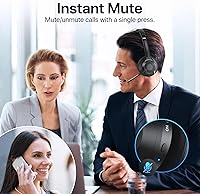
There is a mute function accessible through the button controls, but the headset does not have an indicator light to confirm whether the mic is live or muted — which is a real inconvenience during meetings. Most users rely on the mute control within their conferencing software instead, where the visual feedback is more reliable.