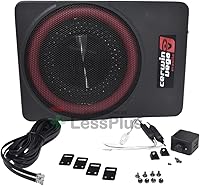
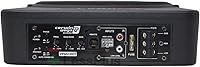
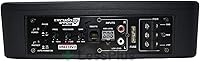
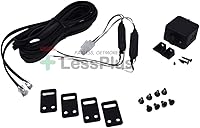
Overview

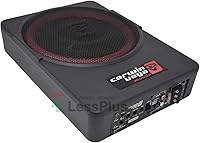
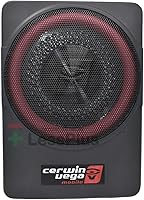
The Cerwin Vega VPAS10 10-inch Powered Subwoofer Enclosure is a compact, under-seat unit built for drivers who want real bass without dedicating their entire trunk to audio gear. Cerwin Vega has been a trusted name in speakers for decades, and their mobile lineup carries that reputation into car audio territory. What separates this powered enclosure from a simple woofer addition is the built-in amplifier — no separate amp, no extra wiring runs, no rack space needed. It sits in the mid-range of the market, priced above throwaway budget units but well short of a full custom install.
Features & Benefits

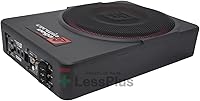
The heart of the VPAS10 is its Class D amplifier, which puts out a continuous 200 watts RMS — enough to genuinely move air in a compact or mid-size vehicle. You get both RCA and high-level inputs, so whether you're running an aftermarket head unit or still on the factory stereo, hookup is straightforward. A variable low-pass filter lets you dial in exactly where the sub hands off to your main speakers, while the bass boost adds up to 12 dB of extra punch for genres that demand it. A fixed subsonic filter at 35 Hz quietly protects the driver from frequencies that produce heat and distortion without audible output. The phase switch is a small but useful detail for getting bass to feel cohesive rather than disconnected in tricky cabin layouts.

Best For

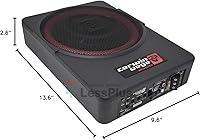
This under-seat subwoofer is a natural fit for daily commuters who want more bass but aren't looking to turn their car into a full audio project. Compact sedans and hatchbacks benefit most — the slim 2.6-inch height profile slides under most front or rear seats without crowding legroom. First-time upgraders will appreciate that the wiring is manageable with basic tools and a little patience; it's not truly plug-and-play, but it's closer to that than a traditional separate-component setup. Fans of hip-hop, R&B, and EDM will get the most out of it. Buyers who want a reputable brand backing their purchase without paying for a separate amplifier and custom enclosure will find the value compelling.

User Feedback

Owners consistently highlight easy installation as a major plus, with many saying they had it running within a couple of hours using basic wiring knowledge. The remote bass knob earns frequent praise — people genuinely use it and appreciate not having to reach under the seat mid-drive. On the flip side, a recurring concern is heat buildup during extended listening sessions, which some owners address by ensuring there's adequate airflow around the unit. Bass quality gets described as punchy and tight in smaller vehicles, though a handful of users in larger cabins or SUVs felt the 200W RMS output ran out of headroom. A few buyers also noted that long-term durability questions linger, with warranty support experiences being somewhat mixed.

Pros

  • No external amplifier needed — the built-in Class D amp keeps the install clean and affordable.
  • The remote bass knob is genuinely useful, letting you adjust levels without taking your eyes off the road.
  • Works with both factory head units and aftermarket stereos thanks to dual RCA and high-level inputs.
  • Bass output is tight and punchy in compact vehicles, not flabby or one-note.
  • The slim 2.6-inch height profile slides under most seats without eating into legroom.
  • Variable low-pass filter and adjustable bass boost give real tuning flexibility for different music styles.
  • The subsonic filter protects the driver from damaging ultra-low frequencies without requiring manual setup.
  • Cerwin Vega is a recognized audio brand, adding a layer of confidence over generic alternatives.
  • Phase adjustment helps the bass integrate naturally with main speakers in acoustically tricky cabins.
  • Installation is manageable for a motivated beginner with basic wiring knowledge and a few hours to spare.

Cons

  • Output starts to feel inadequate in larger vehicle cabins — 200W RMS has a ceiling.
  • Some owners report heat buildup under the seat during extended listening sessions in poorly ventilated areas.
  • The fixed sealed enclosure offers no tuning flexibility for buyers who want to experiment with box design.
  • Warranty and customer support experiences from Cerwin Vega mobile have been inconsistent across buyers.
  • The 2-ohm impedance rating narrows compatibility with certain head units and aftermarket equipment.
  • Long-term durability questions have surfaced in owner feedback, particularly with heavier daily use.
  • Bass performance is heavily dependent on vehicle size — results in a hatchback differ sharply from a large SUV.
  • At this price tier, competing options from other brands offer similar output with more installation support resources.

Ratings

The scores below reflect an AI-driven analysis of verified global buyer reviews for the Cerwin Vega VPAS10 10-inch Powered Subwoofer Enclosure, with spam, bot-generated, and incentivized feedback actively filtered out to ensure accuracy. Each category score is derived from real ownership patterns, not manufacturer claims — strengths are credited where earned, and recurring pain points are reported without softening. The result is an honest snapshot of what living with this powered enclosure actually looks like across different vehicles, use cases, and listener expectations.

Bass Output Quality
78%
22%
In compact sedans and hatchbacks, the VPAS10 consistently delivers bass that feels tight and controlled rather than bloated — owners frequently describe it as punchy during hip-hop and EDM playback. For a slim under-seat unit, the low-end presence it produces genuinely surprises first-time buyers who expected something more modest.
In larger cabins like mid-size SUVs or full-size trucks, the output starts to feel noticeably thin at higher volumes, with 200W RMS reaching its ceiling quickly. A handful of reviewers specifically noted the bass lacks the deeper rumble they were hoping for when listening to bass-heavy tracks at road-trip volumes.
Ease of Installation
83%
The self-contained design — with the amplifier already integrated — removes the most intimidating step in a typical subwoofer project, and owners who had never done car audio before report completing the wiring in an afternoon. High-level inputs mean you can connect directly to existing factory speaker wires without needing a separate line output converter.
It is not entirely plug-and-play despite what some listings imply — running power, ground, and remote turn-on wires still requires basic electrical confidence and the right tools. A few buyers without any prior wiring experience ran into confusion around the power wire gauge and fuse placement.
Remote Bass Knob
91%
The included remote knob earns near-universal praise in owner feedback — being able to dial the bass down during a phone call or crank it back up mid-song without reaching under the seat is something people use every single day. Reviewers consistently call it one of the features they did not expect to appreciate so much before buying.
The knob's mounting hardware is minimal, and a few owners noted it does not feel particularly premium to the touch — more plastic-y than the rest of the unit suggests. Cable length can also be a limiting factor for some dashboard mounting positions depending on vehicle layout.
Value for Money
81%
19%
Getting a recognized audio brand, a sealed enclosure, and a built-in amplifier in a single package at this price tier is genuinely competitive — buyers frequently note they priced out separate components and found the all-in-one approach saves a meaningful amount. For a first audio upgrade, the cost-to-impact ratio lands well.
Buyers stepping up from truly budget units sometimes feel the performance gap is smaller than the price gap would suggest, especially in larger vehicles where output limitations surface quickly. If you eventually outgrow the unit and want to upgrade, you cannot repurpose just the enclosure or just the amplifier — it is a single investment.
Build Quality
67%
33%
The enclosure itself feels reasonably solid for the size, and the amplifier plate does not exhibit the flimsy flex you sometimes find on cheaper powered units. Most owners who have had the unit for six to twelve months report no structural issues with normal daily use.
Long-term durability is a recurring concern in owner feedback — a subset of reviewers note performance degradation or amplifier failure beyond the one-year mark with heavy use. The overall fit and finish reads as functional rather than premium, which is fair at this price but worth flagging if longevity is a priority.
Compatibility
86%
The dual-input design — covering both RCA and high-level connections — makes this powered enclosure genuinely versatile across vehicle types, covering factory stereo owners and aftermarket head unit users equally well. The phase switch and adjustable crossover add another layer of adaptability for vehicles with acoustically challenging layouts.
The 2-ohm impedance rating catches some buyers off guard, particularly those pairing the unit with certain factory amplified systems that expect a different load. It is not a dealbreaker, but it requires checking compatibility before purchasing rather than assuming it will work with any setup.
Thermal Management
58%
42%
Under typical use conditions — a daily 30-to-45-minute commute with moderate volume levels — most owners report no heat-related issues whatsoever, and the thermal protection circuit does its job quietly in the background.
Extended listening sessions in hot climates or confined installation spots where airflow is restricted have led to heat complaints from a meaningful number of reviewers. A few owners noted the thermal protection kicked in and cut output during summer driving, which points to real limitations in how the unit manages heat under stress.
Sound Tuning Flexibility
77%
23%
Having a variable low-pass filter, adjustable bass boost, and phase control in a single under-seat unit gives buyers more fine-tuning options than most competitors at this price point — you can meaningfully shape the sound rather than accepting a fixed factory tune. Owners who take the time to dial it in report a noticeably more integrated listening experience.
The fixed subsonic filter at 35 Hz, while protective, cannot be adjusted — which limits options for users who want to experiment with very low extension. The bass boost control, while useful, can introduce audible distortion at its highest settings if the gain is not set conservatively.
Footprint & Fitment
88%
At just 2.6 inches tall, the VPAS10 slides under front or rear seats in the vast majority of compact and mid-size vehicles without any modification, and owners consistently express relief that it did not interfere with seating position or legroom. The rectangular profile also makes it straightforward to orient and secure in tight under-seat spaces.
A handful of truck and SUV owners found the enclosure still too large for their lower-profile seat clearances despite the slim design. The unit does not come with dedicated mounting brackets, so securing it firmly enough to prevent shifting on aggressive turns requires some improvisation with hook-and-loop fasteners or custom mounts.
Warranty & Support
53%
47%
A limited warranty is included, and for buyers who never need to use it, the purchase experience from the brand side is completely unremarkable in a good way — most units simply work without requiring any support interaction.
When buyers do need warranty service, the experience has been notably inconsistent according to recurring feedback threads — some owners report responsive resolution while others describe difficulty even making contact. This is one of the more legitimate criticisms of Cerwin Vega mobile that shows up repeatedly in verified purchase reviews.
Low-Frequency Extension
72%
28%
The sealed enclosure provides tighter, more accurate bass reproduction in the 40 to 80 Hz range that most music actually lives in, which suits daily listening to a wide range of genres without sounding loose or one-dimensional.
The design does not dig particularly deep in absolute terms — users chasing true sub-30 Hz output for movie content or certain electronic music will find the performance underwhelming. The fixed 35 Hz subsonic filter also means there is a hard floor on extension that cannot be tuned around.
Gain & Level Control
74%
26%
The combination of the onboard input sensitivity adjustment and the remote bass knob gives users two independent points of control, which is more practical than a single fixed gain setting — particularly useful when switching between different audio sources with varying output levels.
Setting the gain correctly the first time requires a bit of patience and ideally a test tone, which some buyers skip, resulting in either a clipping distorted signal or a unit that sounds weaker than its potential. The on-unit controls are small and positioned under the seat, making fine adjustments less convenient after installation.
Packaging & Included Accessories
69%
31%
The remote knob is a genuinely useful inclusion that adds real daily value, and the unit arrives well protected with foam padding that prevents transit damage in the majority of reported cases.
Beyond the remote knob, the accessory package is sparse — no RCA cables, no wire, no mounting hardware — which catches some first-time buyers off guard when they realize a separate shopping trip is required. For a unit targeting beginners, including at least a basic wiring kit would significantly improve the out-of-box experience.

Suitable for:

The Cerwin Vega VPAS10 10-inch Powered Subwoofer Enclosure is a strong match for everyday drivers who want a meaningful bass upgrade without committing to a full audio overhaul. If you own a compact car, sedan, or small SUV where trunk real estate is limited, the slim under-seat form factor solves a real problem — you get the low-end presence without losing cargo space. First-time installers will find the setup approachable, especially since the built-in amplifier removes the most intimidating part of a typical subwoofer project. People who stream bass-heavy music genres like hip-hop, R&B, or EDM will notice the difference immediately, particularly in smaller cabin environments where the driver can pressurize the space effectively. It also suits buyers who want a brand with an established audio reputation backing their purchase, rather than rolling the dice on an unknown budget unit.
Not suitable for:

The Cerwin Vega VPAS10 10-inch Powered Subwoofer Enclosure is not the right tool for every situation, and being honest about that matters. Owners of larger vehicles — full-size trucks, SUVs, or vans — will likely find that 200 watts RMS simply does not produce enough output to fill a bigger cabin satisfyingly, leaving the bass feeling thin or buried in the mix. Serious car audio enthusiasts who want competition-level sound pressure or plan to run multiple subwoofers should look at dedicated external amplifiers paired with higher-excursion drivers. The sealed, pre-loaded enclosure also means there is no tuning the box volume or porting configuration — what you get is fixed, which frustrates experienced builders who like to customize. Long-haul drivers or anyone leaving the unit running in hot climates should also be cautious, as heat management under the seat in confined spaces can be a concern over time. If warranty support reliability is a top priority for you, the mixed feedback from some buyers on that front is worth factoring into the decision.
Specifications

  • Driver Size: The enclosure houses a 10-inch woofer driver built to reproduce deep bass frequencies in a compact sealed cabinet.
  • RMS Power: The integrated amplifier delivers a continuous 200 watts RMS, representing its real-world sustained output during normal listening.
  • Peak Power: Peak power handling reaches 550 watts, reflecting the amplifier's short-burst headroom rather than its sustained capability.
  • Amplifier Type: A PWM MOSFET Class D amplifier is built directly into the enclosure, eliminating the need for a separate external amplifier unit.
  • Impedance: The driver operates at a 2-ohm impedance load, which is an important compatibility factor when planning wiring and power delivery.
  • Enclosure Type: The subwoofer comes in a sealed, pre-loaded enclosure that is tuned at the factory, requiring no additional box construction or porting.
  • Low-Pass Filter: A variable low-pass filter spans from 85 Hz to 150 Hz, letting you set the crossover point to blend cleanly with your existing speakers.
  • Bass Boost: An adjustable bass boost control adds up to 12 dB of extra low-frequency emphasis, tunable to taste depending on music genre and cabin acoustics.
  • Subsonic Filter: A fixed subsonic filter at 35 Hz rolls off damaging ultra-low frequencies that produce heat in the driver without producing audible output.
  • Phase Control: A selectable phase switch toggles between 0 and 180 degrees to help the subwoofer's bass align properly with the vehicle's main speakers.
  • Input Types: Both RCA line-level inputs and high-level speaker wire inputs are provided, covering compatibility with factory and aftermarket head units alike.
  • Remote Control: A remote bass knob is included in the package, allowing the driver to adjust output level without reaching under the seat while driving.
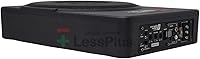
  • Dimensions: The enclosure measures 13.6″ in length, 9.6″ in width, and 2.6″ in height, designed to slide under most standard vehicle seats.
  • Fuse Rating: The unit uses a single 25-amp fuse for overcurrent protection, which is an important reference point when sizing your power wire installation.
  • Power Source: The subwoofer runs on corded electric power sourced directly from the vehicle's electrical system — no batteries or wireless operation involved.
  • Mounting Style: The unit is designed specifically for under-seat installation in automobiles, keeping the trunk and rear cargo areas fully clear.
  • Warranty Type: Cerwin Vega includes a limited warranty with the unit; buyers should confirm current warranty terms directly with the manufacturer at time of purchase.

Related Reviews
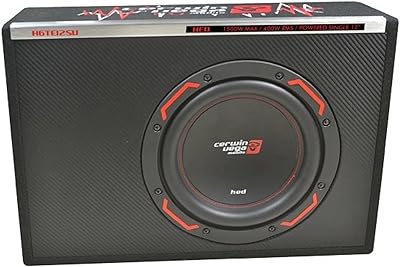
Cerwin Vega HED 12″ Powered Slim Enclosure Subwoofer
86%
88%
Bass Performance
92%
Value for Money
90%
Compact Design
82%
Ease of Installation
84%
Build Quality
More
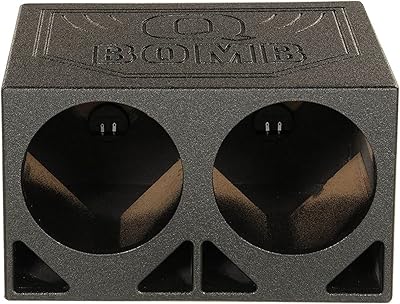
Q Power QBOMB10TB Dual 10-Inch Subwoofer Enclosure
80%
88%
Build Quality
91%
Finish & Appearance
83%
Bass Performance
79%
Ease of Installation
62%
Terminal Quality
More
Q Power QBOMB-DODGE10-4DR 10 Inch Dual Chamber Subwoofer Box Enclosure
88%
92%
Bass Performance
90%
Build Quality
88%
Ease of Installation
89%
Durability
91%
Compatibility with Dodge/Ram Trucks
More
Cerwin-Vega Vega Series V124DV2 12-inch Subwoofer
87%
93%
Bass Performance
89%
Build Quality
85%
Ease of Installation
91%
Sound Clarity
88%
Versatility in Setup
More
Acoustic Audio PSW400-10 10-Inch Powered Subwoofer
85%
91%
Bass Performance
88%
Ease of Setup
85%
Sound Quality
92%
Value for Money
87%
Build Quality
More
Cerwin Vega XED12 12-Inch Subwoofer
84%
92%
Bass Performance
89%
Value for Money
85%
Build Quality
75%
Ease of Installation
81%
Sound Clarity
More
Atrend Bbox Single 10 Inch Subwoofer Enclosure
85%
88%
Installation Ease
86%
Sound Quality
91%
Build Quality
93%
Vehicle Compatibility
84%
Bass Performance
More
Cerwin-Vega XLS-15S 15″ Powered Subwoofer
83%
93%
Bass Performance
87%
Sound Clarity
80%
Setup & Installation
88%
Design & Build Quality
75%
Size & Portability
More
Rockville RW10CA 10-inch Powered Car Subwoofer
77%
88%
Ease of Installation
74%
Bass Output Quality
91%
Low-Profile Fit
69%
Built-in Amplifier Performance
86%
Remote Bass Knob
More
Cerwin Vega VRAD10 10″ Active Slim Subwoofer
86%
88%
Sound Quality
91%
Bass Performance
85%
Ease of Installation
89%
Build Quality
94%
Compactness/Size
More

FAQ

No, and that is one of the main selling points of the VPAS10. The amplifier is already built into the enclosure, so you just need to run a power wire, ground wire, remote turn-on wire, and your audio signal. No external amp required.

In most compact cars, sedans, and mid-size vehicles it fits without issue — the enclosure is only 2.6 inches tall. That said, every vehicle is different, so it is worth measuring the clearance under your seat before ordering. Trucks and SUVs with lower seat rails can be trickier.

Yes, the high-level inputs on the unit are specifically designed for this situation. You tap into the existing speaker wires coming from your factory head unit, so no line output converter is needed in most cases. It is one of the more beginner-friendly aspects of the setup.

In compact vehicles, most users describe the output as punchy and tight rather than thin. The sealed enclosure gives bass more definition than a ported box, which suits rock, hip-hop, and EDM well. In larger cabins, the 200W RMS ceiling can start to feel limiting, so expectations should be calibrated to your vehicle size.

It is more approachable than a traditional subwoofer and separate amplifier setup, but it is not entirely plug-and-play. You will need to run power and ground wires, connect a remote turn-on lead, and route your audio signal. If you are comfortable with basic electrical work and following a wiring diagram, most people complete it in two to three hours.

The remote knob controls the subwoofer output level from wherever you mount it — most people put it near the center console or on the dash. It lets you turn the bass up during music and back down during phone calls or podcasts without touching anything under the seat. Owners consistently call it one of the most useful features in daily use.

Heat can be a factor if airflow around the unit is restricted. Under heavy use in a warm climate, or if the subwoofer is buried under floor mats or other objects, heat buildup becomes a real concern over time. Positioning it with some breathing room on at least one side helps considerably.

Phase controls how the subwoofer's bass waves line up with the output of your main speakers. If the bass sounds thin or hollow with the sub running, switching phase often fills it back in. There is no universal right answer — you just try both settings and pick whichever sounds fuller in your specific vehicle.

Start around 80 to 100 Hz as a baseline. If you hear the subwoofer producing midrange sounds like vocals or guitar body, lower the filter. If the bass sounds disconnected from your main speakers, raise it slightly. The goal is for the sub to blend in rather than stand out as a separate sound source.

For daily use in a compact or mid-size vehicle, it holds up reasonably well and represents solid value considering the built-in amplifier. Some buyers have flagged durability concerns after extended heavy use, and warranty support experiences have varied, so it is worth keeping your purchase documentation handy. If you treat it reasonably and give it proper ventilation, most users get years of reliable use from this powered enclosure.