Overview

The BoT Talk GPS Tracker for Kids is a screen-free child safety device from Japanese manufacturer Bsize Inc., launched in late 2024 with a focused promise: let parents know where their kids are without putting a smartphone in a child's hands. That's a genuinely useful idea, but it's worth knowing upfront that the device price is only part of the cost — a monthly subscription plan is required to use it at all. Coverage is U.S.-only, running on AT&T, T-Mobile, and Verizon networks. With a 3.5-star rating across nearly 100 reviews, buyer experience has been decidedly mixed, which makes this a purchase worth researching carefully rather than buying on impulse.
Features & Benefits

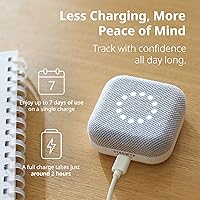
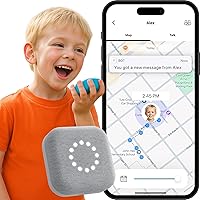
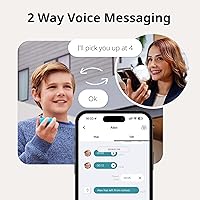
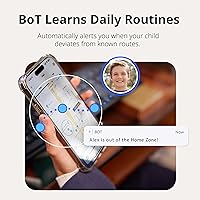
The standout feature here is two-way voice messaging — a child can receive and send short voice clips without needing a phone of their own, which is genuinely practical for after-school pickups or field trip check-ins. The device also learns a child's daily routine over time and pushes automatic alerts when they arrive or leave familiar places, a helpful layer of passive awareness. GPS and Wi-Fi positioning work together for more consistent location updates indoors and out. The claimed 7-day battery life applies primarily to GPS-only mode; heavier voice use will shorten that window. At roughly 2x2 inches and under two ounces, this screen-free tracker fits quietly in any backpack.

Best For

This kids GPS tracker makes the most sense for parents of elementary-age children who want consistent location awareness during the school day but aren't ready to hand over a phone. It's also well-suited for families monitoring kids with special needs who benefit from a non-intrusive device that doesn't demand interaction. School commutes, after-school sports, and chaperoned outings are where it earns its keep. Parents drawn to simple, screen-free devices over smartwatches will appreciate the focused design. The lower-tier GPS-only plan keeps recurring costs manageable, making the BoT Talk device accessible to budget-minded families who still want reliable real-time tracking without a long-term contract.

User Feedback

Parents who've used this screen-free tracker tend to highlight how easy it is to set up and how much they value voice messaging as a practical alternative to texting. The compact size draws consistent praise. On the critical side, the subscription payment restrictions — no debit cards, no gift cards, credit cards only — have frustrated buyers who discovered this after purchase. The inability to pause a plan during summer breaks is another recurring complaint. A handful of users report inconsistent GPS accuracy in dense urban areas. The AI routine alerts get mixed marks: some find them genuinely useful, while others say the false notification rate remains higher than expected.

Pros

  • Two-way voice messaging lets parents check in with kids without either side needing a phone.
  • The BoT Talk GPS Tracker for Kids is lightweight enough that most kids genuinely forget it is in their bag.
  • Setup is fast and straightforward, with an integrated SIM that skips carrier activation entirely.
  • Quiet Mode keeps the device school-friendly without drawing teacher attention or violating device policies.
  • Waterproof and dustproof construction holds up well through rain, mud, and the general chaos of kid life.
  • GPS plus Wi-Fi positioning improves location reliability indoors compared to GPS-only trackers.
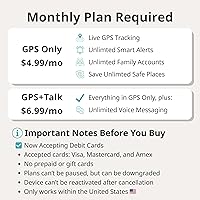
  • The GPS-only plan tier keeps recurring costs low for parents who do not need voice messaging.
  • No long-term contracts mean you are not locked in if the device stops meeting your needs.
  • The companion app is consistently described as clean and easy to navigate, even for less tech-savvy parents.

Cons

  • The device becomes permanently unusable after subscription cancellation — you cannot reactivate it later.
  • Plans cannot be paused, so families pay full price through summer breaks and school holidays.
  • Only Visa, Mastercard, and Amex credit cards are accepted; debit cards and gift cards are not supported.
  • GPS accuracy in dense urban environments has been inconsistent enough to undermine confidence for some buyers.
  • AI routine alerts generate a noticeable number of false notifications during the early learning period.
  • Battery life drops well below the marketed claim when voice messaging is used regularly alongside GPS.
  • Location update frequency is not always consistent, with multi-minute gaps reported on weaker carrier signals.
  • The total annual cost — hardware plus subscription — competes poorly against feature-richer alternatives at a similar price.
  • Audio quality during voice messages degrades in noisy outdoor environments like playgrounds or busy streets.

Ratings

The BoT Talk GPS Tracker for Kids has been scored below by our AI system after analyzing verified buyer reviews worldwide, with spam, incentivized, and bot-driven feedback actively filtered out before any scoring was applied. The result is an honest, data-backed picture that reflects both what parents genuinely love about this screen-free tracker and where it has let buyers down. Strengths and friction points are weighted equally so you can make a well-informed decision.
GPS Tracking Accuracy
67%
33%
In suburban and open environments, parents report location updates that are accurate enough for everyday school-run monitoring. The combination of GPS and Wi-Fi positioning helps bridge gaps that pure GPS often misses, particularly near buildings or during indoor transitions.
In dense urban areas with tall buildings, several buyers noted the reported location lagging by a block or more during real-time tracking. A handful of users found the positioning inconsistent enough during school hours to undermine confidence in the device's core purpose.
Two-Way Voice Messaging
78%
22%
This is consistently cited as the feature parents value most. Being able to send a quick voice clip and hear a child's response without either party needing a phone makes after-school pickups and field trip check-ins noticeably less stressful for families.
Audio quality in noisy environments — a loud cafeteria or a windy playground — comes up as a limitation in several reviews. A few parents also noted a slight delay in message delivery, which reduces its usefulness in genuinely urgent situations.
AI Routine Alerts
61%
39%
When the routine-learning feature works as intended, parents appreciate getting automatic arrival and departure notifications without having to actively open the app. For predictable school-day schedules, it functions as a quiet, low-effort monitoring layer.
The false notification rate is a recurring frustration. Several buyers reported alerts firing during detours like a stop at a friend's house or a delayed bus, which erodes trust in the system over time. The AI appears to need several weeks before its accuracy stabilizes meaningfully.
Subscription Value & Pricing
54%
46%
The entry-level GPS-only plan is genuinely affordable on a monthly basis, and the absence of long-term contracts is appreciated by parents who want flexibility. The tiered structure at least lets buyers choose whether voice messaging is worth the incremental cost.
The inability to pause a plan during school breaks or summer is a persistent complaint that inflates the real annual cost. Combined with the strict credit-card-only payment policy — no debit cards, no gift cards — many buyers felt locked into terms they didn't fully anticipate before purchasing.
Setup & App Experience
74%
26%
Initial setup draws consistent praise for being straightforward, with the integrated SIM meaning parents skip the usual carrier activation headaches. The companion app is described as clean and accessible even for less tech-savvy users.
Some users report the app occasionally failing to refresh location data in the background, requiring a manual open to get a current fix. App stability on older Android devices has also been flagged, with a few buyers noting crashes during location history reviews.
Battery Life
69%
31%
On GPS-only mode with moderate usage, most parents find the battery comfortably covers a full school week without needing a mid-week charge. The built-in lithium-ion cell is compact for the device's size, which is a reasonable engineering trade-off.
Enabling voice messaging noticeably shortens battery performance below the marketed seven-day claim. Parents who use both features regularly report needing to charge every three to four days, which means building a charging routine into the child's backpack drop-off habits.
Build Quality & Durability
82%
18%
The waterproof and dustproof construction holds up well in real-world kid conditions — rain, muddy fields, accidental drops from a backpack. The matte white casing feels solid without adding noticeable bulk, and parents of active kids report no cosmetic damage after months of daily use.
A small number of buyers noted that the charging port cover shows wear relatively quickly with frequent use. The all-white finish also picks up scuffs that are visible on the surface, though this is cosmetic rather than functional.
Size & Portability
88%
At under two ounces and roughly two inches square, this is one of the more compact kids trackers on the market. Parents consistently note that children forget it's in their bag, which is exactly the right outcome for a device meant to stay out of the way.
The compact size, while a strength for portability, means the device is also easy to misplace. A few parents mentioned their child accidentally left it at school or in a coat pocket because it was too easy to overlook during bag checks.
Classroom Compatibility
83%
Quiet Mode is a thoughtful inclusion that addresses a real friction point — schools that restrict electronic devices are less likely to object to a silent, screen-free tracker than to a smartwatch. Parents report no teacher complaints after switching to this from more visible wearables.
A few buyers noted that Quiet Mode disables incoming voice messages during school hours, which some parents found counterintuitive given that school-hour check-ins are a primary use case. Clearer documentation on what Quiet Mode restricts would help manage expectations.
Cancellation & Account Policy
41%
59%
There are no long-term contracts, and the cancellation process itself is described as technically straightforward by the few users who went through it. Month-to-month flexibility is at least partially preserved.
The policy that renders the device permanently unusable after subscription cancellation is the single most criticized aspect across reviews. Buyers who purchased the tracker for seasonal use or as a trial found this policy particularly punishing, with several calling it a significant undisclosed limitation.
Payment Method Flexibility
38%
62%
Accepted credit cards — Visa, Mastercard, and Amex — cover the majority of U.S. households, and for those cardholders the payment experience itself is uncomplicated.
Excluding debit cards and gift cards is a real barrier for a meaningful portion of buyers, particularly parents who prefer not to link a credit card to a recurring subscription. This restriction surfaced repeatedly in negative reviews and contributed directly to post-purchase regret for some buyers.
Real-Time Location Updates
71%
29%
During the school day in most U.S. suburban and rural settings, location refreshes feel responsive enough for practical monitoring. Parents appreciate being able to pull up a current location without waiting through a long delay.
Update frequency is not always consistent, with some users reporting gaps of several minutes between location pings. In areas with weaker carrier signal — which varies by which of the three supported networks dominates locally — real-time tracking can feel more like periodic tracking.
U.S. Coverage & Network Reliability
73%
27%
Using all three major U.S. carriers gives the device a broad national footprint that holds up well for most suburban families. Parents in major metro areas and their surrounding suburbs report reliable connectivity throughout a typical school day.
Rural buyers in areas where even major carrier coverage is patchy report more connectivity drop-outs than urban users. The U.S.-only restriction is also a hard stop for families who travel internationally or live near borders, which limits the device's long-term versatility.
Value Relative to Alternatives
58%
42%
For parents specifically seeking a screen-free, phone-free solution with voice messaging, the BoT Talk device occupies a relatively narrow product niche that few competitors address as directly. The lower subscription tier is competitive against GPS smartwatch plans.
When total annual cost — device plus subscription — is factored in, several reviewers noted that a basic kids smartwatch with similar tracking features ends up comparably priced while offering more functionality. The inability to pause or cancel without losing the hardware amplifies the value concern significantly.

Suitable for:

The BoT Talk GPS Tracker for Kids is built for a specific type of parent: one who wants to know where their child is during the school day without handing over a smartphone or smartwatch that invites distractions. It fits naturally into the routines of families with elementary-age kids who take the bus, walk to school, or attend after-school programs where a quick voice check-in would otherwise require a phone. Parents of children with special needs will also find value here, since the device is non-intrusive, requires no interaction from the child to function for tracking purposes, and doesn't overwhelm kids with a screen. Families who prioritize simplicity over feature density — a tracker that stays in the bag and just works — are the most likely to come away satisfied. If you're based in the U.S., use a Visa, Mastercard, or Amex credit card, and are comfortable with a modest ongoing monthly cost, this screen-free tracker slots in as a focused, low-friction safety tool.
Not suitable for:

The BoT Talk GPS Tracker for Kids is a poor fit for anyone expecting a one-time purchase with no ongoing costs — the device is completely non-functional without an active subscription, and unlike many subscription services, the plan cannot be paused during summers or school breaks. Parents who prefer paying with a debit card or gift card will hit a hard wall at checkout, since only major credit cards are accepted for the monthly plan. Buyers in rural areas with spotty carrier coverage may find location accuracy too inconsistent for the tracker to be genuinely useful. Families who travel internationally should look elsewhere entirely, as the device only works within the United States. Anyone hoping the AI routine alerts will function as a reliable, near-instant safety net from day one will likely be disappointed — the system takes time to stabilize and generates more false notifications early on than most parents find acceptable.
Specifications

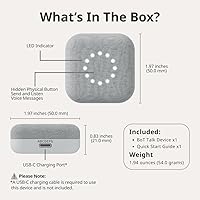
  • Dimensions: The device measures 1.97 x 1.97 x 0.83 inches, making it small enough to sit flat in a backpack side pocket without taking up noticeable space.
  • Weight: At 1.94 oz, this is one of the lighter kids trackers available, so children are unlikely to notice it in their bag.
  • Battery Type: A built-in rechargeable lithium-ion battery is integrated into the housing and is not user-replaceable.
  • Battery Life: Rated for up to 7 days on GPS-only mode; real-world life shortens to approximately 3–4 days when two-way voice messaging is used regularly.
  • Positioning: Location is determined using a combination of GPS satellite data and Wi-Fi network positioning for improved accuracy indoors and in urban settings.
  • Connectivity: The device operates on cellular networks and is compatible with AT&T, T-Mobile, and Verizon coverage across the United States.
  • SIM Card: An integrated SIM card is pre-installed at the factory, so no separate carrier activation or SIM insertion is required by the user.
  • Voice Messaging: Two-way voice messaging allows parents to send and receive short audio clips through the companion app without the child needing any additional device.
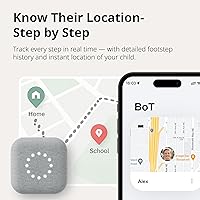
  • AI Alerts: An on-device AI system learns a child's daily routine over time and sends automatic arrival and departure notifications for saved locations such as home and school.
  • Quiet Mode: A dedicated Quiet Mode silences all audio output and incoming alerts, making the tracker compliant with most school no-disruption policies during class hours.
  • Water Resistance: The device is built to be waterproof and dustproof, providing reliable protection against rain, splashes, and typical outdoor conditions children encounter daily.
  • Coverage Area: Tracking and voice messaging are supported exclusively within the United States; the device does not function internationally.
  • Companion App: A free parent-facing mobile app is available for iOS and Android and provides real-time location, movement history, alert management, and voice messaging controls.
  • Monthly Plans: Two subscription tiers are offered: a GPS-tracking-only plan and a higher tier that adds two-way voice messaging, both billed monthly with no long-term contract required.
  • Payment Methods: Monthly plan payments are accepted via Visa, Mastercard, and American Express credit cards only; debit cards and gift cards are not currently supported.
  • In the Box: Each unit ships with the tracker itself (integrated battery and SIM included) and a user manual; no additional accessories are included in the standard package.
  • Manufacturer: The device is designed and manufactured by Bsize Inc., a Japanese technology company, and was first made available in the U.S. market in October 2024.
  • Color: The device is available in Matte White, a neutral finish that keeps the tracker visually understated when carried by children.

Related Reviews

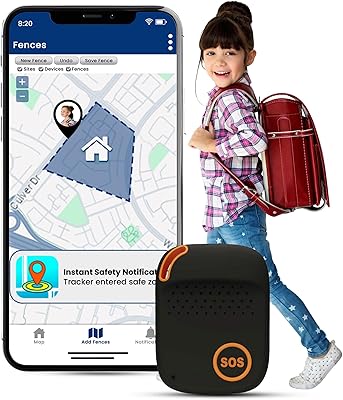
Seculife Kids GPS Tracker
73%
88%
Ease of Setup
67%
GPS Tracking Accuracy
91%
SOS Button & Emergency Alerts
74%
Two-Way Calling Quality
82%
Geofencing & Zone Alerts
More
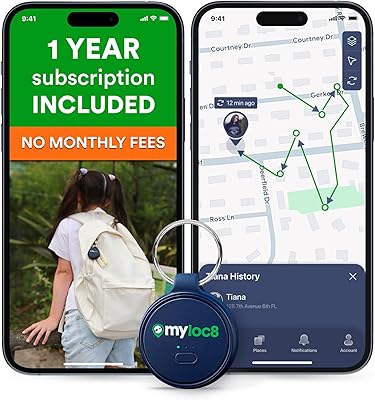
MYLOC8 GPS Tracker for Kids with SOS Button
88%
91%
Real-time Tracking Accuracy
94%
Ease of Use
89%
Battery Life
90%
Waterproof Durability
88%
SOS Button Performance
More
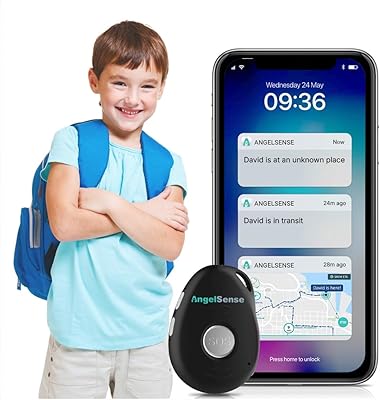
AngelSense Personal GPS Tracker
78%
91%
GPS Tracking Accuracy
88%
Alert Reliability
79%
Speakerphone & Audio Quality
58%
Subscription Value
83%
Wearable Comfort & Sensory Design
More
Spodus G50002 Kids Watch with GPS Tracker 4G Smart Watch
84%
88%
GPS & Location Accuracy
81%
Battery Life
78%
Voice & Video Call Quality
90%
Ease of Use
85%
Build Quality
More
Amcrest GL300 4G LTE Portable GPS Tracker
77%
88%
Ease of Setup
74%
GPS Accuracy
69%
Battery Life
81%
App Experience
91%
Magnetic Mount Strength
More
Tack GPS Tracker
Tack GPS Tracker
89%
94%
Tracking Accuracy
91%
Battery Life
88%
Build Quality
90%
Ease of Setup
95%
Portability
More
Invoxia GPS Pro Tracker
84%
87%
Battery Life
91%
Real-Time Tracking Accuracy
89%
Ease of Setup
83%
Theft Prevention Features
84%
App Usability
More
Vyncs OBD GPS Vehicle Tracker
75%
93%
Ease of Setup
71%
GPS Accuracy
62%
GPS Update Speed
58%
App Experience
83%
Value for Money
More
TKSTAR TK905 GPS Tracker
86%
94%
Tracking Accuracy
91%
Anti-Theft Alerts
88%
Installation Ease
85%
App Usability
82%
Battery Life
More
MYLOC8 Ultra GPS Tracker
85%
91%
Battery Life
88%
Ease of Setup
85%
Real-Time Tracking Accuracy
89%
Durability
78%
Subscription Flexibility
More

FAQ

No, and that is genuinely one of the strongest reasons to consider this device. The tracker operates independently using its own built-in SIM card and cellular connection. Your child carries the device in their bag, and you manage everything — location checks, voice messages, alerts — through the app on your own phone.

This is worth understanding before you buy. Once you cancel the subscription, the device stops working entirely and cannot be reactivated. It is not like pausing a streaming service — cancellation is effectively permanent for that unit. If you think you might want to stop and restart service seasonally, that is not currently an option with this tracker.

Unfortunately, no. The subscription plans cannot be paused. You can downgrade to the lower GPS-only tier to reduce the monthly cost during off-peak periods, but you cannot suspend billing entirely while keeping the device ready for when school resumes. This is one of the most common complaints from buyers, so factor the full annual cost into your decision.

In most suburban and small-city environments, location accuracy is solid enough for practical school-day monitoring. The GPS and Wi-Fi combination helps in areas where pure GPS struggles, like near large buildings. In dense urban areas with tall structures, some parents report occasional location lag or inaccuracies of a block or more. Rural areas with weak carrier signals can also see reduced reliability.

Most parents report no issues. The device has a Quiet Mode that silences it completely, so it will not make noise during class. Because it has no screen and looks like a small white tile, it draws far less attention than a smartwatch or phone. That said, every school has different policies, so it is worth checking with your child's teacher or administration before assuming it is automatically permitted.

The seven-day claim is realistic if you are running GPS tracking only and the child is not sending or receiving voice messages frequently. Once you add regular voice messaging into the routine, expect closer to three to four days between charges. Building a nightly charging habit alongside the child's bag prep is the most practical approach.

Only Visa, Mastercard, and American Express credit cards are accepted at this time. Debit cards, prepaid cards, and gift cards cannot be used. This catches some buyers off guard after they have already purchased the hardware, so if you do not have one of those credit cards readily available, it is a real barrier to getting the device working.

The BoT Talk GPS Tracker for Kids learns your child's regular schedule — school arrival, departure, after-school stops — and eventually starts sending automatic notifications without you needing to check the app manually. In practice, the system needs a few weeks before its alerts become reliably accurate. Early on, expect some false notifications when the child takes a slightly different route or schedule. It is a useful passive layer, but not a substitute for checking the app directly when something feels off.
Yes, it is built to handle rain, splashes, and dusty outdoor conditions without issue. Parents of active kids who spend time on sports fields or walking in wet weather report no water-related problems. It is not designed for submersion, so avoid leaving it at the bottom of a wet pool bag, but for everyday outdoor exposure it holds up well.

No, coverage is strictly limited to the United States. The device relies on domestic AT&T, T-Mobile, and Verizon networks, and it will not connect internationally. If your family travels abroad regularly or lives near a border, this is a firm limitation that rules the device out as a comprehensive solution. You would need a separate internationally capable tracker for those situations.

Where to Buy